A cagrilintide certificate of analysis reports tests run on one sample of one lot. Read the lot field against the vial label first, then the identity method, the purity method with its full chromatographic conditions, the net peptide content, the test date and the issuing laboratory. Verify the numbers yourself.
- A certificate of analysis describes one sample from one lot on one date, and proves nothing about a vial whose lot number does not match it.
- Purity by RP-HPLC is an area percentage of UV-absorbing species that elute in the gradient window, not a weight fraction of the powder.
- Net peptide content, water content and counterion content together explain why a nominal fill weight overstates the peptide in the vial.
- Cagrilintide carries an intramolecular disulfide, a C-terminal amide and a fatty diacid acylation, and the reduced or scrambled disulfide forms are not distinguishable by average-mass MS.
- The verification steps that return real information, recomputing the theoretical mass and inspecting raw chromatograms, require no cooperation from the seller.
What does a cagrilintide certificate of analysis actually cover?
Think of it like a report card for one sample. It tells you how that sample did on the tests listed, and nothing about tests that were never run.
The document describes a sample. Someone drew that sample, on a date, from a batch of material, ran a short list of tests on it and wrote down what the instruments said. Every claim on the page is bounded by that sentence. The certificate does not assert that the vial in your hand came from the batch named at the top, it does not cover any attribute nobody tested, and it makes no statement at all about what the material is suitable for.
That framing matters because most disputes about research peptide quality are not disputes about chemistry. They are disputes about whether a document applies to a particular container. A certificate showing 99.1% purity is a fact about a sample from lot 20260114-C. Whether the powder you weighed out belongs to lot 20260114-C is a separate question, and it is answered by labels, shipping records and your own receiving log, not by the certificate.
Cagrilintide adds a few specific things to look for, which the later sections cover. The reading order below is the order the fields tend to fail in.
- Lot number against the vial label, character for character
- Dates: analysis after manufacture, and how old the data is
- Issuing laboratory: named, addressed, verifiable
- Identity: observed mass against a mass you computed yourself
- Purity: the method first, the percentage second
- Net peptide content, water and counterion, which set how much peptide the vial holds
What should the header block show?
Start at the top and read slowly. The header should carry a product name, a catalog or item code, a lot or batch identifier, a manufacture or fill date, a date of analysis, a storage statement, the name and address of the laboratory that performed the testing, and a signature or electronic equivalent with a named analyst or approver.
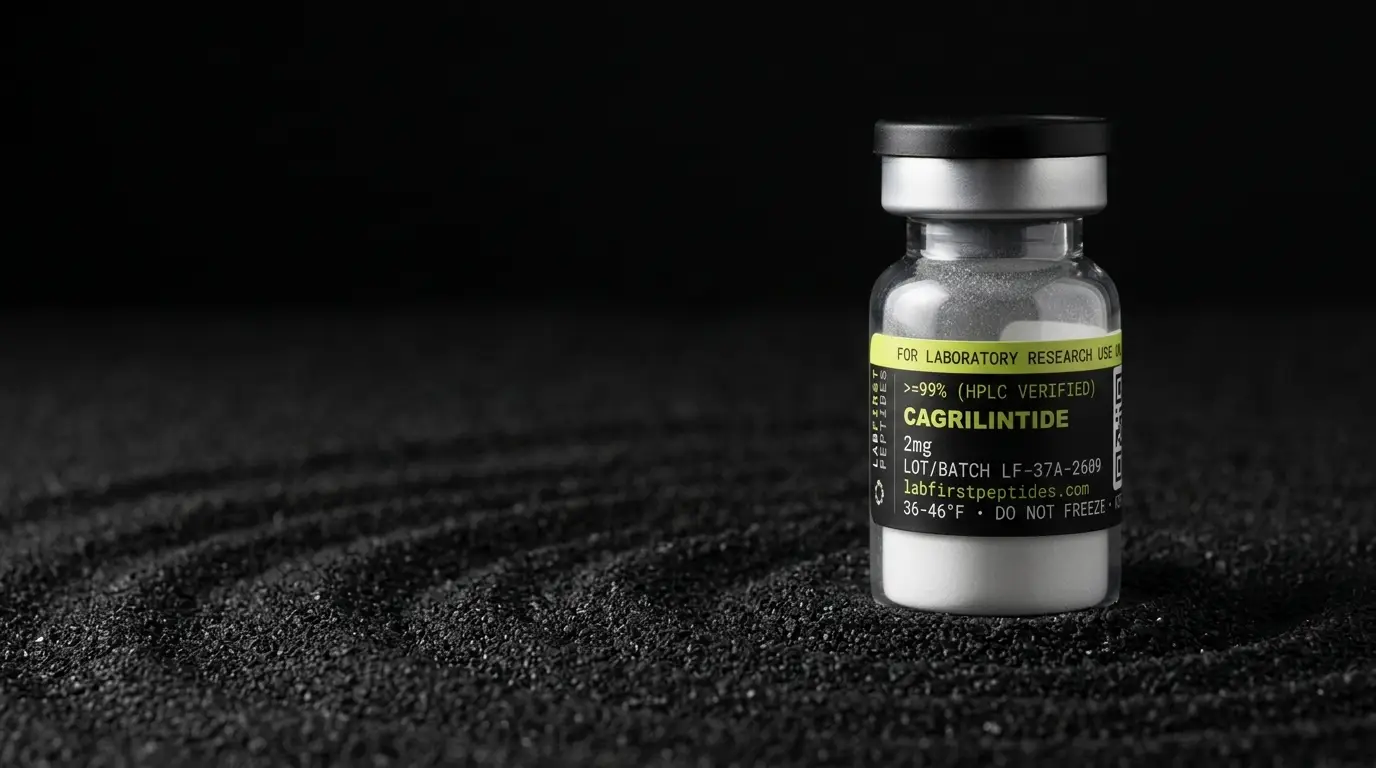
The lot identifier is the field that has to match, character for character, what is printed on the vial label. Not partially. Not with a plausible suffix difference. If the label says one thing and the certificate says another, the document is for other material until someone reconciles it in writing. A blank lot field, a handwritten lot field, or a certificate that names a product but no lot is a generic specification sheet wearing the wrong hat. Those exist legitimately as typical-value documents, and they are not release data.
Then read the dates against each other. An analysis date earlier than the manufacture date means the document was assembled carelessly, whatever else it says. A gap of two years between analysis and shipping is not fraud. It does mean the purity figure describes the material as it was two years ago and nobody has looked since. Retest dates on research peptides are frequently conventions rather than the output of a stability study on that lot, a point covered in more detail in the storage and stability guide.
What does mass spectrometry prove about identity, and what does it leave open?
Identity on a research peptide certificate is almost always electrospray mass spectrometry, sometimes reported as an observed monoisotopic or average mass, sometimes as a set of multiply charged ions, occasionally as a deconvoluted figure. The useful version tells you the instrument, the ionization mode, whether the reported mass is average or monoisotopic, and the theoretical mass it was compared against.
The check you can perform is arithmetic. Ask the supplier for the full sequence in one-letter code plus an explicit description of the modifications, then compute the expected mass yourself and compare. A certificate that reports an observed mass with no stated sequence gives you nothing to compare it to; you are being asked to accept that a number matched another number you cannot see. For cagrilintide the calculation has to account for the C-terminal amide, the intramolecular disulfide bridge between the two cysteines near the N-terminus, and the fatty diacid acylation attached through a linker to a lysine side chain. Each of those changes the mass. The disulfide costs two hydrogens relative to the reduced form.
That two-dalton difference is the honest limit of MS identity here. On a molecule of roughly this size, reported as an average mass with a tolerance of a dalton or so, a fully reduced or partially reduced species is not reliably distinguishable from the intended structure. Nor does a correct mass exclude a scrambled disulfide, a sequence isomer, or acylation on the wrong residue, since all of those weigh the same. Mass spectrometry establishes composition. It does not establish structure, and no research certificate I have read claims otherwise, though many are written in a way that invites the reader to assume it.
| Method | Establishes | Blind to |
|---|---|---|
| ESI-MS, deconvoluted mass | Elemental composition consistent with the stated structure | Isomers, disulfide scrambling, acylation position, low-level contaminants |
| RP-HPLC, area percent | Relative abundance of UV-absorbing species that elute in the window | Co-eluting impurities, non-absorbing species, anything retained on column |
| LC-MS with UV | Which chromatographic peak carries which mass | Quantitation without a reference standard |
| Amino acid analysis | Residue composition and, with care, peptide content by mass | Sequence order, modification position |
| Karl Fischer or loss on drying | Water in the solid | Everything else in the fill weight |
Why read the purity method before the number?
The purity line is the figure people quote and the field with the least information density. A number without a method is a claim about nothing. What you need alongside it: column chemistry and dimensions, mobile phase composition including the acid modifier, the gradient profile and run time, flow rate, column temperature, injection volume and concentration, and the detection wavelength.
Detection is usually 214 or 220 nm, where the amide backbone absorbs. That choice has consequences. Anything in the vial that does not absorb meaningfully at that wavelength contributes to the mass of the powder and not to the chromatogram, which is one reason purity by area percent is not purity by weight. Response factors differ between the main peak and its related substances, so area percent is an approximation of relative abundance even among the species you can see. And a single gradient resolves what it resolves; an impurity that co-elutes with the main peak is reported as main peak.
USP General Chapter <621> sets out how a chromatographic method is described and what system suitability means, and <1225> covers validation of compendial procedures; ICH Q2(R2) covers the validation characteristics an analytical procedure is expected to demonstrate. None of that is binding on a research chemical supplier, and that is exactly why the method description is the thing to judge. A supplier who reports gradient, column and wavelength is showing you a method someone could repeat. A supplier who reports "HPLC: 99.8%" is showing you a marketing figure.
Two further fields earn their space. Largest single impurity, stated as a percentage, tells you whether the remaining 0.9% is spread thinly or concentrated in one unidentified species. And a second chromatographic condition, orthogonal to the first, catches co-elution. Most research certificates do not include one. Asking is free.
Why does the vial hold less peptide than the label says?
This is where certificate literacy pays for itself. A vial labeled 5 mg is usually labeled by the gross weight of lyophilizate dispensed into it. That solid is peptide plus water plus counterion plus whatever excipient the process left behind.
Peptides purified by preparative reverse-phase chromatography with a trifluoroacetic acid modifier come off as TFA salts, and the counterion can account for a meaningful fraction of the dry weight on a molecule with several basic sites. Residual water in a lyophilized cake commonly sits in the low single-digit percentages. Add the two and the peptide fraction of a nominal 5 mg fill can land somewhere in the eighties as a percentage. The certificate field that addresses this is peptide content or net peptide content, determined by HPLC against a reference standard, by amino acid analysis, or by nitrogen determination. Water content appears as Karl Fischer or loss on drying. Counterion appears, when anyone bothers, as an ion chromatography result.
If those fields are absent, the honest reading is that net content is unknown and the label figure is only an upper bound on the peptide in the vial.
Worked example. A vial with a gross fill of 10 mg and a stated net peptide content of 82.4% contains:
10 mg × 0.824 = 8.24 mg peptide
Against the 10 mg the label implies, that is about 18% less peptide than a label-only reading assumes. Record the net content figure and the certificate it came from on the same line, or the correction will be lost by the third person who reads the notebook.
Which cagrilintide-specific fields are worth checking?
Cagrilintide is an acylated analog of human amylin, the 37-residue pancreatic hormone also called islet amyloid polypeptide. The parent hormone is one of the more studied amyloidogenic human peptides, and the substitutions in analogs of this class exist partly to suppress that behavior. Read the certificate with that inheritance in mind.
Three consequences. First, aggregate content is a legitimate quality attribute for this chemistry and is rarely tested on research certificates; size exclusion chromatography would show it and RP-HPLC generally will not, because aggregates either dissociate under the organic mobile phase or fail to elute. Second, the disulfide bridge creates a family of related substances that are difficult to separate: the reduced form, scrambled intramolecular variants, and intermolecular dimers. A certificate reporting one gradient and one mass will not distinguish them. Third, the acyl chain makes des-acyl material a plausible process impurity, and that one does usually separate cleanly on reverse phase because the lipid dominates retention. A large early-eluting peak on the chromatogram is worth asking about.
Where the exact acylation position or the substitution pattern matters to your work, take it from the sequence the supplier states and cross-check the structure against the PubChem record for the compound rather than from any prose description, including this one. Structural detail on modified peptides is copied between secondary sources with errors.
What does each field look like when it is useful?
| Field | Useful form | Failure mode |
|---|---|---|
| Lot / batch | Exact match to vial label and shipping record | Blank, handwritten, or a near-miss variant |
| Date of analysis | A real date, after the manufacture date | Missing, or years before shipment with no retest |
| Issuing laboratory | Named entity with an address you can verify | Logo only, or the seller testing its own goods with no third party named |
| Identity | Observed mass, ionization mode, theoretical mass, stated sequence | A mass with nothing to compare it against |
| Purity | Area percent plus column, mobile phase, gradient, wavelength | A percentage alone, or "≥99%" as a specification with no measured value |
| Largest single impurity | Percentage, ideally with retention time | Omitted, leaving the balance unaccounted |
| Peptide content | Percentage with the method that produced it | Absent; gross fill weight presented as peptide mass |
| Water content | Karl Fischer or loss on drying, with a number | "Complies" with no value |
| Counterion | Salt form named, content quantified | Salt form unstated, so net content cannot be reconciled |
| Appearance | Described in words someone actually looked at | Boilerplate identical across every lot the supplier sells |
| Chromatogram and spectrum | Attached, with labeled axes and legible scale | Cropped image, no axes, or the same trace as another lot |
How do you verify the certificate at the bench?
Asking a seller whether their certificate is genuine returns no information. The verification steps that do return information are all things you can do without the seller's cooperation.
- Recompute the theoretical mass from the stated sequence and modifications, and compare it to the observed value on the page. Disagreement is either a typographical error or a different molecule, and you need to know which.
- Request the raw chromatogram and mass spectrum as images with axes intact, not a table of extracted values. Look at the baseline, the peak shape, the solvent front and whether the time axis extends far enough to show late-eluting material. A chromatogram truncated just after the main peak is hiding the part you wanted.
- Establish whether the issuing laboratory exists independently of the seller. A registered name, a physical address, and an ISO/IEC 17025 accreditation with a scope that actually covers peptide chromatography are all checkable in an afternoon. In-house testing is not disqualifying; unattributed testing is.
- Compare traces across lots. Identical chromatograms from different lots means one file has been reused.
- Run your own identity check on receipt where the work justifies it. An in-house LC-MS injection and a recorded retention time on your own column give you a reference point that makes every subsequent lot comparable, which no supplier document can do for you.
File the certificate with the receiving record, the lot identifier and the date the vial arrived. When a result later comes out wrong, the first question is whether the material was what the protocol assumed, and a filing system that answers it in a minute is worth more than any single purity figure. Our own documentation practice is set out on the quality standard page, and lot-specific certificates for listed material accompany the cagrilintide product record.
What is the regulatory position?
Cagrilintide is a long-acting amylin analog investigated by Novo Nordisk, including in combination with semaglutide under the development name CagriSema in the REDEFINE clinical program. Research-grade cagrilintide supplied for laboratory work is not a medicine, is not manufactured under pharmaceutical quality systems covering sterility, endotoxin or lot release for human use, and has never been a lawful route to human use at any point.
Approval status for compounds in active development changes. Confirm current status directly against the FDA and EMA registers rather than against any supplier page, including this one.
Status verified August 26, 2026.
FOR LABORATORY AND IN-VITRO RESEARCH USE ONLY. NOT FOR HUMAN OR ANIMAL CONSUMPTION. NOT FOR PERSONAL, MEDICAL, DIAGNOSTIC, THERAPEUTIC, OR RECREATIONAL USE.
Bottom line
Read a cagrilintide certificate of analysis in the order its fields tend to fail: the lot against the vial label, the dates against each other, the identity mass against a sequence you can check, and the purity number against its full method. Treat the gross fill as an upper bound unless net peptide content is reported. Then verify what you can at your own bench.
Common questions
How do I read a cagrilintide certificate of analysis?
What is the single most common problem with a peptide certificate of analysis?
Does 99% purity by HPLC mean the vial is 99% cagrilintide by weight?
Can mass spectrometry confirm the disulfide bridge is intact?
Should I accept a certificate issued by the seller rather than a third-party laboratory?
What documentation should a competent supplier provide without being asked?
More documentation guides
Sources
- United States Pharmacopeia, General Chapters <621> Chromatography and <1225> Validation of Compendial Procedures. Establishes how a chromatographic procedure is described, what system suitability requires, and which validation characteristics a purity method is expected to demonstrate; supports the method-description criteria applied to the purity field.
- ICH Q2(R2), Validation of Analytical Procedures. Defines specificity, accuracy, precision and quantitation limits as validation characteristics; supports the position that a purity percentage without a described and validated method is not interpretable.
- PubChem compound record for cagrilintide, US National Library of Medicine. Public structural record for the compound; recommended as the cross-check for sequence, modification positions and formula rather than secondary descriptions.
- Akter and colleagues. Islet Amyloid Polypeptide: Structure, Function, and Pathophysiology. Journal of Diabetes Research 2016:2798269 . Basis for treating amylin-family sequences as aggregation-prone: this review covers the structure and fibrillation behavior of human islet amyloid polypeptide, the parent sequence cagrilintide is analogous to.