A Cerebrolysin certificate of analysis describes a mixture, not one molecule. Published sources call it small peptides and amino acids made from pig brain protein. So there is no single mass to match. Look instead for a fingerprint compared with a reference, composition results, lot details and a named method for each row.
- Cerebrolysin is described as a mixture of low-molecular-weight peptides and amino acids from porcine brain.
- One published description gives roughly 75 percent free amino acids and 25 percent low-molecular-weight peptides.
- One LC-MS study found 638 unique peptides in a single sample.
- Identity is shown by a fingerprint compared with a reference, not by a single mass.
- A purity percentage has no clear meaning for a mixture unless the certificate defines it.
Why does a Cerebrolysin certificate look different?
A Cerebrolysin certificate looks different because it describes a mixture rather than one molecule. Most certificates for research peptides answer one question: is this the molecule on the label? For a seven-residue peptide there is one formula, one mass and one main peak, and the document either matches them or it does not. A Cerebrolysin certificate cannot work that way, and a reader who expects it to will misread it.
Cerebrolysin is described in the Cochrane review of the preparation as a mixture of low-molecular-weight peptides and amino acids derived from porcine brain. An earlier laboratory paper describes it as the product of a standardized enzymatic breakdown of porcine brain proteins, roughly 75 percent free amino acids and 25 percent low-molecular-weight peptides. Nothing in that description is a single sequence.
When researchers have taken it apart, the numbers are large. A 2015 LC-MS study of one sample bought online identified 638 unique peptides, most of them fragments of tubulin, actin and myelin basic protein. A 2019 study of one lighter fraction assigned sequences to 14,635 peptides mapping to 1,643 porcine proteins. A certificate for a vial of that is describing a population.
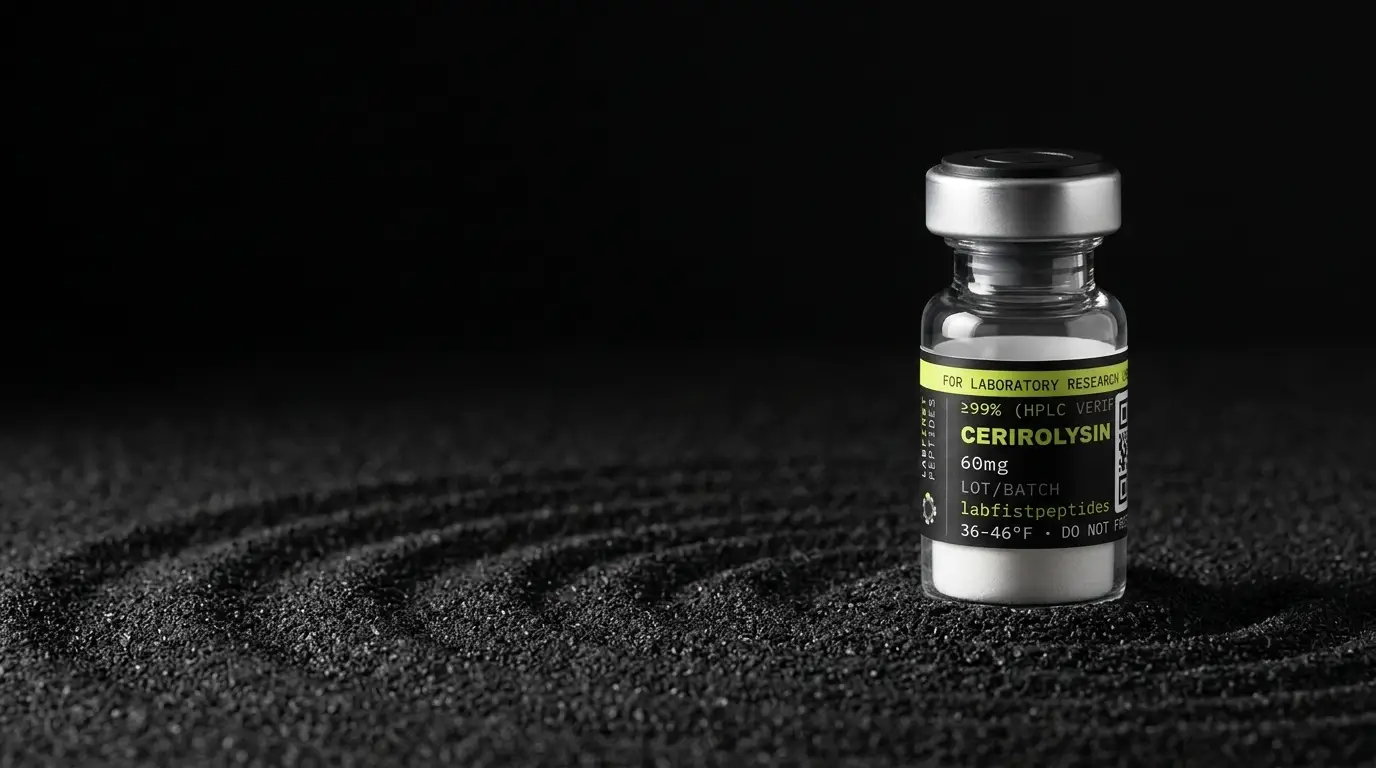
Our product is sold as SKU CBL60, a 60 mg lyophilized vial, listed on the Cerebrolysin product page.
- Match the lot number to the vial
- Expect no single mass for a mixture
- Find the fingerprint chromatogram and its reference
- Check the method behind every row
- Treat an undefined purity figure as unexplained
- Confirm the report number at the laboratory
The rows a strong certificate carries
The FDA's copy of ICH Q6B, the specifications guidance for biotechnological and biological products, treats identity, purity and quantity as separate specification items answered by separate procedures. That framework is a sensible lens for a mixture, even though a research reagent is not held to a marketing-application standard.
| Row | What it reports | What it cannot tell you |
|---|---|---|
| Product name, lot, dates | Which batch the document covers | Anything about the contents |
| Appearance | Color and form of the lyophilized cake | Composition |
| Chromatographic fingerprint | The peak pattern of the peptide population, compared with a reference | The sequence of any individual peptide |
| Peptide or amino acid content | How much of the mass is peptide and free amino acid | Which peptides are present |
| Water content | Residual moisture in the solid | Stability over time |
| Method list | Which technique produced each result | Whether the laboratory ran it well |
A document that carries only a name, a lot number and a single purity percentage is thin for any peptide. For a mixture it is close to empty, for reasons the next section explains.
Why does a purity percentage mean little here?
A purity percentage means little because a mixture has no single intended main peak. On a defined peptide, HPLC purity is the share of ultraviolet signal in the main peak. The idea rests on there being one intended molecule, so everything else counts as impurity. Apply that to Cerebrolysin and the logic breaks. Hundreds of peptides are the intended contents. There is no main peak to divide by the rest, and a figure like "98 percent" has no obvious definition unless the certificate states exactly what was counted and against what.
That does not make HPLC useless. It changes the question the chromatogram answers. Instead of "how much of the sample is one molecule", it answers "does this sample's pattern look like the reference pattern". A 2024 study by Seidl and Aigner used exactly that approach, reversed-phase HPLC fingerprints, and found that several brain-derived peptide preparations sold as similar produced chromatograms clearly different from Cerebrolysin's. Preparations from different makers were not comparable with each other either.
If a certificate reports a single purity number, look for the definition next to it. If there is none, treat the number as unexplained. The HPLC purity versus identity guide covers the general case for defined peptides.
How do you read the fingerprint row?
Read the fingerprint row from the chromatogram itself, which should come with it. Words like "conforms" or "matches reference" are a conclusion; the trace is the evidence. When the trace is attached, a reader can check a few things without a laboratory.
First, the method details. Column type, mobile phases, gradient and detection wavelength should be stated, because the same sample run two ways gives two different pictures. Second, the reference. The document should say what the sample was compared against: a retained reference lot, a prior batch, or a published profile. A match to nothing in particular proves nothing. Third, the comparison itself. Where a reference trace is shown alongside, the main peak clusters should line up in position and roughly in relative size.
Mass spectrometry can add a second layer. An LC-MS profile lists many observed masses across the run, and the published profiling work shows how rich that picture is. The Cerebrolysin identity guide covers what those methods can and cannot establish for a mixture.
Composition rows and what they add
Beside the fingerprint, a document for a mixture may carry composition results. The most useful is some measure of how much of the solid is peptide and how much is free amino acid. The 2001 description of about 75 percent free amino acids and 25 percent low-molecular-weight peptides gives a sense of the scale involved, but the figures on a certificate belong to its lot and its method, not to a published paper.
Composition rows answer a different question from the fingerprint. The fingerprint asks whether the pattern looks right. Composition asks whether the amounts look right. A sample could pass one and fail the other. A preparation with the right pattern but far too little peptide content would still be a poor lot.
Water content matters for the same reason it matters on any lyophilized product. A 60 mg vial is 60 mg of solid, and some of that is residual moisture. Where a certificate reports water, it helps a laboratory work out how much of the weighed mass is actually preparation.
Microbial and endotoxin limits sometimes appear on documents for tissue-derived materials. Where they do, the certificate should name the method and the limit, not just the word "pass".
A worked reading
Picture a document with these rows: lot number, manufacture and test dates, appearance "white to off-white lyophilized powder", a fingerprint result marked "conforms to reference" with a chromatogram attached and the reference lot named, a peptide content figure with its method, water content by a named method, and a laboratory report number.
That document can be checked. The lot number can be matched to the vial. The chromatogram can be looked at. The reference lot is named, so the comparison has a fixed point. The report number can be confirmed with the laboratory.
Now picture a second document: product name, "purity 99.1%", "MW 1,234", and "conforms". It looks tidy and says almost nothing. The purity figure has no definition, the molecular weight cannot belong to a mixture, and nothing is attached that a reader could verify. The first document is better even though it has no headline number at all.
Lot, dates and the issuing laboratory
The administrative rows matter more for a mixture than for a synthetic peptide. A preparation made from animal tissue by enzymatic digestion depends on its process for its composition, so the lot is the unit that means anything. A certificate that does not state the lot, or states one that does not match the vial, does not describe your material at all.
Check the test date against the manufacture date, and look for a retest or expiry date. Confirm the document names the laboratory that ran the tests and gives an accession or report number that the laboratory can confirm. A PDF can be edited. A report number checked at the source is much harder to fake.
Our certificates are published lot by lot on the certificate page. A product page shows results only once the certificate for that lot is published, and until then it shows none.
Red flags on a Cerebrolysin document
A few patterns should make a reader stop. A single molecular weight presented as the identity result is the clearest one, because a mixture has no single molecular weight. A certificate that copies the layout of a defined-peptide document, with one theoretical mass and one observed mass, has probably been filled in from a template rather than from testing.
A purity percentage with no definition is the second. A fingerprint row marked "conforms" with no chromatogram and no named reference is the third. Missing method names and a lot number that appears on documents for other products round out the list.
Storage conditions also belong in the record, because a lyophilized mixture that picked up moisture can drift from its reference pattern. The Cerebrolysin storage guide covers the sealed vial and laboratory solutions, and the general guide to reading a peptide certificate covers the rows every document shares.
FOR LABORATORY AND IN-VITRO RESEARCH USE ONLY. NOT FOR HUMAN OR ANIMAL CONSUMPTION.
What is Cerebrolysin studied for?
Published research on Cerebrolysin investigates the areas below, which is a different question from what Cerebrolysin will do for anyone, a claim about a living system that nothing on this site is sold for.
What it is. A peptide preparation produced by enzymatic breakdown of purified porcine brain protein — a mixture of low-molecular-weight peptides and free amino acids, not a defined molecule.
What the research looks at. Acute ischaemic stroke, vascular dementia and traumatic brain injury, principally in trials conducted in Europe and Asia. Registered and used in a number of countries; not approved in the United States.
How it is thought to work. Not established. Proposed to act as a neurotrophic mixture, but the preparation has no single active constituent, no defined receptor and no characterized pharmacokinetics in the sense a single compound would have.
What is not established. Efficacy. The pooled randomised evidence in acute ischaemic stroke does not demonstrate benefit on functional outcome. For a mixture rather than a molecule, identity and purity testing also cannot mean what they mean for a defined compound.
The full record, including the certificate for the lot in stock, is on the Cerebrolysin product page.
Common questions
What molecular weight should a Cerebrolysin certificate show?
How is Cerebrolysin identity shown on a certificate?
Does a high purity figure mean a good Cerebrolysin lot?
Where are LabFirst certificates for Cerebrolysin published?
More documentation guides
Sources
- Cochrane Database of Systematic Reviews, Cerebrolysin for acute ischaemic stroke (2023). Used only for its description of the preparation as a mixture of low-molecular-weight peptides and amino acids derived from porcine brain.
- Journal of Neural Transmission (2001), Effects of Cerebrolysin on the outgrowth and protection of processes of cultured brain neurons. Used only for its description: a standardized enzymatic breakdown of porcine brain proteins, about 75% free amino acids and 25% low-molecular-weight peptides.
- Gevaert and colleagues, Drug Testing and Analysis (2015), peptide profiling of Internet-obtained Cerebrolysin by LC-MS. 638 unique peptides identified in one sample, mainly fragments of tubulin, actin and myelin basic protein.
- Gromova and colleagues, Zhurnal Nevrologii i Psikhiatrii (2019), peptide composition of a light fraction of Cerebrolysin. Orbitrap mass spectrometry assigned sequences to 14,635 peptides mapping to 1,643 porcine proteins in one fraction.
- Seidl and Aigner, Journal of Medicine and Life (2024), comparing the composition of Cerebrolysin with other peptide preparations. Peptide fingerprints by reversed-phase HPLC separated Cerebrolysin from other brain-derived preparations, which also differed from each other.
- FDA, Q6B Specifications: Test Procedures and Acceptance Criteria for Biotechnological/Biological Products (1999). The ICH framework that treats identity, purity and quantity as separate specification items.