Identity for this blend is confirmed one peptide at a time. The two are separated by liquid chromatography, then each is weighed by mass spectrometry: near 3367.9 for CJC-1295 no DAC and 711.9 for ipamorelin. Mass cannot see the D-form residues, and the CJC-1295 figure must be read against sermorelin at 3357.9.
- Identity for a blend is confirmed per component, after chromatographic separation.
- Expect about 3367.9 for CJC-1295 no DAC and 711.9 for ipamorelin (711.386 monoisotopic).
- Sermorelin, 3357.9, is the close look-alike; it carries a sulfur the modified formula lacks.
- The DAC version differs by a large added group and is easy to exclude.
- Ipamorelin ends in an amide; the free acid would weigh about one dalton more.
- D-form residues are invisible to mass and need a chiral method.
What identity means for a blend
Suppose someone hands you a sealed vial and says there are two kinds of marbles inside. Weighing the whole vial tells you nothing about which marbles. You would pour them out, sort them, then look at each kind. Confirming identity in a blend works the same way.
For the CJC-1295 no DAC + ipamorelin blend, identity means showing that both named peptides are present and that each one is the molecule its name claims. The CJC-1295 no DAC component has the formula C152H252N44O42 and an average mass of 3367.9, and ipamorelin is C38H49N9O5 at 711.9. A result for one says nothing about the other.
A single-peptide product only needs the second half of that sentence. A blend needs both halves, and that is the whole reason this page exists separately from the single-compound guides.
- Label and listing, a claim only
- Two peaks separated by liquid chromatography
- CJC-1295 component weighed near 3367.9
- Sermorelin at 3357.9 ruled out by the figure
- Ipamorelin weighed near 711.9 with its amide end
- Chiral analysis for the D-form residues
How is each peptide in the blend identified?
The standard route is liquid chromatography feeding a mass spectrometer, often written LC-MS. The column pulls the two peptides apart in time so each reaches the detector on its own, and the mass spectrometer then reports what each one weighs.
Separation is easy here because the two molecules are so different. One has 29 residues, the other five, and they leave a reversed-phase column at clearly different times. The hard separations are elsewhere: between the CJC-1295 component and its own near relatives.
A spectrum taken on the unseparated mixture can still show both masses, but it cannot tell you which impurity belongs to which peptide. For an overview of the technique itself, see the LC-MS identity testing guide.
Weighing the CJC-1295 component
A 29-residue peptide picks up several protons in electrospray, so the raw spectrum shows a cluster of peaks at different charge states. Software combines them into one deconvoluted mass. That number is a calculation, and its tolerance should be stated.
The figure to expect is near 3367.9, the average mass for C152H252N44O42. The figure to rule out is 3357.9, which PubChem gives for sermorelin, the unmodified GHRH(1-29) whose sequence comes from the human precursor in UniProt. The two differ by about ten daltons.
The formulas offer a second check. Sermorelin, C149H246N44O42S, carries one sulfur atom from methionine at position 27. The CJC-1295 no DAC formula has none. A high-resolution isotope pattern can reflect that difference, since sulfur shifts the pattern, but the plain mass comparison is what most reports print.
Ruling out the DAC version
The Jette paper in Endocrinology identified CJC-1295 as a derivative of hGRF(1-29) carrying a maleimido group designed to bond to albumin. That added group is large. Any mass result separates the with-DAC molecule from this one without difficulty.
So a mismatch here is a labeling or packing problem, not an analytical puzzle. If the reported mass fits the no DAC peptide and the vial says with DAC, or the other way round, the paperwork and the vial disagree and that needs resolving before the material goes anywhere near an assay.
The single-compound page, how CJC-1295 no DAC identity is confirmed, covers the sermorelin and DAC comparisons at more length.
Weighing ipamorelin
Ipamorelin is small, so its spectrum is simple. PubChem gives an average mass of 711.9 and a monoisotopic mass of 711.386. At this size a laboratory often reports the monoisotopic value directly, and the report should say which one it used.
The PubChem name also shows that the C-terminal lysine ends as an amide, not a free acid. An amide weighs about one dalton less than the matching acid, so a reading near 712.9 instead of 711.9 average would point to the acid form. Small peptide, small difference, and still worth checking.
Raun and colleagues described ipamorelin as a pentapeptide, and the name in PubChem accounts for all five residues.
What can mass spectrometry not see?
Handedness. The PubChem name for ipamorelin marks two residues as (2R), meaning they are D-form building blocks. A D residue and its L mirror image contain the same atoms and weigh the same. A synthesis that put the wrong hand at either position would give a perfect mass match.
The CJC-1295 component raises the same question for any residue whose handedness is part of its specification. Mass is blind to it there too, so the certificate should say whether configuration was checked.
Only a chiral method answers this, such as hydrolysis followed by chiral amino acid analysis or a column built to separate stereoisomers. Most research certificates do not include one. Its absence is a known limit, not a hidden failure, and a careful reader simply notes that the mass result does not cover stereochemistry.
What a trustworthy identity report looks like
| Evidence | CJC-1295 no DAC | Ipamorelin |
|---|---|---|
| Expected average mass | 3367.9 | 711.9 |
| Main look-alike | Sermorelin, 3357.9 | C-terminal acid form, about one dalton heavier |
| Visible to mass? | Substitutions that change atoms | Amide versus acid end |
| Invisible to mass | D versus L configuration | Two D-form residues |
A good report prints both observed masses as numbers, names the instrument and the deconvolution approach, and shows which chromatographic peak each mass came from. A report that says identity confirmed with no figures cannot be checked by anyone.
Checking a report against your vial
Match the lot number first. Then compare each observed mass with the expected values above. Then confirm the report was issued by the laboratory named on it, through that laboratory's own lookup where one exists.
LabFirst shows identity results only once the certificate for that lot is published, and nothing on this page is a result for any of our lots. Published certificates appear through the certificate lookup page and on the CJC-1295 no DAC + ipamorelin product page. The companion pages cover reading the full certificate and storage and stability.
Retention time as supporting evidence
Where a reference standard is available, a laboratory can run it on the same column and compare retention times. A match adds a second, independent line of evidence to the mass result. A mismatch is a warning even when the mass fits.
Retention alone is weak, because unrelated molecules can leave a column at the same moment. Stacked with a mass, it is useful. For this blend, a report that lists both a mass and a retention time for each component is giving more than the minimum.
Why the size gap helps and hurts
A 29-residue peptide and a five-residue peptide are about as easy to tell apart as two molecules in one vial can be. Their masses differ by more than 2,600 daltons, and they leave a reversed-phase column at very different times. Nobody confuses one for the other.
The difficulty is that the easy separation can make a report look more complete than it is. Two clean peaks with two correct masses confirm that both molecules are present. They say nothing about a deletion sequence hiding under the larger peak, or a stereoisomer hiding under either.
That is where identity stops and purity begins. Identity answers which molecules are present. Purity answers what else is present with them. A certificate needs both, reported separately for each component, and the purity versus identity guide explains why one cannot stand in for the other.
Deletion sequences in the larger chain
Solid-phase synthesis adds residues one at a time, so a 29-residue chain goes through 28 coupling steps. When a step fails on a small fraction of chains, those chains end up one residue short. Each such deletion sequence weighs one residue less than the target.
A mass spectrometer can see these if the chromatography separates them from the main peak, or if the spectrum is read closely enough to spot a second set of masses. Ipamorelin, with only four coupling steps, has far fewer places for this to happen.
So the identity question for this blend is lopsided. Almost all the analytical effort belongs with the CJC-1295 component, and a report that spends equal detail on both is spending it in the wrong place.
Regulatory position
No United States pharmacopeial monograph covers this blend or either component, so there is no official identity test to point to. The methods above are the ones a competent laboratory would choose, and the certificate is the only record of whether they were run.
FOR LABORATORY AND IN-VITRO RESEARCH USE ONLY. NOT FOR HUMAN OR ANIMAL CONSUMPTION.
What is Ipamorelin studied for?
Published research on Ipamorelin investigates the areas below, which is a different question from what Ipamorelin will do for anyone, a claim about a living system that nothing on this site is sold for.
What it is. A man-made five-building-block peptide that makes the pituitary release growth hormone.
What the research looks at. Characterised by Raun and colleagues in 1998, and present in the growth-hormone releaser research ever since.
How it is thought to work. It works on the ghrelin receptor. Its build is deliberately defensive: an unusual building block at one end, two others flipped into their mirror-image form, a bulky side chain, and a capped tail. It contains none of the four building blocks that normally react with oxygen or break down, so the usual routes of decay simply are not there.
What is not established. No approved product and no official standard. Its unusual chemical toughness is a fact about storage, not a statement about what it does in any living thing.
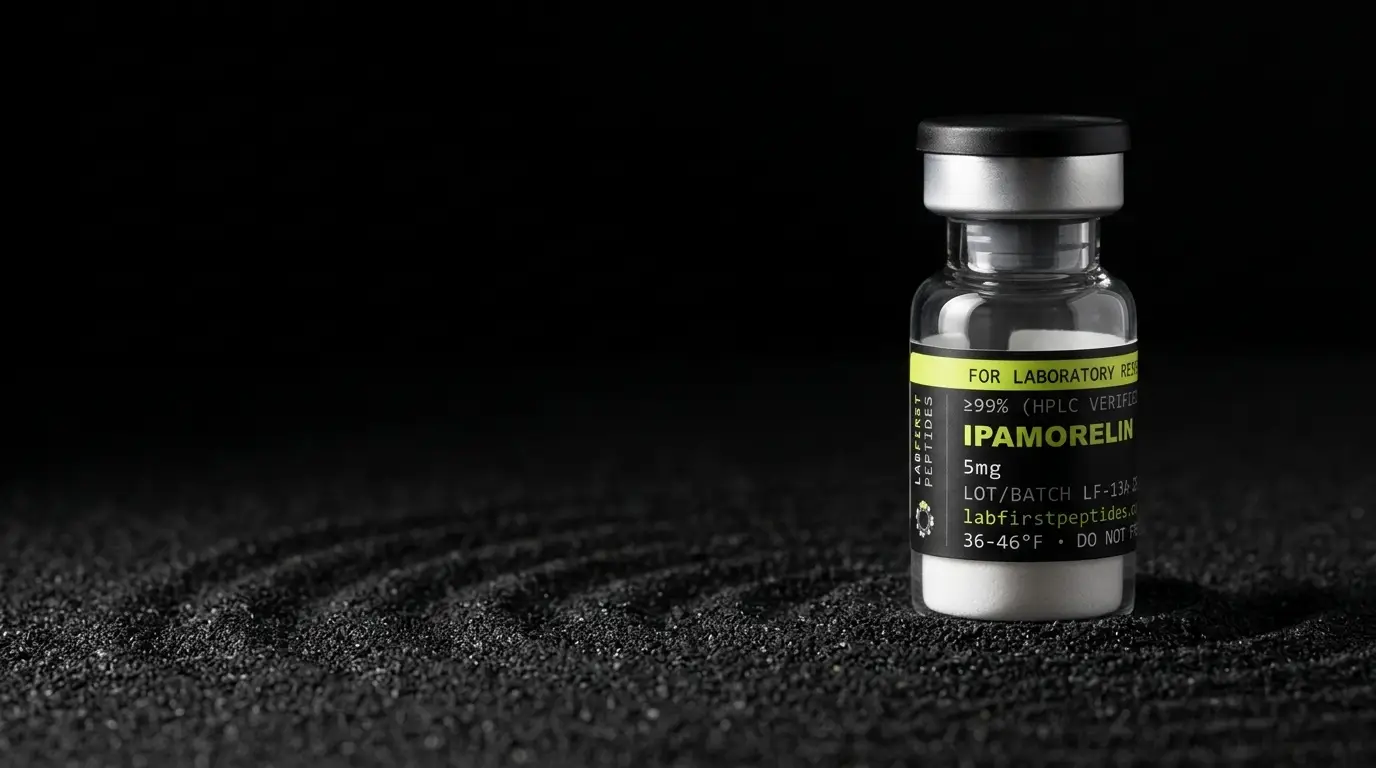
The full record, including the certificate for the lot in stock, is on the Ipamorelin product page.
Common questions
Can one mass spectrum confirm both peptides in the blend?
What mass rules out sermorelin?
Why can't mass spectrometry confirm the D-form residues?
Is telling the no DAC and with-DAC versions apart difficult?
More documentation guides
Sources
- PubChem Compound Summary, Ipamorelin (CID 9831659). Formula C38H49N9O5, molecular weight 711.9, monoisotopic mass 711.386, and the IUPAC name that spells out the residues and the two (2R) centers.
- PubChem Compound Summary, Sermorelin (CID 16132413). Formula C149H246N44O42S and molecular weight 3357.9 for unmodified GHRH(1-29), the parent the CJC-1295 component must be told apart from.
- UniProt P01286, Somatoliberin, Homo sapiens. The GHRH precursor record; the mature peptide sits at positions 32 to 75, and its first 29 residues are the frame both sermorelin and the CJC-1295 component are built on.
- Jette et al., Endocrinology, 2005 (PubMed 15817669). The paper that names CJC-1295 as a maleimido derivative of hGRF(1-29) built to bond to albumin; the no DAC material is the peptide without that reactive group.
- Raun et al., European Journal of Endocrinology, 1998 (PubMed 9849822). Describes ipamorelin as a pentapeptide; cited here for its structure only.