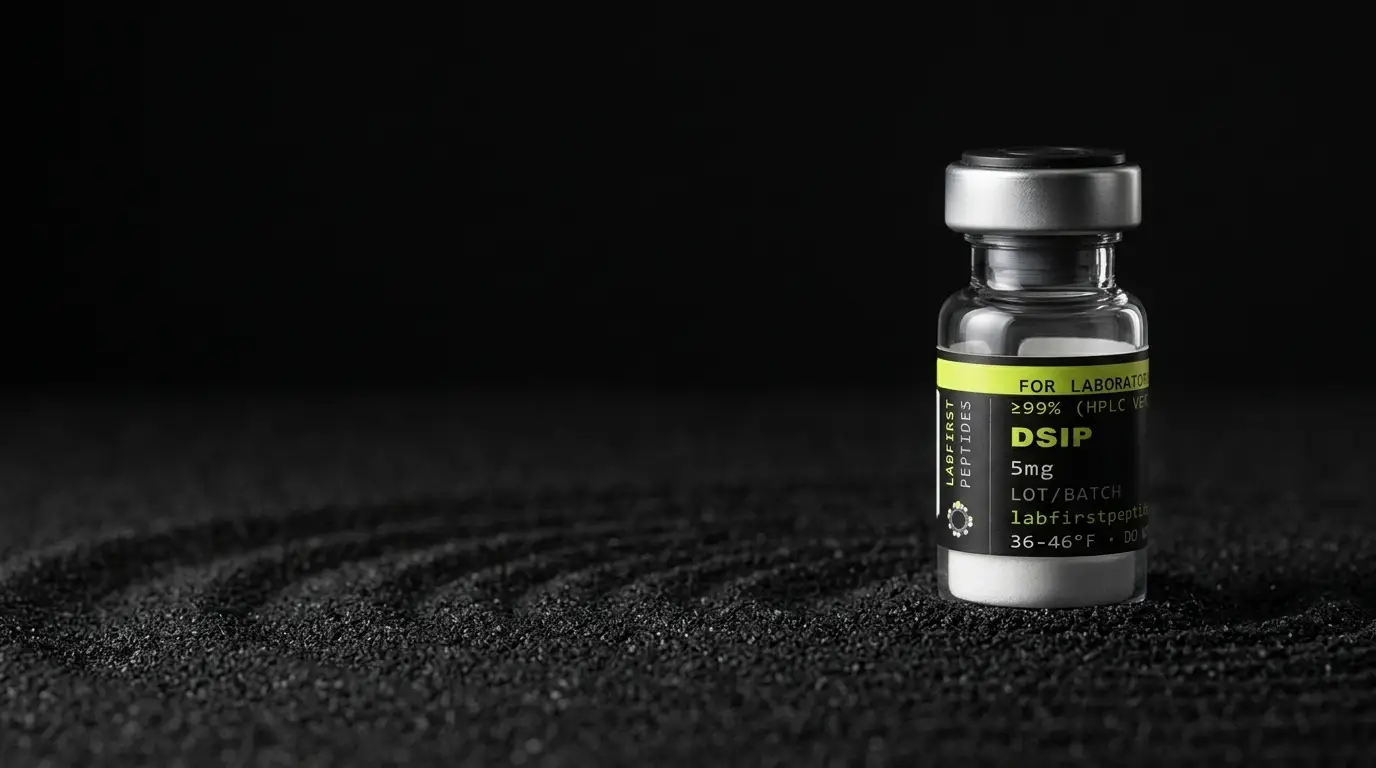
Here is how DSIP identity is confirmed: by mass spectrometry near 848.8, plus a separation that can resolve isomers. The catch is a rearranged form called isoaspartate. It weighs exactly the same as the intended peptide, so mass alone cannot spot it. Confirming this compound needs methods picked for that problem, not a routine panel.
- DSIP is C35H48N10O15, average mass near 848.8, PubChem CID 68816.
- Isoaspartate is an isomer: same atoms, different connectivity, identical mass.
- Glycine after aspartate is the fastest form of the rearrangement, and DSIP has one.
- Chromatography can resolve it because shape changes, but only if the method was built to.
- Protein isoaspartyl methyltransferase gives a targeted, direct measurement.
- The aspartimide intermediate is 18 lighter and shows plainly by mass.
What does identity mean for this peptide?
"Listen" and "silent" use the same letters in a different order. A scale reads two peptides built that way as identical, so in other words the lab needs a method that looks at how the pieces are arranged, not only what they weigh.
That the molecule in the vial is the one the label names. DSIP is a nonapeptide, molecular formula C35H48N10O15, average mass near 848.8, cataloged as PubChem CID 68816.
For most peptides identity is largely settled by mass, with a separation supporting it. For this one the routine panel establishes less than it appears to, and the reason is a single feature of the sequence.
The peptide contains an aspartic acid followed immediately by a glycine. That pair can rearrange into a molecule with the same formula and the same mass, which puts the most likely impurity outside what a mass measurement can see.
- Observed mass near 848.8 excludes deletions and truncation
- It cannot exclude isoaspartate, which weighs exactly the same
- A separation resolves it only if the method was built to
- The aspartimide intermediate is 18 lighter and shows by mass
- A targeted enzymatic assay measures the rearranged form directly
- Chemical sequencing stalls at isoaspartate, which is itself evidence
- Accession number confirmed at the issuing laboratory
What does the mass result establish?
The molecular formula, and it does so cleanly. At 849 daltons there is no charge-state envelope to deconvolute and no meaningful measurement scatter.
A missing residue, an extra one, a truncated chain or an unremoved protecting group all shift the mass by amounts the instrument resolves immediately. That is a real and useful class of failures to exclude.
What it cannot exclude is an isomer. Anything that rearranges atoms without changing which atoms are present weighs the same, and for this sequence that is precisely the change most likely to have occurred.
What exactly is isoaspartate?
The product of an internal rearrangement. The nitrogen of the residue following aspartate attacks the aspartate side chain, closing a five-membered ring called an aspartimide.
The ring is unstable and reopens. One route restores the original aspartate. The other produces isoaspartate, where the peptide backbone now runs through what used to be the side chain, effectively inserting an extra atom into the chain path while removing one from the branch.
The atom count is unchanged. Only the connectivity differs, which is the definition of an isomer and the reason this is so hard to detect by weight.
Why does glycine make it worse?
Because the reaction needs the following residue's nitrogen to reach the aspartate side chain, and the smaller that residue is, the less stands in the way.
Glycine is the smallest amino acid, with a single hydrogen where other residues carry a side chain. An Asp-Gly pair is therefore the fastest version of this rearrangement, and it is the sequence chemists point to first when the question comes up.
DSIP contains one. That makes the rearrangement a structural property of the peptide rather than a defect in a particular batch, and it is why this page exists at all.
How does chromatography see what mass cannot?
By responding to shape rather than weight. Moving the backbone through the former side chain changes the geometry of the molecule, and reversed-phase separation is sensitive to geometry.
So the isoaspartate form usually elutes at a different time from the parent. Usually is the operative word: whether they resolve depends entirely on the column, the gradient and how much effort went into developing the method.
A gradient built to give a quick purity number is not the same as one built to separate isomers, and a chromatogram does not announce which it is. Where the two co-elute the rearranged form is counted inside the main peak, and the purity figure looks reassuring.
Is there a method that targets it directly?
Yes, and it is worth knowing exists even though it rarely appears on a research certificate. An enzyme called protein isoaspartyl methyltransferase recognizes isoaspartate specifically and transfers a methyl group to it.
Because the enzyme acts only on the rearranged form, the amount of methyl transferred is a direct measure of how much isoaspartate is present. It is a targeted assay rather than an inference from a peak position.
There is also a classic diagnostic worth understanding. Sequential chemical sequencing from the N-terminus stalls at an isoaspartate residue, because the rearranged backbone no longer presents the structure the chemistry requires. A sequencing run that stops where it should not is itself evidence.
Can the aspartimide intermediate be seen?
Yes, and this is the one part of the problem that mass handles well. Closing the ring releases a molecule of water, so the cyclic aspartimide weighs about 18 less than the parent peptide.
Eighteen daltons on an 849-dalton molecule is an unambiguous shift. A mass spectrometer detects it without difficulty.
That makes the intermediate a useful marker. It is transient, so its presence indicates the chemistry is actively occurring rather than that it has finished, and finding it on a certificate is a stronger signal about how the material has been handled than the absence of any comment at all.
What does the tryptophan contribute to identification?
A second detection wavelength that is genuinely informative rather than decorative. Tryptophan absorbs strongly at 280 nanometres, where most peptides in this catalog absorb almost nothing.
Running purity at both 214 and 280 gives two views of the same separation. A peak present at 214 but absent at 280 contains no tryptophan, which means it is not a rearranged or oxidised version of the whole peptide but something that lacks that residue, such as a fragment.
That is a real structural inference from a routine measurement, and it is available here because of one residue.
What does composition analysis add?
Less than usual, and knowing why is useful. Amino acid analysis hydrolyses the peptide and quantifies the freed residues, confirming which are present and in what ratio.
For the isoaspartate problem it is largely blind. Hydrolysis breaks the peptide down to free amino acids, and isoaspartate releases aspartic acid just as aspartate does, so the composition looks identical.
It remains useful for other questions: confirming the residue inventory, catching a gross substitution, and giving a peptide content figure by weight that does not depend on chromatographic assumptions. It simply does not answer the question this peptide raises most.
How do you check the report describes your vial?
Confirm the accession or verification number at the issuing laboratory rather than with the seller. The laboratory holds the record; a seller holds a copy of a document. If the number resolves to a different lot, a different product, or nothing, the analysis is not evidence about your material.
Then match the lot number on the report to the vial. Rigorous analysis attached to the wrong batch is not rigour, and that mismatch is more common than falsified results.
Reports for material supplied here resolve through the certificate verification page, and the sizes carried appear on the DSIP product record.
What should you ask a supplier about identity?
Three questions. What was the observed mass. Was the purity method developed to resolve isomers, or is it a general gradient. And was any targeted assessment of the rearranged form performed.
The second is the one that matters and the one most likely to be answered honestly with a no. That is an acceptable answer. What is not acceptable is a purity figure presented as though it settled a question the method could not address.
How to read the rest of the document is covered in the certificate guide.
A supplier who answers the second question with a straightforward no has told you something useful and honest. One who treats the question as unreasonable has told you something else. Neither answer requires them to have run a specialist assay; it only requires them to know what their own method was built to do.
What is the regulatory position?
International guidance on analytical validation defines what makes an identity method fit for purpose: specificity, accuracy, precision, and a demonstration that the method distinguishes the target from what else might plausibly be present. An isomeric degradation product is the hardest form of that requirement, because the usual instruments agree with each other and are both wrong.
There is no FDA-approved product containing DSIP and no United States pharmacopeial monograph, so no official standard requires isoaspartate to be measured or sets a limit.
What a research certificate can honestly establish is what a named laboratory measured, by named methods, on a named lot.
FOR LABORATORY AND IN-VITRO RESEARCH USE ONLY. NOT FOR HUMAN OR ANIMAL CONSUMPTION. NOT FOR PERSONAL, MEDICAL, DIAGNOSTIC, THERAPEUTIC, OR RECREATIONAL USE.
What is DSIP studied for?
Published research on DSIP investigates the areas below, which is a different question from what DSIP will do for anyone, a claim about a living system that nothing on this site is sold for.
What it is. Delta sleep-inducing peptide, a man-made peptide nine building blocks long.
What the research looks at. A small and largely historical body of animal work, much of it decades old.
How it is thought to work. Not established. The peptide was named for something noticed in early animal work, not for a receptor anyone has found, and no target has ever been confirmed.
What is not established. No approved product, no confirmed receptor, and a name that describes an early observation rather than a demonstrated mechanism. The research is thin and old, and that is the most important thing to know about it.
The full record, including the certificate for the lot in stock, is on the DSIP product page.
Common questions
What mass should DSIP show on a certificate?
Why is isoaspartate invisible to mass spectrometry?
Is there a test that targets isoaspartate directly?
Can the aspartimide intermediate be detected?
Does amino acid analysis detect the rearrangement?
More documentation guides
Sources
- PubChem Compound Summary for CID 68816, Delta sleep-inducing peptide. The openable record giving the molecular formula C35H48N10O15 and average mass near 848.8, and showing the aspartate-glycine adjacency this page turns on.
- ICH Q2(R2), Validation of Analytical Procedures . Defines specificity, including that a method must distinguish the target from closely related substances. An isomeric degradation product is the most demanding case of that clause.
- FDA guidance, Q6B Specifications: Test Procedures and Acceptance Criteria. Sets out how named degradation products are specified and tested separately from total purity, which is what a targeted isoaspartate assay would satisfy.
- Finnrick independent verification portal. Third-party lookup used to confirm a certificate resolves to the lot it claims to describe, rather than confirming a document with the seller who supplied it.