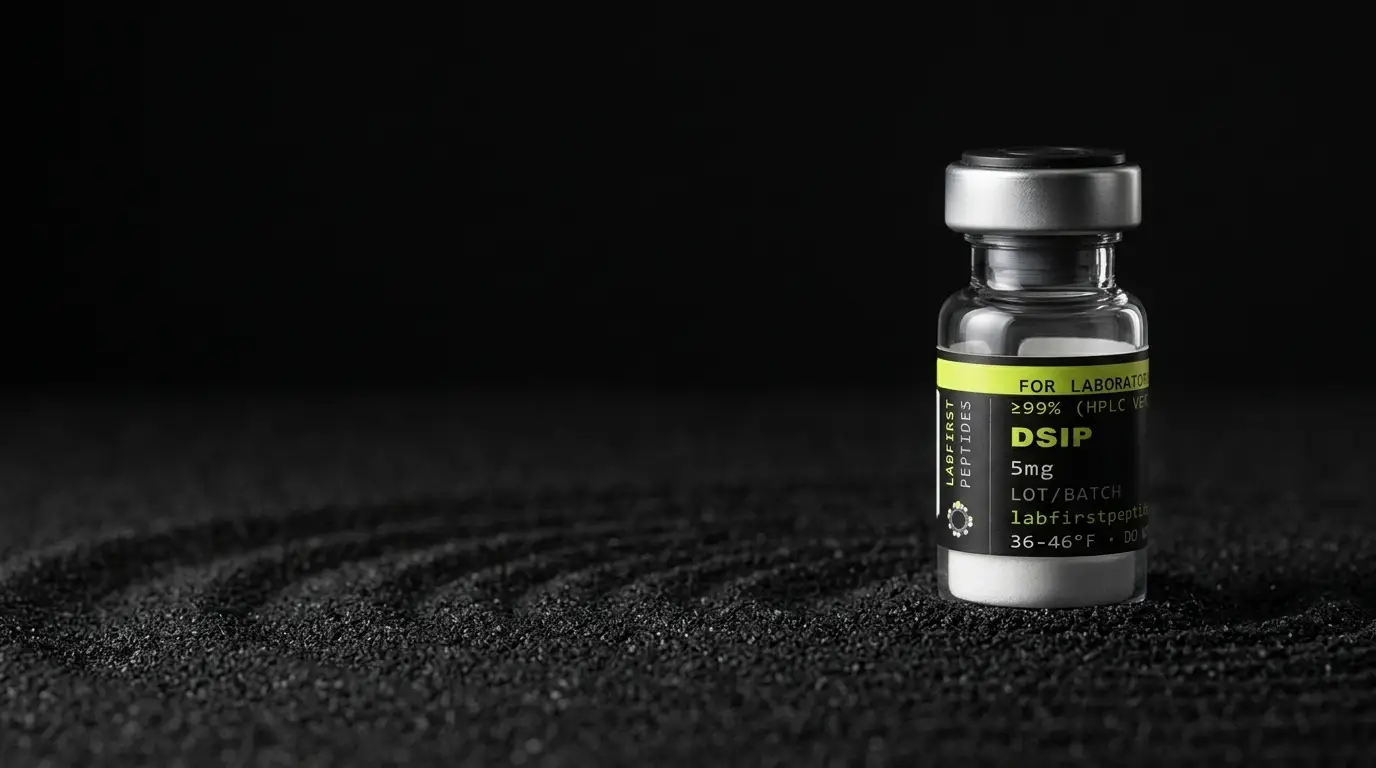
DSIP storage and stability rest on simple rules. Keep the dry powder sealed, frozen and dark. Keep any solution refrigerated and dark. Two features drive its handling. First, an Asp-Gly pair rearranges faster as pH and temperature rise. Second, a tryptophan makes it more sensitive to light than most peptides in this catalog.
- Sealed and frozen as powder, refrigerated in solution, dark in both states.
- Tryptophan is the residue most readily degraded by light, and DSIP carries one.
- The Asp-Gly pair rearranges faster as pH rises, then with temperature and time.
- Isoaspartate weighs the same as the parent, so no mass check reveals it.
- Tryptophan oxidation gives several products rather than one clean mass shift.
- A stability study using a routine method may have measured what it could not detect.
How should DSIP be stored?
In plain terms, the dry powder keeps best the way dried food does: sealed, cold and away from moisture. Light matters more than usual here, so treat the vial like a photo you do not want to fade.
Sealed and frozen as lyophilized powder, refrigerated once a solution exists, and dark in both states. The dark part is not boilerplate here.
The dry form is the stable one. Freeze-drying removes the water that both of this peptide's main degradation routes need, and a sealed vial below freezing is the condition a retest date assumes.
Refrigeration rather than freezing suits a vial in regular use. For this compound the more consequential decisions are about light and, once a solution exists, about pH.
- Sealed and frozen as lyophilized powder, kept genuinely dark
- Tryptophan is the most light-sensitive residue, so amber glass earns its place
- The Asp-Gly pair rearranges faster as pH rises
- Dry and cold effectively stops it; warm solution does not
- The rearranged form weighs the same, so no mass check reveals it
- Caked powder or color change ends the vial; the rearrangement stays invisible
Why does light matter more for this peptide?
Because of the tryptophan. Of the twenty common amino acids, tryptophan is the one most readily degraded by light, and DSIP carries one.
The indole ring absorbs ultraviolet strongly, which is what gives the peptide a usable signal at 280 nanometres, and absorbing light efficiently is precisely what makes photochemistry possible. The same property that helps the analyst is the one that hurts the material.
Photodegradation of tryptophan produces a range of products rather than one, which makes it messy to characterize and easy to overlook. Amber glass or the original carton removes the variable entirely and costs nothing.
What is the Asp-Gly rearrangement?
A cyclisation at the aspartate immediately followed by a glycine. The nitrogen of the glycine attacks the aspartate side chain and closes a five-membered ring, the aspartimide.
That ring reopens, and it can open two ways: back to the original aspartate, or to isoaspartate, in which the backbone now runs through what used to be the side chain.
Glycine makes this fastest of all the possibilities, because it is the smallest residue and puts nothing in the way. An Asp-Gly pair is the textbook hotspot, and this peptide contains one, which makes the rearrangement a property of the sequence rather than bad luck.
What conditions accelerate it?
Higher pH first, then temperature, then time in solution. The reaction needs the attacking nitrogen to be available, and raising pH makes it more so, which is why alkaline conditions are markedly worse than mildly acidic ones.
A dry sealed powder at low temperature is where the reaction effectively stops, because the molecule has neither the mobility nor the water to proceed.
The practical guidance follows and is worth stating plainly: keep it dry and cold, and if a solution is prepared, do not leave it standing warm and do not push it alkaline. That is more specific than generic peptide advice because the sequence gives a specific reason.
Why is this degradation especially awkward?
Because the end product weighs the same as the starting material. Isoaspartate is an isomer of aspartate: the rearrangement moves a bond without adding or removing an atom.
So a mass measurement on degraded material returns the expected mass. Every mass-based identity check passes. The material has changed and the most common analytical test cannot say so.
Only a separation developed to resolve the two shows it, and a routine purity gradient is often not that. This is the reason storage conditions carry more weight for DSIP than for a peptide whose degradation announces itself with a mass shift.
Does the tryptophan oxidise as well?
Yes, and less tidily than methionine does. Methionine oxidation gives one clean product exactly 16 mass units heavier, which is easy to name and easy to quantify.
Tryptophan oxidation produces several different species at several different mass shifts, so on a chromatogram it appears as a scatter of small peaks rather than a single well-defined impurity.
That makes it harder to summarise on a certificate and harder to dismiss when present. Oxygen, light and warmth all contribute, which is a further argument for a sealed vial kept dark and cold rather than a general preference for tidiness.
What does a retest date actually mean?
It describes an unopened container held under the conditions printed beside it, derived from stability data: units stored at defined temperature and humidity, pulled on a schedule, tested against the release specification.
The date is conditional on those conditions being met. A vial that spent a week on a warm bench is no longer described by it, and nothing about it looks different.
It is also not a cliff. Material past a retest date is not established as failing, it is outside the evidence, and testing is the honest response rather than assuming in either direction. A pharmaceutical expiry is a stronger claim made under rules research-grade material is not made under.
What happens once the vial is opened?
Two clocks start. Moisture is the first: lyophilized peptide is hygroscopic, and opening a cold vial in a warm room draws condensation onto the powder, restoring the water that both degradation routes require. Letting the vial reach room temperature first removes the problem.
Air and light are the second, and they matter here more than for most peptides because of the tryptophan. Each entry exchanges headspace, and every minute the vial spends open on a lit bench is exposure.
Moisture also quietly makes the certificate's net content figure optimistic, because the powder now weighs more per unit of peptide than it did at test.
What does stability testing not capture?
Everything after dispatch. A stability study tests unopened units under controlled conditions, so its results describe an ideal a working vial stops matching at first entry.
Transit is the least documented stretch. A parcel can sit in a hot vehicle for a day or freeze overnight and none of it appears on any paperwork.
For this peptide the deeper gap is that the routine panel would not report the most likely change even if it happened during the study. An isomeric rearrangement product weighs the same as the parent, so unless the stability method was developed to separate them, the study measured something it could not detect.
What should make you stop using a vial?
Powder that has caked hard or changed color. Caking is the visible form of moisture ingress. Color change is worth attention here in particular, because tryptophan degradation products are frequently colored.
In solution, cloudiness or visible particulate. A solution that has hazed has something in it that was not there before.
What none of these will show is the Asp-Gly rearrangement, which is invisible in every sense: no color, no mass change, no obvious peak on a routine method. That is precisely why the storage conditions matter more than the inspection.
How does storage relate to the certificate?
They split the timeline and neither covers the other half. A certificate reports what was measured on a sample drawn at one moment, and the certificate guide covers how to read one field by field. Storage evidence covers what happened afterwards.
The split is unusually sharp here. A lot genuinely clean at release can carry a real proportion of rearranged material months later, and because that material weighs the same, re-testing by mass would confirm the original result while missing the change entirely.
Lot reports for material supplied here resolve through the certificate verification page, and the sizes carried are on the DSIP product record.
What is the regulatory position?
Stability expectations for finished pharmaceutical products are set out in international guidance defining storage conditions, sampling intervals and the testing that supports a shelf-life claim. That framework governs drug products made for human use.
There is no FDA-approved product containing DSIP and no United States pharmacopeial monograph defining an acceptable batch, so no official standard requires that isoaspartate be measured or sets a limit for it.
A supplier can honestly report the conditions a lot was held under and what was measured. The useful question stays narrow: what conditions, what measurement, and whether the method could have seen what this sequence is most likely to do.
FOR LABORATORY AND IN-VITRO RESEARCH USE ONLY. NOT FOR HUMAN OR ANIMAL CONSUMPTION. NOT FOR PERSONAL, MEDICAL, DIAGNOSTIC, THERAPEUTIC, OR RECREATIONAL USE.
What is DSIP studied for?
Published research on DSIP investigates the areas below, which is a different question from what DSIP will do for anyone, a claim about a living system that nothing on this site is sold for.
What it is. Delta sleep-inducing peptide, a man-made peptide nine building blocks long.
What the research looks at. A small and largely historical body of animal work, much of it decades old.
How it is thought to work. Not established. The peptide was named for something noticed in early animal work, not for a receptor anyone has found, and no target has ever been confirmed.
What is not established. No approved product, no confirmed receptor, and a name that describes an early observation rather than a demonstrated mechanism. The research is thin and old, and that is the most important thing to know about it.
The full record, including the certificate for the lot in stock, is on the DSIP product page.
Common questions
Why does DSIP need to be kept dark?
What accelerates the Asp-Gly rearrangement?
Would a mass check detect degraded DSIP?
How does tryptophan oxidation differ from methionine oxidation?
What should make me stop using a DSIP vial?
More documentation guides
Sources
- PubChem Compound Summary for CID 68816, Delta sleep-inducing peptide. The openable record giving the molecular formula C35H48N10O15 and showing both the tryptophan and the aspartate-glycine adjacency that drive the handling described above.
- ICH Q2(R2), Validation of Analytical Procedures . Defines what makes an analytical result valid, including specificity against closely related substances, which is the requirement an isomeric degradation product tests hardest.
- 21 CFR 211.84, Testing and approval or rejection of components and containers. Sets sampling and testing expectations for containers and closures, supporting the treatment of closure integrity as part of the product rather than packaging around it.