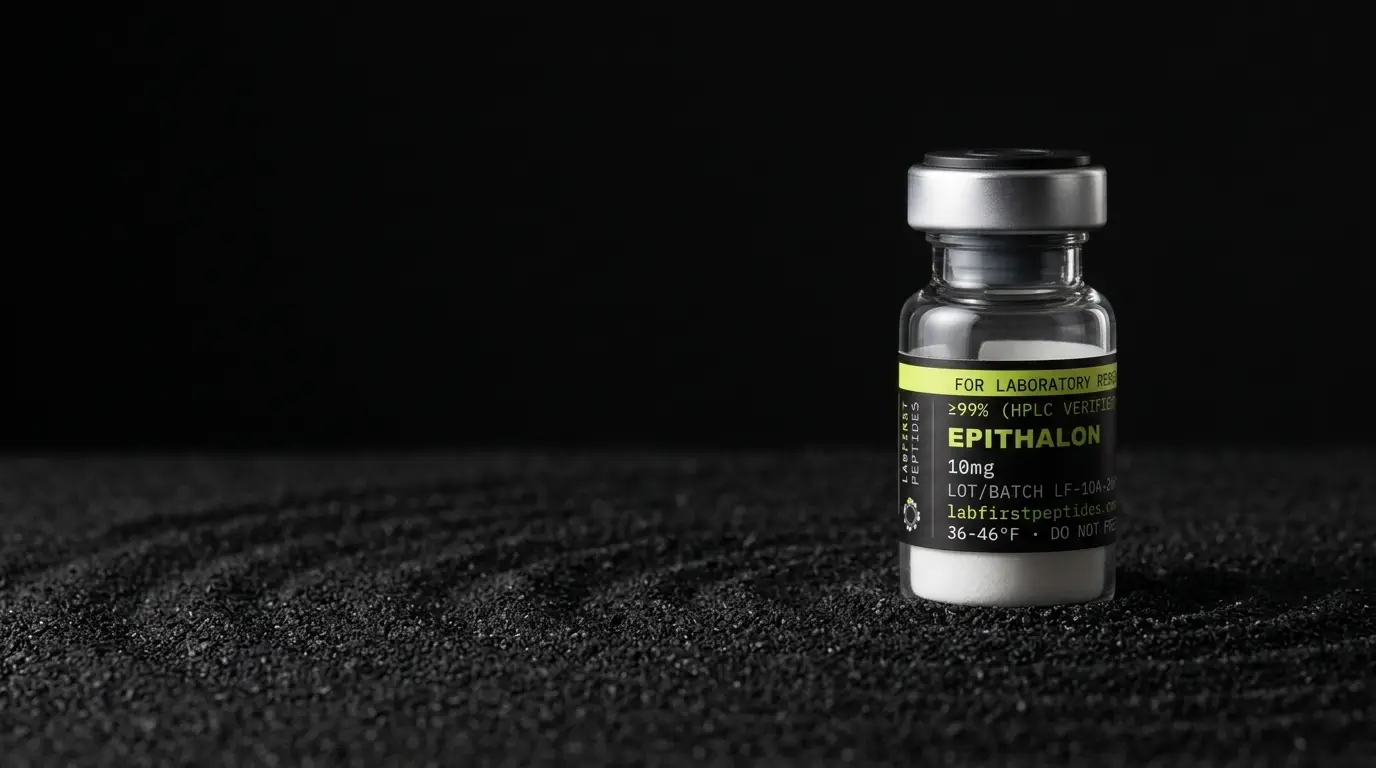
A certificate of analysis for Epithalon documents four things: that the material is the tetrapeptide Ala-Glu-Asp-Gly, how pure it is by a stated chromatographic method, how much peptide the vial actually holds, and which lot was tested. Everything else is packaging. Verify it with the issuing laboratory, not the seller.
- Epithalon is the tetrapeptide H-Ala-Glu-Asp-Gly-OH, formula C14H22N4O9, average molecular weight near 390.3 as the free acid.
- The peptide contains no aromatic residues, so purity by UV must be measured near 214 to 220 nm rather than at 254 or 280 nm.
- HPLC area percent cannot see water, salts or counterions, which is why net peptide content is the figure that says how much peptide a vial holds.
- Mass spectrometry confirms composition but not residue order; amino acid analysis or MS/MS is needed for sequence confirmation.
- No USP-NF monograph exists for Epithalon, so every acceptance criterion on a certificate was set by the supplier or its contract laboratory.
- Verification means contacting the issuing laboratory through independently obtained details and checking any accreditation scope in the public register.
What this guide covers
Think of it like the inspection sheet for one used car. It tells you what the mechanic checked on that car, on that day, and what readings came back. It says nothing about the next car on the lot, which is why the lot number on the vial has to match the lot number on the page.
This guide goes through what an Epithalon certificate certifies and what it cannot, the header fields that tie it to your vial, what mass spectrometry settles, why the wavelength and column matter before the purity number, and how net peptide content, water and counterion change the arithmetic. A worked example follows, then the dates and issuer, a step-by-step check with the laboratory, the red flags and the regulatory position. It finishes with a bottom line.
- Lot match: certificate, vial label and carton carry the same string
- Identity: mass within tolerance, and something orthogonal for sequence
- Purity method: wavelength near 214 nm, column and gradient stated
- Net peptide content: how much of the fill is peptide
- Dates and issuer: analysis before shipment, laboratory contactable independently
What does an Epithalon certificate certify, and what can it not?
A certificate of analysis is a test report for one lot. It records that a named laboratory ran named methods on a submitted sample on a given date and obtained given numbers. That is the whole of its claim. It is not a specification, it says nothing about the next lot from the same synthesis route, and it is not evidence that the material was produced under any quality system at all.
Epithalon complicates this in one specific way: there is no compendial monograph for it. Where a USP-NF monograph exists, the acceptance criteria are fixed by an outside body and the certificate is judged against them. Here, the supplier or the contract laboratory writes the criteria. So the criteria themselves are part of what you are assessing. A limit of ≥ 98.0% by HPLC means one thing if the method is described in enough detail to reproduce, and almost nothing if it is not.
The practical reading order is: confirm the document describes the vial in your hand, confirm the identity test actually identifies this peptide, confirm the purity number is measuring what you assume it measures, then find out how much peptide the vial contains. Most certificates fail somewhere in the second half of that list.
Which header fields tie the certificate to the vial?
The top block should let you tie the document to the physical container without ambiguity. Epithalon carries several names in circulation, which makes the naming block worth reading rather than skimming: Epithalon, Epitalon, epitalone, AEDG, and the sequence itself, H-Ala-Glu-Asp-Gly-OH. The free acid has molecular formula C14H22N4O9 and an average molecular weight near 390.3.
| Field | What it should state | How to check | Common failure |
|---|---|---|---|
| Product name and synonyms | Epithalon or Epitalon, with the sequence written out | Sequence matches Ala-Glu-Asp-Gly, four residues, free acid | Name given without sequence, so nothing is pinned down |
| CAS number | Present and resolving to the synthetic tetrapeptide | Look it up in a chemical registry independently | A number that resolves to a pineal extract preparation instead |
| Formula and molecular weight | C14H22N4O9, average mass near 390.3 | Arithmetic against the sequence | Salt-form mass quoted as free-acid mass, or vice versa |
| Lot or batch number | Identical string to the vial label and the outer carton | Read all three side by side | Label lot absent, or a “reference” lot on a generic certificate |
| Net content | Declared fill, with peptide content distinguished from gross weight | See the content section below | Only a gross figure, presented as if it were peptide |
| Appearance | White to off-white lyophilized powder or cake | Compare with the vial before opening it | Description absent, so a discolored cake has no reference point |
If the lot number on the certificate does not appear on the vial, stop there. Everything downstream is describing material you cannot connect to your bench.
What does mass spectrometry settle for Epithalon?
Identity on a small peptide is normally established by electrospray mass spectrometry. For the free acid the monoisotopic mass is close to 390.14, so the protonated ion sits near m/z 391.1 and the deprotonated ion near m/z 389.1. Epithalon is an acidic peptide, with three carboxyl groups against a single basic amine at the N-terminus, and it often behaves better in negative mode. A certificate that reports only a positive-mode figure is acceptable. Either way, the observed value should be within a few tens of millimass units of theory for a high-resolution instrument, and within about 0.5 units for a quadrupole.
Watch for sodium adducts. A peak 22 units above the expected protonated mass is sodium replacing a proton, and on a peptide with three carboxylates it can dominate the spectrum. That is a formulation and desalting observation. It does not mean identity failed, though it does tell you something about how the lot was worked up.
Mass has one limit. It confirms composition and says nothing about sequence. Any rearrangement of the same four residues gives the same molecular formula and the same mass. If the sequence matters to your work, the certificate needs either MS/MS fragmentation data or an orthogonal test. Quantitative amino acid analysis after acid hydrolysis is the cheap orthogonal check here, and it is unusually clean for this peptide because there is no Asn or Gln to convert to Asp or Glu during hydrolysis. A molar ratio near 1:1:1:1 for Ala, Glu, Asp and Gly is meaningful information. Almost no research-grade certificate includes it, which is itself a data point about how far the identity claim has been pushed.
Why read the wavelength and the column before the purity number?
Purity on these certificates is nearly always reverse-phase HPLC area percent. The number is only interpretable alongside the method, and for Epithalon two method parameters do most of the discriminating.
First, the detection wavelength. Epithalon contains no tryptophan, tyrosine, phenylalanine or histidine. It has no aromatic chromophore at all. Detection has to run on the peptide bond itself, at roughly 214 to 220 nm. A certificate reporting purity at 254 or 280 nm is either using a method borrowed from an unrelated compound or reporting a trace that cannot see the main analyte properly. That single field separates careful documentation from copied documentation faster than anything else on the page.
Second, retention. This is a very hydrophilic tetrapeptide. On a conventional C18 column with a 5 to 95 percent acetonitrile gradient it elutes at or near the void volume, where it is unresolved from salts and injection artifacts. Competent methods start with a high aqueous hold, use ion pairing with trifluoroacetic acid or a phosphate buffer, and often use a polar-endcapped or aqueous-compatible stationary phase, or move to HILIC or mixed-mode entirely. If a certificate shows a lone sharp peak at twelve minutes on a generic gradient with no other detail, ask for the method parameters and the system suitability data. USP General Chapter <621> sets out what a chromatographic procedure has to specify and how system suitability is demonstrated; a report that cannot answer those points has not been held to any standard.
Then the structural limitation of area percent: it counts only what elutes and absorbs. Water, inorganic salts, counterions, residual solvents and anything retained on the column are all invisible. A lot can be 99.2 percent pure by HPLC and still be a third non-peptide by mass.
What do net peptide content, water and counterion change?
This is the section most often missing, and it is the one that changes your arithmetic. Gross fill weight is what the balance saw. Net peptide content is how much of that mass is the tetrapeptide.
| Attribute | Method | Reported as | What it still does not tell you |
|---|---|---|---|
| Chromatographic purity | RP-HPLC, UV 214–220 nm | Area percent of total peak area | Anything that does not elute or absorb |
| Net peptide content | Nitrogen determination, quantitative AAA, or assay against a reference standard | Percent w/w of gross mass | Which impurity makes up the balance |
| Water | Karl Fischer, USP <921>, or loss on drying, USP <731> | Percent w/w | Whether uptake happened before or after filling |
| Counterion | Ion chromatography for acetate or TFA; fluorine NMR for TFA | Percent w/w | Salt stoichiometry across the three carboxylates |
| Residual solvents | Headspace GC | ppm per solvent | Solvents not included in the panel |
Epithalon sits in an unusual spot on counterion load. With only one basic site, a 1:1 trifluoroacetate salt adds roughly a fifth of the free-acid mass, and material supplied as the free acid or an acetate carries less than that. So the counterion correction is smaller than it would be for an arginine-rich peptide of similar length. Water is the bigger variable. An acidic, low-molecular-weight lyophilizate is hygroscopic, and residual moisture in the low single-digit percent range is ordinary while much higher figures are not. The same physics that governs any dry peptide applies once the vial is in your freezer, and the storage and stability guide covers the condensation problem in detail.
Where net content is absent, say so in your own record rather than assuming a value. Treating gross fill as peptide mass builds a systematic error into every mass figure you record for that vial, and it is an error that will not announce itself.
How does declared fill become a documented peptide mass?
Suppose the label declares 10 mg and the certificate reports net peptide content of 88 percent with 4.1 percent water by Karl Fischer. The peptide mass is:
10 mg × 0.88 = 8.8 mg peptide
Working from the gross figure instead would have credited the vial with 10 mg, a 12 percent overstatement carried silently into every record that cites it.
The correction matters for procurement too: price per milligram is only comparable between suppliers when both are computed on net peptide, which the cost per mg tool makes visible. A vial that looks cheaper on gross weight frequently is not.
What do the dates, signatures and issuing laboratory tell you?
Four dates can appear, and they are not interchangeable: date of manufacture, date of analysis, date of issue, and a retest or expiry date. The date of analysis is the one that anchors the document. It should fall after manufacture and before the material shipped to you. A certificate whose analysis date postdates your delivery is describing something other than the sample that was released.
Retest dates on research peptides are usually conventions rather than measurements. Assigning one honestly requires a stability study on that lot, in that container, under those conditions, and almost nobody has run it. A blank retest field is more truthful than a confident one with nothing behind it, though you will rarely see a supplier make that argument.
The signature block should name an analyst and a reviewer, carry a report or certificate number, and identify the issuing laboratory with an address. If the laboratory is separate from the seller, note whether it claims ISO/IEC 17025 accreditation and for what scope. Accreditation is granted for specific test methods, not for the building. A laboratory accredited for water analysis is not thereby accredited for peptide chromatography, and the scope document says which is which. Our own quality standard page sets out which documents accompany a lot and which are withheld.
How to verify an Epithalon certificate: step by step
Verification means asking the issuer, not the party who handed you the PDF. The sequence is short:
- Record the report number, the lot identifier and the sample identification exactly as printed.
- Find the laboratory's contact details independently, through a search or an accreditation directory. Do not use the email address or phone number on the certificate, which is the field an altered document alters first.
- Ask a narrow question: did you issue report number X, and what sample identification was submitted against it? Most laboratories will confirm or decline to confirm, which is enough.
- If accreditation is claimed, look up the certificate number in the accreditation body's public register and read the scope for the relevant method.
- Request the raw chromatogram, the method parameters and the system suitability results. A laboratory that ran the work has these; a template does not.
There is a limit that no amount of diligence removes. A third-party report certifies the sample the laboratory received. Who selected that sample, and whether it came from the lot that was later filled into your vial, is outside the report's scope and outside your visibility. Chain of custody is the gap, and the only closure available is an identity check you run yourself on the vial you were sent.
Two mechanical checks take about a minute. Open the PDF properties and look at author, producer and creation date; a chemistry report authored in a graphics editor is telling you something. Then compare chromatograms across two lots from the same supplier. Retention times matching to the second decimal and peak areas matching exactly means one trace has been reused.
Red flags on an Epithalon certificate
- Purity reported at 254 or 280 nm on a peptide with no aromatic residues.
- A percentage with no chromatogram, no column, no gradient and no wavelength.
- Lot number on the certificate absent from the vial label.
- Net peptide content missing, with gross fill weight presented as peptide mass.
- Identity by mass alone, described as sequence confirmation.
- Analysis date after the shipping date, or no analysis date at all.
- Issuing laboratory named but not locatable, or contactable only through the seller.
- Accreditation logo with no certificate number, or a scope that does not cover chromatography of peptides.
- Identical traces or identical numbers across lots that are supposedly independent.
- Any therapeutic or human-use language anywhere on the document, which tells you the issuer is not treating the material as a laboratory reagent.
None of these is proof of fraud on its own. Two or three together mean the document is decorative, and a decorative certificate should be treated as no certificate.
What is the regulatory status of Epithalon?
Epithalon is a synthetic tetrapeptide that originated in Russian gerontology research on pineal peptide preparations. It holds no marketing authorization as a medicine in the United States or the European Union, and it is not the subject of a USP-NF monograph, so no compendial specification exists to test a lot against. Acceptance criteria on any certificate you receive were written by the supplier or its contract laboratory.
Because there is no approved reference product, there is also no official reference standard in wide circulation. Assay against a characterized in-house standard is the practical substitute, and a certificate should say which standard was used.
Status verified August 26, 2026.
Bottom line
An Epithalon certificate describes one lot, tested by one laboratory on one date. Match the lot to the vial, then look for a mass near 390.14 with something orthogonal for sequence, purity measured near 214 to 220 nm with the column and gradient stated, and a net peptide content figure. Confirm the report with the laboratory through details you find yourself. No USP-NF monograph exists, so every limit on the page was set by the supplier or its contract laboratory.
FOR LABORATORY AND IN-VITRO RESEARCH USE ONLY. NOT FOR HUMAN OR ANIMAL CONSUMPTION. NOT FOR PERSONAL, MEDICAL, DIAGNOSTIC, THERAPEUTIC, OR RECREATIONAL USE.
What is Epithalon studied for?
Published research on Epithalon investigates the areas below, which is a different question from what Epithalon will do for anyone, a claim about a living system that nothing on this site is sold for.
What it is. A man-made peptide of four building blocks.
What the research looks at. It appears in a limited set of animal and cell studies. The evidence behind it is far thinner than the volume of commercial writing about it suggests.
How it is thought to work. Not established. The published record is small, and much of the original work comes from a narrow group of researchers, which is a real limit when reading it.
What is not established. No approved product, no official standard, and no settled mechanism. Claims made for this compound in vendor copy routinely go well past what the sources they cite actually say.
The full record, including the certificate for the lot in stock, is on the Epithalon product page.
Common questions
Why does the detection wavelength matter so much for Epithalon?
Is 99% HPLC purity enough on its own?
How do I confirm a certificate is genuine?
Does mass spectrometry prove the sequence is correct?
Should I expect a retest or expiry date?
What does a third-party report not cover?
More documentation guides
Sources
- USP General Chapter <621>, Chromatography. Defines what a chromatographic procedure must specify and how system suitability is demonstrated; supports the position that a purity figure without method parameters is uninterpretable.
- USP General Chapters <921> Water Determination and <731> Loss on Drying. Compendial methods behind the water content fields on a certificate; supports the distinction between Karl Fischer titration and loss on drying.
- ICH Q2(R2), Validation of Analytical Procedures. Establishes the validation characteristics, including specificity and accuracy, that an identity or assay method is expected to demonstrate.
- ISO/IEC 17025:2017, General requirements for the competence of testing and calibration laboratories. Basis for the point that accreditation is granted for defined methods within a published scope rather than to a laboratory as a whole.