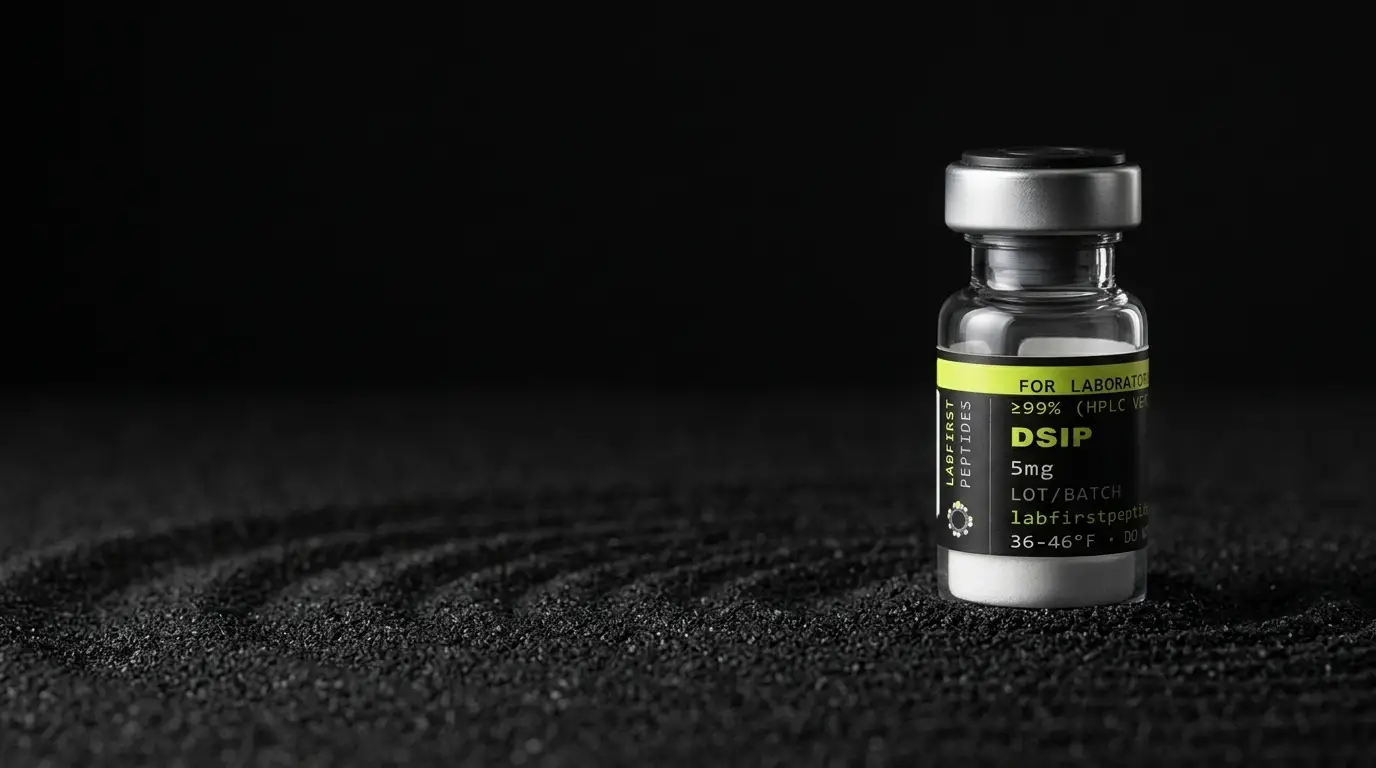
A DSIP certificate of analysis is a test report for one specific lot. Read it in order. First, match the lot number to your vial and note the test date. Then check identity by mass, near 848.8, and RP-HPLC purity with the chromatogram attached. After that, look at aspartimide-related impurities, net peptide content and water, then the issuing laboratory.
- DSIP is C35H48N10O15, average mass near 848.8, PubChem CID 68816.
- The sequence contains an Asp-Gly pair, the classic aspartimide hotspot.
- Isoaspartate is an ISOMER: same formula, same mass, different molecule.
- No mass measurement at any resolution can distinguish it from the parent.
- The aspartimide intermediate weighs about 18 less and IS visible by mass.
- Tryptophan gives a usable 280 nm wavelength and its own untidy oxidation cluster.
What does a DSIP certificate actually certify?
What does a certificate of analysis tell you? It works like a receipt, recording what one named lab measured on a sample from one lot on one date. It does not describe every vial ever made.
It records what a named laboratory measured on a sample drawn from one lot, on one date, by named methods. It is evidence about that sample rather than a warranty about the vial on your bench.
Two documents get confused constantly. A specification sheet lists limits the product is supposed to meet, carries no lot number and no results, and describes an intention. A certificate carries both because it describes an event.
A page with no lot number on its face is the first kind whatever the heading says. For this peptide there is a further reason to want real per-lot results, and it concerns an impurity that weighs exactly the same as the product.
- Lot number on the report against the lot number on the vial
- Identity: observed mass against an average near 848.8
- Related substances, because Asp-Gly is a known rearrangement site
- Isoaspartate weighs the same as the parent and needs a separation to see
- The aspartimide intermediate is 18 lighter and shows by mass
- Purity at 214 nm, with 280 nm available thanks to the tryptophan
- Accession number confirmed at the issuing laboratory
What mass should the identity result show?
DSIP is a nonapeptide with the molecular formula C35H48N10O15 and an average mass near 848.8, cataloged as PubChem CID 68816.
Two features of the sequence explain almost everything analytically interesting about it. It carries a tryptophan, which is the one residue giving strong ultraviolet absorbance at 280 nanometres. And it contains an aspartic acid immediately followed by a glycine.
That second detail looks like nothing and is the most consequential thing on the page. An Asp-Gly pair is the classic site for a rearrangement that produces impurities a mass measurement cannot distinguish from the intended molecule.
What is the Asp-Gly rearrangement?
A cyclisation. The nitrogen of the residue following aspartic acid attacks the aspartate side chain, forming a five-membered ring called an aspartimide.
That ring is unstable and opens again, and it can open two ways. One gives back the original aspartate. The other gives isoaspartate, where the backbone now runs through what used to be the side chain, inserting an extra atom into the chain path.
Glycine is the residue that makes this fastest, because it is the smallest and puts nothing in the way. An Asp-Gly sequence is the textbook hotspot, and DSIP has one.
Why can mass spectrometry not see it?
Because isoaspartate and aspartate are isomers. The rearrangement moves a bond; it does not add or remove a single atom.
The isoaspartate form therefore has exactly the same molecular formula and exactly the same mass as the intended peptide, to any resolution a mass spectrometer can offer.
This is the same class of blindness as chirality, arriving by a different route. A vial could contain a substantial proportion of the rearranged form and every mass-based identity check would pass without hesitation. The molecule is different; the weight is not.
How is it detected then?
By separation, primarily. Isoaspartate changes the shape of the backbone, and reversed-phase chromatography responds to shape, so the rearranged peptide usually elutes at a different time from the parent.
Usually is doing real work in that sentence. Whether the two resolve depends on the method, and a gradient developed only to check overall purity may not separate them at all, in which case the isoaspartate form is counted inside the main peak.
The aspartimide intermediate itself is easier, since ring closure releases water and the cyclic form weighs about 18 less. That one a mass detector sees immediately, which makes it a useful marker that the chemistry has been happening even when the end products are invisible.
What should the certificate say about it?
Ideally, that related substances were assessed with a method able to resolve them, and what was found. Realistically, most research certificates say nothing at all.
That silence is not evidence of absence. It usually means the question was not asked, because a standard purity gradient is not a method developed to separate isomers.
The practical read is straightforward. A DSIP certificate showing high area purity has established that most of what the detector saw was a peptide of the right mass eluting where expected. Given this sequence, that is a weaker statement than it appears, and knowing why is the whole value of understanding the Asp-Gly pair.
What does the tryptophan contribute?
A genuine second detection wavelength, and a second oxidation route.
Tryptophan absorbs strongly at 280 nanometres, so purity can be read there as well as at the usual 214. Comparing the two is informative: an impurity visible at 214 but absent at 280 has no tryptophan, which means it is not simply a rearranged version of the whole peptide.
Tryptophan also oxidises, and less tidily than methionine does. Where methionine gives one clean product 16 mass units heavier, tryptophan oxidation produces several species at several mass shifts, so it appears as a cluster of small peaks rather than one.
How do you read the certificate field by field?
Lot number first, against the vial. Then dates, where a test date should follow the fill date and a print date carries no analytical meaning.
Then identity by mass, stated as a number. Purity by reversed-phase HPLC with the chromatogram attached, ideally at both 214 and 280 nanometres. Related substances. Net peptide content. Counterion. Water. Appearance last.
Every result needs its method beside it. For this peptide the method line decides whether the purity figure could have seen the impurity most likely to be present, which makes it more than a formality.
What is net peptide content, and why does it change the price?
A synthetic peptide ships as a salt carrying a counterion from purification, plus water absorbed because lyophilized peptide is hygroscopic.
The consequence is arithmetic. A vial labeled 5 milligrams may hold 5 milligrams of powder of which a real fraction is salt and water. Net peptide content of 80 percent means 4 milligrams of peptide, and two suppliers quoting the same price for the same nominal size are not selling the same amount.
DSIP is an acidic peptide, carrying aspartate and glutamate, so its counterion situation differs from a basic peptide's: the charges to balance are negative rather than positive. Ask which basis the label uses, and see the cost per milligram comparison.
What does the certificate not cover?
Everything after the sample was drawn. Storage temperature, light, how long the vial has been open and how it has been handled are all outside it.
The gap is pointed here. The Asp-Gly rearrangement continues after release, faster in solution, at higher pH and at higher temperature. A lot that was genuinely clean at test can carry a meaningful proportion of the rearranged form months later.
And because that form weighs the same as the parent, nothing about the material announces the change. Handling belongs with the storage record rather than the test report.
How do you verify the document is genuine?
Confirm the report at the issuing laboratory rather than with the seller. An independent laboratory issues each certificate against an accession number that resolves on its own site. If the number resolves to a different product, a different lot, or nothing, the document does not describe your material.
Certificates with the verification key removed deserve particular suspicion, and this is not hypothetical in this market. A PDF is easy to edit; a third-party lookup is not.
Lot reports for material supplied here resolve through the certificate verification page, and the sizes carried appear on the DSIP product record.
What is the regulatory position?
There is no FDA-approved drug product containing DSIP and no United States pharmacopeial monograph defining what an acceptable batch is. The specification a lot is released against is the supplier's own.
For a peptide with a known rearrangement hotspot that absence has a specific cost. No official standard defines a limit for isoaspartate content or requires that it be measured, so whether anyone looked is entirely a matter of what the supplier chose to test.
Material described here is supplied for laboratory use only, and nothing in this guide describes use in a person or an animal.
FOR LABORATORY AND IN-VITRO RESEARCH USE ONLY. NOT FOR HUMAN OR ANIMAL CONSUMPTION. NOT FOR PERSONAL, MEDICAL, DIAGNOSTIC, THERAPEUTIC, OR RECREATIONAL USE.
What is DSIP studied for?
Published research on DSIP investigates the areas below, which is a different question from what DSIP will do for anyone, a claim about a living system that nothing on this site is sold for.
What it is. Delta sleep-inducing peptide, a man-made peptide nine building blocks long.
What the research looks at. A small and largely historical body of animal work, much of it decades old.
How it is thought to work. Not established. The peptide was named for something noticed in early animal work, not for a receptor anyone has found, and no target has ever been confirmed.
What is not established. No approved product, no confirmed receptor, and a name that describes an early observation rather than a demonstrated mechanism. The research is thin and old, and that is the most important thing to know about it.
The full record, including the certificate for the lot in stock, is on the DSIP product page.
Common questions
What molecular mass should a DSIP certificate show?
What is the Asp-Gly problem in DSIP?
Why can mass spectrometry not detect isoaspartate?
How is the rearranged form detected?
Why does tryptophan matter on this certificate?
More documentation guides
Sources
- PubChem Compound Summary for CID 68816, Delta sleep-inducing peptide. The openable record giving the molecular formula C35H48N10O15 and average mass near 848.8, and showing the aspartate-glycine adjacency the rearrangement depends on.
- ICH Q2(R2), Validation of Analytical Procedures . Defines specificity, including that a method must separate the target from closely related substances. An isomeric degradation product is the hardest form of that requirement.
- FDA guidance, Q6B Specifications: Test Procedures and Acceptance Criteria. Sets out how named degradation products are specified and reported separately from total purity, which is what an isoaspartate limit would require.
- Finnrick independent verification portal. Third-party lookup used to confirm a certificate resolves to the lot it claims to describe, rather than confirming a document with the seller who supplied it.