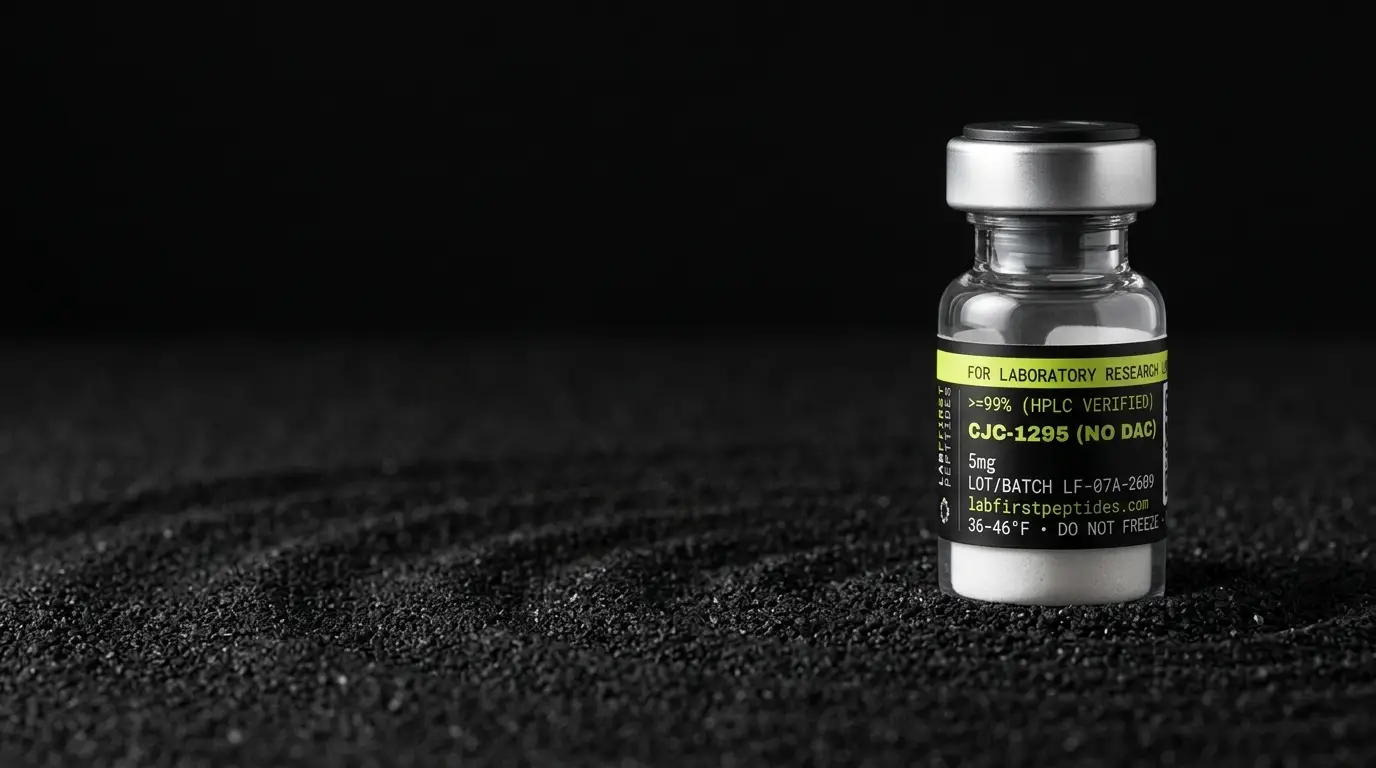
CJC-1295 no DAC storage and stability come down to a few habits. Keep the dry cake sealed, frozen and dark. Keep any solution refrigerated and dark. At 29 residues, it can aggregate, and no chemical test reports that physical change. Its special handling risk is a mix-up, because a near-identical powder sits just ten daltons away.
- Sealed and frozen as lyophilized cake, refrigerated in solution, dark in both states.
- Sermorelin is ten daltons away and looks identical; the DAC version differs by three letters.
- The mix-up easiest to make in a freezer is also the one a casual mass check survives.
- At 29 residues it can aggregate, and no chemical test on the routine panel reports that.
- Freeze-thaw concentrates the peptide locally as ice forms, which drives aggregation.
- A collapsed or slumped cake is the visible sign of moisture ingress.
How should CJC-1295 no DAC be stored?
In plain terms, the dry powder is like dried food: take the water out, keep it cold and dark, and it keeps far longer. The other risk is simple confusion, because a near-identical white powder can sit in the same freezer.
Sealed and frozen as lyophilized cake, refrigerated once a solution exists, dark in both states, and away from repeated temperature swings.
The dry form is the stable one. Freeze-drying removes the water that hydrolysis needs, and a sealed vial below freezing in the dark is the condition every retest date assumes.
Refrigeration rather than freezing suits a vial in regular use, trading a little stability for fewer freeze-thaw cycles. For a peptide this long that trade is usually worth making, because the cycles carry a risk short peptides largely escape.
- Sealed and frozen as lyophilized cake, in the dark
- Label discipline is storage here, not paperwork
- Sermorelin is ten daltons away and looks identical in the vial
- Avoid freeze-thaw: each freeze concentrates the peptide locally
- Do not shake, because interfaces are where unfolding starts
- A collapsed cake, a hazy solution or a missing label ends the vial
What is the handling risk specific to this compound?
Mistaking it for something else. This is a storage problem that no chemistry guide usually mentions and it is the most likely thing to go wrong with this particular vial.
Sermorelin is the unmodified parent, weighs about ten daltons less, and is an indistinguishable white lyophilized cake. CJC-1295 with DAC is a different product sold under a name that differs by three letters. All three plausibly sit in the same freezer box.
Nothing about the material tells them apart. Not color, not texture, not the look of the cake. Only the label and the certificate do, which makes label discipline part of storage rather than an administrative afterthought.
Why does that matter more than it sounds?
Because the analytical safety net is weakest exactly where the confusion is most likely. Telling this compound from the DAC version by mass is trivial. Telling it from sermorelin is a ten-dalton distinction on a 3.3 kilodalton molecule.
So the mix-up that is easiest to make in a freezer is also the one that survives a casual analytical check.
The practical response costs nothing. Keep vials in their original labeled containers, do not decant into unlabeled tubes, and keep the certificate with the lot. A frozen unlabeled vial of white cake is an unidentifiable object, and no amount of careful temperature control changes that.
Why does length change the storage problem?
Because a 29-residue chain can fold, and folding lets two molecules associate with each other. That association is aggregation.
It is a physical change rather than a chemical one. No bond breaks and no atom is added, so each individual molecule still weighs exactly what it should.
Which means an identity test passes on aggregated material. A mass spectrometer reports the monomer it was given and a reversed-phase separation may look entirely normal. Aggregation is real, it matters, and the routine analytical panel is close to blind to it.
What triggers aggregation?
Concentration, agitation, temperature swings and interfaces. A concentrated solution gives molecules more opportunity to meet. Vigorous shaking drives them to the air-liquid interface, where unfolding tends to start.
Freeze-thaw cycling is the trigger most people underestimate. As ice forms it excludes solutes, briefly concentrating the peptide far above its nominal concentration in the shrinking liquid fraction.
The rules that follow are simple and worth stating plainly: avoid repeated freeze-thaw, do not shake, and do not leave a solution standing warm for longer than the work requires.
Which chemical routes apply?
Hydrolysis first, which needs water and is why the lyophilized form is stable and a solution is not. Moisture ingress is therefore the fault that undoes everything else.
Deamidation is the second, converting susceptible residues over time, faster in solution and at higher pH than in a dry sealed vial.
Oxidation is milder here than for a peptide carrying a methionine in an exposed position, though a 29-residue sequence gives more opportunities than a short one simply by having more residues. None of these routes runs quickly at freezer temperature in a sealed dry vial, and all of them run measurably in a warm solution.
What does a retest date actually mean?
It describes an unopened container held under the conditions printed beside it, derived from stability data: units stored at defined temperature and humidity, pulled on a schedule, tested against the release specification.
The date is conditional on those conditions being met. A vial that spent a week on a warm bench is no longer described by it, and nothing about it looks different.
It is also not a cliff. Material past a retest date is not established as failing, it is outside the evidence, and the honest response is to test rather than assume in either direction. A pharmaceutical expiry is a stronger claim made under rules research-grade material is not made under.
What happens once the vial is opened?
The moisture clock starts and the certificate stops describing the contents. Lyophilized peptide is hygroscopic, and opening a cold vial in a warm room draws condensation directly onto the cake.
Letting the vial reach room temperature before opening costs nothing and removes the problem entirely. It is the single cheapest piece of technique in peptide handling and the most frequently skipped.
Cake collapse is the visible consequence when moisture wins. A lyophilized cake that has slumped, shrunk from the vial wall or gone glassy has taken on water, and that is a signal to act on rather than work around.
What does stability testing not capture?
Everything after dispatch. A stability study tests unopened units under controlled conditions, so its results describe an ideal a working vial stops matching at first entry.
Transit is the least documented stretch. A parcel can sit in a hot vehicle for a day or freeze overnight and none of it appears on paperwork. For a dry cake the chemical risk is modest; the mechanical risk to the closure is not, and a stressed seal can look perfect.
Aggregation is the other gap, and it is specific to a peptide this size. It develops in storage and in solution, so a certificate written at release describes material that had not yet had the opportunity.
What should make you stop using a vial?
A cake that has collapsed, slumped or pulled away from the glass. That is moisture, and it is the most useful signal this format gives without equipment.
In solution, cloudiness, haze or visible particulate. For a long peptide those can be the visible end stage of aggregation, which is exactly the failure the analytical panel does not report.
An unlabeled vial belongs on this list too, which is unusual advice and correct for this compound. A white cake with no label cannot be identified by looking at it, and the two nearest alternatives are both plausible.
How does storage relate to the certificate?
They split the timeline and neither covers the other half. A certificate reports what was measured on a sample drawn at one moment, and the certificate guide covers how to read one field by field. Storage evidence covers what happened afterwards.
The split has a sharp edge here. Aggregated material can still pass an identity test and still show a reasonable purity figure, so a clean certificate does not rule out a physical problem that developed later.
Lot reports for material supplied here resolve through the certificate verification page, and the sizes carried are on the CJC-1295 no DAC product record.
What is the regulatory position?
Stability expectations for finished pharmaceutical products are set out in international guidance defining storage conditions, sampling intervals and the testing that supports a shelf-life claim. That framework governs drug products made for human use.
There is no FDA-approved product containing this compound and no United States pharmacopeial monograph defining an acceptable batch, so a research certificate does not carry pharmacopeial weight.
A supplier can honestly report the conditions a lot was held under and what was measured. Presenting that as a drug product shelf life would overstate it, and the useful question stays narrow: what conditions, what measurement, what date.
FOR LABORATORY AND IN-VITRO RESEARCH USE ONLY. NOT FOR HUMAN OR ANIMAL CONSUMPTION. NOT FOR PERSONAL, MEDICAL, DIAGNOSTIC, THERAPEUTIC, OR RECREATIONAL USE.
What is CJC-1295 (no DAC) studied for?
Published research on CJC-1295 (no DAC) investigates the areas below, which is a different question from what CJC-1295 (no DAC) will do for anyone, a claim about a living system that nothing on this site is sold for.
What it is. A man-made 29-building-block copy of GHRH, also sold under the name Mod GRF(1-29).
What the research looks at. It appears in research on the GHRH receptor. The history of those four swaps is well documented and reads as an honest list of the ways the original sequence falls apart.
How it is thought to work. It works on the GHRH receptor. Four building blocks are swapped out at positions 2, 8, 15 and 27. Two of those swaps are repairs: one replaces a building block that tends to break down, the other replaces one that tends to react with oxygen.
What is not established. No approved product. The with-DAC and no-DAC versions are chemically different molecules with different handling needs and must not be treated as the same thing. This record is about the no-DAC form.
The full record, including the certificate for the lot in stock, is on the CJC-1295 (no DAC) product page.
Common questions
Does CJC-1295 no DAC need to be frozen?
Why is mistaken identity a storage issue for this compound?
Would aggregation show up on a certificate?
What does a collapsed lyophilized cake mean?
Should an unlabeled vial be used?
More documentation guides
Sources
- PubChem Compound Summary for CID 16132413, Sermorelin. The openable record for the unmodified parent, whose average mass near 3357.9 is the ten-dalton neighbour this compound must be kept distinguishable from.
- ICH Q2(R2), Validation of Analytical Procedures . Defines what makes an analytical result valid and reproducible, and is the basis for treating a stability figure without a named method and stated conditions as unverifiable.
- FDA guidance, Q6B Specifications: Test Procedures and Acceptance Criteria. Sets out why physical attributes such as aggregation are specified and tested separately from identity and chemical purity, which is the gap described above.