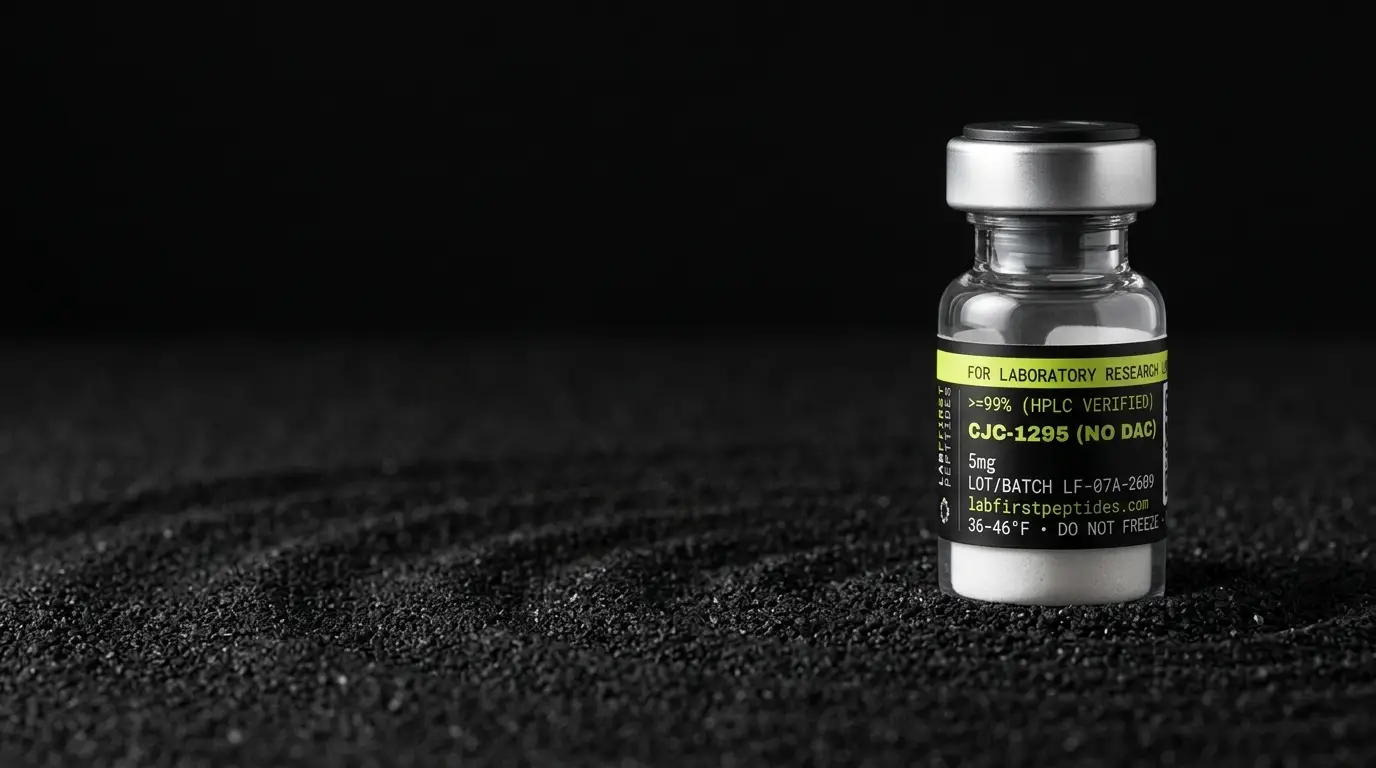
A CJC-1295 no DAC certificate of analysis is a test report for one specific lot. Read it in order. Start with the lot identifier and the test date. Then check identity by deconvoluted mass near 3367.9. Next come purity by RP-HPLC with the chromatogram, related substances, net peptide content and water. Finally, check which laboratory issued the report.
- Average mass near 3367.9; sermorelin sits near 3357.9, about ten daltons away.
- Ten daltons is fine on a 3.3 kilodalton molecule measured by deconvolution.
- CJC-1295 with DAC differs by a large appended group and is easy to tell apart.
- A D-configuration substitution means chirality that mass spectrometry cannot see.
- 29 residues means 28 coupling steps and deletion sequences that often co-elute.
- No approved product and no monograph define what may be called CJC-1295.
What does this certificate have to prove that others do not?
Two neighbors on one street, Dana Price and Dana Pryce, get their parcels checked twice for the right name. In plain terms, the certificate has to show the vial holds this compound and not one of its close relatives, which is why the identity result deserves a careful read.
That the vial holds this compound rather than either of two close relatives sold under confusingly similar names. That is an unusual burden and it is the reason to read this certificate carefully.
A certificate records what a named laboratory measured on a sample from one lot, on one date, by named methods. It is evidence about a sample rather than a warranty about the vial on your bench.
As always, a page with no lot number on its face is a specification sheet rather than a certificate, whatever its heading says. Here the lot-specific part matters doubly, because the identity question is genuinely easy to get wrong.
- Lot number on the report against the lot number on the vial
- Identity: a deconvoluted mass stated as a number, near 3367.9
- Compared against sermorelin at about 3357.9, only ten daltons away
- The DAC version differs by a large group and is easy to exclude
- Related substances: deletion sequences from 28 coupling steps
- Net peptide content, counterion and water by Karl Fischer
- Accession number confirmed at the issuing laboratory
Which look-alikes must it be told apart from?
Two, and they fail in opposite directions. The first is sermorelin, which is growth hormone releasing hormone 1-29 unmodified. This compound is that same 29-residue frame with a small number of amino acid substitutions.
The second is CJC-1295 with DAC, which takes this peptide and attaches a linker allowing it to bind to a blood protein. That addition is chemically substantial.
So one relative differs by a handful of atoms and the other by a whole appended group. A certificate has to distinguish this compound from both, and only one of those is easy.
Why is telling it from sermorelin the hard part?
Arithmetic. This peptide has an average mass near 3367.9 and sermorelin sits near 3357.9. The difference is about ten daltons on molecules of roughly 3,360.
Ten daltons is a large, obvious gap on a small peptide. On a 3.3 kilodalton molecule measured by electrospray and deconvolution, it is a much finer distinction, and deconvolution is a calculation with its own tolerance rather than a direct reading.
This is why the observed mass belongs on the certificate as a figure. A reader can compare 3367.9 against 3357.9 themselves. They cannot do anything at all with the phrase identity confirmed, and for these two products that phrase is close to worthless.
Why is telling it from the DAC version easy?
Because attaching the drug affinity complex adds a substantial chemical group, so the two differ by a large mass rather than a subtle one.
Any competent mass measurement separates them without ambiguity. There is no plausible scenario where a laboratory measures the mass and cannot tell which of the two it has.
Which means confusion between them is a labeling and supply problem rather than an analytical one. If a certificate reports a mass consistent with this compound and the vial is labeled with DAC, the discrepancy is in the paperwork or the packing, and it is worth resolving before anything else.
What do the substitutions actually do analytically?
They change the mass slightly, they change the retention slightly, and one of them introduces a stereochemical question.
The modification set includes a residue in the D configuration. A D-amino acid and its L counterpart are mirror images with identical atoms, so they weigh exactly the same and mass spectrometry cannot distinguish them at all.
That means a synthesis that installed the L form where the D was intended produces a peptide with the correct mass and the wrong structure. Chiral analysis is the only method that answers it, and it is absent from most research certificates, so its absence is a limit worth knowing rather than a scandal.
How do you read the certificate field by field?
Lot number first, against the vial. Then dates, where a test date should follow the fill date and a print date means nothing analytically.
Then identity as a deconvoluted mass, stated as a number. Purity by reversed-phase HPLC with the chromatogram attached. Related substances, which here means deletion sequences. Net peptide content. Counterion. Water. Appearance last.
Each result needs its method named. For a long peptide the method line carries more weight than usual, because whether the separation could resolve near neighbours is the difference between a purity figure that means something and one that does not.
What are deletion sequences and why do they matter here?
They are the characteristic impurity of stepwise synthesis. A 29-residue chain takes 28 coupling steps, and a step that fails on a fraction of chains yields molecules missing exactly one residue.
Each deletion differs from the target by one amino acid mass, between roughly 57 and 186 daltons. On a 3,368-dalton molecule that is a small proportional shift, and such species are nearly the same molecule so they often elute very close to the target.
Resolution therefore matters more than sensitivity. A separation not developed to pull deletions away from the main peak counts them inside it, and the reported purity flatters the material.
What does the purity figure leave out?
Anything that does not absorb at the detection wavelength or does not elute. Reversed-phase purity is an area percentage of what the detector saw.
Peptides are read at 214 nanometres because that responds to the peptide bond, so peptide impurities are detected well while salts and water are largely invisible. A vial can be 98 percent pure by area and still be substantially counterion and moisture by weight.
For this compound there is a second limit worth stating plainly: an unresolved deletion sequence and an unresolved sermorelin contaminant would both be counted inside the main peak. Area purity cannot see what the separation did not separate.
What is net peptide content, and why does it change the price?
It states what fraction of the powder is actually peptide, the rest being counterion, residual water and any inorganic content.
A vial labeled 5 milligrams may hold 5 milligrams of powder of which a real fraction is salt and water. Net peptide content of 80 percent means 4 milligrams of peptide, and two suppliers quoting the same price for the same nominal size are not selling the same amount of compound.
Ask which basis the label uses. The cost per milligram comparison ranks the catalog on one basis so two quotes can be compared honestly.
What does the certificate not cover?
Everything after the sample was drawn. Storage temperature, light, how long the vial has been open and how many times it has been entered are all outside it.
For a peptide of this length there is a specific gap. Aggregation is a physical change with no bond broken and no atom added, so each molecule still weighs the right amount and a mass result looks normal. It develops in storage and in solution, and a certificate written at release describes material that had not yet had the chance.
Handling belongs with the storage record rather than the test report, and reading one as though it covered both is the common mistake.
How do you verify the document is genuine?
Confirm the report at the issuing laboratory rather than with the seller. An independent laboratory issues each certificate against an accession number that resolves on its own site. If the number resolves to a different product, a different lot, or nothing, the document does not describe your material.
Certificates with the verification key removed deserve particular suspicion, and this is not hypothetical in this market. A PDF is easy to edit; a third-party lookup is not.
Lot reports for material supplied here resolve through the certificate verification page, and the sizes carried appear on the CJC-1295 no DAC product record.
What is the regulatory position?
There is no FDA-approved drug product containing this compound and no United States pharmacopeial monograph defining what an acceptable batch is. The specification a lot is released against is the supplier's own.
That absence matters more than usual for a peptide sold under a name shared with a different molecule. No official standard defines what may be called CJC-1295, which is precisely why the observed mass on the certificate is the thing to read rather than the product name on the label.
Material described here is supplied for laboratory use only, and nothing in this guide describes use in a person or an animal.
FOR LABORATORY AND IN-VITRO RESEARCH USE ONLY. NOT FOR HUMAN OR ANIMAL CONSUMPTION. NOT FOR PERSONAL, MEDICAL, DIAGNOSTIC, THERAPEUTIC, OR RECREATIONAL USE.
What is CJC-1295 (no DAC) studied for?
Published research on CJC-1295 (no DAC) investigates the areas below, which is a different question from what CJC-1295 (no DAC) will do for anyone, a claim about a living system that nothing on this site is sold for.
What it is. A man-made 29-building-block copy of GHRH, also sold under the name Mod GRF(1-29).
What the research looks at. It appears in research on the GHRH receptor. The history of those four swaps is well documented and reads as an honest list of the ways the original sequence falls apart.
How it is thought to work. It works on the GHRH receptor. Four building blocks are swapped out at positions 2, 8, 15 and 27. Two of those swaps are repairs: one replaces a building block that tends to break down, the other replaces one that tends to react with oxygen.
What is not established. No approved product. The with-DAC and no-DAC versions are chemically different molecules with different handling needs and must not be treated as the same thing. This record is about the no-DAC form.
The full record, including the certificate for the lot in stock, is on the CJC-1295 (no DAC) product page.
Common questions
What mass should a CJC-1295 no DAC certificate show?
How is this different from CJC-1295 with DAC?
Can mass spectrometry confirm the D-amino acid substitution?
What is a deletion sequence?
Would the certificate detect sermorelin contamination?
More documentation guides
Sources
- PubChem Compound Summary for CID 16132413, Sermorelin. The openable record for the unmodified GHRH 1-29 parent, giving the average mass near 3357.9 that this compound's figure of about 3367.9 must be distinguished from.
- UniProt P01286, Somatoliberin (growth hormone-releasing hormone). The reference protein record for human GHRH, from whose first 29 residues both sermorelin and this modified analogue derive.
- ICH Q2(R2), Validation of Analytical Procedures . Defines specificity, including that a method must distinguish the target from closely related substances, which is the demanding clause when two catalog products differ by ten daltons.
- Finnrick independent verification portal. Third-party lookup used to confirm a certificate resolves to the lot it claims to describe, rather than confirming a document with the seller who supplied it.