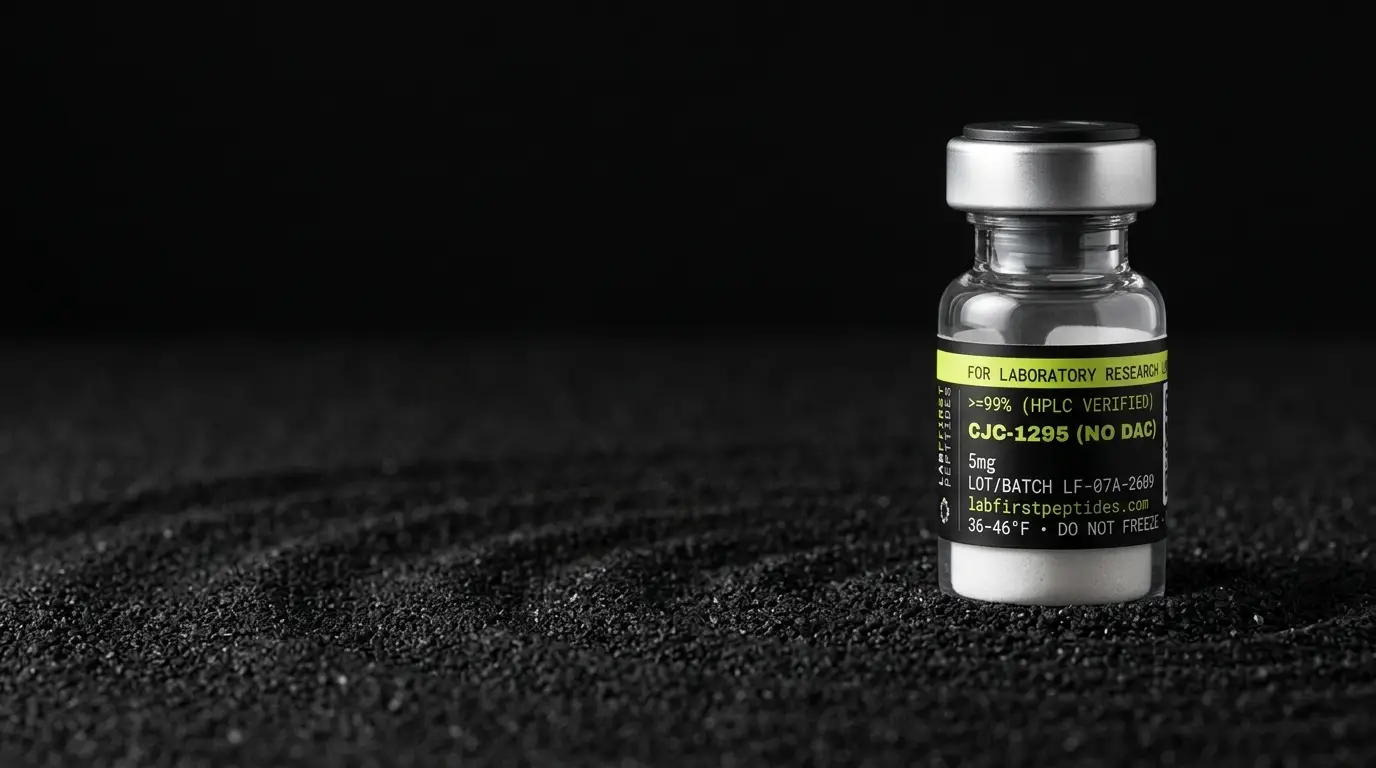
Here is how CJC-1295 no DAC identity is confirmed: the lab must tell it apart from sermorelin. Sermorelin weighs about ten daltons less. On a 3.3 kilodalton molecule, that gap is too small for intact mass to judge well. Peptide mapping settles it. It breaks the peptide into fragments and shows where each substitution sits.
- The identity question is closing a ten-dalton gap from sermorelin on a 3,368-dalton molecule.
- That is about three parts in a thousand, and the mass figure is a deconvolution output.
- Peptide mapping localises each substitution to a fragment rather than to a total.
- Overlapping amino acid masses mean a right total can in principle hide wrong substitutions.
- The D-configuration substitution is invisible to every mass method, including the map.
- The DAC version differs by a large appended group and is trivially excluded.
What is the identity question for this compound?
Weighing CJC-1295 no DAC against its close relatives barely helps, because they differ by only a few changed letters in the same 29-residue chain. Imagine telling nearly identical twins apart: you have to check the specific spots where they differ, and that is what peptide mapping does.
Not whether the vial holds a peptide of roughly the right size. Whether it holds this analogue rather than the parent it was modified from.
This peptide is growth hormone releasing hormone 1-29 with a small set of amino acid substitutions. Sermorelin is the same 29-residue frame without them. Both are sold in this market, both are white lyophilized cake, and their masses differ by about ten daltons.
So the identity question is narrow and specific. Everything on this page is about closing a ten-dalton gap on a molecule of about 3,368.
- Deconvoluted mass near 3367.9, stated as a number
- Sermorelin sits near 3357.9: three parts in a thousand away
- Peptide mapping localises each substitution to a fragment
- Amino acid analysis confirms composition independently
- Chiral analysis for the D residue, which no mass method can see
- The DAC version excluded trivially by intact mass
- Accession number confirmed at the issuing laboratory
Why is intact mass a weak instrument here?
Because of how the measurement is made. A molecule this size picks up several protons in electrospray, so the instrument records a family of charge states rather than one peak, and software combines that envelope into a single figure by deconvolution.
The number on the certificate is therefore the output of a calculation, carrying the tolerance of that calculation.
Ten daltons on 3,368 is roughly three parts in a thousand. That is within reach of a well-run measurement and it is not a comfortable margin, and it is nothing like the unambiguous separation the same ten daltons would give on a 700-dalton peptide. The gap is real; the instrument is simply not well matched to it.
What does peptide mapping do that mass cannot?
It localises. The peptide is cut at defined points by a specific enzyme, producing a set of fragments, and each fragment is weighed separately.
A substitution changes the mass of whichever fragment contains it. So instead of one ten-dalton difference spread across a 3,368-dalton total, you get a much larger proportional difference on a small fragment, and it is attached to a position rather than floating free in the sum.
That is the difference between knowing the molecule weighs about ten more than sermorelin and knowing that residue two, residue eight, residue fifteen and residue twenty-seven are what they should be. Only the second is an identity claim about this analogue.
Why does localisation matter and not just the total?
Because several different substitution patterns can produce a similar total. Amino acids have overlapping masses, so swapping one residue for another elsewhere in the chain can partly offset a difference and leave the sum looking plausible.
A peptide with the right total mass and the wrong substitutions is not this compound. It would pass an intact-mass check and fail a map.
This is not a common commercial failure, and it is the reason the analytical hierarchy exists. Mass constrains; mapping identifies. A certificate offering only the first has told you the molecule is about the right size and has not told you it is the right molecule.
What about the D-configuration substitution?
It is invisible to every mass-based method, including the map. One of the modifications places a residue in the D configuration rather than the L form found in natural sequences.
A D-amino acid and its L counterpart are mirror images containing identical atoms connected in an identical order. They weigh exactly the same, so no mass measurement at any resolution separates them, and a fragment containing one weighs the same as a fragment containing the other.
Only chiral analysis answers it, usually by hydrolysing the peptide and separating the freed amino acids on a handed stationary phase. It is absent from most research certificates, which is a limit rather than a scandal and worth knowing before assuming a mass result covered everything.
Does the separation help distinguish the two?
Sometimes, and not reliably enough to depend on. Substituting residues changes hydrophobicity slightly, so this analogue and sermorelin usually elute at somewhat different times on a reversed-phase column.
Whether they resolve depends entirely on the method. A gradient developed to check purity of one compound is not necessarily a gradient that separates it from a near neighbour, and nothing about the chromatogram announces which situation you are in.
Used deliberately, with both compounds run as references, retention is genuinely useful supporting evidence. Used incidentally, it proves very little, which is the general problem with retention time stated as an identity result.
How is the DAC version excluded?
Easily, and it is worth saying so because it is the one part of this that is simple. Attaching the drug affinity complex adds a substantial chemical group, so the masses differ by a large amount rather than a subtle one.
Any competent intact-mass measurement separates them unambiguously. There is no realistic scenario in which a laboratory weighs the molecule and cannot tell which of the two it has.
So a mismatch between a certificate's mass and a vial labeled with DAC is a supply or labeling problem rather than an analytical uncertainty, and it should be resolved as one.
What are deletion sequences and how are they found?
The characteristic impurity of stepwise synthesis. A 29-residue chain takes 28 coupling steps, and a step that fails on a fraction of chains produces molecules missing exactly one residue.
Each differs from the target by one amino acid mass, roughly 57 to 186 daltons. That is detectable, and such species are nearly the same molecule so they frequently elute very close to the target.
Resolution matters more than sensitivity here. A separation not developed to pull deletions away from the main peak counts them inside it, and the reported purity flatters the material. Peptide mapping catches them too, since a deletion changes the fragment containing it.
What does amino acid analysis contribute?
Composition, measured independently of both the separation and the mass. The peptide is hydrolysed to its constituent residues and each is quantified, giving the ratio present.
For an analogue defined by substitutions that is directly relevant, because changing residues changes the composition. A sequence with an extra alanine and one fewer of something else has a different amino acid ratio from the parent.
It also produces a peptide content figure by weight that does not depend on chromatographic assumptions, which is the honest answer to how much peptide is in the vial and why net peptide content is reported separately from area purity.
How do you check the report describes your vial?
Confirm the accession or verification number at the issuing laboratory rather than with the seller. The laboratory holds the record; a seller holds a copy of a document. If the number resolves to a different lot, a different product, or nothing, the analysis is not evidence about your material.
Then match the lot number on the report to the vial. Rigorous analysis attached to the wrong batch is not rigour, and for a compound with a ten-dalton neighbour that mismatch is more consequential than usual.
Reports for material supplied here resolve through the certificate verification page, and the sizes carried appear on the CJC-1295 no DAC product record.
What should you ask a supplier about identity?
Three questions, and the second is the one that matters. What was the deconvoluted mass, as a number. Was any sequence-level work done, meaning peptide mapping or amino acid analysis. And does the accession number resolve at the issuing laboratory.
A supplier answering only the first has established that the material weighs roughly what this analogue weighs, which is also roughly what sermorelin weighs. For two products separated by ten daltons that is not a satisfying answer.
How to read the rest of the document is covered in the certificate guide.
What is the regulatory position?
International guidance on analytical validation defines what makes an identity method fit for purpose: specificity, accuracy, precision, and a demonstration that the method distinguishes the target from what else might plausibly be present. Sermorelin is exactly what is plausibly present here, and that is the clause an intact mass struggles with.
There is no FDA-approved product containing this compound and no United States pharmacopeial monograph, so no official standard defines what may be sold under this name. The specification is the supplier's own.
What a research certificate can honestly establish is what a named laboratory measured, on a named lot, by named methods.
FOR LABORATORY AND IN-VITRO RESEARCH USE ONLY. NOT FOR HUMAN OR ANIMAL CONSUMPTION. NOT FOR PERSONAL, MEDICAL, DIAGNOSTIC, THERAPEUTIC, OR RECREATIONAL USE.
What is CJC-1295 (no DAC) studied for?
Published research on CJC-1295 (no DAC) investigates the areas below, which is a different question from what CJC-1295 (no DAC) will do for anyone, a claim about a living system that nothing on this site is sold for.
What it is. A man-made 29-building-block copy of GHRH, also sold under the name Mod GRF(1-29).
What the research looks at. It appears in research on the GHRH receptor. The history of those four swaps is well documented and reads as an honest list of the ways the original sequence falls apart.
How it is thought to work. It works on the GHRH receptor. Four building blocks are swapped out at positions 2, 8, 15 and 27. Two of those swaps are repairs: one replaces a building block that tends to break down, the other replaces one that tends to react with oxygen.
What is not established. No approved product. The with-DAC and no-DAC versions are chemically different molecules with different handling needs and must not be treated as the same thing. This record is about the no-DAC form.
The full record, including the certificate for the lot in stock, is on the CJC-1295 (no DAC) product page.
Common questions
Why is intact mass weak evidence for this compound?
What does peptide mapping add?
Could a peptide have the right mass and the wrong substitutions?
Can any mass method confirm the D-amino acid?
How is CJC-1295 with DAC excluded?
More documentation guides
Sources
- PubChem Compound Summary for CID 16132413, Sermorelin. The openable record for the unmodified GHRH 1-29 parent, giving the average mass near 3357.9 against which this analogue's figure of about 3367.9 must be distinguished.
- UniProt P01286, Somatoliberin (growth hormone-releasing hormone). The reference protein record for human GHRH, whose first 29 residues form the frame both this analogue and sermorelin are built on.
- ICH Q2(R2), Validation of Analytical Procedures . Defines specificity, including that a method must distinguish the target from closely related substances. Sermorelin is precisely the closely related substance in this case.
- FDA guidance, Q6B Specifications: Test Procedures and Acceptance Criteria. Sets out peptide mapping and amino acid analysis among the identity tests expected for larger molecules, alongside rather than instead of intact mass.