A CJC-1295 no DAC + ipamorelin certificate should report two identities, a mass near 3367.9 for the CJC-1295 component and near 711.9 for ipamorelin. It should state how many milligrams of each the vial holds, give purity per component with a chromatogram, and carry a lot number that matches the vial.
- CP10 is a 10 mg vial holding CJC-1295 no DAC and ipamorelin.
- CJC-1295 no DAC is C152H252N44O42 at 3367.9; ipamorelin is C38H49N9O5 at 711.9.
- Sermorelin sits at 3357.9, about ten daltons below the CJC-1295 component.
- A blend certificate needs identity, purity and content for each component.
- The CJC-1295 molecule is about 4.7 times heavier than ipamorelin, so mass and molecule ratios differ.
- Our product pages show results only once the certificate for that lot is published.
Two molecules, one report
A single-compound certificate answers one question: is this the molecule on the label, and how clean is it? A blend certificate has to answer that question twice, and then a third one nobody asks of a single compound: how much of each?
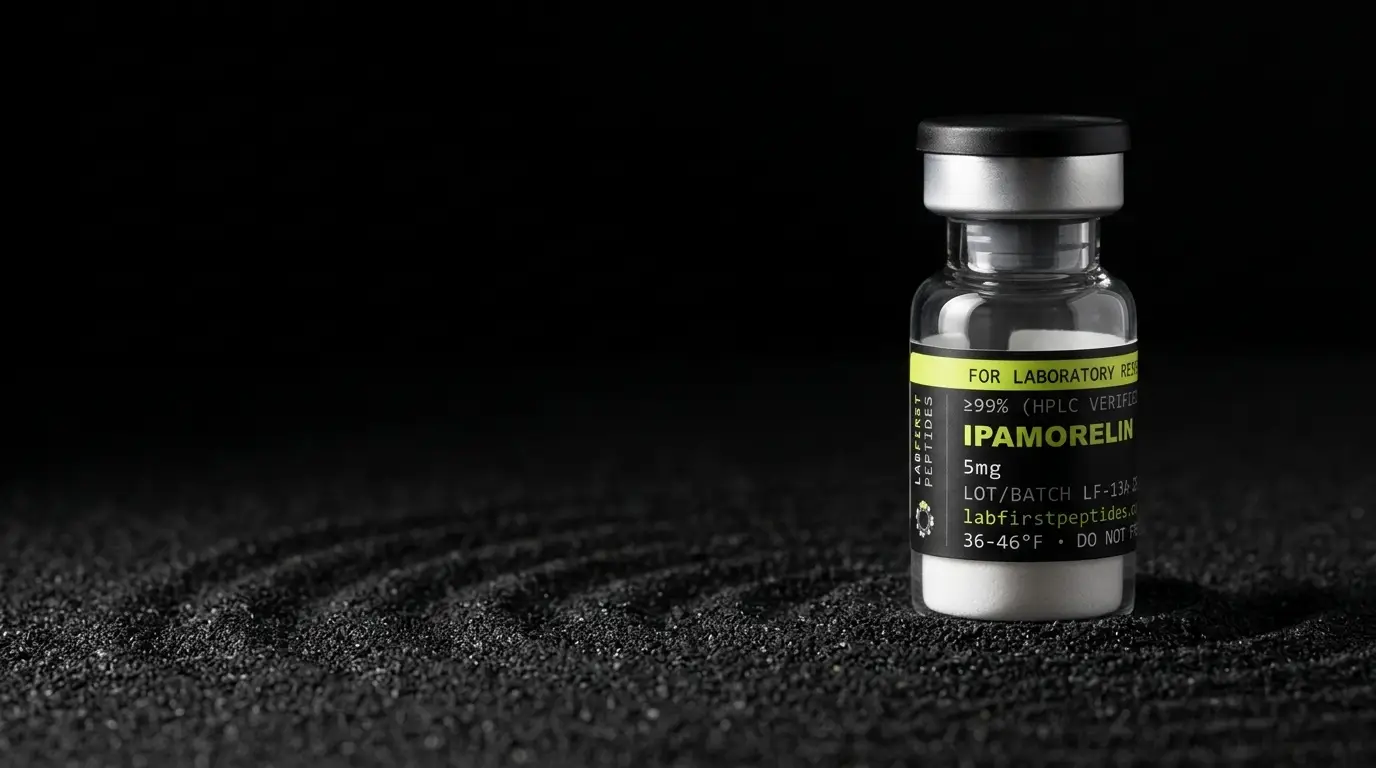
The CJC-1295 no DAC + ipamorelin blend, sold here as SKU CP10 in a 10 mg vial, holds two synthetic peptides freeze-dried together. The CJC-1295 no DAC component has the formula C152H252N44O42 and an average mass of 3367.9, and ipamorelin is C38H49N9O5 at 711.9. One is a 29-residue chain. The other has five residues. They behave differently on every instrument a laboratory uses.
So the report you want is really two reports stapled together, plus a line that ties them to the label. Anything less leaves a gap that a single combined number cannot fill.
- Lot number on the report matches the vial
- A mass near 3367.9 for the CJC-1295 component
- A mass near 711.9 for ipamorelin
- Purity reported for each component separately
- Milligrams of each component against the 10 mg total
- Method lines naming column, wavelength and detector
The rows a blend certificate needs
| Row | What it should show | Why it matters for this blend |
|---|---|---|
| Lot number and test date | Matches the vial; test date after fill | Ties the numbers to your material |
| Identity, CJC-1295 no DAC | Observed mass near 3367.9 | Rules out sermorelin at 3357.9 |
| Identity, ipamorelin | Observed mass near 711.9 | Confirms the pentapeptide is present |
| Purity per component | Two figures, with chromatogram | One figure cannot say which peptide it describes |
| Content per component | Milligrams of each | The label gives the total, not the split |
| Method lines | Column, wavelength, detector | Shows whether the separation could resolve near neighbors |
Read it top to bottom in that order. If the lot line fails, nothing below it describes your vial, so there is no point reading further.
Identity for the CJC-1295 component
The hard comparison here is with sermorelin, the unmodified first 29 residues of human growth hormone releasing hormone. PubChem lists sermorelin at C149H246N44O42S and 3357.9. The CJC-1295 no DAC component sits about ten daltons higher at 3367.9.
Ten daltons on a molecule of about 3,360 is a small gap, and a deconvoluted mass is a calculated value with its own tolerance. That is why the observed figure belongs on the page as a number. A phrase like conforms gives you nothing to compare.
There is also a useful clue in the formulas. Sermorelin carries one sulfur atom, from the methionine at position 27 of the GHRH sequence in UniProt. The CJC-1295 no DAC formula carries none, so that methionine has been replaced. A mass that matches sermorelin is the wrong molecule, however the label reads. The single-compound CJC-1295 no DAC certificate guide covers this comparison in more depth.
Identity for ipamorelin
Ipamorelin is small enough that its mass is easy to read. PubChem gives an average molecular weight of 711.9 and a monoisotopic mass of 711.386, and the certificate should report one of those, labeled so you know which.
The PubChem name for ipamorelin spells out two building blocks in the (2R) configuration, which means they are D-form residues. Mirror-image forms weigh exactly the same, so a mass match cannot confirm them. That limit is shared with the single-compound product and is covered on the ipamorelin certificate guide.
In a blend, the practical question is simpler: is there a clear peak near 711.9 alongside the one near 3367.9? If only one mass is reported, the report describes half of the vial.
Why is one purity number not enough?
One figure cannot say how clean each peptide is, because a blend shows two main peaks by design. A reversed-phase HPLC purity figure is the area of the main peak as a share of all the peaks the detector saw. In a blend there are two main peaks by design. A single percentage has to decide what to do with the second one, and different laboratories decide differently.
Some report the two main peaks added together. That figure can look excellent while one component is badly degraded, because the healthy component carries the average. Others report each component against its own impurities, which is the version you want.
The two peptides are also built from different residues, so they need not respond equally at the detector, and peak areas do not translate directly into milligrams. That is the reason content per component is a separate row and not something a reader can work out from the chromatogram.
The split between the two
Our catalog lists CP10 as 10 mg total. It does not state how that total divides between the two peptides, and this page will not invent a ratio. The certificate for the lot is where the per-component amounts belong.
The split matters more than it first seems because the molecules differ so much in size. The CJC-1295 component weighs about 4.7 times as much per molecule as ipamorelin. If a vial held equal masses of each, it would contain roughly 4.7 ipamorelin molecules for every CJC-1295 molecule. A mass ratio and a molecule ratio are different statements, so check which one a document means.
For a buyer's view of the same blend, the CJC-1295 ipamorelin blend buying guide sets out the checks to run before ordering.
Content, water and counterion
A 10 mg label normally refers to powder, and powder is not all peptide. Synthetic peptides carry counterions from purification and some residual water, and neither shows up at the wavelengths used for purity.
Net peptide content is the row that reports how much of the powder is actually peptide. On a blend it should be split by component, because the two peptides carry different numbers of basic groups that bind counterion. Water is usually measured separately by Karl Fischer titration.
None of this is a defect. It is the difference between the weight of the powder and the weight of the molecules, and a report that states it lets you do honest arithmetic.
Where our certificates stand
LabFirst publishes certificate results only when the certificate for that specific lot is released. Until then, product pages do not show purity or identity figures for our material, and nothing on this page describes a result for any of our lots.
When a lot certificate is published, it appears through the certificate lookup page and on the CJC-1295 no DAC + ipamorelin product page. Match the lot number on the report to the vial before reading anything else. Related reading on this blend: how its identity is confirmed and storage and stability.
Common ways a blend certificate falls short
The most common gap is a report written as if the vial held one compound. It prints one purity figure, one mass and one pass line. That document may be accurate about what it measured, but it has not described the product.
The second is a total with no split. A line reading 10 mg total, conforms, confirms the fill weight and nothing about the proportions. If the ratio were badly off, the total could still be correct.
The third is a mass printed without the kind of mass. For the CJC-1295 component, average and monoisotopic values differ by a couple of daltons, which is a fifth of the gap to sermorelin. A report that leaves the reader guessing has made the one comparison that matters harder to make.
None of these gaps means the material is wrong. Each means the document does not show that it is right, and a reader should ask for the missing rows before relying on the lot.
What should you ask the laboratory or seller?
If a certificate leaves any row blank, ask. A reasonable request is short: which observed mass was measured for each component, was purity calculated per component or for the two peaks together, and how many milligrams of each does the lot contain?
It also helps to ask whether the mass figures are average or monoisotopic. For ipamorelin the two differ by about half a dalton, 711.9 against 711.386, so a report that does not say which it used leaves room for a false mismatch or a false match.
A laboratory that ran the tests can answer these quickly. A document that cannot be traced to a laboratory at all is not a certificate, whatever it is called. The general guide to reading a peptide certificate covers the fields every report shares.
Regulatory position
The Jette paper in Endocrinology describes CJC-1295 as a derivative of hGRF(1-29) carrying a reactive group that bonds to albumin. The no DAC material in this blend is the peptide without that group. Neither the blend nor its CJC-1295 component has a United States pharmacopeial monograph, so no official standard defines an acceptable lot. The release specification is the supplier's own.
That makes the certificate the only document with numbers on it. Read the numbers, not the verdict column.
FOR LABORATORY AND IN-VITRO RESEARCH USE ONLY. NOT FOR HUMAN OR ANIMAL CONSUMPTION.
What is Ipamorelin studied for?
Published research on Ipamorelin investigates the areas below, which is a different question from what Ipamorelin will do for anyone, a claim about a living system that nothing on this site is sold for.
What it is. A man-made five-building-block peptide that makes the pituitary release growth hormone.
What the research looks at. Characterised by Raun and colleagues in 1998, and present in the growth-hormone releaser research ever since.
How it is thought to work. It works on the ghrelin receptor. Its build is deliberately defensive: an unusual building block at one end, two others flipped into their mirror-image form, a bulky side chain, and a capped tail. It contains none of the four building blocks that normally react with oxygen or break down, so the usual routes of decay simply are not there.
What is not established. No approved product and no official standard. Its unusual chemical toughness is a fact about storage, not a statement about what it does in any living thing.
The full record, including the certificate for the lot in stock, is on the Ipamorelin product page.
Common questions
What masses should a CJC-1295 no DAC + ipamorelin certificate show?
Why does a blend need purity for each component?
What is the ratio of CJC-1295 to ipamorelin in the 10 mg vial?
How is the CJC-1295 component told apart from sermorelin?
More documentation guides
Sources
- PubChem Compound Summary, Ipamorelin (CID 9831659). Formula C38H49N9O5, molecular weight 711.9, monoisotopic mass 711.386, and the IUPAC name that spells out the residues and the two (2R) centers.
- PubChem Compound Summary, Sermorelin (CID 16132413). Formula C149H246N44O42S and molecular weight 3357.9 for unmodified GHRH(1-29), the parent the CJC-1295 component must be told apart from.
- UniProt P01286, Somatoliberin, Homo sapiens. The GHRH precursor record; the mature peptide sits at positions 32 to 75, and its first 29 residues are the frame both sermorelin and the CJC-1295 component are built on.
- Jette et al., Endocrinology, 2005 (PubMed 15817669). The paper that names CJC-1295 as a maleimido derivative of hGRF(1-29) built to bond to albumin; the no DAC material is the peptide without that reactive group.
- IUPAC-IUB JCBN, Nomenclature and Symbolism for Amino Acids and Peptides, 3AA-11 to 3AA-13. Defines a peptide as the product of amide formation between amino acids, names the peptide bond, describes the loss of water and the residue, sets the oligopeptide and polypeptide ranges, and fixes N-to-C writing order.