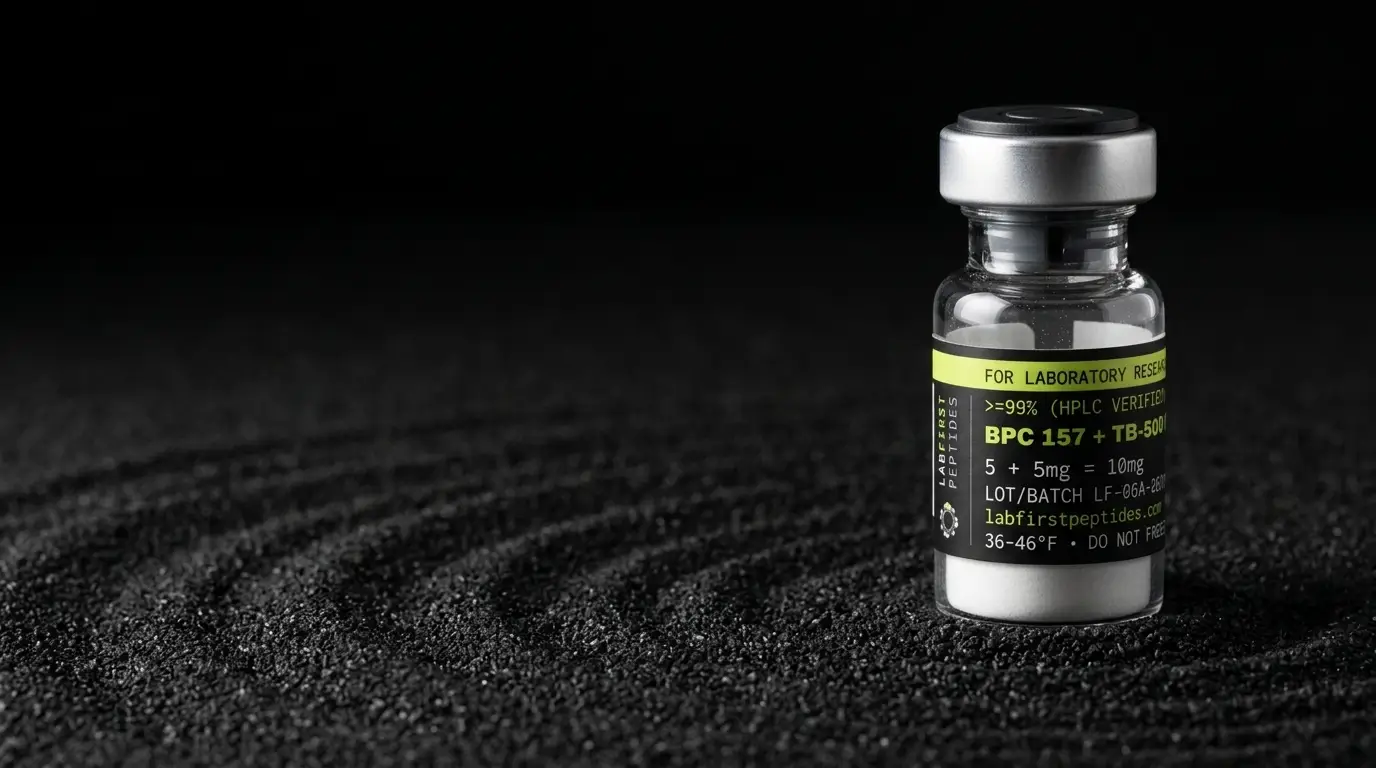
A BPC-157 + TB-500 blend COA should report each peptide separately. For identity, look for an observed mass near 1418.7 Da for BPC-157 and 888.5 Da for TB-500. Each peptide also needs its own HPLC purity with the method, its own net content, and a lot number that matches the vial.
- A BPC-157 + TB-500 blend certificate should report identity, purity and net content separately for each peptide.
- PubChem gives BPC-157 as C62H98N16O22, monoisotopic mass 1418.704 Da, and TB-500 as C38H68N10O14, 888.492 Da.
- Neither peptide contains an aromatic residue, so HPLC detection runs in the low UV, near 214 to 220 nm.
- Equal milligrams of each peptide are not equal molecule counts, because BPC-157 is the heavier molecule.
- The blend is sold as 5 mg + 5 mg, 10 mg + 10 mg and 15 mg + 15 mg, and each half of the label needs its own evidence.
One report, two analytes
A technician opens a blend vial's paperwork and finds a single line: Purity: 99%. Of what? The vial holds two peptides. That one line cannot say which was measured, or whether both were. In plain terms, a blend report is two certificates sharing one page, and every line has to say which peptide it is about.
A certificate of analysis is a record of what a named laboratory measured on a named lot, by named methods, on a named date. For a single peptide that is one set of results. For the BPC-157 + TB-500 blend it has to be two sets, because the vial contains two molecules with different masses, different retention on a column and different impurity profiles.
The label on this blend states the split: 5 mg + 5 mg, 10 mg + 10 mg or 15 mg + 15 mg. Each half of that label is a claim, and a complete certificate gives each half its own evidence. If you only take one habit from this page, make it counting: two identities, two purities, two net contents.
- Lot number matches the vial
- Two theoretical masses printed
- Two observed masses in the spectrum
- Two purity figures with the method
- Net content for each peptide
- Named lab and report number
The two molecules the report must name
PubChem lists BPC-157 as CID 9941957 with the formula C62H98N16O22, an average molecular weight of 1419.5 and a monoisotopic mass of 1418.704 Da. Its systematic name encodes a fifteen-residue chain, Gly-Glu-Pro-Pro-Pro-Gly-Lys-Pro-Ala-Asp-Asp-Ala-Gly-Leu-Val, with a free C-terminal acid.
TB-500 is CID 62707662, formula C38H68N10O14, average weight 889.0, monoisotopic mass 888.492 Da. Its name encodes N-acetyl-Leu-Lys-Lys-Thr-Glu-Thr-Gln, again as the free acid. That seven-residue stretch comes from thymosin beta-4, a much larger protein whose full sequence is on UniProt; the TB-500 certificate guide covers why the name is sometimes used for the whole protein and how to tell the two apart on paper.
A blend certificate should print both sequences, or at least both theoretical masses. If it gives a single "theoretical mass" for the vial, stop there. No such number exists for a mixture, and PubChem has no record for the blend for the same reason.
Fields, and what each should say for a blend
| Field | What a complete blend report shows | Common gap |
|---|---|---|
| Lot number | Same identifier as the vial label | No lot, or a lot from a different size |
| Identity | Two observed masses, one per peptide, with the spectrum | One mass, or none |
| Purity | An HPLC area percent for each peptide, with column, gradient and wavelength | One percentage for the vial |
| Net content | Milligrams of each peptide measured, against 5, 10 or 15 mg claimed | A total only, or no content line |
| Method statement | Each method named, so it can be repeated | "HPLC" with no conditions |
| Laboratory | Name, report number, date, signatory | Seller logo only |
A single-compound certificate that reports six good fields is useful. A blend certificate that reports the same six fields once, for the whole vial, is much less useful, because every line has quietly merged two answers into one.
What masses should the identity section show?
The identity section should show an observed mass for each peptide, close to its own theoretical value. Identity on a peptide certificate is normally mass spectrometry: observed mass against theoretical mass. For this blend the two expected values, about 1418.7 and 888.5 Da, are more than 500 Da apart, so a spectrum of the mixture should show both species without any ambiguity. Depending on the instrument, you may see singly or multiply protonated ions; the report should say which charge state gave the reported mass.
ICH Q2(R2) describes what an identification test has to show: a positive result comparable to a reference for samples containing the analyte, negative results for samples without it, and no false positive from closely related material. For a blend, that means the method should be able to tell the two peptides apart and detect each one on its own.
The identity guide for this blend goes further into what a mass match proves and what it leaves open, such as residue order.
Why does a blend need two purity figures?
One percentage cannot describe two peptides, so a blend report needs a purity figure for each. One percentage cannot describe two peptides, so a blend report needs a purity figure for each. HPLC purity is the share of integrated peak area under the main peak, at one wavelength, under one gradient. In a blend there are two main peaks. If the lab reports a single number, it has either added the two peaks together or reported only one of them, and the certificate rarely says which.
Neither sequence contains tryptophan, tyrosine or phenylalanine, so neither absorbs usefully at 280 nm. Detection has to run in the low-UV range where the peptide bond absorbs, typically around 214 to 220 nm. A report claiming purity at 280 nm for either peptide is describing a measurement that could not have been made as stated.
What to look for: two labeled peaks on the chromatogram, well separated, each with its own area percent, plus the column, the mobile phase gradient, the run time and the wavelength. Federal drug rules require lab records to state each method used and to show the method was verified as suitable under actual conditions. That rule does not bind a research certificate. It still makes a fair yardstick for what a complete record looks like.
Net content: checking both halves of the label
The label says 5 mg + 5 mg. The powder in the vial also includes water and counterion from purification, so the measured peptide content of each component will be lower than its nominal mass. A net content line for each peptide is what lets you see that and correct for it.
A worked example with made-up figures, to show the arithmetic rather than any real lot: suppose a report on a 10 mg + 10 mg vial gives net peptide content of 84 percent for BPC-157 and 80 percent for TB-500.
BPC-157: 10 mg × 0.84 = 8.4 mg
TB-500: 10 mg × 0.80 = 8.0 mg
The ratio by peptide mass is then 8.4 to 8.0, not exactly one to one, and the molar ratio is different again because the molecules differ in size: 8.4 mg of a 1419.5 g/mol peptide is about 5.9 µmol, while 8.0 mg of an 889.0 g/mol peptide is about 9.0 µmol.
Dates and the order they come in
A blend certificate should carry two dates: when the lot was made and when it was tested. The test date should come after the manufacture date, and the gap between them tells you how long the material sat before anyone looked at it. A report with only one date, or one reused across many products, leaves that question open.
For a blend there is a third date worth asking about, the date the two peptides were combined and filled. If the components were tested separately before blending, the certificate describes the inputs, not the filled vial. That can be fine, but it should say so, and the lot number on the report should be the blend lot rather than the lots of the separate peptides.
Test dates also matter for storage. A result that is two years old describes a material that has since been kept somewhere, under conditions the report cannot know. Your own storage record is what fills that gap.
Red flags specific to blends
- A single purity figure with no note on how the two peaks were handled.
- One theoretical mass for the vial.
- A net content that matches the label total but gives no split.
- A chromatogram with one main peak, which would mean one component is missing or the two co-eluted.
- A certificate for a single-peptide product offered in place of a blend report.
Any one of these can have an innocent explanation. Two or more together usually mean the report was written for a single compound and relabeled.
How do you verify a blend report?
Take the lab name and report number from the certificate, find the laboratory's contact details yourself, and ask whether that report exists for that lot. If the report carries an accreditation mark, check the lab in the accreditation body's directory and read the scope, since accreditation covers named tests only. The guide to what certified means covers that check.
For our own blend, the BPC-157 + TB-500 blend product page shows results only once the certificate for that lot is published at the certificate index. Until then it says the certificate is pending. The storage guide for this blend covers how to keep the vial in the state the certificate describes.
FOR LABORATORY AND IN-VITRO RESEARCH USE ONLY. NOT FOR HUMAN OR ANIMAL CONSUMPTION.
What is BPC 157 studied for?
Published research on BPC 157 investigates the areas below, which is a different question from what BPC 157 will do for anyone, a claim about a living system that nothing on this site is sold for.
What it is. A man-made fifteen-amino-acid peptide, based on a protein found in stomach juice.
What the research looks at. It appears in animal and cell-culture research on tissue and blood-vessel biology. Almost everything published is animal or cell work.
How it is thought to work. Nobody has settled how it works. Cell and animal studies report effects on blood-vessel growth signals and on several growth-factor pathways, but no single receptor has been pinned down as its target and the studies do not agree on one model.
What is not established. No FDA-approved product contains BPC 157, and no USP or NF standard defines what an acceptable batch is. Human evidence is close to nonexistent. Any figure printed on a research vial is the supplier’s number, not an official one.
The full record, including the certificate for the lot in stock, is on the BPC 157 product page.
Common questions
Why does a blend certificate need two purity figures?
What masses should the identity section show?
Is a one-to-one ratio on the label a molar ratio?
Can I use a BPC-157 certificate for the blend?
What if the certificate has no net content line?
Published certificates for BPC 157 + TB-500 Blend
Every figure below is read from a report the laboratory issued for that lot; each page carries the PDF and the lab's own verification link.
More documentation guides
Sources
- PubChem PUG REST, formula and masses for CID 9941957 (BPC-157) and CID 62707662 (TB-500). C62H98N16O22, 1419.5 g/mol, monoisotopic 1418.704 Da for BPC-157; C38H68N10O14, 889.0 g/mol, monoisotopic 888.492 Da for TB-500.
- PubChem PUG REST, IUPAC names for CID 9941957 and CID 62707662. The systematic names encode the residue order of each peptide, including the N-acetyl leucine and C-terminal glutamine free acid of TB-500.
- ICH Q2(R2), Validation of Analytical Procedures (2023). Section 3.1.2 on identification tests: a positive result against a reference, negative results for samples without the analyte, and a check against closely related materials.
- 21 CFR 211.84, Testing and approval or rejection of components. At least one identity test on each component, and testing against written specifications for purity, strength and quality.
- 21 CFR 211.194, Laboratory records. Records must state each test method, and the suitability of every method must be verified under actual conditions of use.
- ILAC, About ILAC. Defines accreditation as independent evaluation of competence and impartiality for specific activities, and names ISO/IEC 17025 as the standard for testing laboratories.