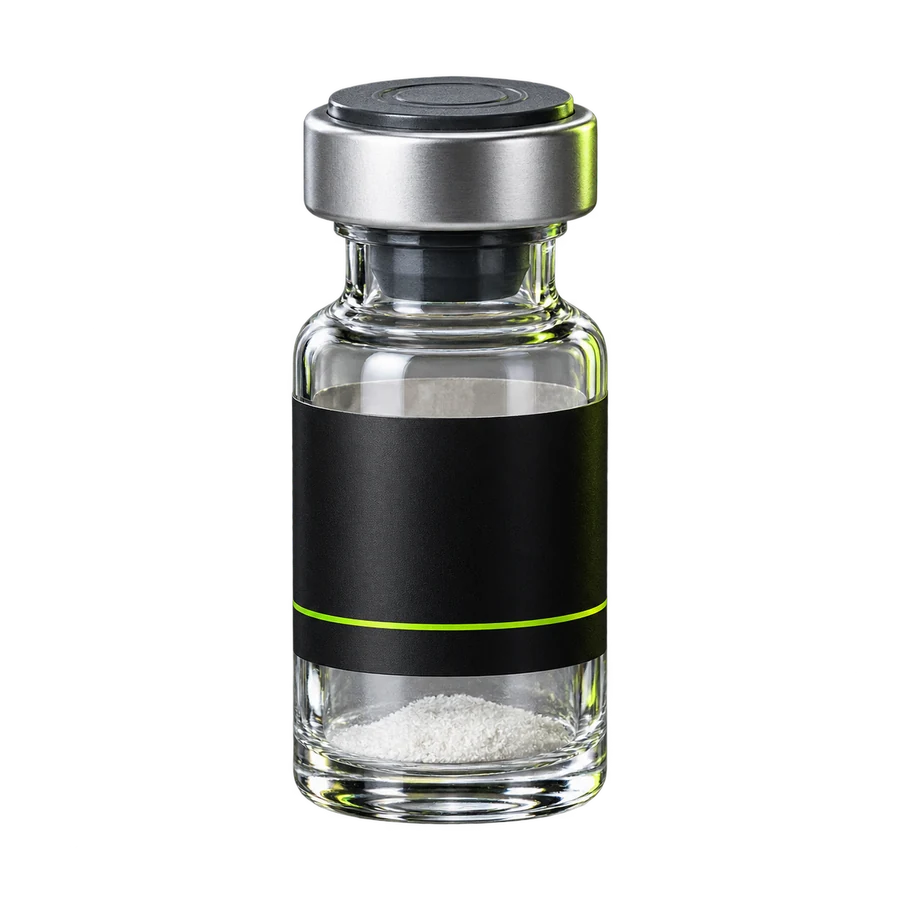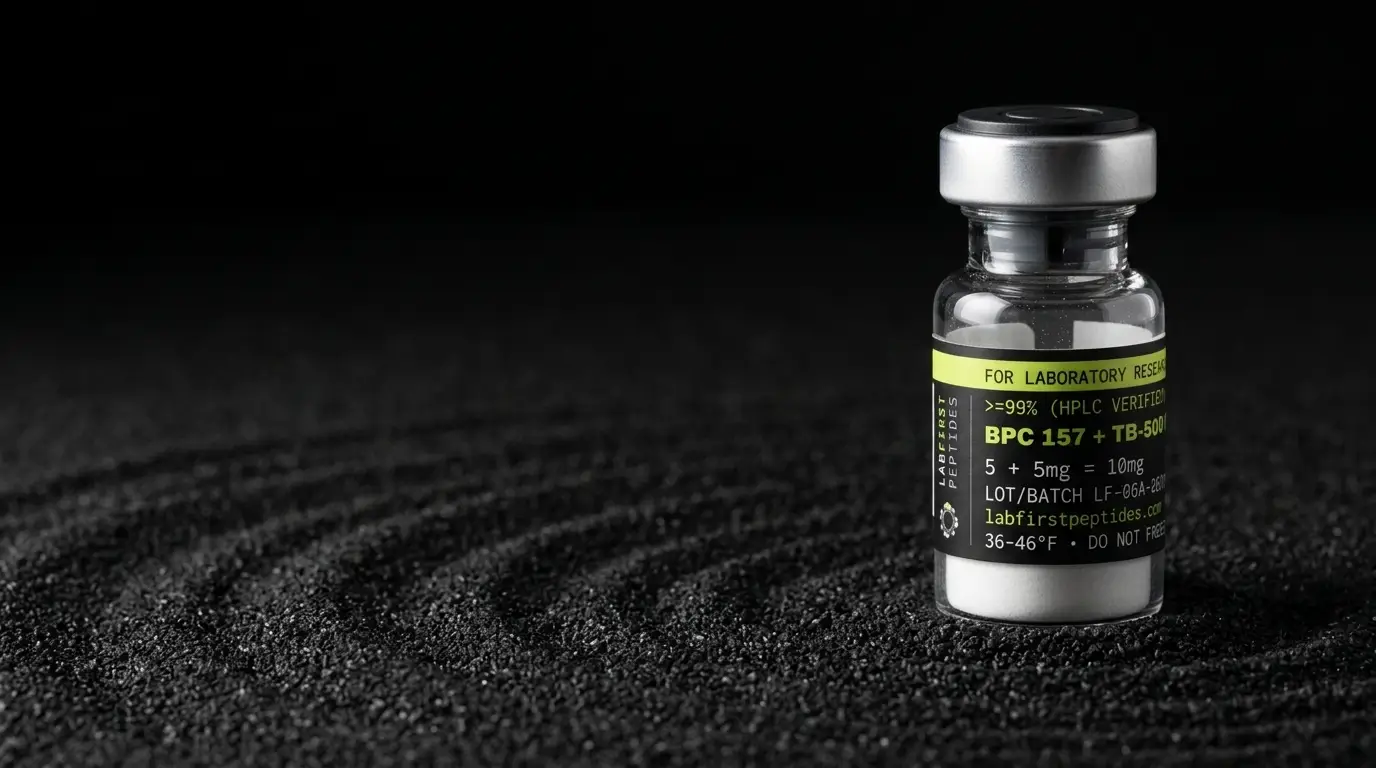
BPC-157 + TB-500 blend storage and stability start with the sealed vial: keep the lyophilized powder cold, dry and dark, and let it reach room temperature before opening so moisture does not condense. Assay solutions should be dated, aliquoted and kept cold, because both peptides are less stable dissolved than dry.
- The sealed lyophilized BPC-157 + TB-500 blend should be stored cold, dry and dark; the lot certificate sets its shelf period.
- A cold BPC-157 + TB-500 blend vial should reach room temperature before opening so moisture does not condense on the powder.
- Neither BPC-157 nor TB-500 contains cysteine, methionine or tryptophan.
- Assay solutions of the BPC-157 + TB-500 blend should be dated, aliquoted and frozen to avoid repeated freeze-thaw.
- ICH Q1A(R2) stress testing covers temperature, humidity, oxidation and light.
Why storage matters for a blend
Picture a vial taken straight from a refrigerator and opened on a warm bench. Within seconds a faint fog forms on the glass. The same thing happens, out of sight, on the powder inside: cold solid, warm air, water condensing. That moment does more harm to a lyophilized peptide than weeks of careful cold storage.
A freeze-dried peptide is a dry, glassy cake. Dry, it changes slowly. Water, heat, light and oxygen are what speed it up, which is why stability testing for drug substances, as set out in ICH Q1A(R2), stresses a material with raised temperature, high humidity, oxidation and light to find how it breaks down.
The BPC-157 + TB-500 blend adds one wrinkle. Two peptides share a vial, so the vial has to be kept in conditions that suit whichever is more sensitive, and a record of what happened to the vial is a record for both.
- Keep the sealed vial cold and dark
- Warm to room temperature before opening
- Take what you need, close promptly
- Date every assay solution
- Aliquot and freeze, one thaw each
- Check aged solutions by HPLC
What is in the vial
The blend holds two peptides freeze-dried together, sold as 5 mg + 5 mg, 10 mg + 10 mg or 15 mg + 15 mg. PubChem's names give their sequences. BPC-157 is Gly-Glu-Pro-Pro-Pro-Gly-Lys-Pro-Ala-Asp-Asp-Ala-Gly-Leu-Val, a free acid of 1419.5 g/mol. TB-500 is N-acetyl-Leu-Lys-Lys-Thr-Glu-Thr-Gln, a free acid of 889.0 g/mol.
Besides peptide, the cake contains some residual water and the counterion carried over from purification. None of that is visible, and all of it affects how the powder takes up moisture once the seal is broken. The guide to what is in this blend sets out the composition in more detail.
Sequence features that bear on storage
Reading the two sequences residue by residue tells you what is not there, which is useful. Neither contains cysteine, so there is no disulfide bond to break or scramble and no free thiol to oxidize. Neither contains methionine or tryptophan, the residues most often damaged by oxidation. That removes several common failure routes before the vial leaves the shelf.
What remains are features that matter mainly in solution. TB-500 ends in glutamine, and side-chain amides of glutamine can be lost slowly by hydrolysis in water. BPC-157 has two adjacent aspartates, and aspartate residues are a known site of backbone rearrangement in solution. Neither concern is large for the dry cake, and both argue for keeping solution time short.
Both molecules also carry charged side chains, lysines and acids, so both are hydrophilic and dissolve readily in aqueous buffers. That makes them easy to handle in the lab, and it also means the dry cake will take up water quickly from humid air.
Conditions by physical state
| State | Temperature | Other controls | Main risk |
|---|---|---|---|
| Sealed lyophilized vial, short term | 2 to 8 °C | Dark, upright, seal intact | Moisture if the seal fails |
| Sealed lyophilized vial, longer term | −20 °C or colder | Dark, in a sealed secondary bag with desiccant | Condensation on removal |
| Opened vial, powder remaining | −20 °C | Close promptly, minimize air exposure | Water uptake at every opening |
| Assay solution | 2 to 8 °C for short use, frozen aliquots otherwise | Dated, labeled, single-use aliquots | Hydrolysis and repeated freeze-thaw |
The shelf period that applies to a specific lot is the one on its certificate. The conditions above are general laboratory practice for dry peptides, not a stability claim for any lot.
The cold vial in a warm room
Before opening a vial that has been refrigerated or frozen, let it stand in its closed secondary bag until it reaches room temperature. That usually takes a quarter of an hour to half an hour for a small vial. Opening it cold draws in humid air, water condenses on the cake, and the powder you weigh afterward is part water.
Weigh or dissolve what the assay needs, then close the vial and return it to cold storage promptly. Each opening is a small exposure, so a vial opened many times ends up in worse shape than one opened once. If the protocol calls for repeated sampling, splitting the solution into aliquots early is better than going back to the powder.
How should assay solutions of the blend be handled?
Once dissolved for a laboratory assay, both peptides are in the state where they change fastest. Date every solution, record the diluent and its lot, and keep it cold. For anything beyond short use, divide it into single-use aliquots and freeze them, so no portion goes through more than one freeze-thaw cycle.
Remember that the blend puts both peptides in the same solution. If one degrades, the ratio between them shifts, and that change will not show up unless someone looks. An HPLC run on an aged solution beside a fresh one, same method, is the direct check: both peaks should keep their areas and retention times. ICH Q1A(R2) describes exactly this use of stress data, to show a method can see the degradation products it is looking for. Net content for the blend is reported on the blend certificate.
Light and shipping
Neither peptide has an aromatic side chain that would absorb strongly in visible or near-UV light, but light exposure is still one of the standard stress conditions in ICH Q1A(R2), and keeping vials in their box or a dark drawer costs nothing. Clear glass vials on an open bench under strong lighting are the easy case to avoid.
Shipping is a short, uncontrolled period. A dry, sealed cake tolerates a few days at ambient temperature far better than a solution would, which is why peptides move lyophilized. On arrival, check the seal, note the condition of the packaging in the log, and move the vial to cold storage the same day.
How can you tell a vial has taken on water?
A dry lyophilized cake is usually a white, fluffy or slightly glassy solid that sits as one piece or a loose powder. A cake that has absorbed water may shrink, look wet or sticky, collapse to a film on the glass, or clump into hard lumps. Those changes leave open whether the peptide has degraded. They do mean the powder is no longer the material described on the certificate, and any weight you take from it includes water.
If a vial looks like this on arrival, record it and ask the seller before using it. If it happens in storage, the seal or the handling routine has failed, and the log should say when the vial was last opened.
Moving vials between freezer and bench
Most damage in a well-run lab happens during handling, not storage. A few habits limit it. Take out only the vial you need, rather than the whole box. Keep it in a closed bag until it reaches room temperature. Work quickly once it is open, and put it back the same session.
Avoid frost-free freezers for long-term storage where you can, since their defrost cycles warm the contents a little several times a day. A manual-defrost freezer, or a box placed deep inside a frost-free one away from the door, gives a steadier temperature. Note any power cut or door-open alarm in the log, with the time, so later results can be read against it.
What the storage record should hold
- Lot number from the vial label, and the certificate reference beside it.
- Date received and the condition of the seal and packaging.
- Storage location and temperature, with any excursions noted.
- Each opening: date, who, and what was taken.
- Each solution: date made, diluent and lot, concentration, and where the aliquots went.
This is short, and it is what connects a result on the bench back to the lot certificate. The identity guide for this blend covers the tests that certificate should contain, and the product page links to it once the lot's certificate is published at the certificate index. For the single-peptide view, see TB-500 storage and stability.
FOR LABORATORY AND IN-VITRO RESEARCH USE ONLY. NOT FOR HUMAN OR ANIMAL CONSUMPTION.
What is BPC 157 studied for?
Published research on BPC 157 investigates the areas below, which is a different question from what BPC 157 will do for anyone, a claim about a living system that nothing on this site is sold for.
What it is. A man-made fifteen-amino-acid peptide, based on a protein found in stomach juice.
What the research looks at. It appears in animal and cell-culture research on tissue and blood-vessel biology. Almost everything published is animal or cell work.
How it is thought to work. Nobody has settled how it works. Cell and animal studies report effects on blood-vessel growth signals and on several growth-factor pathways, but no single receptor has been pinned down as its target and the studies do not agree on one model.
What is not established. No FDA-approved product contains BPC 157, and no USP or NF standard defines what an acceptable batch is. Human evidence is close to nonexistent. Any figure printed on a research vial is the supplier’s number, not an official one.
The full record, including the certificate for the lot in stock, is on the BPC 157 product page.
Common questions
How should a sealed BPC-157 + TB-500 blend vial be stored?
Why let the vial warm up before opening it?
Which peptide in the blend is more sensitive?
How can I tell if a stored solution has changed?
Published certificates for BPC 157 + TB-500 Blend
Every figure below is read from a report the laboratory issued for that lot; each page carries the PDF and the lab's own verification link.
More handling guides
Sources
- PubChem PUG REST, IUPAC names for CID 9941957 and CID 62707662. The systematic names encode the residue order of each peptide, including the N-acetyl leucine and C-terminal glutamine free acid of TB-500.
- PubChem PUG REST, formula and masses for CID 9941957 (BPC-157) and CID 62707662 (TB-500). C62H98N16O22, 1419.5 g/mol, monoisotopic 1418.704 Da for BPC-157; C38H68N10O14, 889.0 g/mol, monoisotopic 888.492 Da for TB-500.
- ICH Q1A(R2), Stability Testing of New Drug Substances and Products. Stress testing covers temperature, humidity, oxidation and photolysis, and is used to find degradation products and prove an analytical method can see them.
- ICH Q2(R2), Validation of Analytical Procedures (2023). Section 3.1.2 on identification tests: a positive result against a reference, negative results for samples without the analyte, and a check against closely related materials.