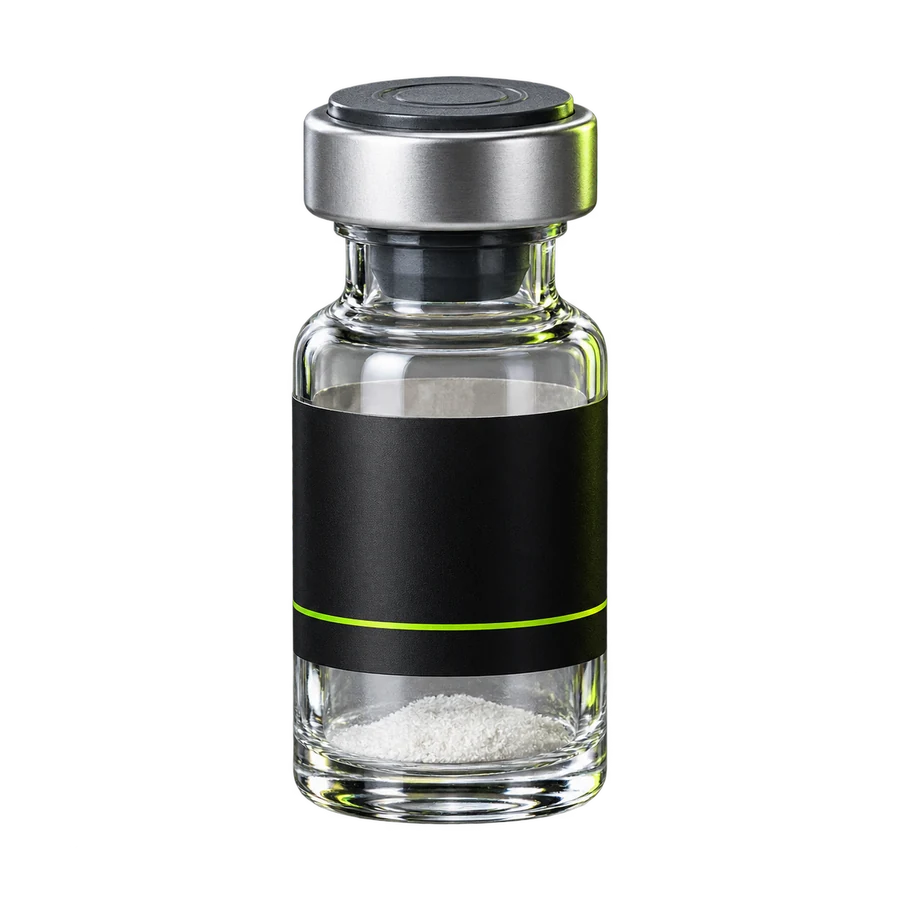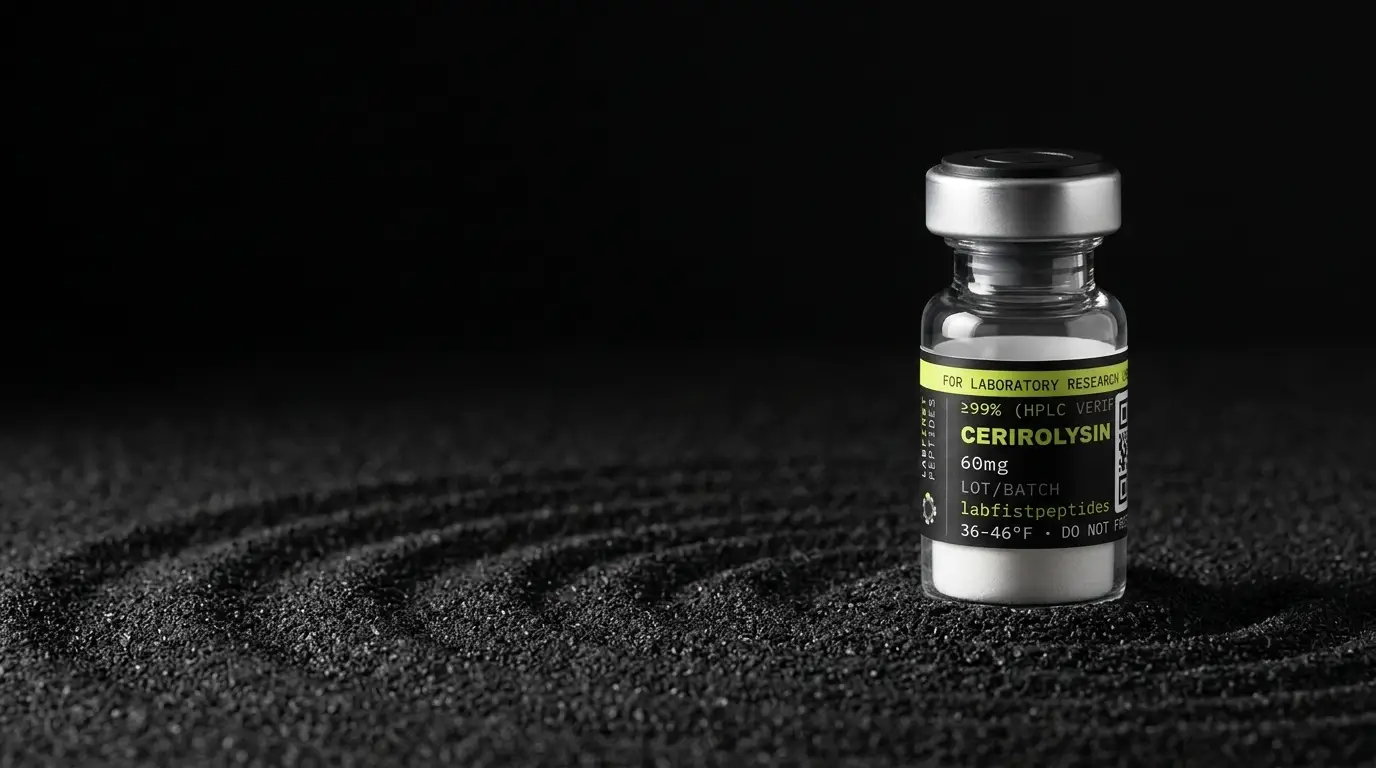
Cerebrolysin storage and stability depend on keeping the lyophilized vial sealed, dry, cold and dark. In plain terms, water is the main enemy. Cerebrolysin is a mixture of many peptides and free amino acids, so damage shows as slow drift across the whole fingerprint. Let a cold vial warm to room temperature before opening it.
- SKU CBL60 is a 60 mg lyophilized vial of a porcine-brain peptide preparation.
- Cerebrolysin has been described as roughly 75 percent free amino acids and 25 percent low-molecular-weight peptides.
- Deamidation mostly affects asparagine and glutamine; methionine is the residue most prone to oxidation.
- In Cerebrolysin, degradation shows as drift across the whole chromatographic fingerprint, not as one new peak.
- A cold Cerebrolysin vial should reach room temperature, still sealed, before it is opened.
What is in a Cerebrolysin vial?
A 60 mg vial comes out of the freezer on a humid afternoon. Within seconds the glass fogs. Open it right away and some of that water lands on the powder inside. Most storage advice for this product is about preventing that moment.
Our Cerebrolysin is SKU CBL60, a 60 mg lyophilized vial, listed on the Cerebrolysin product page. The material itself is not one peptide. The Cochrane review describes it as a mixture of low-molecular-weight peptides and amino acids derived from porcine brain, and a 2001 laboratory paper puts the split at roughly 75 percent free amino acids and 25 percent low-molecular-weight peptides, from a standardized enzymatic breakdown of porcine brain proteins.
Profiling work shows how varied the peptide part is. One LC-MS study found 638 unique peptides in a single sample, mostly fragments of tubulin, actin and myelin basic protein. That changes how stability should be thought about. A synthetic peptide degrades into a few named impurities. A mixture like this degrades a little at a time across many components at once.
- Moisture, mostly from condensation on cold vials
- Warmth, which speeds every route
- Repeated opening and temperature cycling
- Light and oxygen acting on susceptible residues
- Container surfaces and agitation
How peptides degrade, applied to a mixture
The chemistry is the same as for any peptide. A 2022 review in Pharmaceutics sets out the main routes. Deamidation mostly hits asparagine and glutamine, converting the side-chain amide to a carboxyl group. Methionine is the residue most prone to oxidation, with tryptophan, histidine, cysteine and tyrosine also involved. Light damages proteins by direct and indirect routes. Freezing and thawing, agitation, and contact with container surfaces can all drive adsorption and aggregation.
| Route | Main driver | Control |
|---|---|---|
| Hydrolysis and deamidation | Water, warmth, pH extremes | Keep the solid dry and sealed |
| Oxidation | Oxygen, light, trace metals | Dark storage, minimal headspace, limited opening |
| Aggregation and adsorption | Surfaces, agitation, temperature cycling | Keep the vial still, sealed and at one steady temperature |
With hundreds of peptide sequences present, every one of these routes has somewhere to act. No single residue dominates, as the methionine in Semax does. The result is a slow, spread-out change.
Why does a mixture drift rather than fail?
On a defined peptide, degradation shows as a new peak beside the main one, or a mass shifted by a known amount. On a mixture, each small change lands inside an already crowded trace. Peaks shrink a little, others grow, shoulders appear where none were before. No single result flags it.
That is why identity and stability are linked for this material. The same reversed-phase HPLC fingerprint used to confirm the lot, described in the Cerebrolysin identity guide, is the tool that shows drift. A sample stored badly can move away from its reference pattern and become harder to call a match, even though nothing obvious happened to it.
The free amino acids, the larger part of the mass by the 2001 description, are small and comparatively simple. The peptide fraction carries most of the vulnerability, because it has the backbone bonds and side chains the degradation routes act on. Protecting the sealed solid is what keeps both parts close to the lot's documented state.
Conditions by physical state
| State | Temperature | Light | Relative horizon |
|---|---|---|---|
| Sealed lyophilized vial, long term | Minus 20 °C or colder, with desiccant | Dark | Longest |
| Sealed vial, working stock | 2 to 8 °C, with desiccant | Dark | Shorter than frozen |
| Vial in transit | Ambient, insulated | Dark | Days |
These are general laboratory practice for dry peptide solids. They are not a shelf life for any particular lot. A lot's retest or expiry date comes from its own documentation, and the general guide to storing lyophilized peptides gives the reasoning behind each row.
A dry solid tolerates short warm spells well, which is why a vial shipped at ambient temperature is not a cause for alarm if it arrives sealed and dry.
The cold vial and the humid room
The most damaging handling error leaves no visible trace. A vial moved from minus 20 °C into a room at about 22 °C is far below the dew point of the air. Water condenses on every cold surface. Lift the stopper while the vial is still cold and moisture reaches the cake directly.
Once inside, that water stays. The vial goes back to the freezer, and on the next working day the same thing happens again. Deamidation and hydrolysis need water, and this routine keeps supplying it.
The fix is cheap. Let a sealed vial reach room temperature before opening it, still closed and still in its desiccated container. Open it briefly, take what the assay needs, and reseal it. Every extra opening is another chance for humid air to reach the powder.
How can you tell a stored sample has changed?
Visible signs are rare and late. A cake that has collapsed, turned sticky or changed color has almost certainly taken on water, and the material should not be trusted for anything that depends on composition.
Most change is invisible. The reliable check is to run the same fingerprint method used for identity and compare it with the lot's documented trace. Growing shoulders, shifted ratios between peak clusters, or new early-eluting peaks are the patterns to look for. None of them is conclusive alone, but together they say the sample has drifted from the state its certificate describes.
What should you check before a vial goes into storage?
Start with the closure. A seal that has lifted, a cracked vial or a stopper that no longer sits flush has given room air a way in, and with it the water that hydrolysis and deamidation need. Then look at the cake through the glass. A dry lyophilized solid holds its shape. One that has collapsed, turned sticky or changed color has already taken on water, and as the section above says, it should not be trusted for anything that depends on composition.
A vial that traveled at ambient temperature and arrives sealed and dry is fine, which is the transit row of the table. Move it into its storage container still closed. Opening it just to look spends one exposure to room air for no gain.
Next, the paperwork. Match the lot number on the vial to the certificate on the certificate page, and note any retest or expiry date the lot documentation gives, with the conditions printed beside it. That date describes a sealed vial held under those conditions and nothing else. If no date is given, write that down as well. For a mixture with hundreds of peptide components, keep a copy of the certificate's fingerprint trace with the record, since it is the reference any later comparison runs against.
Then pick the storage row and keep the vial in it. Long-term stock goes to minus 20 °C or colder with desiccant, in the dark. Working stock goes to 2 to 8 °C, also with desiccant and dark. A vial that moves between the two picks up temperature cycles, and the degradation table lists temperature cycling as a driver of aggregation. Keep it still in an opaque box labeled with the lot number and the date received, so the lot can be read without picking the vial up.
A vial that arrives with a damaged seal or a changed cake goes into the record as received that way, and it stays apart from good stock. If the material matters, run the fingerprint method on it before deciding, instead of judging from its appearance.
What the record should say
For each vial, the minimum record is the source lot, the date it arrived, where it is stored, each date it was opened, and who handled it. The Cerebrolysin certificate guide covers the composition rows worth copying into that record.
When a result looks wrong months later, that record is the first thing anyone checks. It runs from the vial back through the lot to the certificate, and it answers whether the material was what the protocol assumed. Our lot certificates are published on the certificate page; a product page shows results only once the certificate for that lot is published.
FOR LABORATORY AND IN-VITRO RESEARCH USE ONLY. NOT FOR HUMAN OR ANIMAL CONSUMPTION.
What is Cerebrolysin studied for?
Published research on Cerebrolysin investigates the areas below, which is a different question from what Cerebrolysin will do for anyone, a claim about a living system that nothing on this site is sold for.
What it is. A peptide preparation produced by enzymatic breakdown of purified porcine brain protein — a mixture of low-molecular-weight peptides and free amino acids, not a defined molecule.
What the research looks at. Acute ischaemic stroke, vascular dementia and traumatic brain injury, principally in trials conducted in Europe and Asia. Registered and used in a number of countries; not approved in the United States.
How it is thought to work. Not established. Proposed to act as a neurotrophic mixture, but the preparation has no single active constituent, no defined receptor and no characterized pharmacokinetics in the sense a single compound would have.
What is not established. Efficacy. The pooled randomised evidence in acute ischaemic stroke does not demonstrate benefit on functional outcome. For a mixture rather than a molecule, identity and purity testing also cannot mean what they mean for a defined compound.
The full record, including the certificate for the lot in stock, is on the Cerebrolysin product page.
Common questions
How should a sealed Cerebrolysin vial be stored?
Why does Cerebrolysin degrade differently from a single peptide?
Is a vial that arrived at room temperature still usable?
How can you tell a stored Cerebrolysin sample has changed?
More handling guides
Sources
- Cochrane Database of Systematic Reviews, Cerebrolysin for acute ischaemic stroke (2023). Used only for its description of the preparation as a mixture of low-molecular-weight peptides and amino acids derived from porcine brain.
- Journal of Neural Transmission (2001), Effects of Cerebrolysin on the outgrowth and protection of processes of cultured brain neurons. Used only for its description: a standardized enzymatic breakdown of porcine brain proteins, about 75% free amino acids and 25% low-molecular-weight peptides.
- Gevaert and colleagues, Drug Testing and Analysis (2015), peptide profiling of Internet-obtained Cerebrolysin by LC-MS. 638 unique peptides identified in one sample, mainly fragments of tubulin, actin and myelin basic protein.
- Pharmaceutics (2022), Instability Challenges and Stabilization Strategies of Pharmaceutical Proteins. Review of deamidation at Asn and Gln, methionine as the residue most prone to oxidation, light damage, freeze-thaw, container adsorption and aggregation.