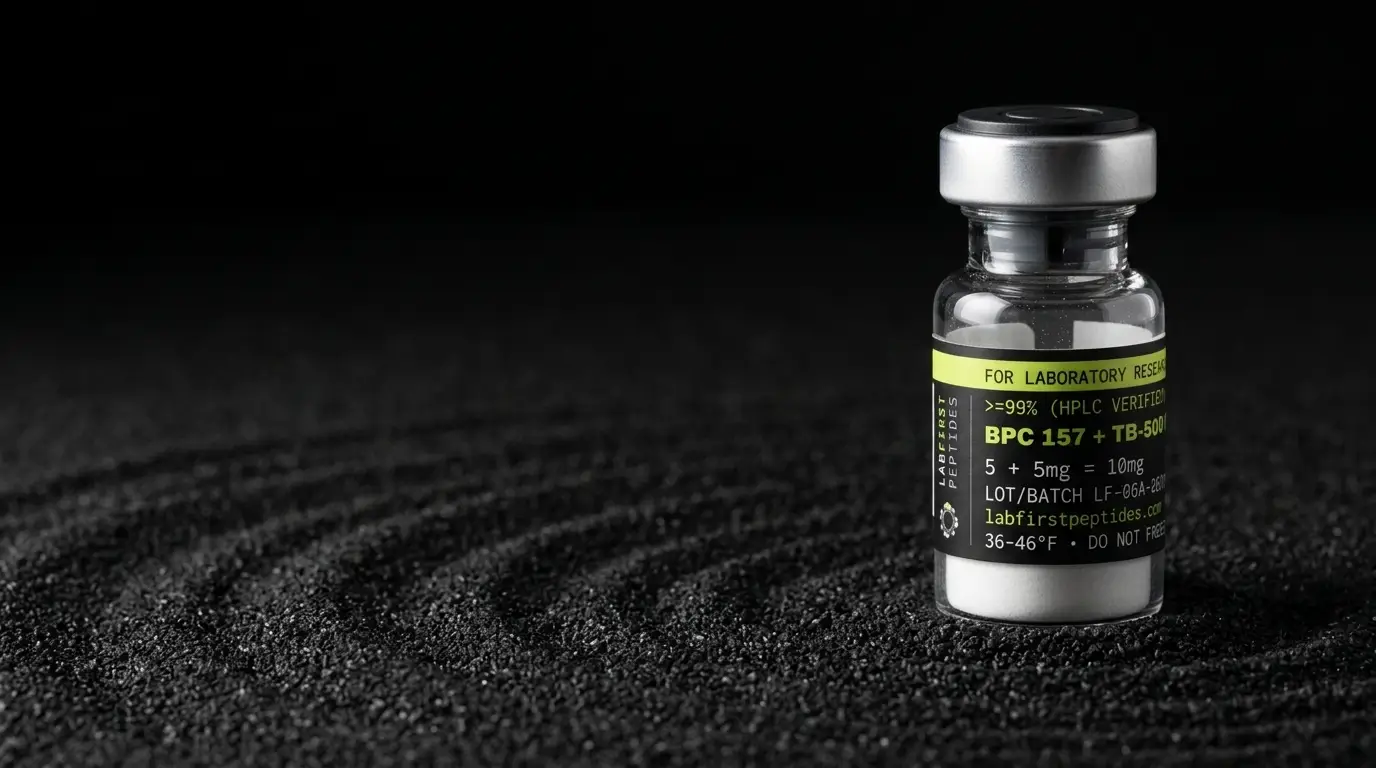
Identity for a BPC-157 + TB-500 blend is confirmed per peptide. Mass spectrometry should find a species near 1418.7 Da for BPC-157 and one near 888.5 Da for TB-500, ideally after HPLC has separated them. A matching mass confirms composition; it does not by itself confirm residue order.
- Identity for the blend is confirmed per peptide: one mass for BPC-157 and one for TB-500.
- The two monoisotopic masses, 1418.704 and 888.492 Da, are about 530 Da apart and easy to resolve.
- LC-MS pairs a retention time with a mass for each peptide, giving two pieces of evidence per component.
- A mass match confirms composition but not residue order; order needs MS/MS fragmentation data.
- TB-500 carries an N-terminal acetyl group that adds 42 to its mass.
What identity means here
In plain terms, the question is simple. You have a vial of white powder. The label says two peptides are inside. How would anyone prove that, without taking the label's word for it?
Identity testing answers it by measuring something that only the right molecule would give. For peptides that is mass, most often, because each molecule has a mass fixed by its formula. If the measured mass matches the one calculated from the sequence, the material is very likely what it says. If a second, unexpected mass shows up instead, something else is in the vial.
A blend doubles the work. Each peptide needs its own match, and the test has to show that the two signals come from two different molecules rather than one contaminated sample. Drug manufacturing rules require at least one identity test on each component of a product; that rule does not govern research material. It still sets a sensible bar, and for this vial it means two.
- Separate the two peptides by HPLC
- Read the mass of each peak
- BPC-157 near 1418.7 Da
- TB-500 near 888.5 Da
- Check for the uncapped TB-500 form
- Sequence order needs MS/MS
The two target masses
| Peptide | PubChem CID | Formula | Average mass | Monoisotopic mass |
|---|---|---|---|---|
| BPC-157 | 9941957 | C62H98N16O22 | 1419.5 | 1418.704 Da |
| TB-500 | 62707662 | C38H68N10O14 | 889.0 | 888.492 Da |
PubChem's systematic names give the sequences behind those numbers. BPC-157 is Gly-Glu-Pro-Pro-Pro-Gly-Lys-Pro-Ala-Asp-Asp-Ala-Gly-Leu-Val as a free acid. TB-500 is N-acetyl-Leu-Lys-Lys-Thr-Glu-Thr-Gln, also a free acid. The acetyl cap adds 42 to TB-500's mass, which is a small detail that makes a large difference if a certificate quietly reports the uncapped form.
The two targets are about 530 Da apart. On any modern mass spectrometer that is an easy separation, so there is no technical reason for a blend report to print a single mass.
How the measurement is usually made
The common approach is liquid chromatography coupled to mass spectrometry. The HPLC column separates the two peptides in time, and the mass spectrometer reads each peak as it comes off. That pairing gives two pieces of evidence at once: each peptide elutes at its own retention time, and each retention time carries its own mass.
With electrospray ionization, small peptides often appear with one or more protons attached, so the instrument reports mass-to-charge values rather than masses. BPC-157 carries a lysine and an N-terminal amine and may show a doubly charged ion; TB-500 has two lysines and may show several charge states. The report should say which ion it used and how it arrived at the neutral mass.
Direct infusion of the mixed sample without a column can also show both masses, since they are far apart. The cost is that you lose the retention time as a second check, and a small impurity peak can hide under a larger one.
What does a passing identity test look like?
ICH Q2(R2), the reference guideline for validating analytical procedures, says an identification test must show it can pick out the analyte from features of its structure. In practice that means a positive result comparable to a reference material when the analyte is present, a negative result when it is absent, and no false positive from structurally similar material.
Applied to this blend, a well-built identity check would show:
- a peak with the BPC-157 mass and a separate peak with the TB-500 mass;
- retention times consistent with a reference standard for each, if the lab has one;
- no dominant signal at a mass that suggests the wrong form, such as TB-500 without its acetyl group.
The blend certificate guide shows where these results sit on the report and what the rest of the page should carry.
What does a mass match not prove?
Mass confirms composition, meaning the right atoms in the right numbers. It does not confirm order. A peptide with the same residues in a different sequence has the same mass. For BPC-157, with three prolines in a row and two aspartates side by side, a scrambled synthesis product would weigh exactly the same.
Sequence-level confirmation needs fragmentation data, MS/MS, where the peptide is broken along its backbone and the fragment masses are read in order. Most research certificates do not include it. That alone is fine. Still, a report that claims "sequence confirmed" should show the fragment data that backs the claim.
TB-500 has its own name trap. The same label is sometimes used for full-length thymosin beta-4, which UniProt lists as a 44-residue precursor whose initiator methionine is removed and whose next serine is acetylated. That protein is several times heavier than the seven-residue fragment, so a mass result settles which one you have. The TB-500 identity guide covers it in detail.
Why is purity a separate question?
A clean chromatogram can still show the wrong molecule. HPLC purity reports how much of the material in a peak is one thing; it does not say what that thing is. That is why identity and purity are separate lines on a certificate, and why a high purity figure with no mass result has not answered the identity question at all.
In a blend the gap is wider. Two tidy peaks prove there are two main species, and nothing more. Only the mass reading attached to each peak says those species are BPC-157 and TB-500. The general version of this argument is in the guide to HPLC purity versus peptide identity.
Common wrong answers and what they mean
| Observed | Likely meaning | What to ask |
|---|---|---|
| About 846 Da where 888.5 is expected | TB-500 without its N-terminal acetyl group | Which form was synthesized and tested |
| About 887.5 Da | TB-500 with an amidated rather than free-acid C-terminus | Which terminal form the specification names |
| Only one of the two masses | One component missing or below detection | Whether both peptides were looked for |
| Several thousand daltons for TB-500 | Full-length thymosin beta-4 in place of the fragment | Which molecule the label intends |
| Extra masses a residue lighter or heavier | Deletion or insertion side products from synthesis | Their share by HPLC |
The arithmetic behind the first two rows is simple. Removing the acetyl group takes away 42 mass units. Changing a free acid to an amide swaps an oxygen for a nitrogen and hydrogen, a change of about one unit. Small numbers, but each one points to a different molecule.
Checking a certificate's arithmetic yourself
You do not need an instrument to test a certificate's identity section. Start from the sequence it prints. Look up the formula in PubChem or add up residue masses, add water for the free acid, and add 42 for the acetyl cap on TB-500. Compare the result with the theoretical mass on the report.
If the report's theoretical mass differs from yours by more than rounding, it was calculated for a different form of the peptide. If the observed mass is close to the report's theoretical mass but not to yours, the lab confirmed a molecule, just not the one you think you bought. Both are worth raising with the seller before the vial goes anywhere near an assay.
Questions to put to a seller
If a blend certificate leaves identity unclear, four questions usually settle it. Which sequence and terminal form was each peptide tested against? Which instrument and ionization method gave the masses? Was the blend lot itself tested, or the two peptides before they were combined? And can the lab confirm the report number against its own records?
A seller who can answer all four in writing has a real report behind the listing. One who answers with a new percentage, or a different PDF, has not answered the question. Keep the replies with the lot record, since they become part of the evidence for what the vial holds.
Our certificates for this blend
Each lot of the BPC-157 + TB-500 blend is sent to an independent laboratory for identity, purity and net content. The product page shows results only once the certificate for that lot is published at the certificate index; until then it says pending and states no result. When a certificate is published, check it against the two masses above. For how the vial should be kept so those results still describe it later, see the blend storage guide.
FOR LABORATORY AND IN-VITRO RESEARCH USE ONLY. NOT FOR HUMAN OR ANIMAL CONSUMPTION.
What is BPC 157 studied for?
Published research on BPC 157 investigates the areas below, which is a different question from what BPC 157 will do for anyone, a claim about a living system that nothing on this site is sold for.
What it is. A man-made fifteen-amino-acid peptide, based on a protein found in stomach juice.
What the research looks at. It appears in animal and cell-culture research on tissue and blood-vessel biology. Almost everything published is animal or cell work.
How it is thought to work. Nobody has settled how it works. Cell and animal studies report effects on blood-vessel growth signals and on several growth-factor pathways, but no single receptor has been pinned down as its target and the studies do not agree on one model.
What is not established. No FDA-approved product contains BPC 157, and no USP or NF standard defines what an acceptable batch is. Human evidence is close to nonexistent. Any figure printed on a research vial is the supplier’s number, not an official one.
The full record, including the certificate for the lot in stock, is on the BPC 157 product page.
Common questions
What masses confirm BPC-157 and TB-500 in the blend?
Why run HPLC before the mass spectrometer?
Does a correct mass prove the sequence is correct?
How would I know if TB-500 in the vial is the whole thymosin beta-4 protein?
Published certificates for BPC 157 + TB-500 Blend
Every figure below is read from a report the laboratory issued for that lot; each page carries the PDF and the lab's own verification link.
More documentation guides
Sources
- PubChem PUG REST, formula and masses for CID 9941957 (BPC-157) and CID 62707662 (TB-500). C62H98N16O22, 1419.5 g/mol, monoisotopic 1418.704 Da for BPC-157; C38H68N10O14, 889.0 g/mol, monoisotopic 888.492 Da for TB-500.
- PubChem PUG REST, IUPAC names for CID 9941957 and CID 62707662. The systematic names encode the residue order of each peptide, including the N-acetyl leucine and C-terminal glutamine free acid of TB-500.
- UniProt P62328, thymosin beta-4 (human). Full parent sequence, removal of the initiator methionine and N-acetylation of the following serine; the LKKTETQ stretch sits inside it.
- ICH Q2(R2), Validation of Analytical Procedures (2023). Section 3.1.2 on identification tests: a positive result against a reference, negative results for samples without the analyte, and a check against closely related materials.
- 21 CFR 211.84, Testing and approval or rejection of components. At least one identity test on each component, and testing against written specifications for purity, strength and quality.