Cagrilintide identity testing matches a measured molecular mass to the mass calculated from the stated sequence. It then confirms that the mass belongs to the main chromatographic peak. Purity tells you how much of one thing is present. Only mass and retention evidence read together say what that thing is.
- Identity requires a measured mass, the sequence it should match, and chromatographic evidence that the mass belongs to the main peak; a purity percentage supplies none of these.
- ICH Q6B treats identity as a separate test category from purity, expected to rest on a unique aspect of molecular structure.
- Cagrilintide is an acylated amylin analogue retaining the Cys2 to Cys7 disulfide and the C-terminal amide, with a C20 fatty diacid on a lysine side chain.
- A parent mass cannot distinguish Leu from Ile, cannot detect residue transpositions, and cannot localise the acyl chain; MS/MS fragmentation is required for that.
- The amide-to-acid conversion and side-chain deamidation both shift mass by about 0.98 Da, so a mass 1 Da high is ambiguous evidence.
- Peptide content by amino acid analysis, not HPLC purity, tells you how much of the powder mass is actually peptide.
Purity and identity answer different questions
Think of it like a name tag and a seat. The mass is the name tag, and the main peak is the seat. Identity is proven when the right name tag sits in the right seat.
A certificate that reads Purity: 98.7% (HPLC) and nothing else has told you that one component dominates the chromatogram. It has not told you which component. Area percent is a relative measure: it compares the main peak against everything else the detector saw at the chosen wavelength, in the run as configured. A vial of the wrong 3.8 kDa peptide, competently synthesised and properly purified, will produce exactly that number.
ICH Q6B draws the distinction cleanly in the context of biological products. An identity test is expected to be highly specific and to rest on some unique aspect of the molecular structure. Purity and impurity tests are a separate category with separate acceptance criteria. The same logic applies to a research-grade powder, and the reason it gets collapsed on vendor certificates is that identity evidence is more work to generate and harder to reduce to a single reassuring figure.
For cagrilintide the practical consequence is narrow and specific. You need a measured molecular mass, a sequence to compute the expected mass from, and a chromatographic run that shows the mass and the main peak are the same species. Take away any one of those three and the identity claim collapses into an assertion.
- Purity percentage alone — describes proportion, names nothing
- A single reported m/z — one ion, no deconvolution
- Deconvoluted mass across charge states — consistent with a sequence
- LC-MS in one run — the mass sits under the main peak
- MS/MS fragment coverage — sequence order and acyl position
What the molecule is, and which features complicate the measurement
Cagrilintide is a long-acting acylated analogue of human amylin, developed by Novo Nordisk and studied in combination with semaglutide under the name CagriSema. Human amylin itself is a 37-residue peptide hormone with an intramolecular disulfide bond between Cys2 and Cys7 and an amidated C-terminus. Published descriptions of cagrilintide retain both of those structural features and add a C20 fatty diacid side chain attached through a linker to a lysine side chain.
Residue counts and substitution positions circulating on supplier pages vary, and I am not going to publish a formula or an average mass here that I cannot verify against a primary record. That is the honest position and it is also the operationally useful one: the expected mass is a property of the sequence the supplier claims to have made, so the sequence has to come from the supplier and be reconciled against a compound record such as the PubChem entry before any mass comparison means anything. A certificate that reports an observed mass without stating the sequence it should match is reporting a number with no reference point.
Three structural features change how the analysis behaves:
- The disulfide bridge. Fully reduced material differs from the correctly cyclised molecule by roughly 2.02 Da, two hydrogens. That is a small shift on a 3.8 kDa molecule and it is invisible to any instrument reporting mass to the nearest unit.
- The C-terminal amide. The free acid form differs from the amide by 0.984 Da. Deamidation of an asparagine or glutamine side chain produces the same shift, so a mass 1 Da high is ambiguous evidence, and the two possibilities are distinguished by fragmentation or by chromatography, not by the parent mass.
- The lipid chain. A fatty diacid conjugate is amphiphilic, retains strongly on C18, and adsorbs to surfaces. Retention behavior is informative for that reason, and low-concentration losses during sample handling are real.
Mass spectrometry: what the spectrum settles
Electrospray on a peptide of this size gives a family of multiply charged ions rather than a single peak. A 4+ ion and a 3+ ion of the same molecule appear at different m/z values, and the mass is recovered from each by the same arithmetic:
M = (m/z × z) − (z × 1.00728)
Worked with a hypothetical 4+ ion at m/z 960.55:
M = (960.55 × 4) − (4 × 1.00728) = 3842.20 − 4.03 = 3838.17 Da
Two things make that calculation trustworthy. Charge states must agree: the 3+, 4+ and 5+ ions should deconvolute to the same mass within the instrument tolerance, and a disagreement usually means an adduct or a co-eluting species is being read as the parent. And the reported mass must be labeled as monoisotopic or average, because on a 3.8 kDa peptide those differ by around 2 Da. A certificate stating Observed: 3838.2 against a calculated average mass is comparing two different quantities and may be off by more than the tolerance it claims to have met.
What a parent mass cannot do is resolve isomers or several common substitutions. Leucine and isoleucine are identical in mass. Lysine and glutamine differ by 0.036 Da, below the resolving power of most routine LC-MS configurations at this mass. A transposition of two residues leaves the mass untouched entirely. Any of those errors passes a parent-mass check and is caught only by fragmentation.
MS/MS is the step that turns a mass match into a structural argument. Fragmenting the parent and reading b and y ion series against the expected sequence localises the substitutions, and for cagrilintide it also places the acyl chain on the correct lysine rather than merely confirming that a C20 diacid is present somewhere in the molecule. Suppliers rarely provide MS/MS data unprompted. Some will supply it on request, and whether they can is itself a reasonable test of what analytical capability sits behind the certificate.
Chromatography read alongside the spectrum
A standalone mass spectrum of dissolved powder tells you that a molecule with the right mass is in the vial. It does not tell you that molecule is the major component. That link is made by running the LC-MS as one experiment and confirming that the correct deconvoluted mass sits under the peak carrying the purity area percent, at the same retention time.
For a certificate to be readable at all, the chromatographic method has to be stated. USP General Chapter <621> sets out what a chromatographic procedure needs to specify and what system suitability is meant to demonstrate; the same elements make a research certificate interpretable. Column chemistry and dimensions, mobile phase composition and the gradient, flow rate, column temperature, and detection wavelength. A purity figure quoted without a gradient is not reproducible, and gradient choice is exactly where a lipidated peptide and its related impurities can be made to look better than they are.
| Evidence | What it establishes | What it cannot rule out |
|---|---|---|
| Deconvoluted ESI mass | Molecular mass consistent with a stated sequence | Residue transpositions, Leu/Ile swaps, near-isobaric substitutions |
| MS/MS fragment series | Sequence order and the position of the acyl modification | Little, when coverage is complete; gaps in coverage matter |
| RP-HPLC retention time | Consistency with a reference under a defined method | Any co-eluting species; means nothing across labs without the method |
| Co-injection with a reference standard | That sample and reference are chromatographically indistinguishable | Only as good as the reference standard provenance |
| Amino acid analysis | Residue composition and net peptide content by mass | Sequence order; destroys some residues during hydrolysis |
| Disulfide mapping after reduction and alkylation | That Cys2 and Cys7 are paired as expected | Nothing much, but it is almost never on a research certificate |
Retention time alone travels badly. A figure of 12.4 minutes is meaningful in the laboratory that generated it, on that column, and is close to useless as a cross-laboratory identity claim. Relative retention against a known marker survives the trip better.
Reading the certificate
Certificates for research peptides range from full analytical packages to a single page of round numbers. The check below is what I would run before a lot goes into a protocol, in the order that fails fastest.
| Field | What it should say | Failure signal |
|---|---|---|
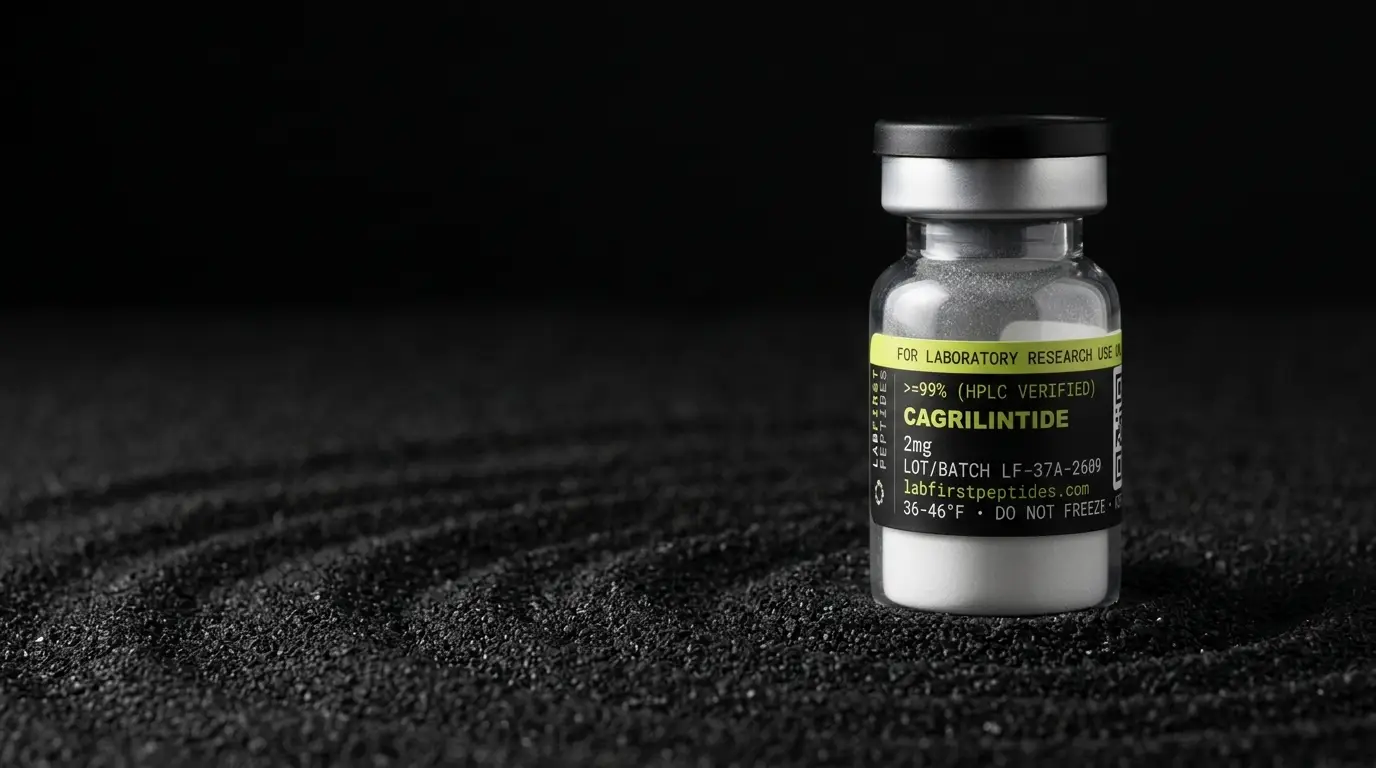
| Lot identifier | A specific batch code matching the vial label | No lot, or a lot that does not match the label |
| Sequence | One-letter or three-letter sequence with modifications noted | Absent, so the calculated mass cannot be checked |
| Calculated mass | Stated as monoisotopic or average | Unlabelled, or inconsistent with the sequence given |
| Observed mass | Deconvoluted, with the charge states used | A single m/z reported as if it were the mass |
| MS trace | Attached spectrum, not a transcribed number | Numbers only; no raw data available on request |
| HPLC method | Column, gradient, flow, temperature, wavelength | A purity percentage with no method |
| HPLC trace | Full chromatogram with the run time visible | Cropped image, or axis labels removed |
| Peptide content | Net peptide by AAA or nitrogen, as a percentage of powder mass | Omitted, leaving salt and water content unstated |
| Counterion | TFA or acetate salt form identified | Not stated at all |
| Water content | Karl Fischer or loss on drying | Omitted for a hygroscopic lyophilizate |
| Test dates and analyst | Date of analysis, laboratory or analyst reference | Undated, or dated after the ship date |
Peptide content deserves more attention than it gets. A powder can be 98% pure by HPLC and still be a substantial fraction TFA salt and residual water by weight, and the two figures are not in conflict because they measure different things. When content is unstated, the mass of actual peptide in the vial is unknown, which affects any comparison of price between suppliers. Our cost per mg tool assumes the stated mass is peptide; if the certificate is silent on content, that assumption is doing unexamined work.
One more failure mode: the reused certificate. A document that carries no lot number, or the same trace images across several products, is a template. Some suppliers issue a generic method summary alongside a lot-specific data package, which is fine. A generic document standing in for lot-specific data is not. What we publish for our own material is set out in the quality standard.
Third-party testing and what it does not cover
An independent laboratory report on the specific lot in hand is stronger evidence than a manufacturer certificate, for the obvious reason. Two limits apply. The report covers the sample submitted, and if the submitter chose the sample, the chain from vial to instrument is only as good as their documentation of it. And identity plus purity is a narrow scope. Sterility, bacterial endotoxin, elemental impurities and residual solvents are separate tests, each with its own compendial method, and none of them is implied by an HPLC purity figure.
This is where the difference between research material and a licensed medicine becomes concrete rather than legalistic. A pharmaceutical release package covers identity, assay, impurities, sterility, endotoxin, container closure integrity and stability, under a quality system with a regulator entitled to inspect it. A research certificate covers identity and purity of a powder. Both can be accurate documents. They are claims of very different scope, and reading one as if it were the other is the single most common error in this supply chain.
Storage sits alongside identity in the same sense: a correctly identified lot degrades on the same schedule as any other lipidated peptide once moisture reaches it, and the general handling logic in the storage and stability guide applies directly to an acylated amylin analogue.
Regulatory position
Cagrilintide is an investigational acylated amylin analogue. It has been evaluated as a single agent and, more prominently, in fixed combination with semaglutide under the development name CagriSema, in the REDEFINE clinical program. Regulatory submissions relating to that combination have been made in major markets.
Approval status changes, and any figure I quote here for the current position could be stale by the time it is read. Confirm the standing of any cagrilintide-containing product against FDA and EMA records directly, on the date you need the answer. What does not change is that research-grade powder supplied against a certificate of analysis is not a licensed medicine and has never been a lawful route to human use, whatever the approval status of a related product.
Status statement written 26 August 2026; verify current approval position before relying on it.
FOR LABORATORY AND IN-VITRO RESEARCH USE ONLY. NOT FOR HUMAN OR ANIMAL CONSUMPTION. NOT FOR PERSONAL, MEDICAL, DIAGNOSTIC, THERAPEUTIC, OR RECREATIONAL USE.
Common questions
Can a purity percentage ever confirm identity?
Is a single reported mass value enough?
Why does the disulfide bond matter for identity testing?
What does peptide content add that purity does not?
How should a retention time on a certificate be read?
Does a third-party report make the material equivalent to a medicine?
More documentation guides
Sources
- ICH Q6B, Specifications: Test Procedures and Acceptance Criteria for Biotechnological/Biological Products. Establishes that identity testing should be highly specific and based on unique aspects of molecular structure, and treats identity as distinct from purity and impurity testing.
- United States Pharmacopeia, General Chapter <621> Chromatography. Defines what a chromatographic procedure must specify and what system suitability demonstrates; supports the position that a purity figure without a stated method is not interpretable.
- PubChem compound record for cagrilintide, National Library of Medicine. Public source for the reported molecular formula and computed masses, against which a supplier-stated sequence and calculated mass should be reconciled.
- ICH Q2(R2), Validation of Analytical Procedures. Defines specificity for an analytical procedure and the evidence needed to show a method measures the intended analyte in the presence of related substances.