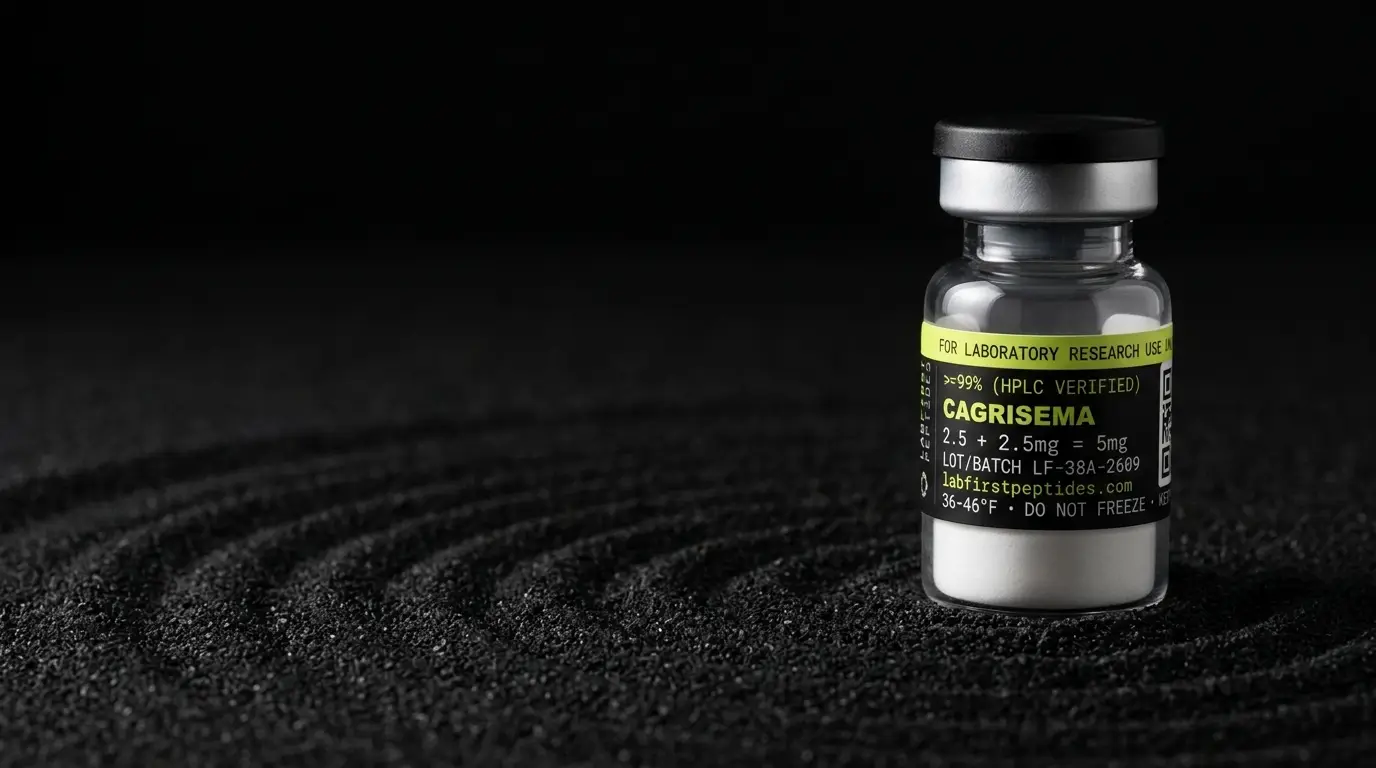
A CagriSema certificate of analysis certifies two separate peptides, so read it as two documents stapled together. Check that the lot number matches the vial, that identity rests on mass spectrometry, that purity states a method and a wavelength, and that the stated mass ratio was measured rather than assumed.
- CagriSema is a fixed-ratio combination of two peptides, cagrilintide and semaglutide, so identity and purity have to be reported per component.
- Mass spectrometry confirms molecular mass but is blind to D-amino acid substitution, sequence isomerism and misplaced disulfide bonds.
- RP-HPLC area percent excludes salts, water and non-eluting aggregates, so it is not a statement about how much of the vial is peptide.
- Equal chromatographic peak areas do not establish an equal mass ratio without quantitative assay against reference standards.
- The lot number on the certificate must appear on the vial, or the document describes different material.
- Certificates are verified with the issuing laboratory and by in-house identity testing, not with the seller.
What this guide covers
Picture a receipt for two items in one bag. Each item needs its own line, its own check and its own amount, or the receipt doesn't cover what's inside. A CagriSema certificate has the same job. This guide goes through it from the header block down: identity for each peptide, what the purity number leaves out, net content, the ratio question, and how to confirm the report with the lab that issued it.
- Lot number on the document against the lot number on the vial
- Analysis date, separate from the issue or print date
- Identity, per component, with observed and calculated mass
- Purity, with method, wavelength and the convention for two peaks
- Net content: powder mass, water, counterion, net peptide
- Ratio: quantitative assay against standards, or unverified
- Issuing laboratory: report number confirmed independently
Why is a CagriSema certificate really two certificates?
CagriSema is not a molecule. It is a fixed-ratio combination of two distinct lipidated peptides: cagrilintide, a long-acting amylin analogue, and semaglutide, a GLP-1 receptor agonist. Any certificate of analysis that treats the contents of the vial as a single substance with a single purity figure has already told you something about the laboratory that produced it.
The consequence for document review is straightforward. Identity has to be established twice, once per component. Purity has to be reported in a way that makes clear whether the number applies to each peak separately or to the sum of both. And the ratio between the two peptides is a third question that neither identity nor purity answers, because a chromatogram showing two clean peaks says nothing about their relative mass without calibration against reference standards.
Reviewers who come from small-molecule work sometimes expect a single assay value against a monograph. There is no compendial monograph for this combination. What arrives instead is a supplier-generated or contract-lab-generated report whose scope was chosen by whoever commissioned it, and the first job of the reader is to work out what was left out.
What should the header block show?
Before any analytical result matters, the document has to be tied to the physical vial on the bench. Four fields do that work, and all four are commonly wrong or missing on low-quality paperwork.
| Field | What it should say | Failure mode |
|---|---|---|
| Lot or batch number | An identifier that appears character-for-character on the vial label or foil seal | A generic product code shared across every shipment |
| Product description | Both component names, the stated ratio, and the physical form (lyophilized solid) | Trade-style naming only, with no component chemistry |
| Net content | Stated mass per vial and whether that figure is gross powder or net peptide | A bare number with no basis given |
| Date of analysis | The date testing was performed, distinct from any issue or print date | One undated signature line, or an issue date years after manufacture |
| Issuing laboratory | Legal entity name, physical address, report number, accreditation status | A logo and nothing else |
The lot match is the check people skip because it feels clerical. It is the only field that connects the analytical claims to the material you are holding. A certificate whose lot number does not appear on the vial documents a different batch, and no amount of good chromatography further down the page repairs that.
Test date deserves the same attention. A purity figure generated eighteen months ago describes the material as it was, and for a lipidated peptide held under uncertain conditions in the interim, that is a historical statement. Our own quality standard page sets out what a current-lot document has to carry; the general principle is that the date on the analysis and the date on the shipment should be within a range you can defend.
What does mass spectrometry settle, and what does it leave open?
Identity for both components should rest on mass spectrometry, normally electrospray LC-MS, reported as an observed mass compared against a calculated value. A good certificate gives the deconvoluted average or monoisotopic mass, the calculated expectation, and the deviation. A weak one gives the phrase conforms to structure and moves on.
Verify the calculated masses yourself rather than accepting the numbers printed on the page. Semaglutide is a 31-residue analogue carrying α-aminoisobutyric acid at position 8 and a C18 fatty diacid attached through a short AEEA linker chain to the lysine at position 26; its molecular formula and average mass are recorded in public chemical databases and are easy to check. Cagrilintide is an amylin analogue with an intramolecular disulfide near the N-terminus, a C-terminal amide, and its own fatty diacid conjugate. Where you cannot confirm an expected mass from a primary reference, treat the certificate's calculated column as unverified rather than as fact.
A matching mass is necessary and not sufficient. Mass is blind to stereochemistry, so a D-amino acid substitution at any position returns the same number. It is blind to sequence isomers and to positional isomers of the acylation. For cagrilintide it is blind to disulfide scrambling in a molecule that has been oxidized at the wrong cysteines, because an incorrect bridge weighs exactly what a correct one weighs. Retention time against a qualified reference standard is what separates those cases, and that is why the chromatogram matters as much as the mass spectrum.
What does the purity number leave out?
The purity figure on a peptide certificate is almost always area percent from reverse-phase HPLC with UV detection. That method has to be described for the number to mean anything. At minimum the certificate should state the column chemistry and dimensions, the mobile phase system, the gradient, the detection wavelength, and the run time.
Detection wavelength changes the answer. Peptide bonds absorb around 214 to 220 nm, so that is where a general impurity profile is run. Detection at 280 nm sees only aromatic residues and will systematically under-report impurities that lack them. A certificate reporting 99.2% with no wavelength given is reporting a preference, not a measurement.
What area percent does not cover is worth listing plainly. It excludes anything that does not absorb at the chosen wavelength, which means inorganic salts and most counterions are invisible. It excludes species that do not elute within the gradient, including high-molecular-weight aggregates that need size-exclusion chromatography to see. It excludes water. And in a two-component blend it is arithmetically ambiguous unless the report states its convention.
| Method | Answers | Does not answer |
|---|---|---|
| LC-MS / ESI-MS | Is each component the expected mass? | Stereochemistry, disulfide placement, sequence isomerism |
| RP-HPLC, UV 214 nm | What fraction of eluting UV-absorbing material is the target peak? | Salts, water, non-eluting aggregates, mass ratio |
| Size-exclusion HPLC | Dimer and higher aggregate content | Small related impurities |
| Karl Fischer or TGA | Water content of the lyophilizate | Peptide identity or related substances |
| Elemental or ion chromatography | Counterion identity and level | Anything about the peptide backbone |
| Quantitative HPLC vs. standards | Mass of each component, and therefore the ratio | Nothing else, but it is the only method that gives the ratio |
What is the difference between net content and peptide content?
A vial labeled 10 mg may contain 10 mg of powder rather than 10 mg of peptide. Lyophilized material carries residual water, and peptides purified by preparative HPLC leave the process as salts of whatever acid was in the mobile phase, usually trifluoroacetate unless a deliberate exchange to acetate was performed. Both contribute weight.
Peptide content of 80 to 90% by mass is unremarkable for material that has not been formulated to a target. It is also not a defect, provided the certificate says so. What is a defect is silence: a net content line with no accompanying water figure and no counterion statement leaves the reader unable to calculate anything downstream with confidence. If the protocol depends on mass, that gap propagates into every concentration derived from it.
Where the certificate does give peptide content, use that figure and not the label figure when comparing lots or prices.
Why is the ratio hard to prove in a two-peptide blend?
This is the field most often absent. A blend certificate that reports two peaks with area percentages of, say, 49.6 and 49.9 invites the reading that the material is a 1:1 mixture. That reading is not supported by the data. Area response depends on the molar extinction of each species at the detection wavelength and on molecular weight, and two different lipidated peptides do not share a response factor. Equal areas are not equal masses.
Establishing the ratio requires quantitative assay of each component against its own qualified reference standard, with the reference standard's own provenance documented. That is a more expensive experiment than an area-percent run, and its absence from a certificate usually means it was not done. A supplier who states a ratio without that work has stated a formulation intent.
For a laboratory whose protocol depends on the relative amounts of the two peptides, the practical position is that an unverified ratio is an unverified variable. Some groups resolve this by sourcing the two components separately and combining them in-house against gravimetric records, which moves the uncertainty somewhere they control. That decision has cost implications, and the cost per mg tool makes the comparison on a like-for-like mass basis.
How to verify a CagriSema certificate: step by step
Every element of a certificate can be typed into a template. Fonts are free, chromatograms can be redrawn, and a PDF with a scanned signature carries no evidential weight on its own. Verification therefore has to happen outside the document. The routes below run in ascending order of effort.
- Contact the issuing laboratory directly using contact details you obtained independently, quote the report number, and ask them to confirm they issued it. Laboratories operating to ISO/IEC 17025 keep records that make this a short conversation, and a report number that returns nothing is an answer in itself.
- Check the internal consistency of the supplied traces: the injection timestamp, the sample identifier in the chromatogram header, the axis scales, and whether the reported peak areas actually sum as claimed. Mismatches between the narrative table and the raw trace are common in fabricated paperwork.
- Run identity in-house on the received lot. That's the definitive route.
- Record the result against the lot number so the next person can see it was done.
In-house confirmation does not require a full validated method. An LC-MS injection that returns two components at the expected masses, with retention times consistent with a previously characterized lot, settles the question of gross substitution, which is the failure mode that matters most. Where a certificate names an accreditation body, that claim is checkable against the body's public register, and it is worth checking, because accreditation scopes are specific and a laboratory accredited for water testing is not thereby accredited for peptide assay.
Red flags in the document itself
| Observation | Why it matters |
|---|---|
| Purity stated as “>99%” with no method, column or wavelength | The figure is unattributable to any measurement |
| One purity number for a two-component product | The convention is undeclared, so the number cannot be interpreted |
| No mass spectrum or chromatogram attached | Only conclusions were supplied; the data were withheld |
| Lot number absent from the vial | The document cannot be tied to the material |
| Analysis date missing, or identical across unrelated lots | Suggests a template rather than a test |
| Ratio asserted without quantitative assay against standards | Formulation intent presented as a result |
| Sterility or endotoxin claims on a research powder | Outside the scope of a research supply chain, and unverifiable as written |
| Language implying suitability for human use | A regulatory problem for the supplier and a reliability signal for you |
None of these is proof of bad material. Each is proof of bad documentation, which for a laboratory amounts to the same operational conclusion: the lot cannot be qualified from the paperwork alone.
What is the regulatory position of CagriSema?
Semaglutide is the active ingredient in several FDA-approved prescription medicines, manufactured under pharmaceutical quality systems that cover sterility, endotoxin, formulation and lot release. Cagrilintide is an amylin analogue that has been studied in clinical development and is not an approved drug substance in its own right. The fixed-ratio combination marketed under the CagriSema name has been the subject of phase 3 clinical reporting by its developer; approval status changes and should be checked against the relevant regulator's own database rather than against a supplier page.
Research-grade powder supplied against a certificate of analysis is a different category of material from an approved medicine, and a certificate covering identity and purity is a narrower claim than a pharmaceutical release specification. It has never been a lawful route to human use.
Status reviewed August 26, 2026; verify current approval status directly with the regulator.
FOR LABORATORY AND IN-VITRO RESEARCH USE ONLY. NOT FOR HUMAN OR ANIMAL CONSUMPTION. NOT FOR PERSONAL, MEDICAL, DIAGNOSTIC, THERAPEUTIC, OR RECREATIONAL USE.
Bottom line
A CagriSema vial holds two peptides, so its certificate has to prove two identities, state how its purity number was calculated, and say whether anyone measured the ratio. Equal peak areas don't mean equal masses. Tie the document to the vial by lot number, read the method lines, and confirm the report with the issuing laboratory before the lot goes into use.
Common questions
Why does a CagriSema certificate need two identity results?
Do equal peak areas mean the two peptides are present in equal amounts?
What does a purity figure of 99% actually exclude?
Can a certificate be verified without running the sample?
Is the label mass the same as the peptide mass?
How old can a test date be before the certificate stops being useful?
More documentation guides
Sources
- USP General Chapter <621>, Chromatography. Establishes system suitability, adjustment limits and reporting expectations for chromatographic procedures; supports the requirement that a purity figure be accompanied by column, mobile phase, gradient and detection conditions.
- ICH Q6B, Specifications for Biotechnological and Biological Products. Sets out how identity, purity and impurity specifications are constructed and why identity tests must be specific to the substance; supports the separation of identity, purity and content as distinct questions.
- ISO/IEC 17025:2017, General requirements for the competence of testing and calibration laboratories. Defines required test report content and record retention for accredited laboratories; supports the practice of verifying a report number directly with the issuing laboratory and checking accreditation scope.
- PubChem compound record for semaglutide. Public reference for molecular formula and calculated mass of the semaglutide component; supports independent checking of the calculated-mass column on a certificate rather than accepting the supplier's figure.