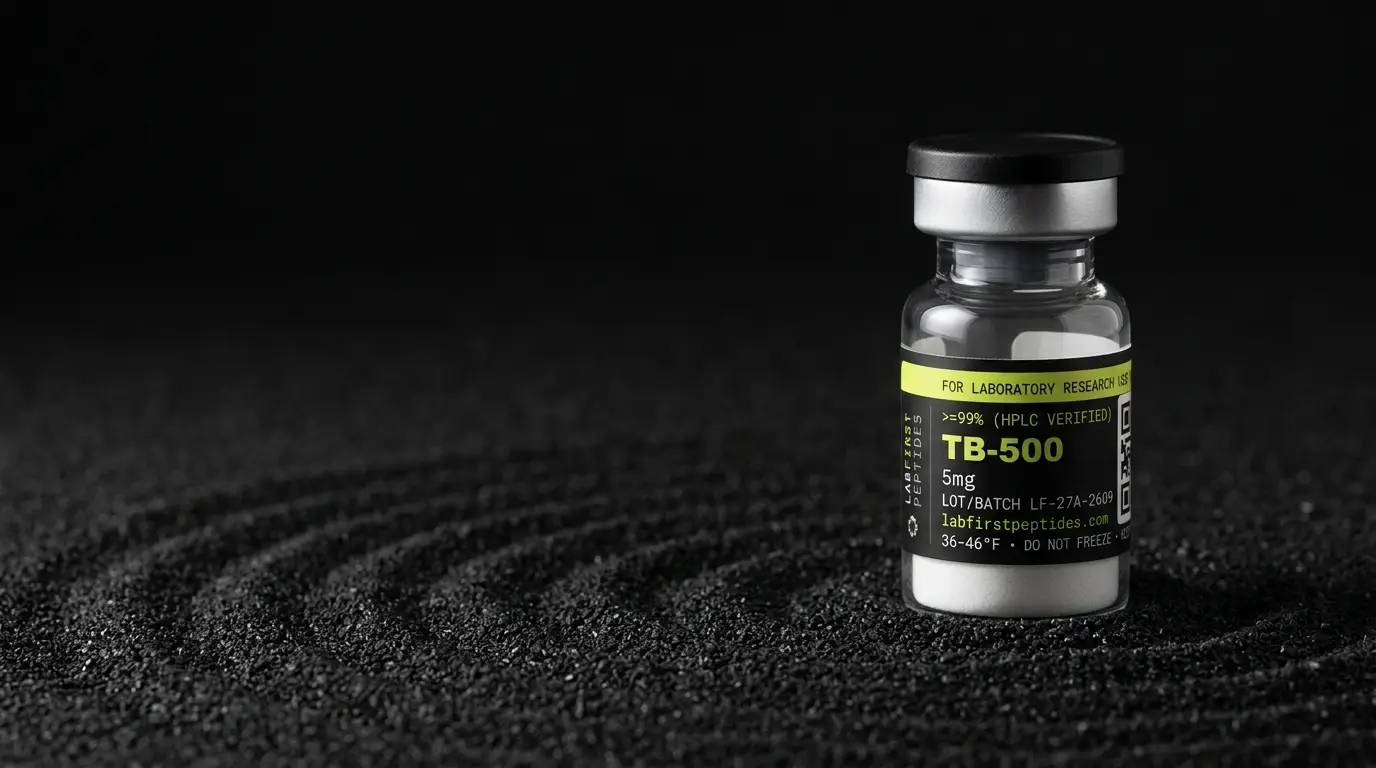
TB-500 identity testing relies on mass spectrometry. The deconvoluted observed mass is compared with the theoretical mass of the claimed sequence and read alongside the RP-HPLC chromatogram. A purity percentage alone cannot confirm identity. It only states how much of the sample is one substance, never which substance it is.
- TB-500 is a catalog name with no compendial definition; both full-length thymosin β4 at about 4,963 Da and its 889 Da actin-binding fragment circulate under it.
- A purity percentage is an area ratio from a chromatogram and carries no information about which molecule produced the main peak.
- Identity rests on an intact-mass measurement, ESI-MS or MALDI-TOF, with the observed mass compared against the theoretical mass of the claimed sequence.
- An intact-mass match confirms composition rather than sequence; sequence-level proof takes tandem MS or peptide mapping.
- An observed mass 42 Da below theory indicates a chain missing its N-terminal acetyl group, and a +16 Da satellite indicates methionine oxidation.
- A certificate that prints the word conforms without an observed mass has asserted identity rather than recorded it.
What this guide covers
Think of two parcels that look alike. Put them on a scale and you can tell them apart. Full-length thymosin β4 and the short fragment sold under the same name differ in mass by thousands of daltons, so a mass reading shows which one is in the vial. This guide walks through that test, why the purity figure can't do the same job, and what a certificate has to print before its identity claim counts.
- Label and listing — a claim, unverified
- Purity percentage — how much of one substance, never which
- RP-HPLC retention vs reference — weak alone, useful stacked
- Intact mass by ESI or MALDI — the working identity evidence
- Tandem MS or peptide mapping — sequence-level proof
Is TB-500 one molecule or more than one?
TB-500 is a catalog name. No compendial monograph defines it, no pharmacopeia lists it, and nothing polices what may be sold under it. Most listings describe synthetic thymosin β4, a 43-residue peptide with an acetylated N-terminus and an average mass close to 4,963 Da. Some material in circulation under the same name is a much smaller molecule: the seven-residue actin-binding fragment of that sequence, Ac-LKKTETQ, at roughly 889 Da. Both are real, well-characterized peptides. They are different substances, and the label does not say which one is in the vial.
That makes identity testing more than a formality here. For most single compounds the identity check confirms what everyone already assumed. For TB-500 the name itself is ambiguous, so the identity record is the only place the ambiguity gets resolved. The full-length sequence, at least, is settled ground: the human protein is cataloged in UniProt with its acetylated N-terminus, which is why the theoretical mass a certificate should quote is a fixed number rather than a supplier's opinion.
A laboratory receiving a vial marked TB-500 therefore has one question that comes before any purity discussion. Which molecule is this?
Why doesn't a purity percentage prove identity?
Purity by reversed-phase HPLC is an area ratio. The sample runs through a column, the eluent is monitored at a wavelength where the peptide bond absorbs, usually 214 to 220 nm, and the main peak's area is divided by the total area of everything that eluted. The number answers one question: of the material that reached this detector, how much was a single substance. It never asks which substance. A cleanly synthesized wrong peptide produces a beautiful purity figure. The 889 Da fragment can run at 99% purity. So can full-length thymosin β4. So can something unrelated to either.
The figure has a second limit that matters for procurement arithmetic. Area percent is not weight percent. Water, residual trifluoroacetate or acetate counterions from synthesis, and inorganic salts neither elute as discrete peaks nor absorb at the detection wavelength, so the purity measurement cannot see them at all. Net peptide content, the fraction of the gross vial weight that is actually peptide, is a separate measurement made by amino acid analysis or nitrogen determination, and on research-market material it commonly sits well below the purity figure.
None of this makes the purity number worthless. It makes it an answer to a narrow question. The ICH specifications guidance for biological products treats identity, purity and content as separate specification classes with separate test procedures, and the separation is the whole point: no one of the three can be inferred from another.
What mass should the spectrum show?
The identity evidence that carries weight on a peptide certificate is an intact-mass measurement. In electrospray ionization (ESI-MS) the peptide picks up several protons and appears as a family of charge states; software deconvolutes the family into a single neutral mass. MALDI-TOF yields a predominantly singly charged ion and reads more directly. Either instrument ends at the same deliverable, an observed mass, which is then set against the theoretical mass calculated from the claimed sequence. Agreement within the instrument's stated tolerance is the identity claim.
For material sold as TB-500 the comparison is unusually decisive, because the candidate molecules sit far apart.
| Species | What it is | Approximate average mass |
|---|---|---|
| Full-length thymosin β4 | 43 residues, N-terminus acetylated | ≈ 4,963 Da |
| Des-acetyl chain | Same sequence, acetyl group absent | ≈ 4,921 Da, 42 Da below the parent |
| Actin-binding fragment Ac-LKKTETQ | Residues 17–23 of the parent sequence | ≈ 889 Da |
| Oxidized satellite | Methionine sulfoxide at position 6 | Parent mass + 16 Da |
The 42 Da acetyl difference is a fair illustration of the method's resolution. A routinely calibrated instrument distinguishes 4,921 from 4,963 without difficulty, so a synthesis that skipped the N-terminal acetylation is visible in the very first measurement. Satellite peaks carry information too. A peak 16 Da above the parent is oxidation, and thymosin β4 has exactly one methionine, at position 6, to oxidize. A certificate spectrum with a prominent +16 satellite is telling you something about the lot's handling history, the same chemistry the storage and stability guide walks through for another compound.
What can a mass match not prove?
An observed mass that lands on theory confirms that the molecule's composition is consistent with the claimed sequence. It does not read the sequence. Leucine and isoleucine weigh exactly the same. Lysine and glutamine differ by 0.04 Da, which an average-mass measurement of a 5 kDa peptide will not resolve. Two peptides built from the same residues in a different order have identical mass and identical formula. Intact mass narrows the field; it cannot close it.
Sequence-level confirmation takes fragmentation. Tandem MS breaks the intact ion and reads the ladder of fragment masses against the expected backbone. Peptide mapping digests the chain enzymatically and identifies the pieces by LC-MS. Routine supplier certificates rarely go that far, and for a catalog compound they usually do not need to, because chromatography supplies an orthogonal check at much lower cost. Retention time on a reversed-phase column, compared against a qualified reference standard and ideally confirmed by co-injection, is weak evidence on its own; plenty of peptides co-elute. Stacked on a mass match it becomes meaningful, since a wrong molecule now has to reproduce two independent physical properties at once.
That convergence is the actual logic of an identity file. No single measurement is proof. The right mass and the right retention behavior, recorded on the same lot, are jointly hard to satisfy with the wrong substance, and that difficulty is what the certificate is selling.
How do I read a TB-500 certificate?
An identity section worth the paper states the technique by name, ESI-MS or MALDI-TOF, and then shows two numbers: the theoretical mass of the claimed sequence and the observed mass for this lot, together, on the same basis. The word conforms standing alone is a claim, not a record; a certificate that asserts identity without printing the observed value has asked to be taken on faith. The chromatogram carrying the purity figure should show its conditions, the detection wavelength, the retention time and the main-peak percentage. And the lot number on the certificate should match the lot number on the vial, because an unlotted document proves nothing about the material in hand.
The TB-500 product record carries lot documentation in this format, and the quality standard sets out what every certificate on the catalog is required to show. Verification on arrival, at minimum a check that lot numbers agree and that the observed mass is consistent with the molecule the listing describes, costs minutes and settles the identity question while there is still time to act on the answer.
How to check a TB-500 lot: step by step
- Match the lot number on the certificate to the lot number on the vial. An unlotted document proves nothing about the material in hand.
- Find the identity block and confirm it names the technique, ESI-MS or MALDI-TOF.
- Read the theoretical and observed masses side by side. For the full-length acetylated chain the figure should sit close to 4,963 Da, within the instrument's stated tolerance.
- Look at the satellites. A peak 42 Da under theory is the des-acetyl chain, and a prominent +16 peak is oxidation at the single methionine.
- Check the chromatogram for its conditions: detection wavelength, retention time and main-peak percentage.
That last step tells you about purity. Steps one to four are the ones that settle identity.
Red flags on a TB-500 certificate
- An observed mass near 889 Da under a listing that describes the 43-residue peptide. That's a substitution, whatever the label says.
- The word conforms with no observed value printed beside it.
- A purity figure and no identity block at all.
- Artwork that repeats pixel-for-pixel across lots.
What is the regulatory position of TB-500?
TB-500 appears in no approved medicine in the United States and has no USP monograph. The figures in this article come from the primary sequence record and from general mass-spectrometry practice rather than from any compendial standard for the compound itself, and they should be read that way. Thymosin β4 and its derivatives, with TB-500 named as an example, appear on the World Anti-Doping Agency's Prohibited List, a fact about sport governance worth knowing when reading the compound's public footprint. Material sold under the name is a research chemical, supplied for laboratory characterization work of exactly the kind described above. Status verified August 25, 2026.
FOR LABORATORY AND IN-VITRO RESEARCH USE ONLY. NOT FOR HUMAN OR ANIMAL CONSUMPTION. NOT FOR PERSONAL, MEDICAL, DIAGNOSTIC, THERAPEUTIC, OR RECREATIONAL USE.
Bottom line
TB-500 is a catalog name that can cover two very different molecules. Purity can't tell them apart. An observed intact mass printed beside the theoretical figure can, and a matching retention time on the same lot makes the case much harder to fake. Check the lot, read both masses, and you'll know which peptide you have while there is still time to act on it.
What is TB-500 studied for?
Published research on TB-500 investigates the areas below, which is a different question from what TB-500 will do for anyone, a claim about a living system that nothing on this site is sold for.
What it is. A man-made peptide matching a section of thymosin beta-4.
What the research looks at. Animal and cell-culture research on the cell skeleton and how cells move. Suppliers often blur TB-500 and full thymosin beta-4 together. They are not the same molecule, and this record is about the section.
How it is thought to work. Thymosin beta-4 is a protein that grabs hold of actin, the building material of a cell’s internal skeleton, and the section sold as TB-500 is its actin-grabbing part. The published work is about how actin behaves and how cells move in culture.
What is not established. No approved product, no official standard, and very little human research. The section-versus-whole-protein distinction gets blurred commercially, so check which one a certificate actually names.
The full record, including the certificate for the lot in stock, is on the TB-500 product page.
Common questions
Is TB-500 the same thing as thymosin beta-4?
Why isn't a 99% purity figure enough to prove identity?
What observed mass should a TB-500 certificate show?
Is MALDI-TOF or ESI-MS better for peptide identity?
Does a receiving laboratory need to repeat the identity test?
More documentation guides
Sources
- UniProt record for human thymosin β4. Establishes the 43-residue sequence and the N-terminal acetylation from which the theoretical mass on a certificate is calculated.
- ICH Q6B, specifications guidance for biotechnological and biological products. Establishes identity, purity and content as separate specification classes answered by separate test procedures.
- USP general chapter on mass spectrometry. Compendial description of ESI and MALDI measurement and calibration practice underlying intact-mass identity evidence.
- World Anti-Doping Agency Prohibited List. Names thymosin β4 and its derivatives, with TB-500 given as an example, among substances prohibited in sport.