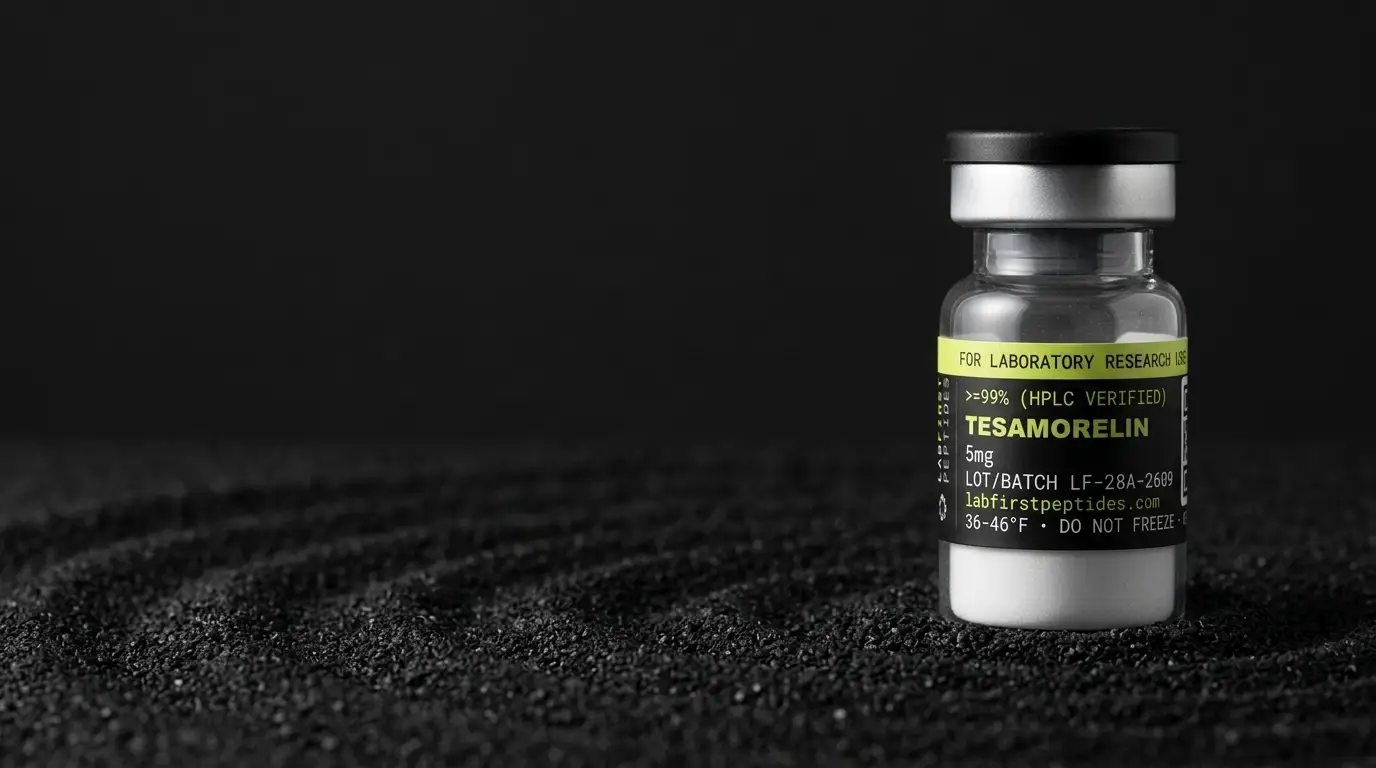
A tesamorelin certificate of analysis is a lot-specific test report, not a guarantee. Read it in six passes: identity method, purity method and wavelength, net peptide content and salt form, lot number matching the vial, test date, and the laboratory that signed it. Verify the claims at your own bench.
- A certificate of analysis reports one laboratory's measurements on one lot on one date, and applies only if the lot number matches the vial.
- RP-HPLC area percent at 214 nm is a relative chromatographic figure, not a mass fraction of the powder in the vial.
- Net peptide content, water content and counterion identity together determine how much peptide a nominal 10 mg vial actually holds.
- Mass spectrometry cannot resolve single-dalton changes such as deamidation on a 5136 Da peptide using routine linear instruments.
- A report number and a named issuing laboratory are what make a certificate independently verifiable; without them it cannot be checked.
- Tesamorelin is a trans-3-hexenoyl-modified analogue of human GHRH (1-44), CAS 218949-48-5 for the free base.
What the document is
A certificate of analysis reports what one laboratory measured, on one lot, on one day. That is the whole of its authority. It is not a specification, it is not a release document carrying pharmaceutical quality-system weight, and it says nothing about the vial in your hand unless the identifiers on the two objects agree.
In research supply the term covers a wide range of documents. At one end is a native PDF from an accredited testing laboratory naming the instrument, the column, the gradient and the analyst. At the other is a one-page image with a logo, a percentage and no method described at all. Both get called a COA. Only one of them can be read.
The reading habit that matters is looking for absences. A certificate that reports purity but not water content has left a large fraction of the vial mass unaccounted for. One that reports identity by retention time alone has confirmed that something eluted where a peptide of roughly that hydrophobicity should elute. Neither omission is announced. You have to notice it.
Tesamorelin makes a useful worked example because it is a large peptide with a modified N-terminus, which stresses both the identity and the mass-balance parts of the document.
- Lot number — does it match the vial, carton and packing list
- Identity — method named, observed mass against theoretical
- Purity — wavelength, column, gradient, chromatogram attached
- Mass balance — net peptide content, water, counterion
- Dates — manufacture, analysis, retest, kept separate
- Signature — named laboratory and a verifiable report number
Field by field
Tesamorelin is a synthetic analogue of human growth hormone-releasing hormone (1-44) carrying a trans-3-hexenoyl group on the N-terminal tyrosine. Public chemical databases report the free base as C221H366N72O67S with an average mass near 5136 Da, CAS 218949-48-5. Salt forms carry their own registry numbers, and a certificate that names one form while the label names another is the first discrepancy to chase.
| Field | What it should carry | Failure mode |
|---|---|---|
| Product name and CAS | Sequence name, salt form, CAS matching that form | Free base named, salt supplied, or no salt stated |
| Lot or batch number | A string that matches vial, carton and packing list | Blank, handwritten, or matching nothing |
| Appearance | White to off-white lyophilized solid | Copied text that no one looked at the cake to confirm |
| Identity | Method named, observed mass or spectrum reported | “Conforms” with no method and no number |
| Purity | RP-HPLC area percent, wavelength, column, gradient | A percentage with no chromatogram attached |
| Net peptide content | Percent peptide by mass, method stated | Absent, leaving gross powder mass as the only figure |
| Water content | Karl Fischer or loss on drying, percent | Absent in most research certificates |
| Counterion | Acetate or trifluoroacetate, percent by mass | Absent, which usually means TFA |
| Dates | Manufacture, analysis, and any retest date | One undifferentiated date, or analysis before manufacture |
| Signature and laboratory | Named analyst, named laboratory, report number | Unsigned, or the seller signing its own report |
Endotoxin and bioburden results appear on very few research certificates. Their absence is expected for material documented as a laboratory reagent, and it is one of several reasons such material sits outside any human-use pathway.
Identity: mass, sequence, and what mass spectrometry cannot tell you
Identity on a competent certificate means mass spectrometry, usually ESI-MS or MALDI-TOF, with the observed value printed next to the theoretical one. For a peptide this size, electrospray produces a family of multiply charged ions rather than a single peak, and the deconvoluted mass is what gets compared.
| Charge state | Approximate m/z |
|---|---|
| [M+2H]2+ | 2569 |
| [M+3H]3+ | 1713 |
| [M+4H]4+ | 1285 |
| [M+5H]5+ | 1028 |
Confirm the theoretical mass yourself against a public record such as PubChem, for the salt form your certificate names. Then note the limits. A 1 Da difference on a 5136 Da molecule is 0.02 percent, which is finer than routine MALDI mass accuracy on a linear instrument. Deamidation of an asparagine costs one dalton. So does isomerisation to an isoaspartate, at zero mass change. Leucine and isoleucine are isobaric. A D-amino acid substitution is invisible to mass alone.
What closes those gaps is sequence-level evidence: MS/MS fragmentation, or amino acid analysis, or an Edman result on the relevant stretch. Most research certificates do not include any of it, and that is a fair commercial decision rather than fraud. It does mean the identity claim you have been given is consistent with tesamorelin, not proof of the sequence.
Retention-time matching against a reference standard is weaker still. It tells you the analyte is about as hydrophobic as the standard. Dozens of related sequences would satisfy that test.
Purity: the number and its footnotes
Purity on peptide certificates is nearly always RP-HPLC area percent: the main peak's area divided by total integrated area, on a C18 column with an acetonitrile gradient in dilute trifluoroacetic acid or formic acid, detected at 214 or 220 nm. That wavelength is chosen because the peptide bond absorbs there. It also means the number is a relative comparison of chromophores, not a mass fraction of the vial.
Three consequences follow. Impurities that absorb weakly at 214 nm are under-reported. Anything that does not elute inside the gradient window is not counted at all. And a single peak proves resolution under one set of conditions, which is why an orthogonal run at a different pH, or on a different stationary phase, sometimes splits what looked like one component.
A percentage without a chromatogram is close to unreadable. The chromatogram shows baseline quality, the shape of the main peak, whether shoulders were integrated or ignored, and where the gradient ended. USP General Chapter <621> sets the system suitability expectations any such method should be meeting, and a certificate that names its column, gradient and suitability criteria is telling you the method was run rather than asserted.
Purity also says nothing about potency, aggregation state or how much of the powder is peptide. Those are separate measurements, and the next section is where they live.
Net content and the mass balance
A vial labelled 10 mg may contain 10 mg of gross lyophilized solid, of which the peptide is a fraction. The rest is water, counterion, residual solvent and inorganic salts. For a basic peptide purified in TFA-containing buffers, trifluoroacetate alone can account for several percent of the mass, and residual water in a hygroscopic cake commonly runs from two to eight percent unless it has been measured and controlled. USP General Chapter <921> describes Karl Fischer titration, which is the reference approach when a certificate reports water at all.
Net peptide content is the field that reconciles this. Where it is reported, the arithmetic is direct. A 10 mg nominal vial at 82.5 percent net peptide content dissolved in 2 mL of diluent gives:
10 mg × 0.825 = 8.25 mg peptide
8.25 mg ÷ 2 mL = 4.13 mg/mL
Against the gross figure the same preparation reads 5 mg/mL, a 21 percent overstatement carried silently into every downstream calculation. The vial concentration calculator handles other vial and volume combinations; it covers laboratory measurement only.
Counterion identity matters beyond mass accounting. Residual TFA is cytotoxic in cell-based work at concentrations that are easy to reach when the peptide itself is the intended variable. Material ion-exchanged to acetate is a different reagent for that purpose, and a certificate that reports the counterion is telling you something an assay can be designed around.
Lot match and the three dates
Start with the identifier, before reading a single result. The lot number on the certificate has to match the vial label, the carton and the shipping paperwork. If the vial is unlabelled, or labelled with a different string, the document in front of you describes some other material and none of its numbers apply. This is the most common real-world failure and the easiest to check.
Then separate the dates. Date of manufacture, date of analysis and any retest or re-evaluation date are three different things, and certificates that collapse them into one field hide the interval you care about. A purity result generated eighteen months before the vial shipped describes the lot as it was, which for a lyophilized solid held dry and cold may be close enough, and for one that has spent a year on an ambient shelf is not. The same reasoning as in peptide storage and stability applies: moisture and temperature history sit between the test date and today, and the certificate records neither.
Two mechanical checks are worth thirty seconds. Open the PDF properties and look at the creation date and producing application; a document generated the morning your order shipped, for a lot manufactured months earlier, has at least been reprinted. And prefer native PDFs to scanned images, because a flattened image is the format in which a percentage gets edited.
Who signed it
The issuing laboratory determines how much of the document is independent evidence and how much is self-assessment. Three arrangements are common.
- In-house quality control at the manufacturer. Legitimate, routine, and not independent. Read it as the producer's own record.
- A contract laboratory engaged by the seller. Independent of the manufacturer, still commissioned and paid by the party with an interest in the result.
- A laboratory accredited to ISO/IEC 17025 for the specific method. The strongest of the three, and only within its scope of accreditation, which is a published document you can read.
Whichever it is, the report should name the laboratory, carry a report or work-order number, and identify the analyst or authorising signatory. Those three items exist so that a third party can call the laboratory and ask whether report number such-and-such was issued for lot such-and-such. Laboratories will usually confirm or decline; either answer is informative. A certificate with no report number cannot be verified this way at all, which may be the point.
Method statements are the other tell. ICH Q2(R2) sets out what validation means for an analytical procedure, and a certificate claiming a validated method should be able to say which characteristics were validated. Most research certificates make no validation claim, which is honest. The ones to watch are those that claim it in a footnote and cannot support it.
Verifying at the bench rather than with the seller
Asking the seller to confirm its own certificate returns the certificate. Verification happens elsewhere.
The direct route is independent retesting. Send a retained aliquot to a laboratory of your choosing, blinded to the supplier's reported figures, and specify the method rather than the outcome: RP-HPLC purity at 214 nm with the chromatogram returned, mass confirmation by ESI-MS, water by Karl Fischer if the mass balance matters to your work. Compare the chromatograms, not just the percentages. Two labs running different gradients will disagree slightly on area percent and that disagreement is not evidence of anything.
Cheaper checks first, though. Inspect the cake against the appearance statement. A collapsed, glassy or visibly damp cake contradicts a certificate describing a white lyophilized powder, and it also tells you something about the transport history that no shipping documentation will. Confirm the theoretical mass independently. Confirm the lot string on every surface it appears. Retain a sealed aliquot from every lot so that a question raised in six months is answerable.
Red flags, in rough order of how much they should worry you: no lot number; a purity figure with no method; a scanned image with no report number; identity by retention time only; net content and water content both absent; a certificate whose stated storage conditions contradict how the parcel arrived. None of these is proof of a bad lot. Each is a reason to test before the material enters a study. Our quality standard sets out which of these fields we publish per lot.
Regulatory position
Tesamorelin is a growth hormone-releasing hormone analogue. A prescription product containing tesamorelin acetate for injection has been approved in the United States since 2010 and is manufactured under pharmaceutical quality systems covering sterility, endotoxin, formulation and lot release. Reformulated versions have been approved subsequently.
Research-grade tesamorelin is a different article. Its documentation covers identity and purity, sometimes content and water, and nothing about sterility or pyrogenicity. A certificate of analysis is a chemistry report; it is not a release document and confers no human-use status of any kind.
Status verified 26 August 2026.
FOR LABORATORY AND IN-VITRO RESEARCH USE ONLY. NOT FOR HUMAN OR ANIMAL CONSUMPTION. NOT FOR PERSONAL, MEDICAL, DIAGNOSTIC, THERAPEUTIC, OR RECREATIONAL USE.
What is Tesamorelin studied for?
Published research on Tesamorelin investigates the areas below, which is a different question from what Tesamorelin will do for anyone, a claim about a living system that nothing on this site is sold for.
What it is. A man-made copy of growth-hormone-releasing hormone (GHRH).
What the research looks at. There is a registered clinical record, and an approved medicine containing tesamorelin exists under its own brand name for one specific condition.
How it is thought to work. It works on the GHRH receptor. It is a hardier copy of the hormone that triggers growth hormone, rather than growth hormone itself, which matters: it acts one step earlier in the chain.
What is not established. What is sold here is a research chemical, not a drug product. Listing it is not an approval and not a claim that it is equivalent to or a fit substitute for any medicine.
The full record, including the certificate for the lot in stock, is on the Tesamorelin product page.
Common questions
Does a 99 percent purity figure mean the vial is 99 percent tesamorelin?
What identity evidence is strong enough?
Why does the counterion appear on some certificates and not others?
How do I check a certificate without relying on the seller?
Is an old test date a problem?
Should a research certificate include endotoxin results?
More documentation guides
Sources
- United States Pharmacopeia, General Chapter <621> Chromatography. Establishes system suitability, resolution and reporting expectations that any credible RP-HPLC purity method on a certificate should be meeting.
- United States Pharmacopeia, General Chapter <921> Water Determination. Describes Karl Fischer titration as the reference approach for residual water, supporting the mass-balance argument for lyophilized solids.
- ICH Q2(R2), Validation of Analytical Procedures. Defines the specificity, accuracy and precision characteristics behind any claim that an analytical method on a certificate is validated.
- FDA approval record for tesamorelin acetate for injection (Drugs@FDA). Supports the statement that a prescription product containing tesamorelin has been approved in the United States since 2010.