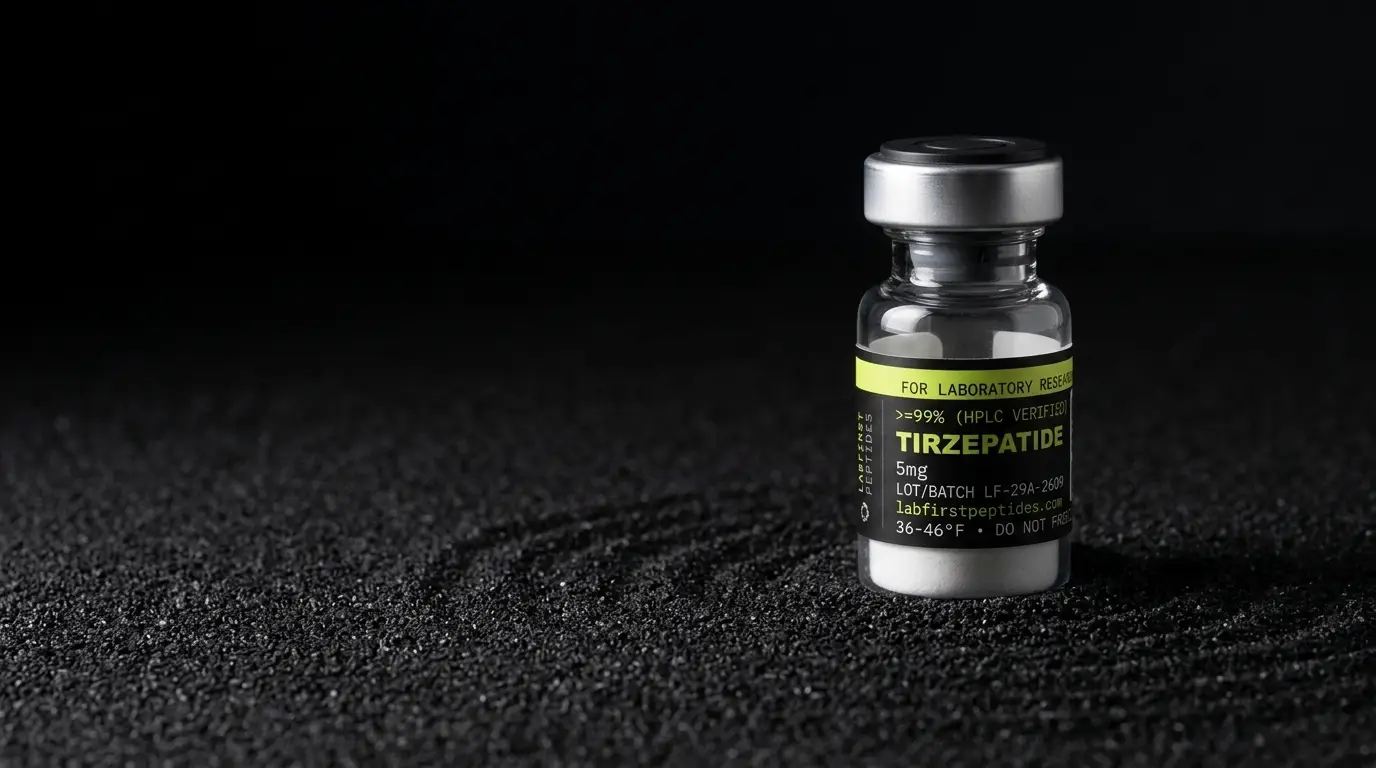
Tirzepatide identity testing rests on two independent lines of evidence. Mass spectrometry gives an intact mass that must match the theoretical value for C225H348N48O68. Chromatographic behavior must agree with a reference standard. A purity percentage describes how much of the vial is one species; it never says which species that is.
- HPLC purity is area-percent within a single run and assumes the main peak's identity; it cannot establish what the peak is.
- Tirzepatide's identity anchor is its molecular formula C225H348N48O68, with an average mass a little over 4813 Da.
- Intact mass and retention against a reference standard are orthogonal measurements, and the identity claim rests on both agreeing.
- A mass alone cannot prove sequence order or stereochemistry, and near-tolerance changes such as deamidation can hide inside a loose tolerance.
- The found-versus-theoretical mass pair and the lot number tying certificate to vial are the two highest-value lines on a certificate of analysis.
What this guide covers
Tirzepatide certificates lead with a purity figure, and that number gets read as proof of identity far too often. This guide covers what identity testing for tirzepatide involves, what mass spectrometry and chromatography each show, when to go further, and how to read the certificate.
In plain terms, it works like checking a house key two ways. The cut has to match the pattern on file, and it has to behave the way a known good copy does. Mass and chromatography are those two checks.
- Purity percentage: how clean, never what
- Intact mass: composition matches C225H348N48O68
- Retention against a reference: behavior matches the standard
- Peptide mapping: residue order, when the stakes demand it
- Lot number: the certificate is about your vial
Why does a purity figure not prove identity?
A certificate that reads 99.1% answers one question and is routinely mistaken for answering another. Purity, as reported for research peptides, is area-percent from a reversed-phase chromatogram: of everything the detector saw in that run, this share sat under the main peak. The figure is a statement about how clean the material is relative to itself. It carries a silent assumption that the main peak is tirzepatide, and nothing in the number tests that assumption.
The failure case is easy to construct. A vial of the wrong peptide, competently made, will produce a beautiful chromatogram. So will a vial of the right peptide from which a synthesis step was quietly dropped. Area-percent cannot tell these apart, because it is a relative measure inside a single run; the identity of the species under the peak has to be established by separate evidence.
Identity testing is that separate evidence. In practice it rests on two measurements that fail independently: a mass-spectrometric determination of what the molecule weighs, and chromatographic behavior read against a reference. Each has blind spots. Together they make a claim that is hard to counterfeit and easy to audit, which is exactly what a certificate exists to provide.
What molecule are the tests looking for?
Tirzepatide is a linear peptide of 39 residues with a C-terminal amide, the non-coded residue α-aminoisobutyric acid at positions 2 and 13, and a C20 fatty diacid attached through a hydrophilic linker to the lysine at position 20. The molecular formula is C225H348N48O68 and the average mass is a little over 4813 Da, both recorded on the compound's PubChem entry along with the CAS registry number 2023788-19-2.
Three of those structural facts do real work in identity testing. The mass itself is distinctive: no common research peptide shares it, and the incretin-family compounds tirzepatide is most often confused with sit hundreds of daltons away, far outside any instrument's tolerance. The two Aib residues are non-coded, which marks the molecule as unambiguously synthetic and rules out reading its sequence with tools built for the twenty standard amino acids alone. And the fatty diacid makes the molecule strongly amphiphilic, which pushes retention late on a reversed-phase column and gives the chromatographic fingerprint some of its character.
Everything a certificate claims is a claim against this structure. The theoretical mass a supplier prints should trace to that formula; a certificate quoting a theoretical value that belongs to a different compound has failed before any measurement is examined. The Tirzepatide product record carries the reference figures used here.
What does mass spectrometry prove?
The workhorse identity measurement is intact mass. Electrospray ionization puts the whole molecule into the gas phase as a family of multiply charged ions, and software deconvolutes that envelope into a single neutral mass. On a calibrated instrument the found value should agree with theory to within about a dalton. MALDI-TOF is the common alternative, faster and cheaper per sample, with somewhat looser mass accuracy that is still far tighter than the spacing between tirzepatide and any plausible substitute.
Agreement between found and theoretical mass establishes that the dominant species has the elemental composition of tirzepatide. That is strong evidence, and it is worth being precise about what it is not. A mass does not prove sequence order: two peptides with the same residues in a different arrangement weigh the same. It does not distinguish stereochemistry: a D-amino-acid substitution changes nothing on a spectrum. And modifications near the tolerance limit can hide, the classic example being deamidation of an asparagine, which adds roughly one dalton and disappears inside a loose tolerance without comment.
These limits are the reason to want the spectrum itself rather than a bare number. A real spectrum shows the charge envelope, the deconvolution, any adducts riding along, sodium and trifluoroacetate being the usual passengers, and whether the baseline suggests a mixture. A single "MS: conforms" line on a certificate compresses all of that into an assertion the reader cannot audit.
How does chromatography add a second line of evidence?
The second line of evidence is chromatographic. Under stated conditions, meaning column, gradient, temperature and detection wavelength, a peptide elutes at a characteristic time, and the identity argument compares that behavior with a reference standard of the same compound, ideally by co-injection in the same run. Peptide detection is typically at 214 nm, where the backbone amide absorbs; 280 nm picks up the aromatic residues as a secondary check.
Retention time alone is weak evidence, since unrelated molecules can co-elute. Intact mass alone falls short of sequence proof. The standard identity argument works because the two measurements are orthogonal: they read different physical properties through different failure modes, so a wrong compound would have to counterfeit both at once. This is the logic written into ICH Q6B, which asks that identity methods be highly specific and grounded in unique aspects of the molecule's structure, and the conventions that make a retention-time comparison auditable are the territory of the USP general chapter on chromatography.
| Measurement | Question it answers | What it cannot show |
|---|---|---|
| Intact mass (ESI or MALDI-TOF) | Does the dominant species weigh what tirzepatide weighs? | Sequence order, stereochemistry, near-tolerance modifications |
| RP-HPLC retention against a reference | Does the material behave like the standard under identical conditions? | A co-eluting impostor, on its own |
| Area-percent purity | How much of the detected signal is the main peak? | What the main peak actually is |
| Peptide mapping with MS/MS | Are the residues in the claimed order? | Water and counterion content; costs more time and material |
One run frequently produces both the identity comparison and the purity figure, which is economical and also the source of the confusion this article opened with. The two claims use the same trace differently. Purity reads relative areas within the run and assumes the main peak's identity; the identity claim reads position against a standard and assumes nothing.
When should identity testing go deeper?
Intact mass plus retention against a standard is the routine identity package, and for most receiving decisions it is enough. Some situations justify more. When a found mass and a chromatogram disagree, when a lot will anchor months of downstream work, or when a supplier is new to the laboratory, sequence-level confirmation is the next step: the peptide is digested enzymatically and the fragments are read by tandem mass spectrometry, which converts right composition into right order. Amino acid analysis is the older complement, quantifying residue composition and, usefully, the peptide content of the vial as a whole, since a lyophilized solid also contains water and counterion that no mass spectrum reports.
Independent verification deserves a plainer description: paying a contract laboratory to test the vial actually received. A supplier certificate, however complete, documents the supplier's sample. The identity package from a third-party laboratory costs a small fraction of what a meaningful quantity of material does, and it is the only document in the chain the buyer controls end to end. The requirements applied to every lot before it ships are written in the quality standard.
A mismatch is handled as a quarantine, never as a judgment call. The lot is set aside, the supplier is asked for the raw data behind the certificate, and the material does not move until an independent result lands. Rationalizing a two-dalton discrepancy is cheaper in the moment and more expensive every week afterward.
What should a tirzepatide certificate show?
The certificate of analysis is where all of this either becomes checkable or does not. Read it as an auditor rather than as a customer: every identity claim should arrive with its evidence attached and its conditions stated.
| Certificate element | What a strong certificate shows | What weakness looks like |
|---|---|---|
| Mass spectrum | The spectrum itself, method named, found and theoretical masses stated side by side | A conforms line with no spectrum and no numbers |
| Theoretical mass | A value traceable to C225H348N48O68 | A theoretical figure belonging to a different compound |
| Chromatogram | The trace, with column, gradient, wavelength and retention time on the page | A purity percentage floating free of any trace |
| Lot linkage | A lot number matching the vial label exactly | A certificate with no lot, or one matching nothing received |
| Analysis provenance | Date of analysis and the laboratory that performed it | Undated, unattributed results reused across listings |
Two of these carry most of the weight. The found-versus-theoretical mass pair is the single most informative line on the document, and the lot linkage is what makes the rest of the document about your vial instead of about a vial somewhere. A certificate can be beautifully produced and still fail both.
Identity, once confirmed, stays confirmed. The material it describes keeps changing. A lot verified on arrival still has to be stored and prepared in ways that keep the confirmed molecule intact, which is the subject of the storage and stability guide. Documentation for diluents follows the same logic at lower stakes; the bacteriostatic water guide covers it.
How to check tirzepatide identity on a certificate, step by step
- Check that the lot number on the certificate matches the vial label exactly.
- Check the theoretical mass. It should trace to C225H348N48O68, an average mass a little over 4813 Da.
- Find the mass spectrum itself, with the method named and the found and theoretical masses side by side. On a calibrated instrument the found value should agree with theory to within about a dalton.
- Find the chromatogram, with column, gradient, wavelength and retention time on the page, compared against a reference standard.
- Confirm the date of analysis and the laboratory that performed it.
- If the found mass and theory disagree, quarantine the lot, ask the supplier for the raw data and commission an independent test of the vial you received.
Red flags on a tirzepatide certificate
- A "conforms" line with no spectrum and no numbers.
- A theoretical mass that belongs to a different compound.
- A purity percentage floating free of any trace.
- A certificate with no lot number, or one matching nothing received.
- Undated, unattributed results reused across listings.
Bottom line
A purity percentage describes how much of the vial is one species and never says which species. Tirzepatide identity rests on two measurements that fail independently: an intact mass matching C225H348N48O68, and chromatographic behavior that agrees with a reference standard. The found-versus-theoretical mass pair and the lot number are the two lines that carry the most weight. When they disagree with the vial, quarantine first and ask questions second.
FOR LABORATORY AND IN-VITRO RESEARCH USE ONLY. NOT FOR HUMAN OR ANIMAL CONSUMPTION. NOT FOR PERSONAL, MEDICAL, DIAGNOSTIC, THERAPEUTIC, OR RECREATIONAL USE.
What is Tirzepatide studied for?
Published research on Tirzepatide investigates the areas below, which is a different question from what Tirzepatide will do for anyone, a claim about a living system that nothing on this site is sold for.
What it is. A peptide that works on the GIP and GLP-1 receptors at the same time.
What the research looks at. There is a large published clinical record: how it behaves at the receptors, how the body handles it, and the measurements its sponsor registered its trials to take. Approved medicines containing it exist under their own brand names.
How it is thought to work. It switches on both the GIP receptor and the GLP-1 receptor. Working on two rather than one is the design feature that separates it from the GLP-1-only drugs.
What is not established. What is sold here is a research chemical, not a drug product. Listing it is not an approval, and not a claim that it is equivalent to, as safe as, or a fit substitute for any approved medicine.
The full record, including the certificate for the lot in stock, is on the Tirzepatide product page.
Common questions
Can a high purity percentage stand in for identity testing?
What mass should tirzepatide show on a spectrum?
Is an intact mass alone enough to confirm identity?
What does peptide mapping add, and when is it worth running?
What should happen when the found mass does not match theory?
Published certificates for Tirzepatide
Every figure below is read from a report the laboratory issued for that lot; each page carries the PDF and the lab's own verification link.
More documentation guides
Sources
- ICH Q6B, Specifications: Test Procedures and Acceptance Criteria for Biotechnological/Biological Products. The principle that identity methods must be highly specific and based on unique aspects of the molecule's structure; the orthogonal-evidence framing follows from it.
- USP general chapter on chromatography. Conventions for retention-time comparison, system suitability and stated chromatographic conditions that make an HPLC identity comparison auditable.
- PubChem compound record for tirzepatide. Molecular formula C225H348N48O68, average mass and CAS 2023788-19-2, used as the reference figures throughout.