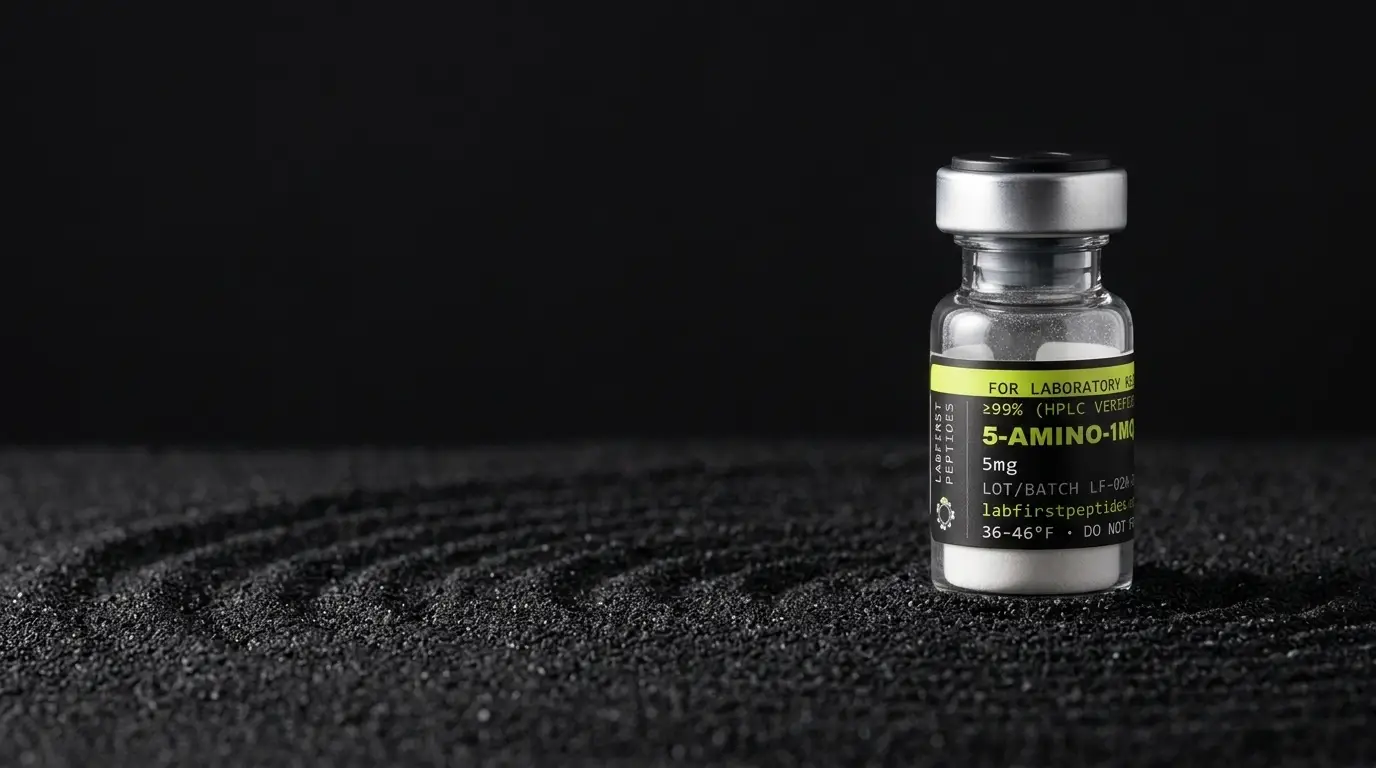
For 5-Amino-1MQ storage and stability, start with one fact: it is a small molecule, not a peptide. Peptide storage habits do not automatically apply. Keep it sealed, dry and dark. The quaternary salt is hygroscopic, which means it pulls in water from the air. The aromatic amine can oxidise and darken. Those are the two changes worth watching for.
- This is a small molecule; peptide storage rules are answers to problems it does not have.
- Quaternary ammonium salts are frequently hygroscopic, and moisture uptake changes every weight.
- The aromatic amine oxidises to coloured products, so colour is an early indicator here.
- The quinolinium ring absorbs UV strongly, which makes light exposure a real route.
- Nothing aggregates, so freeze-thaw carries none of its peptide significance.
- The appearance field on this certificate is a genuine baseline rather than filler.
How should 5-amino-1MQ be stored?
Think of it like keeping sugar in a sealed jar away from the window. Left open, it clumps from moisture, and some things fade or darken in light. This compound has similar weak spots, so the basics are a closed container, dry air and no light.
Sealed, dry and dark, in the container it arrived in. Whether it also needs to be frozen is a question the supplier's own stability data should answer rather than one to settle by analogy with the peptides beside it in the catalogue.
That is the honest starting point, and it differs from the advice on almost every other page in this library. Peptides get a standard instruction because they share a set of vulnerabilities. A small organic molecule does not necessarily share them.
What this compound does share is a sensitivity to moisture, and it adds one of its own in the form of an oxidisable aromatic amine.
- Sealed, dry and dark, in the container it arrived in
- Freezing is a question for the stability data, not an analogy with peptides
- The quaternary salt is hygroscopic: keep it closed and warm it before opening
- The aromatic amine oxidises to coloured products, so colour is the early signal
- The quinolinium ring absorbs UV, so amber glass or the carton earns its place
- Sticky, clumped or noticeably darkened material ends the container
Why do peptide storage rules not transfer?
Because they are answers to peptide problems. Freeze-drying, deep freezing and strict cold chains exist because a peptide is a long, fragile, water-sensitive chain that hydrolyses, oxidises at particular residues, deamidates and aggregates.
A crystalline small molecule with ten carbons has none of those failure modes. It has no backbone to hydrolyse, no side chains to deamidate and nothing to aggregate.
Many small organic solids are perfectly stable at room temperature in a sealed container for years. Applying a freezer requirement by reflex is not harmful, and it is also not evidence-based, and the difference matters when someone treats a warm delivery as a disaster on a compound that never needed the cold.
What does the quaternary salt do to moisture behaviour?
Makes it worse, and this is the vulnerability the compound genuinely has. Quaternary ammonium salts are frequently hygroscopic, drawing water out of the air readily.
A hygroscopic solid left open in a humid room takes up water, and a solid that has taken up water weighs more without containing any more compound. Every gravimetric calculation made afterwards is quietly wrong in the same direction.
Severe uptake can go further, turning a free-flowing crystalline solid sticky or, in the extreme, liquefying it altogether. That is a visible, unambiguous signal, and it is the main reason to keep the container sealed and to let a cold container reach room temperature before opening it.
Why can an aromatic amine change colour?
Because aromatic amines are among the more readily oxidised organic functional groups. This molecule carries one, an amino group attached to a quinolinium ring system.
Oxidation products of aromatic amines are typically coloured, often yellow, brown or pink, and they are usually visible at concentrations far too low to matter analytically. A faint tint can mean a very small amount of change.
That makes colour an unusually useful early indicator here, and one worth reading carefully rather than panicking over. A material that has darkened noticeably has changed. A slight off-white cast is not automatically a failure, and the certificate's stated appearance is the reference point rather than an expectation of pure white.
Does light matter?
Yes, and more than for most peptides. The quinolinium ring system is an extended aromatic structure that absorbs ultraviolet light strongly, which is exactly why it is easy to detect chromatographically.
A molecule that absorbs light efficiently is a molecule that can be driven into photochemistry by it. Combined with an oxidisable amine, that gives a plausible route to the coloured degradation products described above.
The remedy is trivial and free. Amber glass, or simply keeping the container in its outer carton, removes the variable entirely. This is one storage instruction that transfers from the peptide pages for a reason that happens to be different.
What does a retest date actually mean?
It describes an unopened container held under the conditions printed beside it, derived from stability data: units stored at defined temperature and humidity, pulled on a schedule, tested against the release specification.
The date is conditional on those conditions being met, so a container held elsewhere is not described by it, and nothing about the solid looks different.
It is also not a cliff. Material past a retest date is not established as failing, it is outside the evidence, and testing is the honest response rather than assuming in either direction. A pharmaceutical expiry is a stronger claim made under rules research-grade material is not made under.
Is a solution more or less stable than the solid?
Less, as for essentially every compound, though the reasons here are its own. In solution the molecule is mobile, oxygen is dissolved alongside it, and any pH-dependent chemistry has a medium to happen in.
The oxidation route described above is the relevant one. Dissolved oxygen and an aromatic amine in the same liquid is a slower version of the same reaction that colours the solid.
What does not apply is the peptide-specific worry about repeated freeze-thaw driving aggregation, because there is nothing here to aggregate. That is a genuine simplification, and it is worth stating so that handling advice is proportionate rather than borrowed.
What does stability testing not capture?
Everything after dispatch. A stability study tests unopened units under controlled conditions, so the results describe an ideal a working container stops matching once it is opened.
Transit is the least documented stretch of the timeline. A parcel can sit warm for a day or freeze overnight and none of it appears on paperwork. For a stable crystalline solid the chemical risk from that is genuinely modest, which is worth saying rather than implying every excursion is a catastrophe.
Humidity exposure during handling is the real gap. A hygroscopic solid weighed out on a humid bench begins taking up water immediately, and no stability protocol describes that.
What should make you stop using a container?
A solid that has gone sticky, clumped hard, or partly liquefied. For a hygroscopic quaternary salt that is unambiguous moisture uptake and it is the clearest signal available.
Marked colour change is the second. A material noticeably darker than the appearance stated on its certificate has undergone chemistry that the document does not describe.
A closure that no longer seals counts as well, since the moisture protection depends entirely on it. None of these require equipment and all of them describe events that happened after the certificate was written.
How does storage relate to the certificate?
They split the timeline and neither covers the other half. A certificate reports what was measured on a sample drawn at one moment, and the certificate guide covers how to read one field by field. Storage evidence covers what happened afterwards.
For this compound the certificate's appearance line is more useful than usual, because it gives a colour reference to compare against later. On a peptide certificate that field tells you almost nothing; here it is a baseline.
Lot reports for material supplied here resolve through the certificate verification page, and the sizes carried are on the 5-amino-1MQ product record.
What should you ask a supplier about storage?
Two questions, and the first is the one people skip. What storage conditions does the stability data actually support, as opposed to what does the label say by convention. A freezer instruction copied from a peptide catalogue is a habit rather than a finding.
The second is what the material looked like at release. A stated colour gives you something to compare against, and without it any later judgement about darkening is guesswork.
Neither question is unreasonable, and a supplier who has treated this compound as the small molecule it is will have both answers to hand.
What is the regulatory position?
Stability expectations for finished pharmaceutical products are set out in international guidance defining storage conditions, sampling intervals and the testing that supports a shelf-life claim. That framework governs drug products made for human use.
There is no FDA-approved product containing 5-amino-1MQ and no United States pharmacopoeial monograph defining an acceptable batch, so a research certificate does not carry pharmacopoeial weight.
A supplier can honestly report the conditions a lot was held under and what was measured. Presenting that as a drug product shelf life would overstate it, and copying a storage instruction from a different class of molecule would be a different kind of overstatement.
FOR LABORATORY AND IN-VITRO RESEARCH USE ONLY. NOT FOR HUMAN OR ANIMAL CONSUMPTION. NOT FOR PERSONAL, MEDICAL, DIAGNOSTIC, THERAPEUTIC, OR RECREATIONAL USE.
What is 5-AMINO-1MQ studied for?
Published research on 5-AMINO-1MQ investigates the areas below, which is a different question from what 5-AMINO-1MQ will do for anyone, a claim about a living system that nothing on this site is sold for.
What it is. A small molecule, a methylquinolinium salt, not a peptide.
What the research looks at. It appears in enzyme and cell-biology research on NNMT and nicotinamide, mostly in cells and animals.
How it is thought to work. Described in the research as a blocker of an enzyme called NNMT, which sits in the pathway that handles nicotinamide.
What is not established. No approved product. Being a small molecule rather than a peptide, it dissolves, stores and tests differently from the rest of this catalogue, and its certificate should be read on small-molecule terms.
The full record, including the certificate for the lot in stock, is on the 5-AMINO-1MQ product page.
Common questions
Does 5-amino-1MQ need to be frozen?
Why does it need to be kept dry?
Why might the material darken?
Does light matter for this compound?
Is freeze-thaw a concern in solution?
More documentation guides
Sources
- PubChem Compound Summary for CID 950107, 5-amino-1-methylquinolinium. The openable record for the cation, showing the quinolinium ring system and the aromatic amine whose oxidation and light absorbance are discussed above.
- ICH Q2(R2), Validation of Analytical Procedures . Defines what makes an analytical result valid and reproducible, and is the basis for treating a stability figure without a named method and stated conditions as unverifiable.
- FDA guidance, Q3A(R) Impurities in New Drug Substances. Sets out how degradation products of a synthesised small-molecule substance are identified and reported, which is the framework a coloured oxidation product would be assessed under.