Identity for bacteriostatic water is established on two fronts at once. The water is characterised by conductivity and total organic carbon, and the preservative is identified and quantified by chromatography against a reference standard of known purity. Neither result alone confirms the preparation, which is why both belong on the report.
- Identity splits in two: water quality on one side, preservative assay on the other.
- Conductivity and total organic carbon bound contamination rather than identifying a target.
- Benzyl alcohol is C7H8O, average mass near 108.14, PubChem CID 244.
- Retention time alone is weak identity evidence without a structure-sensitive detector.
- Every quantitative result is a comparison, so an unnamed reference standard undermines the number.
- Plain sterile water sold as bacteriostatic is caught by the preservative assay and by nothing else.
What does identity mean for a two-component preparation?
Identity testing for a peptide asks one question: is this molecule the molecule it claims to be. Bacteriostatic water has no single molecule, so the question splits. Is the solvent actually water of appropriate quality, and is the preservative present, correct, and at the stated concentration?
Those are separate measurements made by different instruments, and a report that answers only one of them has established only half the product. This is the structural reason a diluent certificate looks unlike a peptide certificate, and why comparing the two by length or by number of fields is misleading.
The preservative side is the more familiar half. Benzyl alcohol is a well characterised small molecule, C7H8O, average mass near 108.14, catalogued as PubChem CID 244. It has a reference standard, a retention behaviour, and a spectrum. The water side has none of those things in the same sense, and is characterised by what is absent from it rather than by what is present.
- Conductivity bounds ionic contamination
- Total organic carbon bounds organic contamination
- Preservative separated by GC or reversed-phase HPLC
- Peak confirmed by a structure-sensitive detector, not retention time alone
- Concentration compared against a named reference standard
- Microbiological testing for what chemistry cannot see
- Accession number confirmed at the issuing laboratory
How is the water itself characterised?
Water is assessed by purity rather than identified by structure. The two workhorse measurements are conductivity and total organic carbon. Conductivity responds to dissolved ions: the purer the water, the less current it carries, so a low reading is evidence that inorganic contamination is low. Total organic carbon does the same job for organic contamination.
Both are non-specific by design, which is their strength here. They do not tell you what a contaminant is; they tell you how much of a category is present. For a solvent, that is the useful question, because the specification is an upper bound on everything rather than a match to one target.
A complication worth knowing about: the preservative is itself organic carbon. In a preparation already containing benzyl alcohol, a total organic carbon figure has to be interpreted against that expected contribution rather than read as though the water were neat. Laboratories handle this by testing the water before the preservative is added, and a report that is silent about which sample was measured has left an ambiguity in place.
Which grade of water is in the vial?
Water is not one material. Purified water and water for injection are different grades produced by different processes and held to different limits, the sharpest difference being the endotoxin control that the injectable grade carries and the purified grade does not. Conductivity and organic carbon limits are similar between them; the microbiological expectations are not.
For a diluent this distinction does more work than it first appears to. A preparation can meet every chemical specification for purified water and still be the wrong starting material for something expected to carry an endotoxin limit. The chemistry looks identical on the report because the difference lives in the microbiological section rather than the chemical one.
So the grade is worth reading as a claim in its own right, not as a label on the front page. A certificate that names the grade and shows the testing behind it is saying something specific. One that says only water is leaving the most consequential question unanswered.
How is the preservative identified and quantified?
By chromatography, most often gas chromatography or reversed-phase HPLC with ultraviolet detection. The principle is the same in both: the sample is separated so the preservative comes off the column at a characteristic time, and the size of its peak is compared against a reference standard of known purity run under identical conditions.
Retention time alone is weak evidence of identity. Plenty of compounds elute at similar times, and a peak in roughly the right place is a starting point rather than a conclusion. Stronger evidence comes from detection that carries structural information: a mass spectrometer reporting the expected mass, or a diode array detector reporting the expected ultraviolet spectrum across the peak.
The reference standard is the part of this that quietly does the most work. Every quantitative result is a comparison, so a result is only as trustworthy as the standard it was compared against. A certificate that reports a concentration without naming the standard has reported a ratio to something unspecified.
What makes evidence orthogonal, and why does it matter?
Two methods are orthogonal when they can fail independently. Retention time and peak area both come from the same separation, so a problem with that separation moves both together and the agreement between them proves little. Retention time plus mass spectrometry is a genuinely different pairing, because the mass detector would not be fooled by a co-eluting compound in the way the retention time was.
This is the reason good reports stack methods that seem redundant. The redundancy is the point. A single technique confirming itself is one result wearing two hats.
For this product, the orthogonal set is roughly: conductivity and total organic carbon for the solvent, chromatographic separation plus a structure-sensitive detector for the preservative, and microbiological testing for what neither of those can see. Sterility and bacterial endotoxin belong to that last category, and the certificate guide covers how those results sit alongside the chemical ones.
What does a mis-identified diluent look like?
The failure that matters commercially is not exotic. It is plain sterile water sold as bacteriostatic, which is to say a preparation with no preservative in it at all. It looks identical, pours identically, and behaves identically until the closure has been pierced more than once.
A preservative assay catches this immediately, and nothing else does. No amount of sterility testing distinguishes the two, because both may be genuinely sterile at the point of filling. This is the single strongest argument for insisting the assay appears on the report rather than accepting a document that only proves the liquid was clean.
The second failure is a preservative present but low. That produces a preparation which is bacteriostatic in name and progressively less so in practice, and it is invisible without a number. Both failures are detected by the same test, which is why its absence from a certificate is more serious than the absence of most other fields.
How do you check the report describes your vial?
Confirm the accession or verification number at the issuing laboratory rather than with the seller. The laboratory holds the record; the seller holds a copy of a document. If the number resolves to a different lot, a different product, or nothing, the analysis on the page is not evidence about the material you have.
Then check that the lot number on the report matches the vial. Analytical rigour upstream is worth nothing if the document has been attached to the wrong batch, and that mismatch is far more common than falsified results.
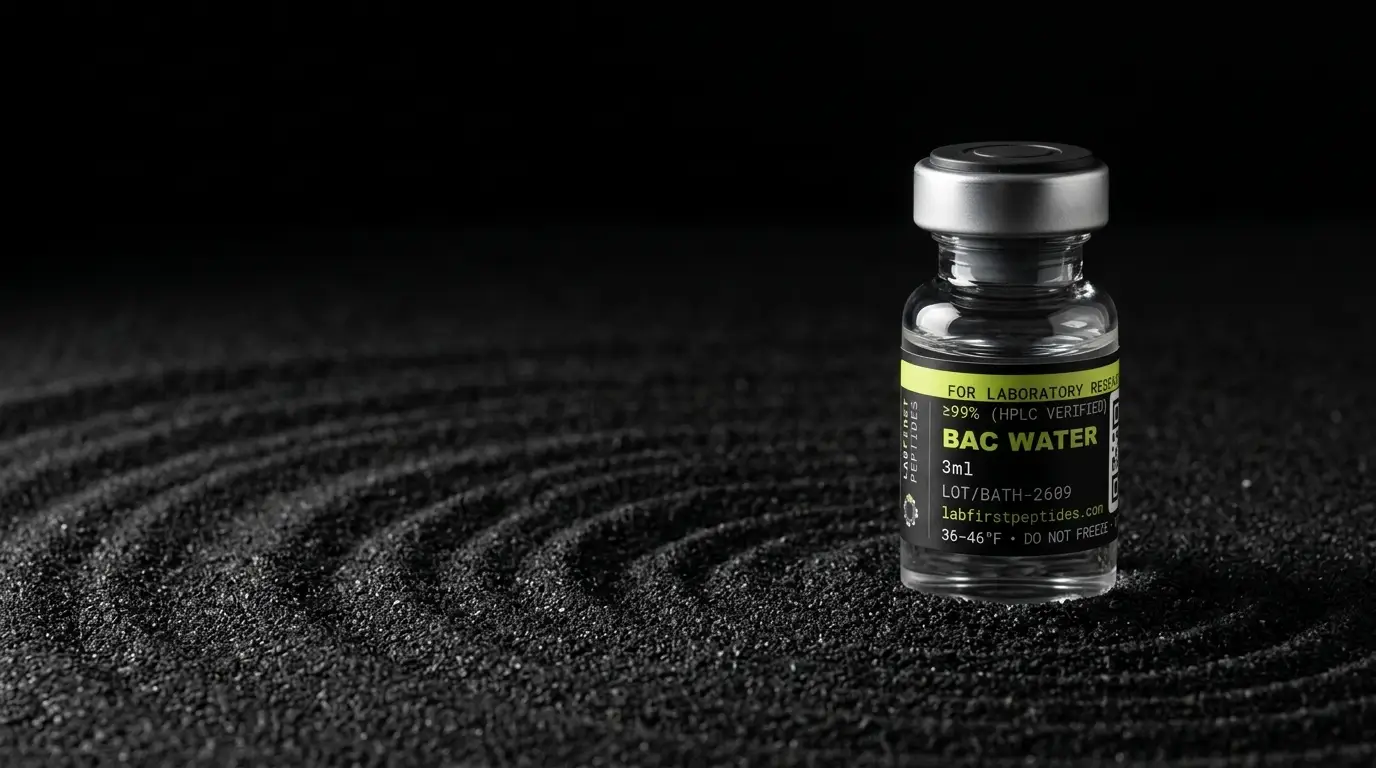
Reports for material supplied by us resolve through the certificate verification page, and the sizes carried appear on the BAC water product record.
What is the regulatory position?
International guidance on analytical validation defines what makes an identity or assay method fit for purpose: specificity, accuracy, precision, and a demonstration that the method distinguishes the target from what else might be in the sample. Those expectations are why a named method beside each result is not bureaucratic decoration.
That framework was written for pharmaceutical manufacturing. Research-grade material is not a finished drug product, and a research certificate does not carry pharmacopoeial weight. What it can honestly establish is what a named laboratory measured on a named lot by named methods, which is a real claim and a narrower one.
Lot records for material supplied here are issued per lot rather than per product.
FOR LABORATORY AND IN-VITRO RESEARCH USE ONLY. NOT FOR HUMAN OR ANIMAL CONSUMPTION. NOT FOR PERSONAL, MEDICAL, DIAGNOSTIC, THERAPEUTIC, OR RECREATIONAL USE.
What is BAC Water studied for?
Published research on BAC Water investigates the areas below, which is a different question from what BAC Water will do for anyone, a claim about a living system that nothing on this site is sold for.
What it is. Bacteriostatic water: sterile water with benzyl alcohol added to hold back bacterial growth. Not a peptide and not an active compound.
What the research looks at. A laboratory diluent rather than a subject of research. What matters here is that it is a solvent, and what a solvent is made of affects the stability of whatever gets dissolved in it.
How it is thought to work. The benzyl alcohol stops bacteria multiplying, which is what separates bacteriostatic water from plain sterile water and is why a sealed multi-use container can be entered more than once under laboratory conditions.
What is not established. This record covers the diluent as laboratory material only. Nothing here describes preparing, combining or administering any substance, and a diluent being in the catalogue implies no such use.
The full record, including the certificate for the lot in stock, is on the BAC Water product page.
Common questions
How does a laboratory confirm bacteriostatic water is what it claims to be?
Can you tell bacteriostatic water from plain sterile water by looking?
Why is retention time not enough to identify the preservative?
What does orthogonal evidence mean on a certificate?
Does total organic carbon get affected by the preservative?
More documentation guides
Sources
- PubChem Compound Summary for CID 244, Benzyl alcohol. The openable record for the preservative, giving the molecular formula C7H8O and average mass near 108.14 that a chromatographic identity result is read against.
- ICH Q2(R2), Validation of Analytical Procedures . Defines specificity, accuracy and precision for identity and assay methods, and is the basis for the requirement that each result names the method that produced it.
- FDA guidance, Q6B Specifications: Test Procedures and Acceptance Criteria. Sets out how specifications and acceptance criteria are constructed and why orthogonal evidence is expected rather than a single confirmatory test.
- Finnrick independent verification portal. Third-party lookup used to confirm a certificate resolves to the lot it claims to describe, rather than confirming a document with the seller who supplied it.