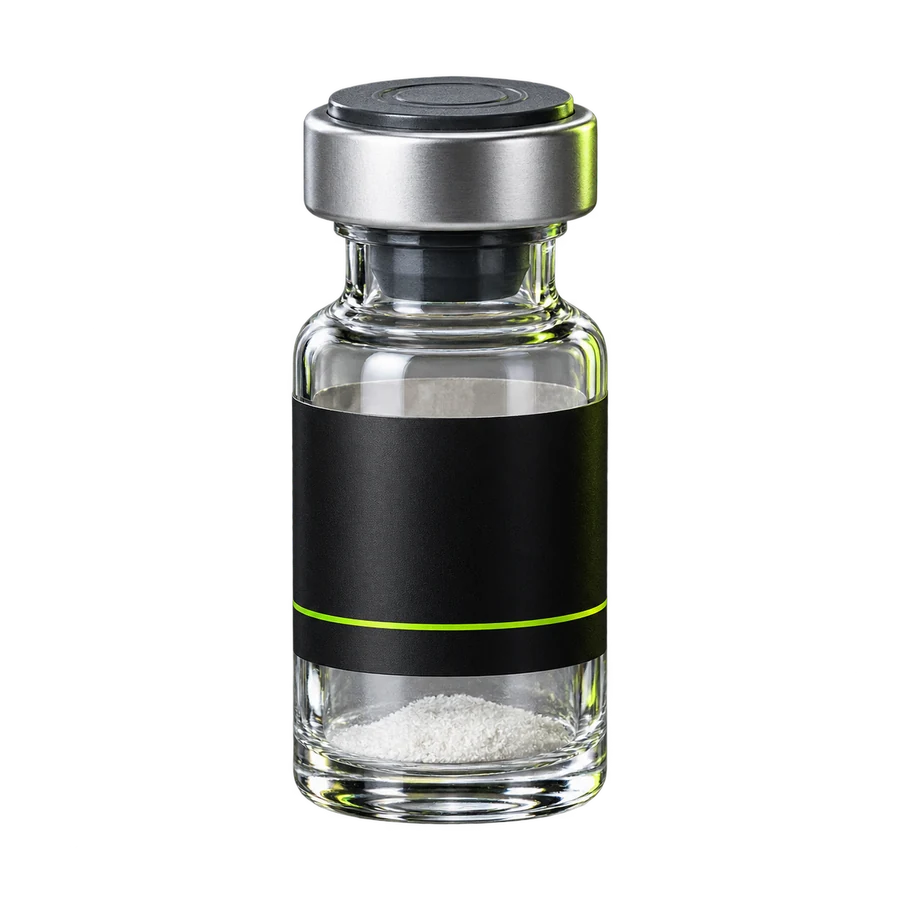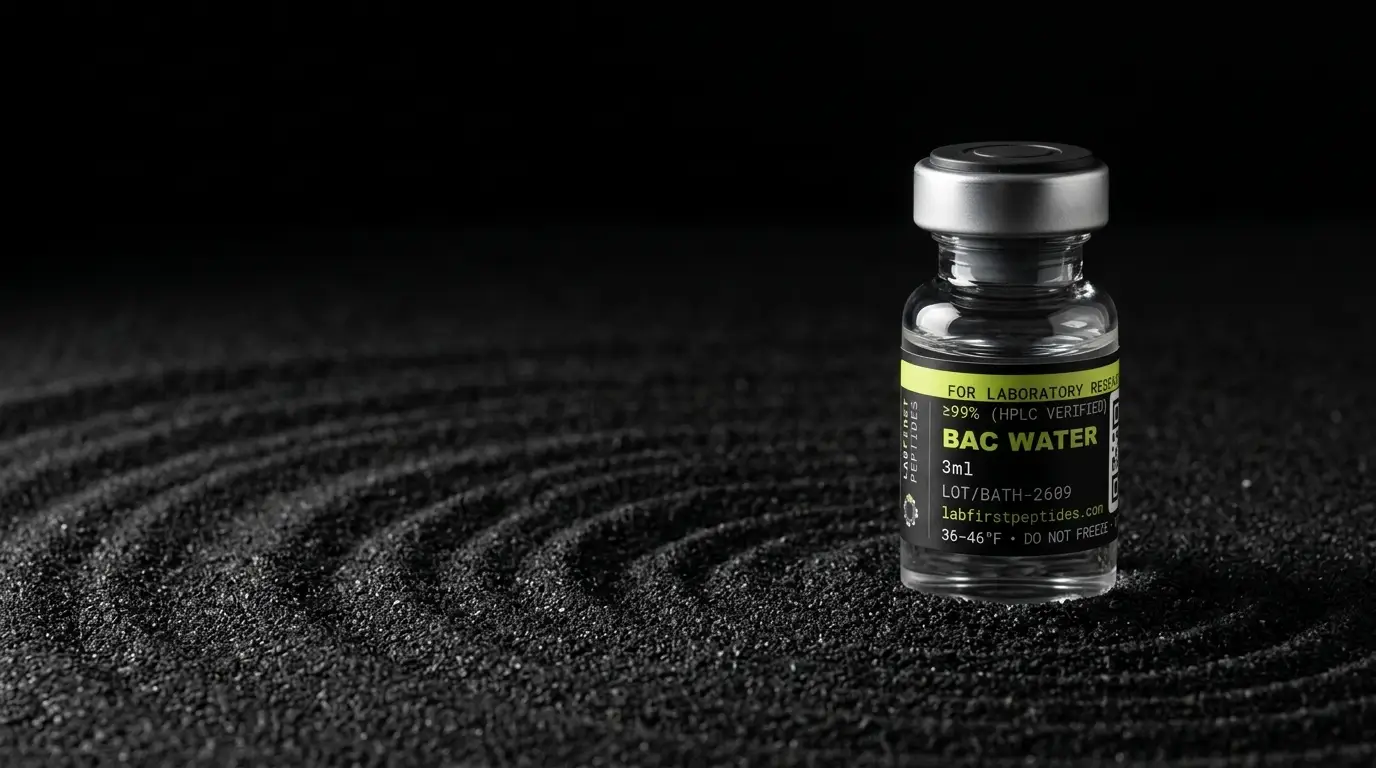
Bacteriostatic water is stored sealed at controlled room temperature, away from light and freezing. Its stability rests on the benzyl alcohol preservative and on closure integrity rather than on refrigeration. A retest date describes an unopened vial held under stated conditions, and says nothing about a vial already in use.
- Sealed storage at controlled room temperature, away from light, with freezing avoided.
- Stability rests on the benzyl alcohol preservative and closure integrity, not on refrigeration.
- A retest date describes an unopened container held under stated conditions only.
- Bacteriostatic suppresses microbial growth; it does not sterilise on contact.
- Stability protocols test unopened units, so they do not describe a vial already in use.
- Cloudiness, particulate, colour change or a lifted closure are stop signals a certificate cannot give.
How should bacteriostatic water be stored?
Sealed, at controlled room temperature, out of direct light, and not frozen. That is the whole instruction, and it is shorter than people expect because the preparation is chemically undemanding. Water and benzyl alcohol are both stable compounds at ordinary temperatures, and neither degrades quickly in the dark in a closed container.
Refrigeration is not required and is not obviously helpful. Peptide powders are refrigerated or frozen because they are fragile; a diluent is not, and treating the two the same way is a habit rather than a requirement. Freezing is worth avoiding outright, because ice formation stresses the container and the closure, and closure integrity is the part of this product that actually matters.
Light is worth taking more seriously than temperature. Storage in the original container, in a closed box or cupboard, removes the variable entirely and costs nothing.
- Sealed, controlled room temperature, out of direct light
- Not frozen: ice stresses the container and the closure
- Retest date applies to an unopened vial under stated conditions
- First entry starts a separate clock the certificate does not cover
- Each entry adds burden the preservative works against
- Cloudiness, particulate or a lifted stopper ends the vial
What does a retest date actually mean?
A retest date is a statement about an unopened container held under the conditions written beside it. It is derived from stability data: samples stored under defined temperature and humidity, pulled at intervals, and tested to see whether they still meet specification. The date is the point at which the manufacturer stops asserting the result without testing again.
Two things follow that people routinely miss. The first is that the date is conditional on the storage conditions being met. A vial that spent a summer in a hot car has not been held under those conditions, and the date on the label no longer describes it. Nothing visible changes, which is what makes this easy to ignore.
The second is that a retest date is not an expiry in the sense of a hard cliff. It is the boundary of the evidence. Material past it is not established as failing; it is simply no longer covered by a measurement, and the honest response is to test rather than to assume in either direction.
Why does the preservative govern how long a vial lasts?
The distinguishing feature of this preparation is that it tolerates repeated entry. Benzyl alcohol at roughly 0.9 percent is bacteriostatic, meaning it suppresses microbial growth rather than sterilising on contact. That property is what allows a closure to be pierced more than once without the contents spoiling, and it is the reason the product exists as a separate category from plain sterile water.
Bacteriostatic is a weaker claim than sterile, and the difference is worth holding onto. A bacteriostatic preparation resists organisms establishing themselves; it does not instantly kill whatever enters. Repeated entries introduce repeated opportunities, and the preservative works against a rising burden rather than resetting it each time.
Practical consequence: the number of entries and the elapsed time since first entry both matter, and neither appears on a certificate. Suppliers commonly state a period after first entry. That figure comes from the preservative system and the closure, not from the water.
What does stability testing establish, and what does it miss?
A stability study is a controlled experiment. Containers from a real lot are stored at defined temperature and humidity, sampled on a schedule, and tested against the same specification the batch was released to. Accelerated conditions are used to probe what happens under stress, and long-term conditions establish the claim that ends up on the label.
What that design captures well is chemical change over time in a sealed container. What it does not capture is the container after somebody has used it. Stability protocols test unopened units, so the results describe an ideal that a working vial stops matching the moment it is first entered.
It also cannot capture handling. Temperature excursions in transit, a vial left on a warm bench for a week, a closure pierced with a blunt needle that leaves a poor reseal, are all real and none of them appear in the data. Stability testing describes the product's inherent behaviour. Everything after delivery is a separate question that the buyer owns.
What happens to a vial in transit?
Shipping is the part of the timeline nobody documents and everybody assumes went well. A parcel can sit in a hot vehicle for a day, freeze overnight in winter, or spend a week in a warehouse, and none of that appears on any paperwork that arrives with it.
For this preparation the risk is not chemical degradation. Water and benzyl alcohol tolerate a wide temperature range without meaningful change, which is why the product ships without cold chain and why that is a reasonable decision rather than a corner cut. The risk is mechanical, and it concentrates on the closure. Freezing expands the contents and stresses the seal, and a seal that has been stressed may still look perfect.
The reasonable response is a look rather than a test. Check the stopper sits flush, the seal is intact, the liquid is clear, and the volume looks right. Doing that on arrival separates a transit problem from a problem you will otherwise discover weeks later and attribute to something else.
What changes should prompt you to stop using a vial?
Visible particulate is the clearest signal. A clear liquid that has become cloudy, or that carries anything suspended in it, has changed in a way that no document accounts for. Colour change is the same category of evidence.
A compromised closure deserves the same response even when the contents look untouched. A stopper that has lifted, cracked, or no longer sits flush has stopped doing the job the preservative depends on. This is easy to miss because attention goes to the liquid rather than the top of the vial.
Loss of volume without a corresponding number of entries suggests a seal that is not holding. None of these are analytical findings, and none of them require equipment. They are the checks that catch the failures a certificate cannot, because a certificate describes the vial as it was filled and these are all things that happened afterwards.
How does storage relate to the certificate?
The two documents divide the timeline between them. A certificate of analysis reports what a laboratory measured on a sample drawn at one point, and the certificate guide covers how to read one field by field. Storage evidence covers what happens to the material after that point, under stated conditions.
Neither substitutes for the other, and confusing them is the common error. A recent certificate on a badly stored vial proves nothing useful about the liquid in front of you. Good storage of material that never had a certificate proves nothing about what is in it.
Lot certificates for material supplied by us resolve through the certificate verification page, and the sizes carried are listed on the BAC water product record.
What is the regulatory position?
Stability expectations for finished pharmaceutical products are set out in international guidance, which defines the storage conditions, the sampling intervals and the specification testing that support a shelf-life claim. That framework governs drug products manufactured for human use.
Research-grade bacteriostatic water is not a finished drug product, and its documentation does not carry the weight of a pharmacopoeial shelf life. A supplier can honestly report the conditions material was held under and what testing was done on it. Presenting that as equivalent to a drug product shelf life would be overstating it, and the two are frequently displayed as though they were the same thing.
The useful question to ask a supplier is narrow and answerable: under what conditions was this lot stored, and what was measured, when. Vague reassurance about quality is not an answer to it.
FOR LABORATORY AND IN-VITRO RESEARCH USE ONLY. NOT FOR HUMAN OR ANIMAL CONSUMPTION. NOT FOR PERSONAL, MEDICAL, DIAGNOSTIC, THERAPEUTIC, OR RECREATIONAL USE.
What is BAC Water studied for?
Published research on BAC Water investigates the areas below, which is a different question from what BAC Water will do for anyone, a claim about a living system that nothing on this site is sold for.
What it is. Bacteriostatic water: sterile water with benzyl alcohol added to hold back bacterial growth. Not a peptide and not an active compound.
What the research looks at. A laboratory diluent rather than a subject of research. What matters here is that it is a solvent, and what a solvent is made of affects the stability of whatever gets dissolved in it.
How it is thought to work. The benzyl alcohol stops bacteria multiplying, which is what separates bacteriostatic water from plain sterile water and is why a sealed multi-use container can be entered more than once under laboratory conditions.
What is not established. This record covers the diluent as laboratory material only. Nothing here describes preparing, combining or administering any substance, and a diluent being in the catalogue implies no such use.
The full record, including the certificate for the lot in stock, is on the BAC Water product page.
Common questions
Does bacteriostatic water need to be refrigerated?
How long does bacteriostatic water last after it is first opened?
What is the difference between a retest date and an expiry date?
What should make me discard a vial of bacteriostatic water?
Does the certificate of analysis cover storage?
More documentation guides
Sources
- PubChem Compound Summary for CID 244, Benzyl alcohol. The openable record for the preservative whose behaviour governs multi-entry use, supporting the stability discussion above.
- ICH Q2(R2), Validation of Analytical Procedures . Defines what makes an analytical result valid and reproducible, which is the basis for treating a stability result without a named method and stated conditions as unverifiable.
- 21 CFR 211.84, Testing and approval or rejection of components and containers. Sets sampling and testing expectations for containers and closures, supporting the treatment of closure integrity as part of the product rather than packaging.