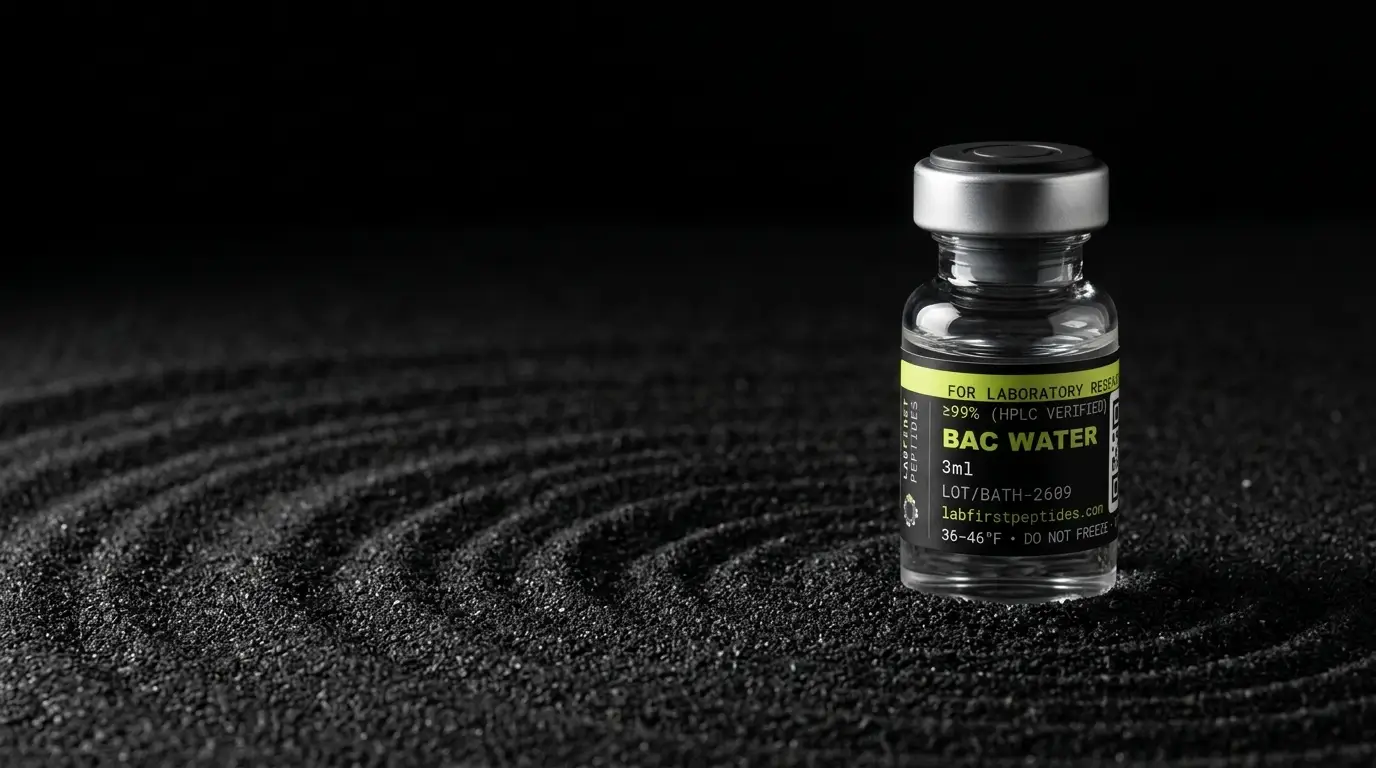
A bacteriostatic water certificate is a lot-specific test report for a preparation, not a molecule. Read it in order: lot identifier against the vial, test date, benzyl alcohol assay near 0.9 percent, sterility, bacterial endotoxins, pH, fill volume, and the issuing laboratory. Verify the report number with that laboratory.
- Bacteriostatic water is a preparation, not a compound, so its certificate reports concentration and sterility rather than a molecular mass.
- The preservative is benzyl alcohol at roughly 0.9 percent, catalogued as PubChem CID 244.
- Sterility and bacterial endotoxin answer different questions, and a sterile preparation can still carry endotoxin.
- A certificate without a lot number matching the vial describes someone else's material.
- Container closure integrity is the field most often missing, and the preservative claim depends on it.
- Research-grade material is not the pharmacopoeial Bacteriostatic Water for Injection drug product.
What is a certificate of analysis for a diluent?
Most certificates in this catalogue describe a single molecule. A vial of peptide has a formula, a mass, and a chromatogram, and the document exists to say that the powder matches all three. Bacteriostatic water is a different kind of thing. It is a preparation: water, with benzyl alcohol added at roughly 0.9 percent so that the contents resist microbial growth after the closure has been pierced.
That difference changes what the paper can honestly claim. There is no molecular mass to confirm, because the product is not one compound. What a laboratory can measure is how much preservative is present, whether the liquid is sterile, whether it carries bacterial endotoxin, what its pH is, and how much of it is in the vial. Those five results are the certificate.
A document that reports a molecular formula for bacteriostatic water has misunderstood the product. Benzyl alcohol has a formula and a mass, and those figures are worth knowing, but they describe the preservative rather than the preparation it is dissolved in.
- Lot number on the report against the lot number on the vial
- Test date after the fill date, and distinct from the print date
- Benzyl alcohol assay near 0.9 percent, with the method named
- Sterility: growth or no growth, from a sample drawn at fill
- Bacterial endotoxin, which survives sterilisation and is asked separately
- pH and fill volume against the declared vial size
- Accession number confirmed at the issuing laboratory, not with the seller
How do you read the certificate field by field?
Start at the lot number and stop there until it matches. The number printed on the report has to be the number on the vial in front of you. If it does not match, nothing further on the page describes your material, however good the results look. This is the single most common failure and it takes four seconds to check.
Then the dates. A certificate carries a test date, and the test date should fall after the fill date rather than before it. A report dated earlier than the batch it claims to describe is describing something else. Print date is a third date and it means nothing analytically.
After that, read the results in the order the tests actually matter for a sterile liquid: preservative content, sterility, endotoxin, pH, fill volume. Each should carry a method reference beside it. A number with no named method is an assertion, not a measurement, and the method is what makes the number reproducible by anyone else.
Why is identity here a preservative assay rather than a mass?
For a peptide, identity is settled by mass spectrometry: the instrument reports what the molecule weighs and the answer either matches the expected value or it does not. For bacteriostatic water there is nothing to weigh in that sense. The identity question is instead a question about concentration. Is the preservative present, is it the right preservative, and is it at the stated level?
Benzyl alcohol is measured by chromatography, usually gas chromatography or reversed-phase HPLC with ultraviolet detection. Both are separation methods: the preservative is pulled away from everything else in the sample and quantified against a reference standard of known purity. The reference standard is the part people skip when reading a report, and it is the part that makes the number mean anything.
The compound itself is well characterised and openly documented. Benzyl alcohol is C7H8O with an average mass near 108.14, catalogued as PubChem CID 244. Those are the figures for the preservative. The diluent is water, and the certificate reports the preparation the two of them make together.
What do the sterility and endotoxin results actually tell you?
Sterility testing asks whether viable organisms can be recovered from the sample under conditions that would let them grow. It is not a scan of the vial on your bench. A sample is drawn, incubated in growth media for a defined period, and the result is read as growth or no growth. That is evidence about the batch at the moment it was sampled.
Bacterial endotoxin is a separate question and a stricter one. Endotoxin is a fragment of bacterial cell wall that survives sterilisation, so a preparation can be genuinely sterile and still carry it. A sterile result and an endotoxin result answer different questions and neither substitutes for the other.
Read the preservative result alongside both. Benzyl alcohol at roughly 0.9 percent is what makes the preparation bacteriostatic rather than merely sterile at the moment of filling, and bacteriostatic is a claim about what happens after the closure is first pierced. A report showing preservative well below the stated level describes a liquid that will not do what the label says.
What about fill volume, pH and the container closure?
Fill volume sounds trivial and is not. A vial sold as 10 millilitres should contain at least that, and laboratories buying by volume are buying that number. Certificates that omit it leave the buyer measuring their own.
pH belongs on the report because it affects what happens to anything dissolved in the liquid. Bacteriostatic water sits near neutral, and a value drifting away from that is a signal worth asking about rather than a detail to skim past.
Container closure integrity is the field most often missing. The preservative exists so that the closure can be pierced without the contents spoiling, which means the closure is part of the product rather than packaging around it. A stopper that does not reseal makes the preservative claim moot. Not every research-grade supplier tests this, and its absence is worth noticing even though it is common.
How do you verify the certificate is genuine?
Check it at the issuing laboratory rather than with the seller. An independent testing laboratory issues each report against an accession number or verification key that resolves on the laboratory's own site. Type the number in there. If it resolves to a different product, a different lot, or nothing at all, the document is worthless no matter how it is formatted.
Certificates with the verification key removed deserve particular suspicion. A stripped key is not a formatting choice, and this is not a hypothetical concern in this market. Our own lot reports are published against the certificate verification page, and the material they describe is listed on the BAC water product record.
A PDF is easy to edit. The lookup at the laboratory is the part that is difficult to fake, which is exactly why it is the step worth taking.
What does the certificate not cover?
A certificate describes a sample drawn from a lot on one date. It says nothing about what happened to the vial afterwards, and that gap is where most disappointment lives. Storage temperature, light exposure, how many times the closure has been pierced, and how long the vial has been open are all outside the document entirely.
This matters more for a preserved liquid than for a sealed powder. The preservative is what allows repeated entry, and its effectiveness is a property of the preparation as filled rather than a permanent guarantee. A certificate showing 0.9 percent on the day of testing is not a statement about the same vial six months and twenty entries later.
Handling questions belong with the storage record rather than the test report, and the two documents answer genuinely different questions. Reading the certificate as though it covered both is the mistake worth avoiding.
What is the regulatory position?
There is a pharmacopoeial monograph for Bacteriostatic Water for Injection, which is a finished drug product made under drug manufacturing rules for use in people. Research-grade bacteriostatic water is not that product, and a certificate for one does not make a listing for the other. Any supplier blurring those two things is describing a regulatory status it does not hold.
What a research-grade certificate can honestly establish is what a named laboratory measured on a named lot on a named date, by named methods. That is a real and useful claim. It is simply a narrower one than a pharmacopoeial monograph, and the difference is worth understanding before comparing two documents that look superficially alike.
Lot reports for material supplied by us are held against the product record, and certificates are issued per lot rather than per product.
FOR LABORATORY AND IN-VITRO RESEARCH USE ONLY. NOT FOR HUMAN OR ANIMAL CONSUMPTION. NOT FOR PERSONAL, MEDICAL, DIAGNOSTIC, THERAPEUTIC, OR RECREATIONAL USE.
What is BAC Water studied for?
Published research on BAC Water investigates the areas below, which is a different question from what BAC Water will do for anyone, a claim about a living system that nothing on this site is sold for.
What it is. Bacteriostatic water: sterile water with benzyl alcohol added to hold back bacterial growth. Not a peptide and not an active compound.
What the research looks at. A laboratory diluent rather than a subject of research. What matters here is that it is a solvent, and what a solvent is made of affects the stability of whatever gets dissolved in it.
How it is thought to work. The benzyl alcohol stops bacteria multiplying, which is what separates bacteriostatic water from plain sterile water and is why a sealed multi-use container can be entered more than once under laboratory conditions.
What is not established. This record covers the diluent as laboratory material only. Nothing here describes preparing, combining or administering any substance, and a diluent being in the catalogue implies no such use.
The full record, including the certificate for the lot in stock, is on the BAC Water product page.
Common questions
Does bacteriostatic water have a molecular formula?
What tests should appear on a BAC water certificate of analysis?
What is the difference between sterile water and bacteriostatic water?
How do I verify a bacteriostatic water certificate is real?
Is research-grade bacteriostatic water the same as the pharmacopoeial product?
More documentation guides
Sources
- PubChem Compound Summary for CID 244, Benzyl alcohol. The openable record for the preservative in bacteriostatic water, giving the molecular formula C7H8O and an average mass near 108.14 used in the identity discussion above.
- ICH Q2(R2), Validation of Analytical Procedures . Defines what makes a chromatographic assay valid, including specificity, accuracy and the role of the reference standard, which is the basis for treating a preservative result without a named method as unverifiable.
- 21 CFR 211.84, Testing and approval or rejection of components and containers. Sets out sampling and testing expectations for components and container closures, supporting the point that closure integrity is part of the product rather than packaging around it.
- Finnrick independent verification portal. Third-party lookup used to confirm that a certificate resolves to the lot it claims to describe, rather than confirming a document with the seller who supplied it.