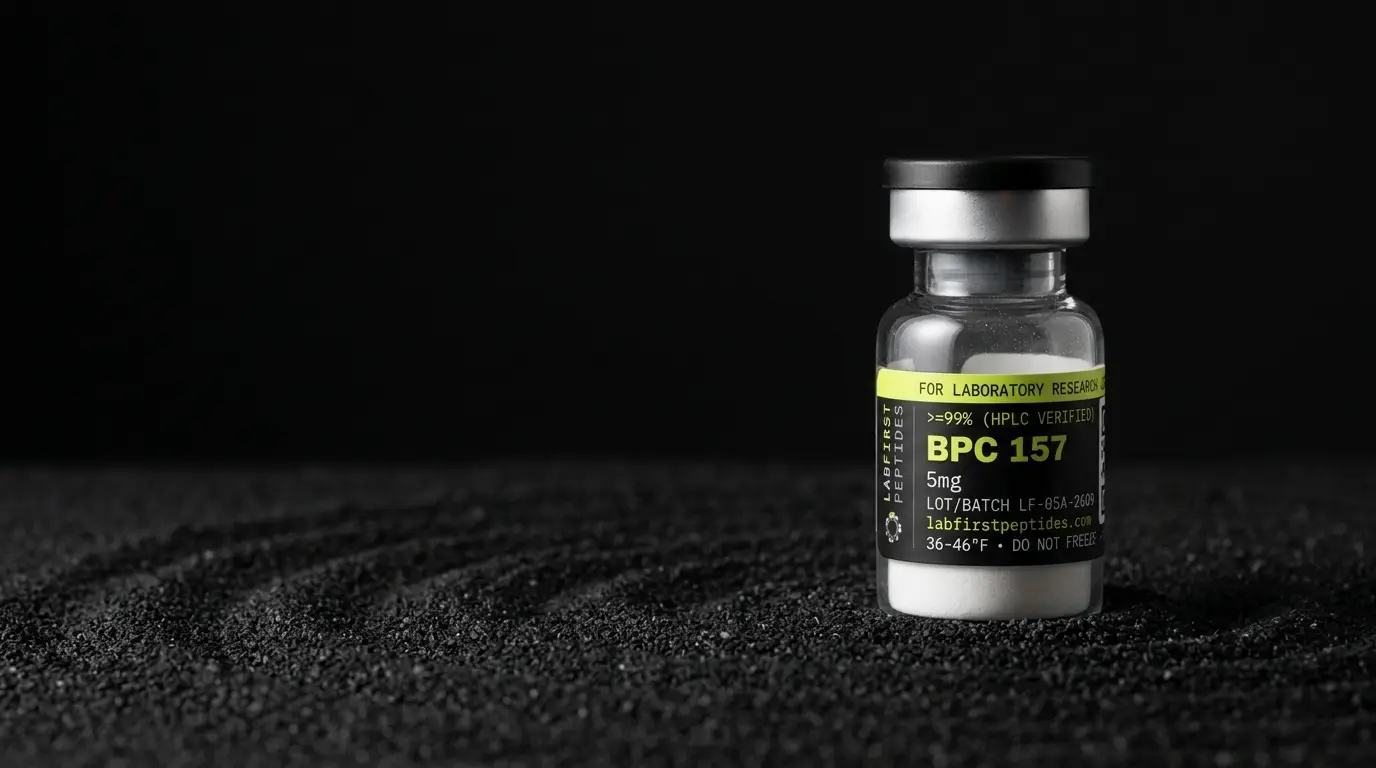
A BPC 157 certificate of analysis is a lot-specific test report. Reading it means checking six things: the lot number against the vial, an identity method with an observed mass near 1419.5 Da, an RP-HPLC purity figure with its chromatogram, net peptide content, a test date, and a named laboratory you can contact directly.
- BPC 157 is a synthetic pentadecapeptide with molecular formula C62H98N16O22 and an average mass a little over 1419 Da; identity on a certificate is confirmed against that mass by mass spectrometry.
- No USP or NF monograph exists for BPC 157, so the lot's certificate of analysis is the only specification the material carries.
- RP-HPLC area-percent purity is chromatographic purity; it does not measure water, counterion, or net peptide content.
- A certificate verifies with the issuing laboratory, by report number and lot, never with the seller alone.
- BPC 157 sat in Category 2 of the FDA's 503A bulk drug substances list from 29 September 2023 until its removal in April 2026, and removal did not make it approved or permitted for compounding.
The document that stands in for a monograph
Think of it like the inspection sheet for one used car. It tells you about that exact car, checked on a stated date, by a named inspector. A BPC 157 certificate does the same for one lot, and it only counts if the lot number matches your vial.
For a compendial substance, the question of whether a lot is acceptable has an official answer: the USP or NF monograph defines the tests, the limits, and the methods, and a certificate of analysis simply reports the lot's results against them. BPC 157 has no monograph. No official standard anywhere defines what an acceptable article of this substance is, and there is no approved product to borrow a specification from. Whatever the certificate says is the entire specification of the lot in front of you.
That changes how the document has to be read. A certificate issued against a monograph can be skimmed, because the standard already did the thinking. A certificate for BPC 157 has to be read the way an auditor reads one, field by field, because the seller chose which tests to run, which methods to name, and which numbers to print. Nothing forced any of those choices to be sound.
One definition before starting. A certificate of analysis is a lot-specific test report: it describes measurements one laboratory made on one batch on one date. It is not a general claim about a product line, a supplier, or the next lot. A certificate that cannot be tied to the lot in your hand describes something you did not buy.
- Lot number matches the vial exactly
- Identity: named MS method, expected and observed mass
- Purity: RP-HPLC percentage with the chromatogram attached
- Net peptide content stated, or fill mass treated as an upper bound
- Test date specific and consistent with manufacture
- Issuing laboratory named, real, and willing to confirm the report
The field-by-field map
Six fields carry the weight. The table is the first pass; the sections after it expand the three that decide most purchasing decisions.
| Field | What a sound entry shows | Walk away when |
|---|---|---|
| Compound and sequence | Names BPC 157 and states the molecular formula C62H98N16O22 or the fifteen-residue sequence | A trade name alone, with no formula and no sequence |
| Lot or batch number | Matches the lot printed on the vial label exactly | Missing, or stated nowhere on the certificate |
| Date of analysis | A specific test date, consistent with the lot's manufacture | A print date standing in for a test date |
| Identity | A named mass-spectrometric method with expected and observed mass | The word "conforms" with no method and no number |
| Purity | RP-HPLC area percent at a stated wavelength, chromatogram attached | A bare percentage with no method parameters and no trace |
| Net peptide content | A separate content figure with its own method named | Purity presented as if it were content |
| Issuing laboratory | A named laboratory with a real address and a working contact | An unnamed "third-party lab", or the seller's own letterhead only |
Two of these deserve a note before the detailed sections. The date of analysis describes the lot on the day it was tested, and everything after that date is a storage question the certificate cannot answer; the reasoning in the storage and stability guide applies to this compound as much as to any other lyophilized peptide. And the lot match is binary. A pristine certificate for lot A says nothing about the vial from lot B on your bench, however similar the labels look.
Identity: the mass has to match the molecule
BPC 157 is a synthetic pentadecapeptide: fifteen residues, sequence GEPPPGKPADDAGLV, molecular formula C62H98N16O22, average molecular weight a little over 1419 daltons. Those numbers are the anchor for the identity section, and PubChem's compound record is the convenient public reference for them. Identity testing on a peptide of this size is almost always mass spectrometry, reported as ESI-MS or as part of an LC-MS run, occasionally MALDI-TOF.
A sound identity entry shows three things: the method by name, the expected mass, and the observed mass. In electrospray work the raw observation is often a multiply charged ion rather than the neutral molecule, so a certificate may report a deconvoluted mass or the ion series itself. Either is fine as long as the arithmetic lands on the molecule. What the entry may not do is skip the numbers. "Identity: conforms" with no method and no measurement is an assertion, and assertions are what the certificate exists to replace.
Two soft spots. Retention-time agreement against a reference standard is sometimes offered as identity on its own; it is supporting evidence, and weak by itself, because many things co-elute. Full sequence confirmation by tandem MS is rare on routine certificates, which is acceptable. Intact mass is the reasonable minimum for a synthetic peptide, since a wrong or truncated sequence almost always shows up as a wrong mass.
Purity: what the RP-HPLC percentage says, and what it leaves out
The purity figure on a peptide certificate is nearly always area-percent purity by reversed-phase HPLC: the main peak's share of total integrated peak area, detected by UV at a stated wavelength, usually 214 or 220 nm where the peptide bond absorbs. Read as exactly that, it is a useful number. It says the method separated the sample into peaks and the main one accounted for, say, 98.6% of the absorbance the detector saw.
What it does not say matters just as much. Water does not absorb at 214 nm and never appears. Neither does the counterion carried over from synthesis and purification, trifluoroacetate or acetate depending on the process. Co-eluting impurities hide inside the main peak. Anything without a chromophore at the detection wavelength is invisible to the whole exercise. A lot can be 99% pure by this measure while a fifth of the vial's mass is something other than peptide, with no contradiction between the two figures.
The practical checks are physical. The chromatogram itself should be printed on the certificate, with a peak table and the method parameters: column, gradient, wavelength. Analytical method reporting is its own discipline with its own guideline in ICH Q2, and while nobody expects a validation package behind a research chemical, a certificate that names no column and no gradient is not reporting a method at all. Purity quoted to implausible precision, or chromatograms that repeat pixel for pixel across lots and compounds, close the question in the other direction.
Net peptide content: what a milligram actually means
A lyophilized peptide solid is never pure peptide by mass. It carries bound water and the counterion salt of its synthesis, together commonly somewhere between ten and thirty percent of the solid's weight. Net peptide content is the measurement that accounts for this: the fraction of the solid that is peptide, determined by amino acid analysis, elemental nitrogen, or quantitative UV against the sequence's calculated absorptivity.
The arithmetic is where it bites. A vial with a 5 mg fill at 80% net content holds 4 mg of peptide:
5 mg × 0.80 = 4 mg
Brought into 2 mL of diluent, that is 2.0 mg/mL where the fill mass alone would have suggested 2.5. Every concentration a laboratory documents downstream inherits that correction or inherits the error, and the cost-per-milligram tool returns a truer figure when the content number, rather than the fill, is the input.
Most research-market certificates omit net content, and the omission is itself information. Measuring it costs real analytical work, so a supplier who reports it, with the method named, is showing you a documentation habit the rest of the certificate should be read in light of. Where it is absent, treat the fill mass as an upper bound on peptide and record it that way in your own notes.
Verifying the certificate with the issuing laboratory
The certificate PDF arrived from the seller, which makes the seller the one thing it cannot vouch for. Verification runs through the issuing laboratory. A genuine certificate names that laboratory, and a genuine laboratory can confirm, given the report number and the lot, that it issued the document and that the numbers match its records. That confirmation is a short email, and a testing house doing contract work answers it routinely.
Before sending it, three checks cost nothing. The laboratory should exist outside the certificate: an address, a working website, a phone that answers. If the certificate claims third-party status, the letterhead should not resolve to the seller. And if the laboratory claims ISO/IEC 17025 accreditation, the accreditation body's public registry will list it, with a scope covering the kind of testing on the certificate; accreditation for one test type is not accreditation for everything.
Where the order size justifies it, independent retest is the strong form of all of this: send a portion of the received lot to a laboratory you chose yourself, for intact mass and RP-HPLC. Our own quality standard describes the documentation we treat as the floor for the catalog, including the BPC 157 record this guide supports. The refusal cases are simple. A seller who will not name the testing laboratory, or who names one with no record of the report, has answered the diligence question, just not in the direction intended.
Regulatory status, with dates
BPC 157 is not an ingredient in any FDA-approved product, and no USP or NF monograph covers it. Its compounding status has moved twice in three years. The FDA placed it in Category 2 of the 503A bulk drug substances list, the category for substances that may present significant safety risks, effective with the agency's update of 29 September 2023. In April 2026 the agency removed it from Category 2 after the nomination behind the listing was withdrawn.
Removal is narrower than it sounds: the substance was not added to the permitted-bulks category, and it remains unapproved. BPC-157-related substances were before the Pharmacy Compounding Advisory Committee again on 23 July 2026, so the status is still in motion, and anyone relying on it should read the FDA's current list rather than any summary, including this one. Status checked August 2026.
None of that changes what the document in this guide is for. A certificate of analysis supports laboratory work on a research chemical, and nothing else. FOR LABORATORY AND IN-VITRO RESEARCH USE ONLY. NOT FOR HUMAN OR ANIMAL CONSUMPTION. NOT FOR PERSONAL, MEDICAL, DIAGNOSTIC, THERAPEUTIC, OR RECREATIONAL USE.
What is BPC 157 studied for?
Published research on BPC 157 investigates the areas below, which is a different question from what BPC 157 will do for anyone, a claim about a living system that nothing on this site is sold for.
What it is. A man-made fifteen-amino-acid peptide, based on a protein found in stomach juice.
What the research looks at. It appears in animal and cell-culture research on tissue and blood-vessel biology. Almost everything published is animal or cell work.
How it is thought to work. Nobody has settled how it works. Cell and animal studies report effects on blood-vessel growth signals and on several growth-factor pathways, but no single receptor has been pinned down as its target and the studies do not agree on one model.
What is not established. No FDA-approved product contains BPC 157, and no USP or NF standard defines what an acceptable batch is. Human evidence is close to nonexistent. Any figure printed on a research vial is the supplier’s number, not an official one.
The full record, including the certificate for the lot in stock, is on the BPC 157 product page.
Common questions
What should the identity section of a BPC 157 certificate show?
Is 99% purity the same as 99% peptide by weight?
How do I verify a certificate of analysis is genuine?
Does the certificate have to match my vial's lot number?
What does the test date on a certificate actually cover?
Published certificates for BPC 157
Every figure below is read from a report the laboratory issued for that lot; each page carries the PDF and the lab's own verification link.
More documentation guides
Sources
- PubChem compound record for BPC 157. Public reference for the molecular formula C62H98N16O22, the fifteen-residue sequence, and the average molecular weight used as the identity anchor.
- FDA 503A bulk drug substances list and Pharmacy Compounding Advisory Committee materials, 2023 to 2026. Supports the Category 2 placement effective 29 September 2023, the April 2026 removal following withdrawal of the nomination, and the 23 July 2026 committee review.
- ICH Q2 guideline on validation of analytical procedures. Supports the point that a reported analytical method carries named parameters; cited for the reporting standard, not to claim research-market certificates meet it.
- ISO/IEC 17025 accreditation framework. Basis for checking a testing laboratory's accreditation claim against the accreditation body's public registry and scope.