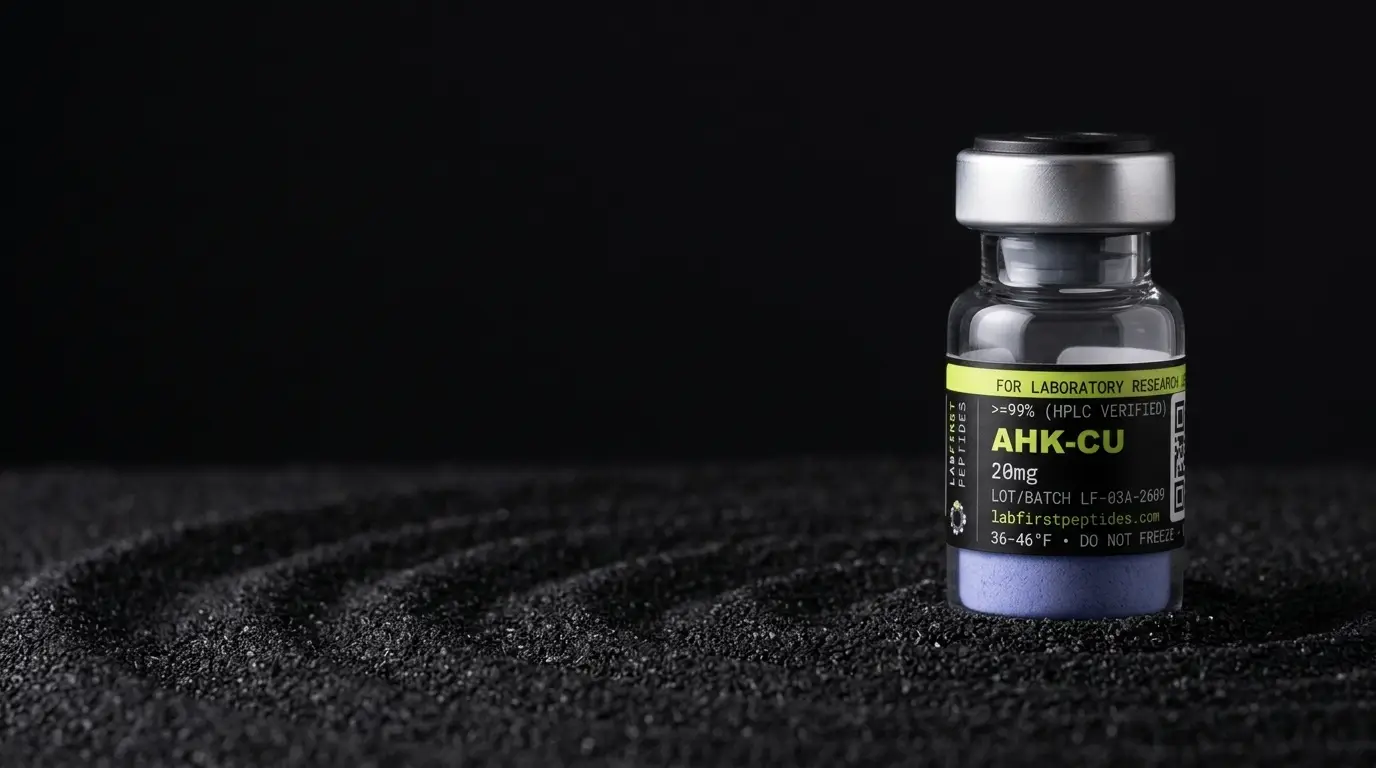
For AHK-Cu storage and stability, keep the vial sealed, dry, cool and dark. The main risk is that the complex can come apart. Copper binding depends on pH, and acidic conditions free the metal. Colour is a real indicator here, which is unusual. The bound copper is also redox-active, one more reason to keep conditions steady.
- The failure to guard against is dissociation of the complex, not degradation of the peptide.
- Copper binding competes with hydrogen ions, so acidity frees the metal.
- That inverts the usual advice: for most peptides here mild acidity is the safe choice.
- Colour is a genuine indicator, because bound copper absorbs visible light specifically.
- The bound copper is itself a redox-active metal, constrained while coordinated.
- A purity-only stability method follows the peptide and misses the metal entirely.
How should AHK-Cu be stored?
Think of it like a magnet on a fridge door. The copper is held on but not welded, so the wrong conditions, such as acid, can pull it off. That is why storing this compound is about keeping the complex together.
Sealed, dry, cool and dark, in the container it arrived in. The instruction reads like every other page in this library and the reasons behind it are different, because the thing most likely to go wrong is not degradation of a peptide.
It is dissociation of a complex. This product is a tripeptide with a copper ion bound to it, and that binding is a reversible interaction rather than a permanent covalent bond.
So the failure to guard against is the copper coming off, which leaves both components present and the compound itself gone.
- Sealed, dry, cool and dark, in the original container
- The risk is the complex coming apart, not the peptide breaking down
- Acidity frees the copper, which inverts the usual peptide advice
- Colour is a genuine indicator: faded or shifted means changed coordination
- Bound copper is redox-active and constrained; free copper is not
- Clumping, colour change or precipitate ends the container
Why does pH decide whether the copper stays bound?
Because the peptide holds copper through nitrogen atoms that also bind hydrogen ions. The two compete for the same sites.
At higher pH there are fewer hydrogen ions around, those nitrogens are available, and the copper is held well. As conditions become more acidic, hydrogen ions increasingly occupy those positions and displace the metal.
The practical rule is the reverse of most peptides in this catalogue. Elsewhere mildly acidic conditions are the safe choice, because they slow deamidation and disulfide exchange. Here acidity is what takes the product apart, and that inversion is worth holding onto rather than applying peptide habits by reflex.
What does dissociation look like?
A colour change, and this is the one product in the catalogue where the eye is a genuine instrument.
The complex is coloured because copper bound to a peptide absorbs visible light in a specific way. Free copper salts absorb differently, and the free peptide barely absorbs in the visible at all.
So a solid or solution that has shifted noticeably in colour, or faded toward pale, has changed its coordination. That is a real analytical observation available without equipment, and it is the reason the appearance field on this certificate is worth reading where on a white peptide it is nearly meaningless.
Does the copper create problems of its own?
Yes, and it is a neat irony worth understanding. Copper is a redox-active metal, which means it can cycle between oxidation states and catalyse oxidation reactions.
Elsewhere in this library trace copper appears as a contaminant to exclude, arriving from glassware or buffers and accelerating the degradation of peptides that carry oxidisable residues. Here the copper is deliberately part of the product.
So this compound carries its own potential oxidation catalyst. In the intact complex the metal is coordinated and constrained, which limits that reactivity considerably. Free copper released by dissociation is a different matter, which gives a second reason to care about keeping the complex together.
Does moisture matter?
Yes, for two reasons rather than the usual one. Water enables hydrolysis of the peptide backbone as it does for any peptide, which is the familiar argument for a dry sealed container.
It also provides the medium in which coordination chemistry happens at all. A dry solid holds its structure; a damp one gives ions the mobility to move and equilibria the opportunity to shift.
Opening a cold container in a warm room draws condensation onto the material, so letting it reach room temperature before opening removes the problem at no cost. That advice is the same everywhere in this library, and here it protects the complex as well as the peptide.
Does light matter?
More than for a plain colourless peptide, and for the reason the colour itself implies. A material that absorbs visible light is a material that takes energy from it.
Coordination complexes of transition metals can undergo photochemistry through that absorbed energy, including changes in the oxidation state of the metal.
The remedy is the same as everywhere else and costs nothing. Amber glass or the original carton removes the variable. Here it protects against a mechanism the compound's own colour advertises rather than a hypothetical one.
What does a retest date actually mean?
It describes an unopened container held under the conditions printed beside it, derived from stability data: units stored at defined temperature and humidity, pulled on a schedule, tested against the release specification.
The date is conditional on those conditions being met. Material held elsewhere is not described by it.
It is also not a cliff. Material past a retest date is not established as failing, it is outside the evidence, and testing is the honest response rather than assuming in either direction. A pharmaceutical expiry is a stronger claim made under rules research-grade material is not made under.
What should a stability method have measured?
Both halves of the product, and this is where a stability study on a metal complex can quietly fall short.
A protocol that tracked only chromatographic purity followed the peptide. It would report a healthy figure on material whose copper had entirely dissociated, because the peptide is still there and still elutes where it should.
A protocol that genuinely covers this product tracks copper content and evidence of coordination alongside peptide purity. Asking which of those was measured is a fair question, and the answer says a good deal about whether the supplier understands what they are selling.
What does stability testing not capture?
Everything after dispatch. A stability study tests unopened units under controlled conditions, so its results describe an ideal a working container stops matching once opened.
Transit is the least documented stretch, and none of it appears on paperwork that arrives with the material.
The buffer any solution is made up in is the gap specific to this compound, and it is entirely outside any protocol. Its pH decides whether the copper stays where it belongs, and that is a property of the experiment rather than of the material you were sold.
What should make you stop using a container?
Colour change above all. A material noticeably paler, or shifted in hue from what the certificate describes, has undergone a change in coordination and is no longer the compound the document reports.
Clumping or stickiness indicates moisture uptake, with the same consequences as for any hygroscopic solid.
In solution, cloudiness or precipitate. Copper compounds can precipitate as conditions shift, and a solid appearing in a solution that was clear is unambiguous. For once these visible signals cover most of what can actually go wrong, which is a welcome change from the rest of this library.
That is a rare position to be in and worth stating plainly. On a white lyophilised peptide the visible checks catch moisture and little else, and the real chemistry hides. Here the dominant failure has a colour, so a careful look genuinely covers most of the risk.
How does storage relate to the certificate?
They split the timeline and neither covers the other half. A certificate reports what was measured on a sample drawn at one moment, and the certificate guide covers how to read one field by field. Storage evidence covers what happened afterwards.
The split is unusually favourable here, because the main failure is visible. A certificate plus an intact colour is a stronger combination than a certificate alone, which is not something that can be said for a white lyophilised powder.
Lot reports for material supplied here resolve through the certificate verification page, and the sizes carried are on the AHK-Cu product record.
What is the regulatory position?
Stability expectations for finished pharmaceutical products are set out in international guidance defining storage conditions, sampling intervals and the testing that supports a shelf-life claim. That framework governs drug products made for human use.
There is no FDA-approved product containing AHK-Cu and no United States pharmacopoeial monograph defining an acceptable batch, so no official standard requires copper content or coordination to be tracked over time.
A supplier can honestly report the conditions a lot was held under and what was measured. The useful question stays narrow: what conditions, what measurement, and did it cover the metal as well as the peptide.
FOR LABORATORY AND IN-VITRO RESEARCH USE ONLY. NOT FOR HUMAN OR ANIMAL CONSUMPTION. NOT FOR PERSONAL, MEDICAL, DIAGNOSTIC, THERAPEUTIC, OR RECREATIONAL USE.
What is AHK-Cu studied for?
Published research on AHK-Cu investigates the areas below, which is a different question from what AHK-Cu will do for anyone, a claim about a living system that nothing on this site is sold for.
What it is. A three-building-block peptide (alanine, histidine, lysine) joined to copper.
What the research looks at. A smaller body of cell-culture work than GHK-Cu, on copper-peptide chemistry and skin structure.
How it is thought to work. A close relative of GHK-Cu, differing at the first building block. Like GHK-Cu it grips copper, and the copper-carrying form is what has been studied.
What is not established. No approved product, and a noticeably thinner evidence base than its better-known relative. The two get marketed as interchangeable; the published record does not support treating them that way.
The full record, including the certificate for the lot in stock, is on the AHK-Cu product page.
Common questions
Why does acidity take AHK-Cu apart?
Is that the opposite of the usual peptide advice?
Can you see whether AHK-Cu has degraded?
Does the copper itself cause problems?
Would a stability study have caught dissociation?
More documentation guides
Sources
- PubChem Compound Summary for CID 7408502, Ala-His-Lys. The openable record for the free tripeptide, showing the histidine and terminal amine nitrogens through which copper is coordinated in the complex.
- NIST Atomic Weights and Isotopic Compositions. The reference source for copper's stable isotopes, used when confirming by mass that the metal is still part of the species being measured.
- ICH Q2(R2), Validation of Analytical Procedures . Defines what makes an analytical result valid, and is the basis for asking whether a stability method covered the metal as well as the peptide.