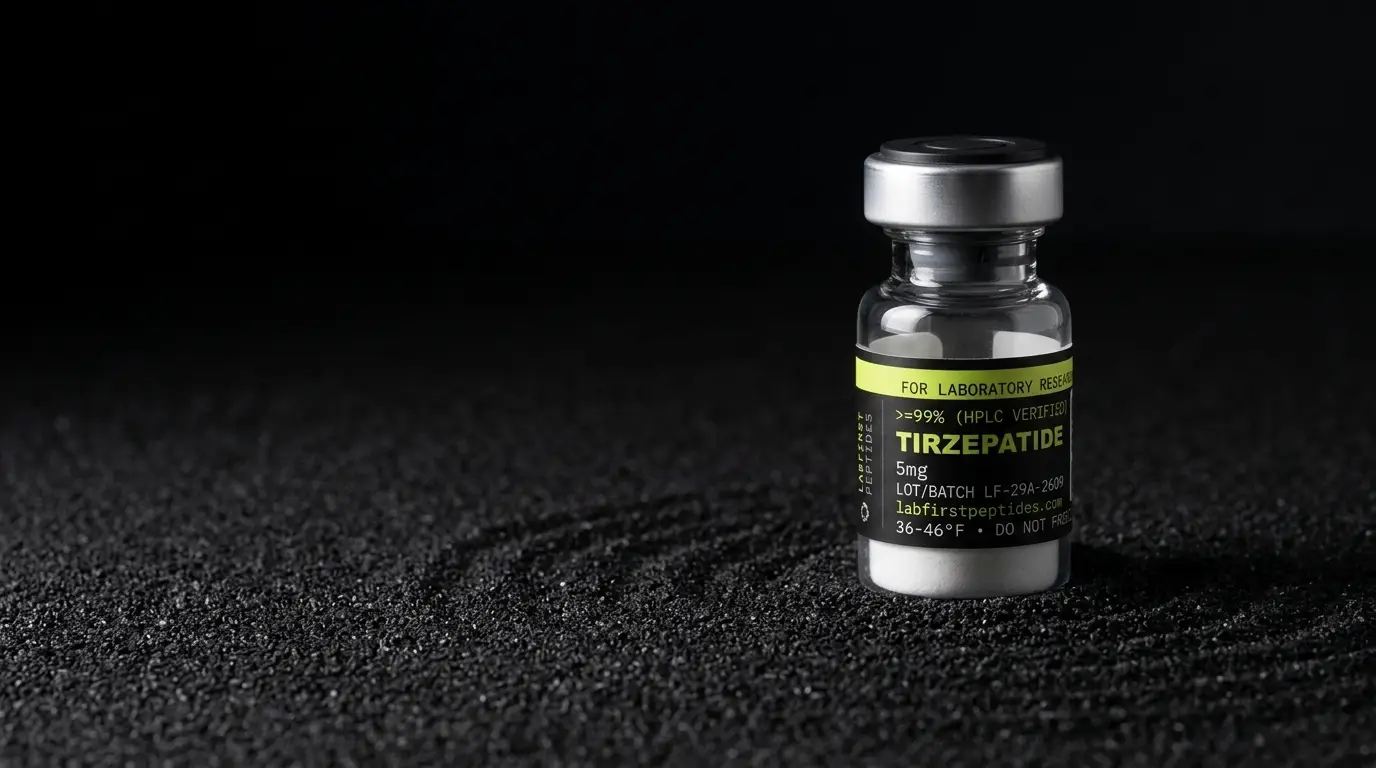
A tirzepatide certificate of analysis reports test results for one lot. It shows identity by mass spectrometry against a theoretical mass near 4813.5 Da, purity by RP-HPLC area percent, and peptide content where tested. Match the lot to the vial. Check each method has a result. Confirm the report number with the issuing laboratory, not the seller.
- A certificate of analysis is a lot-specific test report; it makes no claim about the seller's quality system, future lots, or sterility unless those tests appear with results.
- Tirzepatide's molecular formula is C225H348N48O68, giving a theoretical average mass near 4813.5 Da that the identity line's observed mass should match within instrument tolerance.
- RP-HPLC area percent counts only what the detector resolves and sees; water, salts and the trifluoroacetate counterion sit outside it, which is why purity and peptide content are different numbers.
- Peptide content for a lyophilized trifluoroacetate salt commonly runs 70 to 90 percent of fill mass, so a 10 mg vial rarely holds 10 mg of peptide.
- The only verification that settles anything is confirming the report number with the issuing laboratory through contact details found independently of the document itself.
What the document is and what it is not
Think of it like the inspection sticker inside a lift. It shows one lift was checked on one date, and it means little if the sticker came from a different building. Match the lot on the certificate to the lot on the vial.
A certificate of analysis is a test report for one lot of material. A laboratory ran named methods on samples drawn from that batch, recorded the results, and signed the document. That is the entire claim, and it is worth being precise about it, because both halves get inflated in the research-chemical trade. The certificate does not describe the seller's quality system. It does not promise that the next lot will match this one. It says nothing about sterility or endotoxin unless those tests appear on it with methods and results, and on most research-grade peptide certificates they do not. What it can do, read carefully, is answer the two questions that matter before a vial is opened: is the molecule in the vial tirzepatide, and how much of the fill is actually peptide.
Certificates come from two places. The manufacturer's own quality control issues one as part of lot release, and an independent analytical laboratory can issue a second on samples sent to it after the fact. For research material, where no regulator inspects the process, the independent report carries more weight for an obvious reason: the party that issued it has no stake in the answer. The quality standard describes how this catalog documents its own lots on that basis.
- Match the lot on the vial to the lot on the document
- Identity: observed mass against the 4813.5 Da theoretical
- Purity: RP-HPLC area percent, with the method stated
- Peptide content: the fraction of fill that is peptide
- Confirm the report number with the issuing laboratory
The fields, one by one
Set the document next to the vial it claims to describe and work through it field by field. The table below is the reading order that catches problems fastest, and the right-hand column is what the weak version of each field looks like.
| Field | What a complete certificate shows | The weak version |
|---|---|---|
| Product identity | Compound name with a sequence or structure reference and the theoretical mass stated | A trade name alone |
| Lot number | One lot identifier, matching the vial label character for character | No lot, or a lot that appears on no vial you received |
| Test date | When the analyzes ran, ahead of the ship date by a plausible interval | Missing, or later than the shipment it travels with |
| Appearance | Described physical state, such as white lyophilized powder | Absent |
| Identity | Method named (LC-MS or MALDI-TOF) with the observed mass printed beside the theoretical | The word conforms with no number |
| Purity | RP-HPLC with detection wavelength stated and area percent reported | A percentage with no method behind it |
| Net content | Measured fill mass per vial | The nominal label claim restated |
| Peptide content | Fraction of fill that is peptide, by amino acid analysis or nitrogen determination | Not reported, which is common and matters (see below) |
| Water content | Karl Fischer result | Absent |
| Counterion | Trifluoroacetate content by a named method | Absent |
| Issuing laboratory | Name, physical address, unique report number, an identifiable signatory | A logo with no address and no report number |
Absence of the optional rows is survivable. Absence of the lot, the identity method or the issuing laboratory is not; a certificate missing any of those three is a decoration, whatever numbers it carries.
Identity: the mass spectrometry line
Tirzepatide is a 39-residue linear peptide with α-aminoisobutyric acid at positions 2 and 13, a C20 fatty diacid conjugated through a linker at lysine 20, and an amidated C-terminus. Its molecular formula is C225H348N48O68, which gives an average molecular mass near 4813.5 Da; the PubChem compound record carries the same figures. That number is what the identity line exists to be compared against. A mass spectrometer measures the mass of what is actually in the sample, and the observed value should sit within the instrument's stated tolerance of the theoretical one, typically within a dalton or two after deconvolution.
The deconvolution point is worth a sentence, because raw electrospray data confuses people seeing it for the first time. An ESI source produces multiply charged ions, so the underlying spectrum is a series of peaks at different mass-to-charge values that the software collapses into a single neutral mass. A certificate reporting that deconvoluted mass is normal practice, and a supplier who can show the spectrum behind it is showing you the actual evidence.
Two readings to reject. An identity row that says conforms or passes with no observed mass is an assertion, and assertions are free. And a correct mass proves the right molecule is present; it does not say how much is there or what travels with it. Related incretin analogs differ from tirzepatide by hundreds of mass units, so the identity check is a strong discriminator against outright substitution, and that is all it is.
Purity: what the RP-HPLC number counts
The purity figure on a peptide certificate is almost always reversed-phase HPLC area percent: the target peak's share of the total integrated peak area, usually monitored at 214 or 220 nm where the peptide backbone absorbs. Read the number together with its method. A wavelength, a column and a gradient tell you what the analysis could see. A bare 99.2% tells you nothing about what it could not.
What area percent cannot see is the more useful thing to hold in mind. It does not register water, residual solvents or inorganic salts, because those do not absorb where the detector is looking or elute where the integration runs. It counts the trifluoroacetate counterion poorly for the same reason. And it cannot separate what the method fails to resolve: an impurity that co-elutes with the main peak is invisible by construction. A deamidated variant differs from the parent by a single mass unit and can run very close to it, which is why an adequate gradient from a careful laboratory is worth more than a higher number from a lazy one.
Ask for the chromatogram. A trace with a clean main peak, labeled axes and visible integration marks supports the printed number. A seller who cannot produce one is quoting a summary of a document you are not being allowed to check.
Net content and peptide content arithmetic
Chromatographic purity and peptide content answer different questions, and the difference is measured in milligrams. Purity says what fraction of the peptide material is the target molecule. Peptide content says what fraction of the weighed fill is peptide at all, as opposed to bound water and counterion, and for a lyophilized trifluoroacetate salt that fraction commonly lands between 70 and 90 percent. A certificate that reports it, by amino acid analysis or nitrogen determination, lets you compute what the vial actually holds:
10 mg fill × 0.85 peptide content = 8.5 mg peptide
8.5 mg × 0.99 purity = 8.4 mg tirzepatide
Brought into 2 mL of diluent, that vial gives a working concentration of about 4.2 mg/mL rather than the 5.0 mg/mL the label arithmetic suggests. Nothing here is a defect; it is what a lyophilized salt is. The defect is a certificate silent on the point, which leaves every downstream concentration carrying a hidden error of ten to thirty percent. The vial concentration calculator accepts a peptide-content figure where you have one, and the cost-per-milligram tool is the honest way to compare a supplier who reports content against one who does not, since the cheaper listing is not cheaper if a third of its fill mass is water and salt.
Lot match, dates and the issuing laboratory
The certificate describes a lot, so the first physical check is character for character: the lot identifier on the vial label against the lot identifier on the document. A certificate for the product in general, with no lot stated or with a lot that never appears on any vial you receive, describes someone else's material. Some sellers reuse a single good certificate across many shipments, and a lot mismatch is usually how that practice surfaces.
Dates carry information too. The test date should precede your ship date by an interval consistent with a stocked catalog item, weeks to months for most peptides. A certificate tested years before shipment describes what the lot was then; what storage has done to it since is a separate question the document cannot answer, and the storage and stability guide covers that clock in detail. A test date after the ship date is the arithmetic telling you the document was generated for the sale rather than for the lot.
The issuing laboratory block anchors everything else. A real report names the laboratory, gives a physical address, carries a unique report number, and is signed or electronically authorised by an identifiable person. Those details exist so the report can be traced back. A certificate that omits them is unverifiable even in principle, and an unverifiable test report has the evidentiary weight of a brochure.
Verifying the certificate at the laboratory
Verification means asking the laboratory, not the seller. A seller confirming its own paperwork adds nothing, since a seller willing to fabricate a certificate is equally willing to vouch for it. The party that issued the report is the only one whose confirmation settles anything, and the procedure for asking is short. Find the laboratory's contact details independently, from its own published site rather than from anything printed on the certificate, because a fabricated document can carry a fabricated phone number just as easily as a fabricated purity. Send the report number and the lot, and ask a single question: did this laboratory issue this report?
Analytical laboratories answer that question routinely. They will not release another client's data, and they do not need to; issued or not issued is the entire test. Three outcomes are possible. The laboratory confirms, and the document is what it claims to be. The laboratory has no record of the report number, and you are holding a forgery, which is worth reporting to the laboratory whose name it borrows. Or the laboratory cannot be found at all, with no site, no address that resolves and no phone that answers, in which case the certificate has failed a test simpler than any chromatography: the entity that supposedly stands behind it does not exist.
A lot-specific document that survives this check, read against the fields above, is the strongest evidence a research buyer gets before the material reaches an instrument. The Tirzepatide product record shows how lot documentation is presented for this catalog. FOR LABORATORY AND IN-VITRO RESEARCH USE ONLY. NOT FOR HUMAN OR ANIMAL CONSUMPTION. NOT FOR PERSONAL, MEDICAL, DIAGNOSTIC, THERAPEUTIC, OR RECREATIONAL USE.
What is Tirzepatide studied for?
Published research on Tirzepatide investigates the areas below, which is a different question from what Tirzepatide will do for anyone, a claim about a living system that nothing on this site is sold for.
What it is. A peptide that works on the GIP and GLP-1 receptors at the same time.
What the research looks at. There is a large published clinical record: how it behaves at the receptors, how the body handles it, and the measurements its sponsor registered its trials to take. Approved medicines containing it exist under their own brand names.
How it is thought to work. It switches on both the GIP receptor and the GLP-1 receptor. Working on two rather than one is the design feature that separates it from the GLP-1-only drugs.
What is not established. What is sold here is a research chemical, not a drug product. Listing it is not an approval, and not a claim that it is equivalent to, as safe as, or a fit substitute for any approved medicine.
The full record, including the certificate for the lot in stock, is on the Tirzepatide product page.
Common questions
What is the difference between purity and peptide content?
How do I confirm a certificate of analysis is genuine?
Does a certificate of analysis prove the material is sterile?
What observed mass should a tirzepatide identity test report?
What should happen when the vial's lot number does not match the certificate?
How recent should the test date on a certificate be?
Published certificates for Tirzepatide
Every figure below is read from a report the laboratory issued for that lot; each page carries the PDF and the lab's own verification link.
More documentation guides
Sources
- PubChem compound record for tirzepatide. Molecular formula C225H348N48O68 and the average molecular mass used as the theoretical anchor for the identity check.
- ICH Q6A, specifications for new drug substances. The framework treating identity, purity and content as distinct questions a specification answers separately; the reading order in this guide follows it.
- ICH Q2, validation of analytical procedures. What a named, validated method claims that a bare percentage does not; the basis for reading purity figures together with wavelength, column and gradient.