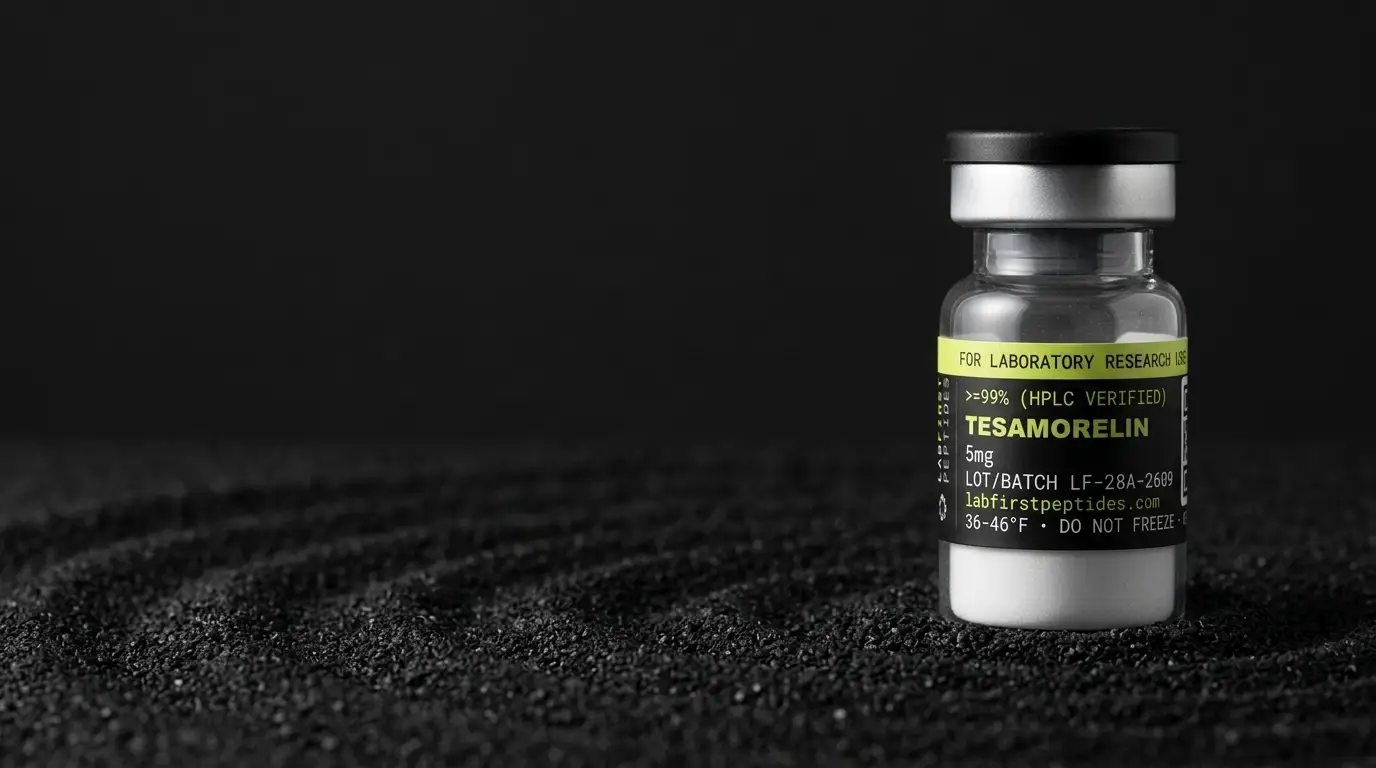
Identity is confirmed by orthogonal evidence, not a single number: high-resolution mass spectrometry matching the expected monoisotopic or average mass of the 44-residue acylated chain, retention-time agreement with a characterized reference on RP-HPLC, and where the record demands it, MS/MS sequence coverage. Purity percentage says nothing about identity.
- Identity, purity and peptide content are three separate determinations, and a purity percentage alone establishes none of the others.
- Tesamorelin is GRF(1-44) with a trans-3-hexenoyl group on the N-terminal tyrosine and a C-terminal amide, average free-base mass close to 5136 Da.
- Electrospray gives a charge envelope rather than a single peak; at least two charge states should deconvolute to the same neutral mass.
- D-amino acid substitutions and Leu/Ile interchanges are exactly isobaric with the correct compound and require a separation, not a mass measurement, to detect.
- The N-terminal acyl cap blocks Edman degradation, so N-terminal sequence data on intact tesamorelin is not obtainable by that route.
- A certificate reporting MS as 'conforms' without an observed mass and tolerance has provided nothing a reviewer can check.
Identity, purity and content are three separate questions
A certificate of analysis that reports 99.2% and nothing else has answered one question out of three, and not the first one. Purity is a statement about how much of what eluted was one peak. Identity is a statement about which molecule that peak is. Content, sometimes called assay or peptide content, is a statement about how much of the labelled mass in the vial is actually peptide rather than counterion, water and residual salts.
The three fail independently. A vial can be 99% pure and be the wrong compound, because a well-made deletion analogue or a shorter growth-hormone-releasing factor fragment chromatographs as a single clean peak. A vial can be correctly identified and still contain forty percent acetate and moisture, which is a content problem that no purity figure exposes. And a vial can carry an accurate identity confirmation performed on a different lot, which is a traceability problem that only the document layout reveals.
ICH Q6B, written for biotechnological products but useful well beyond that scope, is explicit that an identity test should be highly specific and that specificity may require more than one procedure. That is the standard worth holding a peptide certificate to. One method is a claim. Two orthogonal methods that agree is evidence.
- Purity percentage alone — answers a different question entirely
- Retention time reported without a reference — not portable between laboratories
- Intact mass at one charge state — no internal cross-check
- Deconvoluted high-resolution mass from a full charge envelope — rules out truncation and missing acyl cap
- Co-injection against a characterised reference standard — catches isobaric errors mass cannot see
- Peptide mapping with MS/MS coverage including the N-terminal fragment — places residues in order
The molecule under test
Tesamorelin is human growth-hormone-releasing factor, residues 1 to 44, with two modifications. The alpha-amino group of the N-terminal tyrosine carries a trans-3-hexenoyl acyl group, and the C-terminus is an amide rather than a free acid. Everything else is the native GRF(1-44) sequence. Commercial material is normally supplied as the acetate salt.
Three structural details drive the analytics:
- The hexenoyl cap adds roughly 96 Da to the unmodified chain and blocks the free N-terminal amine. That block is why classical Edman sequencing does not work on intact tesamorelin, a fact that occasionally surprises people who expect N-terminal sequence data on a certificate.
- The C-terminal amide differs from the free acid by about one dalton. On a molecule near 5136 Da that is a 0.02% mass change, which is invisible to a low-resolution deconvolution and obvious in a high-resolution isotope pattern.
- There is a single methionine at position 27. Oxidation there produces a +16 Da species that usually resolves earlier on a reversed-phase gradient and is one of the more common process- and storage-related impurities to appear in a chromatogram.
The average mass of the free base is close to 5136 Da, and the molecular formula is generally cited as C221H366N72O67S. Before using any figure as an acceptance criterion, take it from a compendial or database record such as the PubChem entry rather than from a supplier's marketing page, and confirm whether the number quoted is the free base or the salt. Certificates do get this wrong, and a mass window built on the wrong basis will reject good material or pass bad.
What the mass spectrum actually shows
Electrospray on a 5 kDa peptide does not give you one peak at 5136. It gives a charge envelope, because the molecule picks up multiple protons across its many basic residues, and tesamorelin has plenty of arginine and lysine. What a reviewer sees on a raw spectrum is a series of m/z values that only becomes a molecular weight after deconvolution.
| Species | Calculation | Expected m/z |
|---|---|---|
| [M+2H]2+ | (5135.9 + 2.015) / 2 | 2568.96 |
| [M+3H]3+ | (5135.9 + 3.022) / 3 | 1712.97 |
| [M+4H]4+ | (5135.9 + 4.029) / 4 | 1284.98 |
| [M+5H]5+ | (5135.9 + 5.036) / 5 | 1028.19 |
| [M+6H]6+ | (5135.9 + 6.044) / 6 | 856.99 |
A useful habit when reading a supplied spectrum: check that at least two charge states are present and that they deconvolute to the same neutral mass. A single reported m/z with no envelope behind it is weak evidence, because any coincidence at one charge state cannot be cross-checked. If the certificate shows only a deconvoluted number and no spectrum image, you are reading someone else's arithmetic.
Tolerance matters too. On a time-of-flight or Orbitrap instrument, a competent laboratory will state an observed mass within a few tenths of a dalton of theory for a peptide this size, and better on the monoisotopic basis. A certificate declaring "MS: conforms" with no observed value has told you nothing checkable. Ask for the number.
Where mass alone is not enough
Mass is powerful against gross substitution. Sermorelin, which is GRF(1-29), sits near 3358 Da and cannot be mistaken for tesamorelin by any instrument. A des-hexenoyl chain comes in about 96 Da light and shows up cleanly. The problems are the near misses.
| Error | Mass difference | Detectable by MS? | What resolves it |
|---|---|---|---|
| Missing hexenoyl cap | about −96.1 Da | Yes, readily | Deconvoluted mass; also earlier RP retention |
| C-terminal free acid instead of amide | +0.98 Da | Only at high resolution | Isotope-resolved spectrum; orthogonal RP separation |
| Deamidation of an Asn or Gln | +0.98 Da | Only at high resolution | Peptide mapping to localise the site |
| Met27 oxidation | +16.0 Da | Yes | MS plus a resolving gradient |
| Gln substituted for Lys, or the reverse | about 0.036 Da | Marginal on the intact molecule | Digestion and MS/MS on the local fragment |
| Leu / Ile interchange | 0 Da | No | Sequencing chemistry, or acceptance that it is unresolved |
| A D-amino acid at any position | 0 Da | No | Chiral or high-resolution RP separation against a standard |
| Wrong counterion or high water content | Not a peptide mass change | No | Content assay, Karl Fischer, ion chromatography |
The diastereomer row is the one that should shape how the certificate is read. A single D-residue in a 44-mer is isobaric with the correct compound, biologically consequential in the assay, and invisible to any mass measurement. Only a separation, run against a reference standard on a system that has been shown to resolve the pair, has a chance of catching it. That is the whole argument for orthogonality in one line.
Chromatography as identity evidence, not just a purity number
Reversed-phase HPLC on a C18 or C8 column with a water/acetonitrile gradient and 0.1% trifluoroacetic acid is the standard workhorse. Most certificates report it as a purity percentage by area at 214 nm, which is peak-area normalisation and is not an identity test at all.
Chromatography becomes identity evidence when the retention behaviour is compared against something known. USP General Chapter <621> describes the mechanics: relative retention, system suitability, resolution between the analyte and a nearby peak. In practice there are three levels of strength:
- Retention time reported alone. Almost worthless across laboratories, because it depends on column lot, gradient slope, dwell volume and temperature.
- Relative retention against an internal marker or a stated system-suitability peak. Portable between runs on the same method.
- Co-injection with a characterised reference standard, showing a single symmetric peak with no shoulder and no loss of resolution. This is the strongest routine identity argument chromatography can make, and it is rarely offered on research-grade certificates because it requires the supplier to hold a reference standard.
Two limitations of the purity figure are worth keeping in view. Detection at 214 nm sees the amide backbone, so it responds to most peptidic impurities, but it does not see acetate, chloride or water, which is why a 99% purity result and a 78% peptide content result can sit on the same certificate without contradiction. And anything that fails to elute inside the gradient window, including aggregated or strongly retained material, is simply absent from the denominator.
When comparing quoted purity between suppliers, compare the methods before the numbers. Different gradients, different columns and different integration cutoffs produce different percentages from the same vial. The cost per mg tool is only meaningful once the peptide content basis is known, since a per-milligram figure computed on gross vial mass and one computed on net peptide are not the same figure.
Sequence-level confirmation, when it is warranted
Intact mass plus retention agreement is adequate for routine lot release of a well-characterised product from a supplier with history. For a new supplier, a suspicious result, or any material feeding a study that will be published, the sequence itself is the question.
Peptide mapping is the usual route. Tesamorelin is rich in arginine and lysine, so trypsin cuts it into many short fragments; Glu-C or a combination gives larger, more informative pieces. Each fragment is then measured by LC-MS, and MS/MS on selected fragments produces b and y ion series that place residues in order. The output to look for on a report is coverage: what percentage of the sequence was observed, and which regions were not. Coverage of the N-terminal fragment matters most here, because that is the fragment carrying the hexenoyl group, and it is the one piece of the sequence-level evidence that speaks directly to the modification distinguishing tesamorelin from unmodified GRF(1-44).
Two other methods appear on certificates and are worth reading accurately. Amino acid analysis after total hydrolysis gives composition, not order, and it destroys the information about the acyl cap; it is a content and composition tool. Edman degradation gives N-terminal order on unblocked peptides and will fail outright on intact tesamorelin because the terminus is acylated, which is itself a crude confirmation that some cap is present but says nothing about which one.
Reading the certificate line by line
| Line | What competent documentation shows | Red flag |
|---|---|---|
| Product name and structure | Full name including the trans-3-hexenoyl modification and C-terminal amide, plus sequence or formula | "Tesamorelin" alone with no structural description |
| Lot number | Matches the vial label exactly and appears on every attached data page | Certificate lot differs from label, or data pages are unlabelled |
| Identity by MS | Method named, observed mass stated, tolerance stated, spectrum attached | "Conforms" with no observed value |
| Purity by HPLC | Column, gradient, wavelength, run time, percentage, chromatogram attached | A percentage with no method and no trace |
| Peptide content | Stated as net peptide with the method used | Absent, or silently conflated with purity |
| Water and counterion | Residual water by Karl Fischer or loss on drying; acetate or TFA quantified | Both absent on a lyophilised salt |
| Appearance and solubility | Described; cake condition noted | Boilerplate copied across unrelated products |
| Dates and signature | Manufacture date, test date, analyst or reviewer named | No dates, or a test date preceding manufacture |
The layout tells you as much as the values. Certificates assembled from a template with a purity number typed in have a recognisable look: no chromatogram, no instrument model, tolerances absent, and identical wording across every product in a catalogue. Certificates generated from real data carry the instrument's own formatting, retention times to two decimals, and the occasional unremarked small peak. That last detail is a mark in favour, not against. Real chromatograms are never perfectly empty.
Keep the certificate with the lot for as long as the material or any derived data exists. Our quality standard page sets out which documents accompany a lot and what testing sits behind them, and the tesamorelin product record carries the lot-specific paperwork.
Verifying independently, and what that costs
Where identity carries consequence, a supplier's certificate is a starting point rather than a conclusion. Independent confirmation on a contract analytical laboratory typically means an LC-MS intact mass with a reported deconvolution and an RP-HPLC purity determination, which is a modest expense per lot and turns around in days. Peptide mapping with MS/MS coverage costs several times that and takes longer, because someone has to interpret the spectra.
Reasonable practice is tiered. Confirm intact mass and purity on every new supplier and on the first lot of any new product. Repeat on subsequent lots at a defined interval or when anything in the material's behaviour changes: a cake that looks different, a solubility difference, an assay result that drifts. Commission full sequence coverage once for a given supplier and product, and again if the supply route changes.
Solution preparation records belong in the same file. A prepared solution's identity chain runs back through the vial to the lot to the certificate, and if the concentration arithmetic is not written down the chain breaks at the last link. The vial concentration calculator covers the milligram-per-millilitre arithmetic, and the note on diluent selection covers what the record should say about the water used.
Regulatory position
Tesamorelin is a synthetic analogue of growth-hormone-releasing factor. A tesamorelin acetate product, marketed as Egrifta, holds United States marketing authorisation granted in 2010, with the labelled indication concerning reduction of excess abdominal fat in patients with HIV-associated lipodystrophy. That product is prescription-only and is manufactured under pharmaceutical quality systems covering sterility, endotoxin, formulation and lot release.
Research-grade lyophilised tesamorelin is a different article. Its documentation covers identity and purity of a chemical, which is a narrower claim than a medicinal product specification, and it has never been a lawful route to human use. Verify current approval status and labelling directly with the relevant regulator before relying on any date quoted here.
Status verified 26 August 2026.
FOR LABORATORY AND IN-VITRO RESEARCH USE ONLY. NOT FOR HUMAN OR ANIMAL CONSUMPTION. NOT FOR PERSONAL, MEDICAL, DIAGNOSTIC, THERAPEUTIC, OR RECREATIONAL USE.
What is Tesamorelin studied for?
Published research on Tesamorelin investigates the areas below, which is a different question from what Tesamorelin will do for anyone, a claim about a living system that nothing on this site is sold for.
What it is. A man-made copy of growth-hormone-releasing hormone (GHRH).
What the research looks at. There is a registered clinical record, and an approved medicine containing tesamorelin exists under its own brand name for one specific condition.
How it is thought to work. It works on the GHRH receptor. It is a hardier copy of the hormone that triggers growth hormone, rather than growth hormone itself, which matters: it acts one step earlier in the chain.
What is not established. What is sold here is a research chemical, not a drug product. Listing it is not an approval and not a claim that it is equivalent to or a fit substitute for any medicine.
The full record, including the certificate for the lot in stock, is on the Tesamorelin product page.
Common questions
Can mass spectrometry alone confirm tesamorelin identity?
Why does a 99% purity figure not establish identity?
What does the trans-3-hexenoyl group mean for the analysis?
Should the certificate list peptide content as well as purity?
How much independent testing is reasonable for a new lot?
More documentation guides
Sources
- ICH Q6B, Specifications: Test Procedures and Acceptance Criteria for Biotechnological/Biological Products. Establishes that identity testing should be highly specific and that specificity may require more than one analytical procedure; supports the orthogonality argument used throughout.
- USP General Chapter <621>, Chromatography. Defines retention time, relative retention, resolution and system suitability; supports the distinction between reported retention time and a defensible chromatographic identity comparison.
- USP General Chapter <1225>, Validation of Compendial Procedures. Defines specificity and the demonstration that a procedure measures the analyte in the presence of related substances; supports the acceptance-criteria discussion for MS and HPLC identity tests.
- FDA-approved prescribing information for tesamorelin acetate (Egrifta). Establishes the existence of an approved prescription product, its salt form and its labelled indication, used only for the regulatory status statement.