Read it as a lot-specific test record, not a guarantee. Confirm the lot number matches the vial, that identity rests on mass spectrometry rather than retention time alone, and that purity by RP-HPLC is stated separately from net peptide content. Then verify the report with the laboratory that issued it.
- A certificate of analysis documents tests on one lot on one date and carries no meaning for any other lot.
- Thymosin alpha-1 has no aromatic residues, so purity must be measured at 214 or 220 nm rather than 280 nm.
- Purity by RP-HPLC and net peptide content are separate figures, and the gap between them can exceed 15% of the labelled mass.
- The acetylated N-terminus makes classical Edman sequencing of the intact peptide impossible, so a claimed Edman result is a template error.
- Verification means contacting the issuing laboratory with the report number using contact details found independently of the seller.
- Identical chromatogram baselines across two different lot numbers indicate a reused file, not two analyses.
What the document is and what it is not
A certificate of analysis is a record of tests performed on samples drawn from one lot of material, on one set of dates, by one laboratory. That is the whole of its scope. It is not a warranty, not a safety assessment, not evidence of a quality system, and not transferable to any other lot, however similar the label looks.
The practical consequence is that a certificate is only worth what the tests behind it are worth. A single line reading Purity: 99.1% with no method, no column, no detection wavelength and no chromatogram tells you almost nothing. A three-page report with an identity spectrum, an annotated chromatogram, a water determination and a counterion figure tells you a great deal, including things the seller may not have intended to disclose.
Thymosin alpha-1 makes an instructive case because its chemistry punishes lazy analysis. It is a 28-residue linear peptide, N-terminally acetylated, with a free acid C-terminus and a molecular formula usually given as C129H215N33O55 for an average mass near 3108 Da. It contains no phenylalanine, tyrosine or tryptophan. It contains no cysteine and no methionine. The sequence is heavily acidic, with multiple aspartate and glutamate residues, which makes the molecule strongly hydrophilic and gives it a low isoelectric point. Every one of those facts changes what a competent analytical section should look like, and several of them are quietly ignored on template certificates.
- Lot number on the paper matches the lot number on the glass
- Test date present and later than the manufacture date
- Identity by intact mass, with the tolerance stated
- Purity at 214 or 220 nm, with column, gradient and disregard limit
- Net peptide content, water and counterion reported separately
- Issuing laboratory named, with a report number you can quote back to them
Header fields: lot, dates, issuer
Start at the top of the page and do the boring checks first, because most bad documents fail here rather than in the chromatography.
Product name and identifiers. The name should be unambiguous. Thymosin alpha-1 also appears under the international nonproprietary name thymalfasin, and the CAS registry number commonly cited for it is 62304-98-7. A certificate that gives only a marketing name and a catalogue code has skipped the step where the material is chemically identified in words.
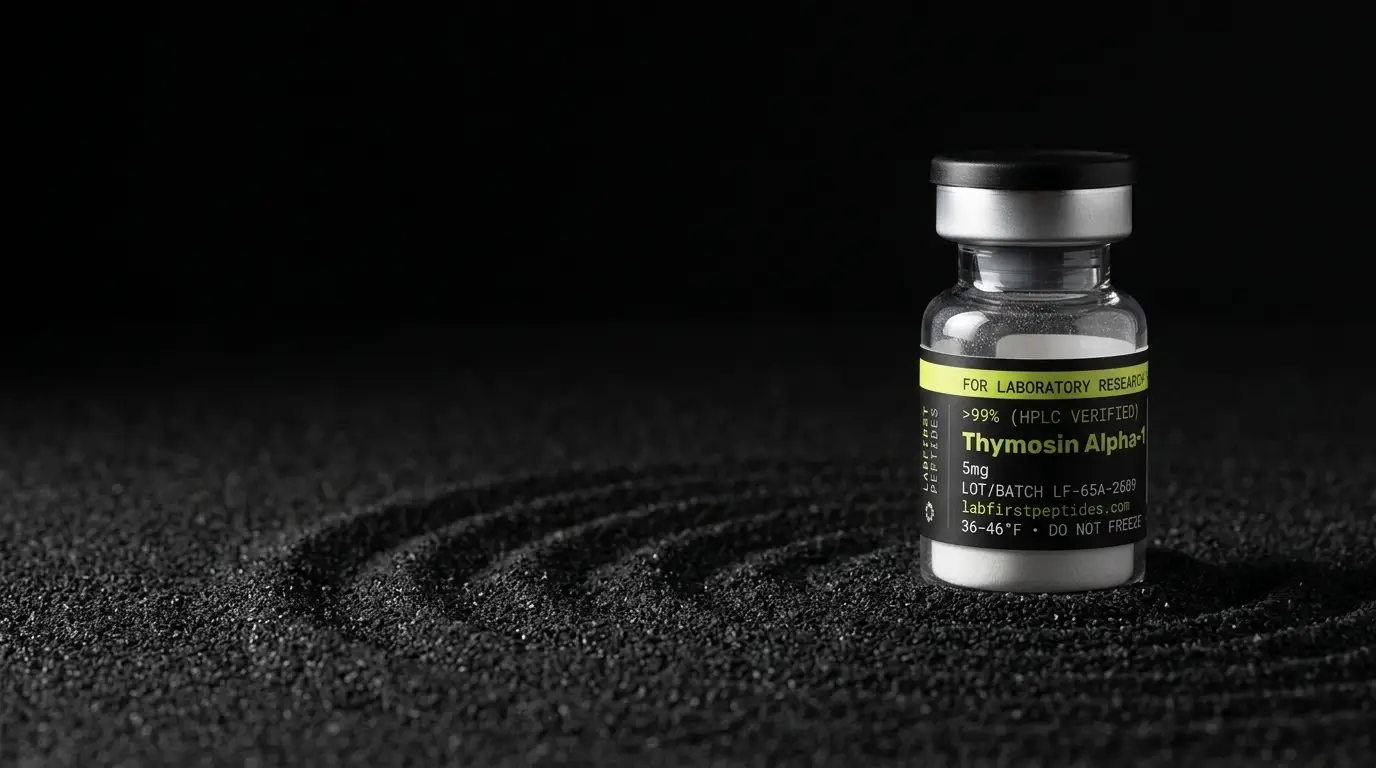
Lot or batch number. This must match the vial label character for character, including any suffix. A mismatch is not a clerical curiosity. If the number on the glass is not the number on the paper, you hold an untested vial and a certificate for something else. Photograph the label at receipt, before anyone peels it or writes on it.
Quantity and fill. The stated content, usually in milligrams, and whether that figure is gross solid weight or net peptide. More on that below, because it is where the largest arithmetic errors originate.
Dates. There are normally three, and they answer different questions. Manufacture or fill date tells you how old the solid is. Test date or analysis date tells you when the numbers on the page were true. Retest or expiry date, where present, is an assignment rather than a measurement unless a stability study on that lot backs it. A certificate with a test date years behind the manufacture date, or with no test date at all, is describing a measurement you cannot place in time.
Issuer. A named laboratory with an address, a report or work-order number, and the name or initials of whoever authorised release. An unsigned document from an unnamed lab is an assertion, and assertions are what the certificate exists to replace.
Identity: what actually proves the molecule
Identity and purity answer separate questions. Identity asks whether the main peak is thymosin alpha-1. Purity asks how much of the sample that peak represents. A report can be excellent on one and silent on the other.
For a 28-mer, mass spectrometry does most of the work. An ESI-MS spectrum showing multiply charged ions consistent with an average mass near 3108 Da, or a deconvoluted mass within a few tenths of a Dalton of the theoretical value on a high-resolution instrument, is the single most useful identity datum on the page. Note the tolerance stated. A low-resolution instrument reporting to the nearest Dalton cannot separate the intact peptide from the deamidated form, which differs by about 0.98 Da and is a plausible degradation product given the C-terminal asparagine.
| Method | What it establishes | What it cannot rule out |
|---|---|---|
| ESI-MS or LC-MS, intact mass | Total composition consistent with C129H215N33O55 | Deamidation and isomerisation at low resolution; sequence scrambling |
| MS/MS fragmentation | Residue order and coverage of the acetylated N-terminus | Little, but it is rarely included on routine certificates |
| Amino acid analysis | Residue molar ratios and net peptide content | Sequence order; hydrolysis destroys the N-acetyl group |
| RP-HPLC retention time | Comparative identity, only against a reference standard run in the same sequence | Anything co-eluting; it is not an identity test on its own |
| Edman sequencing | Nothing useful here | The blocked N-terminus prevents the first coupling step entirely |
That last row is worth pausing on. Thymosin alpha-1 is acetylated at the N-terminal serine, so classical N-terminal sequencing of the intact peptide fails. If a certificate claims Edman confirmation of the full sequence from residue one, either the material is not what it says it is or the document was assembled from a template for a different peptide. I have seen the second explanation more often than the first.
Purity: reading the chromatography section
Purity by RP-HPLC is an area percentage at a stated wavelength, and every word in that sentence constrains the number. Because thymosin alpha-1 has no aromatic residues, there is no meaningful chromophore at 280 nm. Detection must be at the peptide bond, conventionally 214 or 220 nm. A certificate reporting purity at 280 nm for this sequence is either measuring an impurity or copying a template.
The other thing the sequence dictates is retention. A strongly acidic, highly hydrophilic 28-mer retains poorly on C18 without ion pairing. Competent methods use a trifluoroacetic acid or formic acid modifier and a shallow low-organic gradient. A method summary showing a steep gradient with the main peak eluting almost at the void is not separating anything, and it will report a flattering purity because the impurities are hidden under the same front.
Read for these fields, and note which are absent:
- Column chemistry, dimensions and particle size
- Mobile phase composition, modifier and gradient profile
- Flow rate, column temperature, injection mass, detection wavelength
- Purity as area percent, plus the single largest impurity quantified separately
- The disregard limit below which peaks were not integrated
- An actual chromatogram with labelled axes, run date and an integration table
The disregard limit matters more than people expect. Raising it from 0.05% to 0.5% can move a stated purity by a full point without changing the sample. Purity figures are only comparable between lots when the integration rules are the same, which is one reason to keep the method summary on file rather than only the summary number. The general expectations for chromatographic system suitability and for reporting impurities are set out in the United States Pharmacopeia general chapters on chromatography and on impurities in drug substances; those chapters are the reference point when a supplier method looks unusually permissive.
Net content: where the arithmetic goes wrong
Chromatographic purity describes the composition of the peptide-related material. It says nothing about how much of the solid in the vial is peptide at all. A lyophilised peptide cake routinely carries water and a counterion, and for a peptide purified by RP-HPLC with a trifluoroacetic acid modifier, TFA can be a substantial fraction of the mass.
The fields that close this gap are water content, by Karl Fischer titration or loss on drying, counterion identity and content, by ion chromatography or fluorine NMR, and net peptide content, by amino acid analysis or nitrogen determination. Many certificates omit all three and still print a milligram figure on the front page. That figure is then gross solid weight.
Worked example, using plausible values for a lot that would pass most purity specifications:
- Label content: 10 mg
- Purity by RP-HPLC at 214 nm: 98.2%
- Water by Karl Fischer: 6.5%
- TFA content: 8.0%
- Net peptide content by amino acid analysis: 84%
Peptide mass actually present:
10 mg × 0.84 = 8.4 mg
With 2 mL of diluent added to the vial, the concentration assumed from the label is:
10 mg ÷ 2 mL = 5 mg/mL
The concentration of peptide is:
8.4 mg ÷ 2 mL = 4.2 mg/mL
That is a 16% overstatement, which is larger than the difference between a 98% and a 99% purity claim and entirely invisible to anyone reading only the front page. If your protocol is sensitive at that level, net content is the field to insist on, and the calculation should be recorded with the source of each input. The vial concentration calculator handles the arithmetic for other fill sizes and diluent volumes, and the cost per mg tool is the honest way to compare quotes once you know net rather than gross mass. Diluent choice and its own documentation are covered in the note on bacteriostatic water.
Verifying the document at the laboratory, not with the seller
A certificate supplied by the party selling the material is a claim about a claim. Verification means going around them. None of the following is difficult; it is mostly a matter of doing it before the material is committed to an experiment rather than after a result looks wrong.
- Find the issuing laboratory's contact details independently, from the lab's own site or a public register, not from the phone number printed on the PDF. Send them the report number, the sample identifier and the date, and ask whether they issued that report and for whom. Legitimate contract labs field this question routinely and will confirm or decline to confirm.
- Ask for the raw data, not the summary. A full chromatogram with axes, sample ID, acquisition date and the integration table. The mass spectrum, not a cropped picture of one peak. Files rather than screenshots where possible.
- Check internal consistency across the pages. Lot number identical everywhere. Retention time in the tabulated results matching the trace. Main peak plus reported impurities summing sensibly toward 100%. Test date after manufacture date. Stated mass consistent with the molecular formula given.
- Compare across lots you have received. Two chromatograms with pixel-identical baselines and different lot numbers are one chromatogram used twice. This is the most common falsification and the easiest to catch, provided you keep the old files.
- Commission your own orthogonal check. Intact mass by LC-MS plus a purity run at 214 nm is inexpensive at most contract labs and answers the two questions that matter. Sample under your own chain of custody, from the sealed vial, with the sampling recorded.
What you are building is a documentation trail that survives someone else's failure. Our own position on which fields we require before a lot is released is set out in the quality standard. The point of publishing it is that you can hold a supplier to a written expectation instead of a conversation.
Fields commonly absent, and what their absence means
Some omissions are ordinary and some tell you the document was never meant to be read closely.
Sterility and bacterial endotoxin testing are usually absent from research-grade certificates, and their absence is expected rather than suspicious. Research powder is not manufactured as a sterile product, and a certificate claiming sterility without naming a compendial test method has added a line rather than a measurement.
Residual solvent data, by contrast, is often missing when it should not be. Synthesis and purification leave acetonitrile, dimethylformamide and similar behind, and the ICH guideline on residual solvents defines the classes and limits that a supplier can be asked to address.
Then there are the pattern-level warnings. Purity stated as a bare inequality such as ≥99% with no method. A specification column with no results column beside it. An analysis date that is the same on every certificate a supplier has ever sent you. Mismatched fonts and inconsistent decimal places within one table. A laboratory name that returns nothing in any search. Any of these is grounds to withhold the material from use until the report is confirmed at source, which costs an email.
Regulatory position
Thymosin alpha-1 carries the international nonproprietary name thymalfasin. Finished medicinal products containing it are licensed in a number of jurisdictions outside the United States, and it has held orphan drug designations in the United States and Europe for particular indications. It is not an FDA-approved drug product in the United States. Regulatory status changes by country and by year; verify against the relevant national register on the date you need the answer rather than relying on a secondary summary.
Where an approved product exists, it is manufactured under a pharmaceutical quality system covering sterility, endotoxin, formulation and lot release. A research-grade certificate of analysis addresses identity and purity of a chemical. Those are different claims about different material, and no certificate converts one into the other.
Status verified 26 August 2026.
FOR LABORATORY AND IN-VITRO RESEARCH USE ONLY. NOT FOR HUMAN OR ANIMAL CONSUMPTION. NOT FOR PERSONAL, MEDICAL, DIAGNOSTIC, THERAPEUTIC, OR RECREATIONAL USE.
What is Thymosin Alpha-1 studied for?
Published research on Thymosin Alpha-1 investigates the areas below, which is a different question from what Thymosin Alpha-1 will do for anyone, a claim about a living system that nothing on this site is sold for.
What it is. A 28-residue acetylated peptide originally isolated from thymic tissue; the pharmaceutical form is called thymalfasin.
What the research looks at. Immune suppression associated with infection, cancer and ageing, and as a vaccine adjuvant. Registered and used in a number of countries; not approved in the United States.
How it is thought to work. Acts through Toll-like receptors on myeloid and plasmacytoid dendritic cells, initiating signalling that leads to production of immune-related cytokines. The mechanism is described as pleiotropic — it affects multiple immune cell subsets rather than acting on a single target.
What is not established. No United States approval. Effects on immune cell subsets are better established than effects on clinical outcomes.
The full record, including the certificate for the lot in stock, is on the Thymosin Alpha-1 product page.
Common questions
Why is purity by HPLC not the same as how much peptide is in the vial?
What detection wavelength should the purity method use for thymosin alpha-1?
Can retention time alone confirm identity?
How do I check that a certificate is genuine?
Should a research certificate include sterility and endotoxin results?
Does the acetylated N-terminus affect what tests are possible?
More documentation guides
Sources
- United States Pharmacopeia general chapters on chromatography and on impurities in drug substances. Establish system suitability expectations, integration and disregard-limit practice, and impurity reporting conventions used to judge whether a supplier purity method is adequately specified.
- United States Pharmacopeia general chapter on water determination. Defines the Karl Fischer and loss-on-drying approaches referenced when reading the water content field on a lyophilised peptide certificate.
- ICH guideline on validation of analytical procedures and ICH guideline on residual solvents. Supports the expectations for method validation parameters and for the residual solvent classes and limits a supplier can be asked to address.
- PubChem and CAS registry records for thymalfasin. Support the molecular formula C129H215N33O55, average mass near 3108 Da, the 28-residue acetylated sequence and the registry number 62304-98-7.