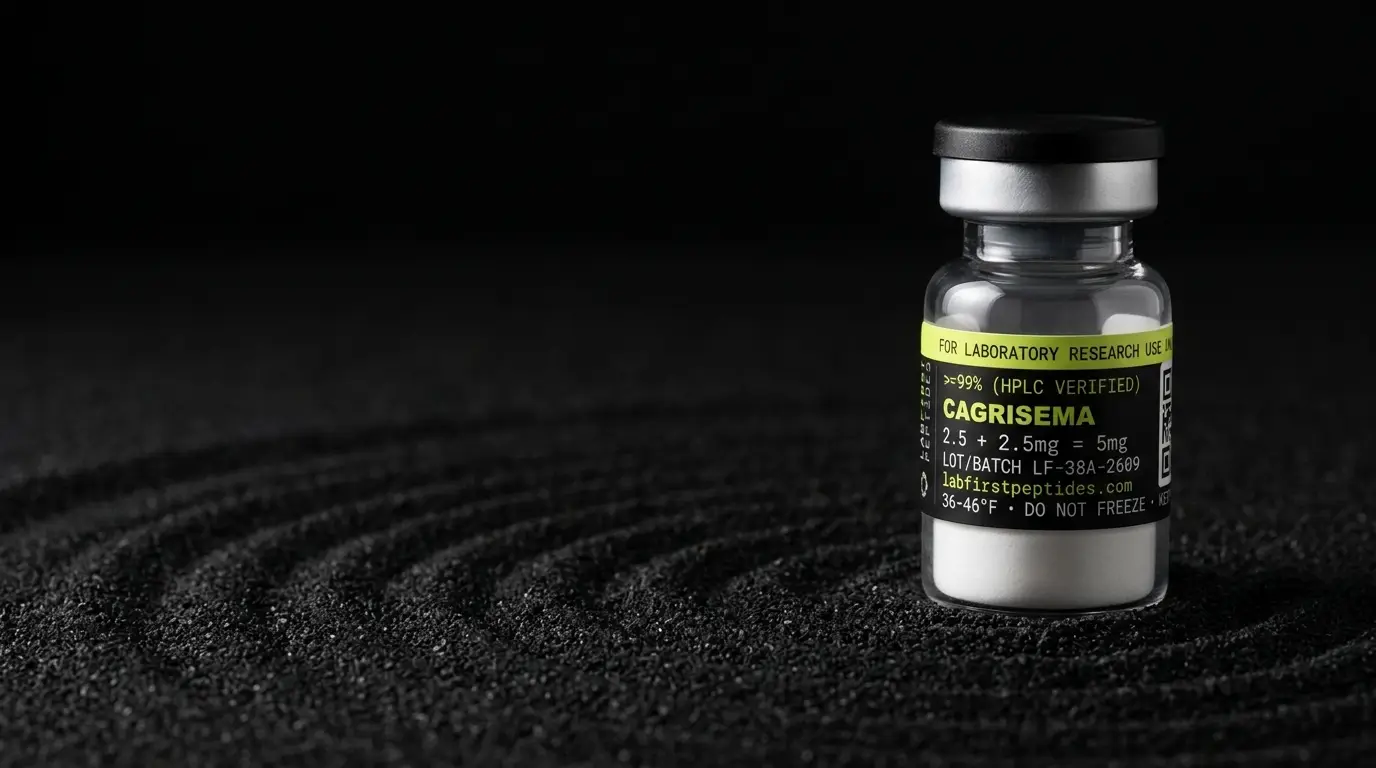
CagriSema identity testing means confirming two peptides, cagrilintide and semaglutide, not one. The lab checks accurate mass and fragment data for each. It reads those against retention behavior from a second, different chromatography method. It also states the ratio of the two. A purity percentage only describes peak area, not what the peak is.
- CagriSema is a fixed-ratio co-formulation of cagrilintide and semaglutide, so a valid identity test must resolve and assign both peptides.
- Semaglutide has a well-documented average mass near 4113.6 Da, giving expected ions around 1372.2 m/z at 3+ and 1029.4 m/z at 4+.
- Residue transpositions, D-amino acid substitutions and isoaspartate are exactly isobaric with the parent peptide and cannot be resolved by mass measurement alone.
- Chromatographic purity is a peak-area statement about one method at one wavelength and carries no information about molecular identity.
- UV area percent is not a mass ratio; component proportion requires calibrated response factors from characterized reference standards.
- Cagrilintide carries an intramolecular disulfide loop, which a reducing step in sample preparation will destroy before analysis.
What does a CagriSema identity test have to confirm?
Think of it like checking a two-person ticket. Each name has to match its own ID, and the ticket has to say how many of each are traveling.
The first thing to settle before any analysis is what the label is supposed to describe. CagriSema is the development name for a fixed-ratio combination of two separate acylated peptides: cagrilintide, a long-acting amylin analog, and semaglutide, a GLP-1 receptor agonist. There is no single CagriSema molecule to characterize. There are two, held in a defined proportion.
That has a direct consequence for identity testing. A certificate that reports one mass, one retention time and one purity figure has, at best, characterized half the material, and more likely has characterized something that is not the stated product at all. An identity claim for a two-component preparation has to resolve, detect and assign both components, and it has to say something about their ratio. Anything less is an incomplete test regardless of how good the instrument was.
This is also where a large share of mislabeled material in research supply chains sits. Semaglutide is abundant and comparatively cheap to source; cagrilintide is not. A preparation sold under the combination name that contains only the cheaper component will pass a careless identity check with flying colors, because the analyst found exactly what they went looking for.
- Two deconvoluted masses, one per component, with stated deviation
- Isotope spacing confirming each charge assignment
- Retention matching by co-injection against a reference standard
- MS/MS or peptide-map coverage, reported as a percentage
- Component mass ratio from calibrated response, not raw area
- Purity, last, with method and wavelength attached
What does mass spectrometry show for each peptide?
Electrospray ionization of a multiply charged peptide gives a charge-state envelope rather than a single ion, and the envelope itself carries information. Deconvoluting it returns a neutral monoisotopic or average mass, and the spacing of the isotope peaks within one charge state confirms the charge assignment. On a 4 kDa peptide, isotope spacing of roughly 0.33 m/z units means a 3+ ion; 0.25 means 4+.
Semaglutide has a well-documented average mass near 4113.6 Da. From that, the expected protonated ions follow by arithmetic:
[M+3H]3+ = (4113.6 + 3 × 1.008) / 3 ≈ 1372.2 m/z
[M+4H]4+ = (4113.6 + 4 × 1.008) / 4 ≈ 1029.4 m/z
For cagrilintide I would take the expected mass from the reference standard's own documentation rather than from an aggregated web record, because the acylation and the C-terminal amide are exactly the sort of detail that gets transcribed wrongly between databases. If your certificate quotes a cagrilintide mass, it should be traceable to a named standard or to the supplier's own structural characterization, not to a number of unclear origin.
| Observation | Supports | Does not support |
|---|---|---|
| Accurate mass of intact component within a few ppm of expected | Elemental composition consistent with the stated structure | Sequence order, stereochemistry, site of acylation |
| Consistent charge-state envelope | Correct charge assignment and deconvolution | Anything about identity by itself |
| Two distinct deconvoluted masses in one injection | Presence of two components | Their proportion, without calibrated response |
| MS/MS fragment series matching the sequence | Sequence assignment over the covered stretches | Regions with no fragment coverage |
| Mass shift of +15.995 Da | Oxidation of a susceptible residue | Which residue, absent fragmentation |
| Mass shift of +0.984 Da | Deamidation somewhere in the sequence | Asp versus isoAsp, which are exactly isobaric |
Why read chromatography alongside the mass?
Mass is a constraint, not an identification. Several classes of variant share an exact mass with the intended peptide and cannot be separated by mass measurement at any resolution. Transposition of two residues gives an identical formula. A D-amino acid at any position gives an identical formula. Aspartate and isoaspartate, the two outcomes of a deamidation pathway, differ only in connectivity. Positional isomers of an acyl chain on a different lysine give an identical formula.
Every one of those usually shifts retention time on a reverse-phase column. So the useful evidence is the pair: the deconvoluted mass tells you the composition is right, and the retention behavior tells you the arrangement is probably right too. ICH Q6B is explicit on the principle for biotechnological products, requiring that an identity test be highly specific and based on the unique structural properties of the molecule. In practice that means orthogonal methods, because no single measurement carries enough specificity on its own.
The strongest routine evidence available in a working laboratory is co-injection against a characterized reference standard. Inject standard, inject sample, then inject a spiked mixture. If the peak count stays the same and the peak does not broaden or shoulder, the sample and the standard elute together under those exact conditions. Retention times quoted from a different instrument, a different column lot or a different gradient are not comparable and should not be treated as if they were.
How are the sequence and the disulfide confirmed?
Where a protocol needs more than intact mass and retention matching, the next step is fragmentation. Tandem MS on the intact peptide gives partial b/y coverage; an enzymatic digest followed by LC-MS/MS peptide mapping usually gives more, because smaller fragments ionize and fragment more informatively. Coverage is never total, and the honest way to report it is as a percentage of the sequence covered rather than as a bare claim that the sequence was confirmed.
Cagrilintide inherits an intramolecular disulfide loop from the amylin scaffold it is based on. That has two analytical consequences. A reduced or scrambled disulfide shifts the intact mass by roughly two daltons and changes retention, so a mass two units high on that component is a specific and checkable finding rather than noise. And any sample preparation involving a reducing agent will destroy the feature you are trying to verify, which is a mistake that gets made when a generic peptide-mapping method is applied without reading it.
USP's guidance on the application of mass spectrometry in the General Chapters sets out the reporting expectations for this kind of work: instrument type, resolution, mass accuracy, calibration and the basis of the assignment. A result reported without those parameters cannot be audited, and an unauditable identity result is a formality.
Why is the ratio part of the identity?
For a two-component preparation, the stated composition includes a proportion. Confirming that both peptides are present says nothing about whether they are present as intended. A vial holding ninety-five percent semaglutide and five percent cagrilintide will produce two correct masses and two correct retention times.
Quantifying the ratio requires calibrated response. UV detection at 214 nm responds mainly to peptide bonds, with additional contribution from aromatic side chains, so two peptides of different length and composition do not give equal area for equal mass. The correct procedure is external standard curves for each component, prepared from characterized reference material, with the ratio calculated from mass rather than from raw area. Where reference standards are not available, the appropriate reporting position is that the ratio is undetermined.
Ask suppliers directly which of the two approaches produced the number on the certificate. The answer separates a laboratory that ran the method from one that read the chromatogram and did arithmetic on area percentages.
What does a purity percentage tell you?
The figure most prominent on most certificates is chromatographic purity, typically reported as area percent by RP-HPLC at 214 nm. It answers one question: of everything the detector saw in that run, what fraction sat under the main peak. It says nothing about what that peak is.
Three limitations matter in reading it. First, the number is method-dependent; a shallower gradient resolves impurities a steep one hides, and purity rises when resolution falls. Second, it only counts what absorbs at the chosen wavelength and elutes within the run window, so inorganic counterions, residual solvents, water and strongly retained species may be invisible. Third, area percent is not mass percent unless response factors have been established.
So a certificate reading 99.2 percent purity, with no identity method named, is telling you that a single well-shaped peak was present. Mislabeled material routinely reports high purity, and truthfully. It is pure. It is pure something else. Our own documentation standard describes which analytical claims we consider a certificate entitled to carry.
What should the certificate show?
| Field | What a complete entry looks like | Why it matters |
|---|---|---|
| Lot identifier | Unique, printed on both certificate and vial label | Without it the document is not tied to the material |
| Analysis date | Specific date, after the manufacturing date | A certificate predating the lot describes a different lot |
| Identity method | Named technique with instrument class and conditions | "Conforms" with no method is not a result |
| Observed masses | Deconvoluted mass per component with expected value and deviation | Lets a reader recompute the assignment |
| Chromatographic conditions | Column, mobile phases, gradient, flow, wavelength | Retention data is meaningless without them |
| Component ratio | Mass ratio with the basis of quantitation stated | Defines whether this is the stated combination |
| Purity | Area percent with method and wavelength | Scopes what the figure covers |
| Water and counterion content | Residual water, trifluoroacetate or acetate | Net peptide content differs from gross vial mass |
| Attribution | Testing laboratory named, analyst or approver signed | Makes the document answerable to someone |
Failure patterns are consistent enough to list. A single mass reported for a two-component product. A spectrum image with the axes cropped or the intensity scale removed. Purity quoted to two decimal places with no method. The same trace reused across lots, which shows up as identical retention times to the second and identical baseline noise. A ratio given as a nominal formulation target rather than as a measured value. And certificates carrying an expiry date on a research powder with no stability study behind it, which is a separate problem covered in our note on storage and stability.
Request the underlying data files, not the summary. A supplier who can produce the raw chromatogram and the mass spectrum on request is a different proposition from one who cannot.
Worked example: how does area percent compare with mass ratio?
Take a certificate reporting two peaks with areas of 4,820,000 and 5,180,000 counts at 214 nm, summing to 10,000,000. Raw area gives 48.2 percent and 51.8 percent, which looks close to parity.
Now apply response factors from external standards. Suppose the calibration gives 12,000 counts per microgram for the earlier peak and 15,500 counts per microgram for the later one. Then:
4,820,000 ÷ 12,000 = 401.7 µg
5,180,000 ÷ 15,500 = 334.2 µg
Mass ratio 401.7 to 334.2, or about 1.20 to 1. The area percentages implied something near 0.93 to 1. The difference comes entirely from unequal detector response, and it is the sort of gap that decides whether a lot meets a stated composition.
Any figure built on vial mass should use net peptide content rather than gross mass, since water and counterion take up part of the weight. The cost per mg tool depends on that correction, and pricing is where it usually bites, since gross-mass pricing quietly overstates what you bought.
How do you check a CagriSema certificate, step by step?
Work down the page in this order. Stop at the first step that fails.
- Match the lot identifier on the certificate to the vial label.
- Look for two deconvoluted masses, one per component, each printed beside its expected value and deviation.
- Check that the chromatographic conditions are given: column, mobile phases, gradient, flow and wavelength.
- Find the component ratio and the basis of quantitation. A nominal formulation target is no measured value.
- Read purity last, with its method and wavelength attached.
- Ask for the raw chromatogram and mass spectrum for that lot, with the axes uncropped.
Where does CagriSema stand with regulators?
Semaglutide-containing medicines are FDA-approved and available only on prescription. Cagrilintide has no approved single-agent medicine. The CagriSema combination has been evaluated in the REDEFINE clinical program and was under regulatory review at the time of writing; its approval status should be re-checked directly against the FDA and EMA product databases rather than taken from any secondary page, including this one.
Research-grade material of either component, or of any preparation sold under the combination name, is not manufactured under pharmaceutical quality systems and has never been a lawful route to human use at any point in that timeline. A certificate of analysis covering identity and purity is a narrower claim about a different category of material than a licensed product's release testing.
Approval status stated as reviewed in-session; verify before relying on it.
FOR LABORATORY AND IN-VITRO RESEARCH USE ONLY. NOT FOR HUMAN OR ANIMAL CONSUMPTION. NOT FOR PERSONAL, MEDICAL, DIAGNOSTIC, THERAPEUTIC, OR RECREATIONAL USE.
Bottom line
A CagriSema identity test is complete only when both peptides are resolved, detected and assigned, and the ratio between them is measured. One mass, one retention time and one purity figure describe half the material at best. Ask for the raw data for the lot. A supplier who can produce it on request is a different proposition from one who cannot.
What is CagriSema studied for?
Published research on CagriSema investigates the areas below, which is a different question from what CagriSema will do for anyone, a claim about a living system that nothing on this site is sold for.
What it is. A fixed-combination product name covering two separate molecules: cagrilintide, a long-acting amylin analogue, and semaglutide, a GLP-1 analogue.
What the research looks at. Investigational combination, developed by Novo Nordisk. The two components each have their own separate literature.
How it is thought to work. Two distinct mechanisms in one product. Cagrilintide acts non-selectively at calcitonin family receptors — the amylin receptors and the calcitonin receptor. Semaglutide acts at the GLP-1 receptor. The combination rationale is that amylin and GLP-1 signalling act through different pathways and are proposed to be additive.
What is not established. No approved product. Nothing here is a single molecule, and the properties of the combination are not the sum of the components.
The full record, including the certificate for the lot in stock, is on the CagriSema product page.
Common questions
What does a CagriSema identity test check?
Why is one mass measurement not enough to confirm CagriSema?
What does a 99 percent purity figure actually tell me?
How is the ratio between the two components determined?
Can retention time from a supplier certificate be compared to my own?
Does the disulfide bond in cagrilintide need separate confirmation?
What should I ask a supplier for beyond the certificate?
More documentation guides
Sources
- ICH Q6B, Specifications for Biotechnological/Biological Products. Establishes that an identity test must be highly specific and based on unique structural or other properties of the molecule; supports the orthogonal-methods requirement rather than reliance on a single measurement.
- USP General Chapters on chromatography and on the application of mass spectrometry. Define system suitability, resolution and reporting expectations for chromatographic and mass-spectrometric data; support the position that undocumented conditions make a reported retention time or mass unauditable.
- PubChem compound record for semaglutide. Source for the molecular formula and average mass near 4113.6 Da used in the charge-state arithmetic.
- ICH Q2(R2), Validation of Analytical Procedures. Defines specificity and its demonstration, including the use of orthogonal procedures and reference materials; supports the co-injection approach described for retention matching.