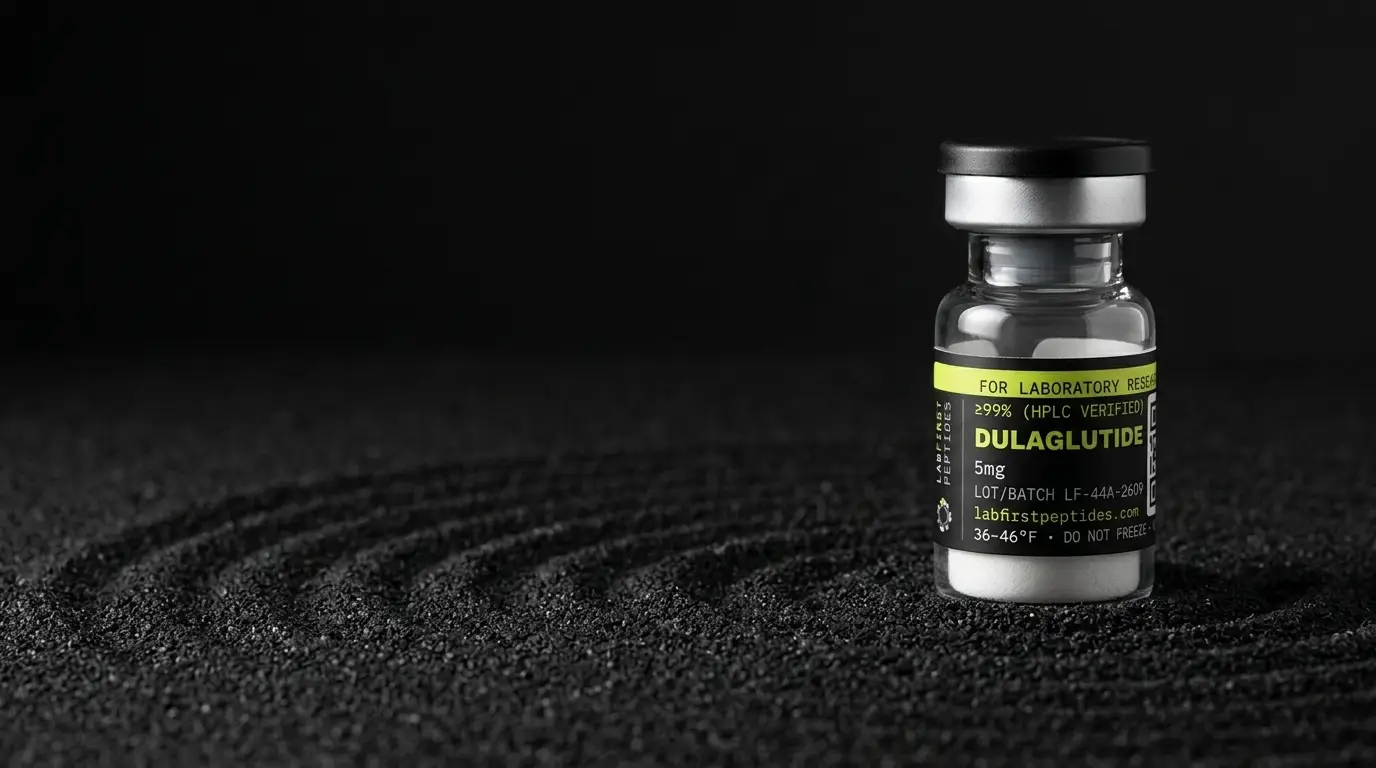
Dulaglutide storage and stability follow protein rules, not small-peptide rules. In plain terms, keep the sealed lyophilized vial cold, dry and dark, and let it warm to room temperature before opening. Moisture, light and temperature swings drive aggregation, oxidation and deamidation, so log each time the vial leaves cold storage.
- Dulaglutide is a two-chain Fc-fusion protein of approximately 63 kDa, per the FDA label description.
- ICH Q5C says protein products are sensitive to temperature changes, oxidation, light, ionic content and shear.
- ICH Q6B lists deamidation, oxidation, aggregation and proteolysis as degradation routes for biotechnological products.
- For a sealed lyophilized dulaglutide vial, moisture is the main risk; let it warm before opening.
- ICH Q5C notes that a formulated protein can interact with its container and closure.
A protein in a small vial
A lab tech takes a vial out of the fridge, uncaps it straight away, and sees a film of fog form on the inside of the glass. That fog is water from the room air, and it just landed on a dry protein cake.
That scene is most of what goes wrong with lyophilized proteins. Dulaglutide is a protein, not a short peptide. The FDA label describes it as two identical chains held together by disulfide bonds, each a GLP-1 analog joined to the Fc portion of a modified human IgG4 heavy chain, with an overall molecular weight of approximately 63 kilodaltons.
A molecule that size depends on its folded shape. The ICH Q5C guideline on the stability of biotechnological products says that for proteins, maintaining conformation depends on noncovalent as well as covalent forces. Storage has to protect that shape as well as the chemical bonds.
- Check the cake and indicator on arrival
- Sealed vial: cold, dry, dark
- Keep it in its carton, away from light
- Log each time it leaves cold storage
- Warm to room temperature before opening
- Check stored material by SEC
What degrades a fusion protein?
ICH Q6B lists degradation products of biotechnological products as changes that arise over time or through light, temperature, pH, water, or reaction with an excipient or the container. Its examples are deamidation, oxidation, aggregation and proteolysis. Q5C adds that such products are sensitive to temperature changes, oxidation, light, ionic content and shear.
| Route | What drives it | What limits it |
|---|---|---|
| Aggregation | Temperature changes, shear, freeze-thaw, surfaces | Steady cold storage, minimal agitation |
| Oxidation | Oxygen, light, trace metals | Dark storage, low headspace |
| Deamidation | Water, pH, time | Keep the powder dry and sealed |
| Fragmentation | Hydrolysis and proteolysis over time | Cold storage, clean handling |
Aggregation deserves the most attention for this molecule. Q6B defines aggregates as dimers and higher multiples of the product, and a protein of 63 kDa has a lot of surface to stick with.
The sealed lyophilized vial
Dry, cold and dark is the working rule for the sealed vial, and dry does most of the work. A freeze-dried cake takes up moisture readily, and water is what lets deamidation and other hydrolytic reactions start.
Q5C says labeling for biotechnological products should state precise storage temperatures, should say so where a product cannot tolerate freezing, and should give protection against light or humidity where appropriate. For a research lot, the storage line on the vial label and the certificate is the instruction to follow. If the two disagree, ask before storing the material, and record the answer.
Let a cold vial reach room temperature before you open it, with the cap on. That stops condensation from forming on the cake, which is the fog in the opening scene. Keep the vial in its carton or a dark box, and note in the log each time it leaves cold storage.
Light, containers and transport
Light is listed in both ICH guidelines as a factor in protein degradation, and Q5C says the need for light protection is set case by case. For a research lot with no photostability data, the cheap answer is to keep the vial in its carton. Nothing is lost by doing it.
The container matters more than people expect. Q5C notes that a formulated protein can interact with its container and closure, and that liquid products should be studied lying on their side and upside down as well as upright, so the solution touches the stopper. For a sealed research vial, that is one more reason to keep it upright and undisturbed in its carton.
Shipping is a period of temperature change and agitation. On receipt, check the vial for a cracked cake or moisture, record the arrival temperature if an indicator was packed, and move the vial into cold storage before doing anything else. Note in the log if the package arrived warm.
How do you check stored material?
If a lot has been stored for a while and the results matter, test it rather than trust it. Q5C lists methods that detect degradation during storage: SDS-PAGE, gel filtration (size-exclusion chromatography), reversed-phase and ion-exchange chromatography, and peptide mapping.
Analytical SEC is the practical first check for this protein. A growing early-eluting peak means aggregates have formed. A new late peak means fragments. A shift in a reversed-phase or ion-exchange profile points to oxidation or deamidation. Compare against the trace on the lot certificate, or one run when the lot first arrived.
A collapsed, sticky or discolored cake is the visible warning sign, and it usually means water got in. The dulaglutide identity guide covers the same methods from the identity side.
What the record should say
- Lot number, fill size (DL5 5 mg or DL10 10 mg), and the certificate reference.
- Date received, storage location and temperature, and each time the vial left cold storage.
- The arrival condition of the cake and any temperature indicator reading.
- Any check run on stored material and its date.
A log with gaps leaves the vial's history unknown. Our certificates are pending; a lot's figures appear only once its certificate is published on the certificate index. The dulaglutide certificate guide explains the content and purity fields the record refers to, and the dulaglutide product page lists both vial sizes.
What should you check before a dulaglutide vial goes into storage?
Read the storage line first. Q5C expects labeling to say where a product cannot tolerate freezing, and for a protein that depends on its folded shape that line decides which shelf the vial goes on. Find it on the vial label and on the certificate. If neither says whether freezing is allowed, ask before the vial goes into a freezer, and record the answer. Freeze-thaw sits on the aggregation row of the table above, and a 63 kDa protein has a lot of surface to aggregate with.
Then match the paperwork to the glass. The lot number on the vial should be the one in your record, along with the fill size, DL5 or DL10. Our certificates are pending, so for now the record carries the lot and a note that its figures are not yet published, and the certificate reference is added the day that lot's certificate appears on the index.
Look at the vial itself with the cap on. The cake should be intact and dry. A cracked cake, moisture on the inside wall, or a cake that has collapsed, turned sticky or discolored means water or temperature stress reached it on the way. A closure that has lifted or no longer sits flush counts too, even when the cake looks fine, because the closure is the only barrier between the dry protein and the room.
Light and moisture control for the closed vial are simple. The carton blocks light, which settles the case-by-case light question for a lot with no photostability data. A dark box with desiccant around the carton keeps the surrounding air dry each time the cold-storage door opens. Keep the vial upright and still, since agitation and shear also sit on the aggregation row.
Plan each trip out of cold storage. A vial that has to warm with its cap on before it is opened should come out once, for a reason, and the log should show when it left and when it went back. Repeated trips out and back are temperature changes, and Q5C names temperature changes first among the stresses a protein product is sensitive to.
A vial that arrives damaged, or arrives warm with no indicator to say how warm, goes into the log as received that way and stays apart from good stock. If the results matter, run analytical SEC on it before anyone relies on that lot.
Regulatory position
Dulaglutide is the active ingredient of an FDA-approved drug product first approved in the United States in 2014. The storage guidance on this page covers research material in a laboratory, meaning the sealed vial. It says nothing about the approved product and nothing about any use outside the laboratory.
Status verified September 29, 2026.
FOR LABORATORY AND IN-VITRO RESEARCH USE ONLY. NOT FOR HUMAN OR ANIMAL CONSUMPTION.
What is Dulaglutide studied for?
Published research on Dulaglutide investigates the areas below, which is a different question from what Dulaglutide will do for anyone, a claim about a living system that nothing on this site is sold for.
What it is. Recombinant fusion protein: two GLP-1 analogue peptides linked to a modified human IgG4 Fc fragment. Not a peptide in the sense the rest of this catalog uses the word.
What the research looks at. An approved medicine, marketed as Trulicity, with an extensive clinical literature. Also used as a GLP-1 receptor agonist reference compound in preclinical research.
How it is thought to work. Agonist at the GLP-1 receptor. The Fc fusion is the long-acting strategy — a large protein is cleared slowly by the kidney and is recycled through the neonatal Fc receptor, which extends circulating time by a completely different route from the albumin-binding acylation used by semaglutide.
What is not established. That a research vial under this name contains the same molecule as the licensed product. A recombinant fusion protein is manufactured in cell culture rather than synthesised, and identity and purity for such a product mean something different from what they mean for a synthetic peptide.
The full record, including the certificate for the lot in stock, is on the Dulaglutide product page.
Common questions
Why does dulaglutide need different handling from a small peptide?
How should a sealed dulaglutide vial be stored?
Why let a cold vial warm up before opening it?
How can stored dulaglutide be checked for degradation?
More handling guides
Sources
- TRULICITY (dulaglutide) prescribing information, section 11 Description (DailyMed, National Library of Medicine). Two-chain disulfide-linked Fc-fusion structure and approximately 63 kDa molecular weight.
- ICH Q5C, Quality of Biotechnological Products: Stability Testing of Biotechnological/Biological Products. Sensitivity to temperature changes, oxidation, light, ionic content and shear; methods for detecting degradation; stability after reconstitution of freeze-dried product; storage labeling.
- ICH Q6B, Specifications: Test Procedures and Acceptance Criteria for Biotechnological/Biological Products. Definition of degradation products and aggregates.