A dulaglutide certificate of analysis is a test report on one lot of this protein. Dulaglutide is large, about 63 kDa, with two chains. So the report should show protein tests: mass, a peptide map, size-exclusion results for clumps and fragments, and protein content. It should also give the lot number, test date and issuing laboratory.
- The FDA label describes dulaglutide as two identical disulfide-linked chains, each a GLP-1 analog joined by a peptide linker to a modified human IgG4 Fc.
- Dulaglutide's labeled overall molecular weight is approximately 63 kilodaltons.
- ICH Q6B says protein purity is method-dependent and is usually estimated by a combination of methods.
- Q6B defines aggregates as dimers and higher multiples of the product, measured by methods such as size-exclusion chromatography.
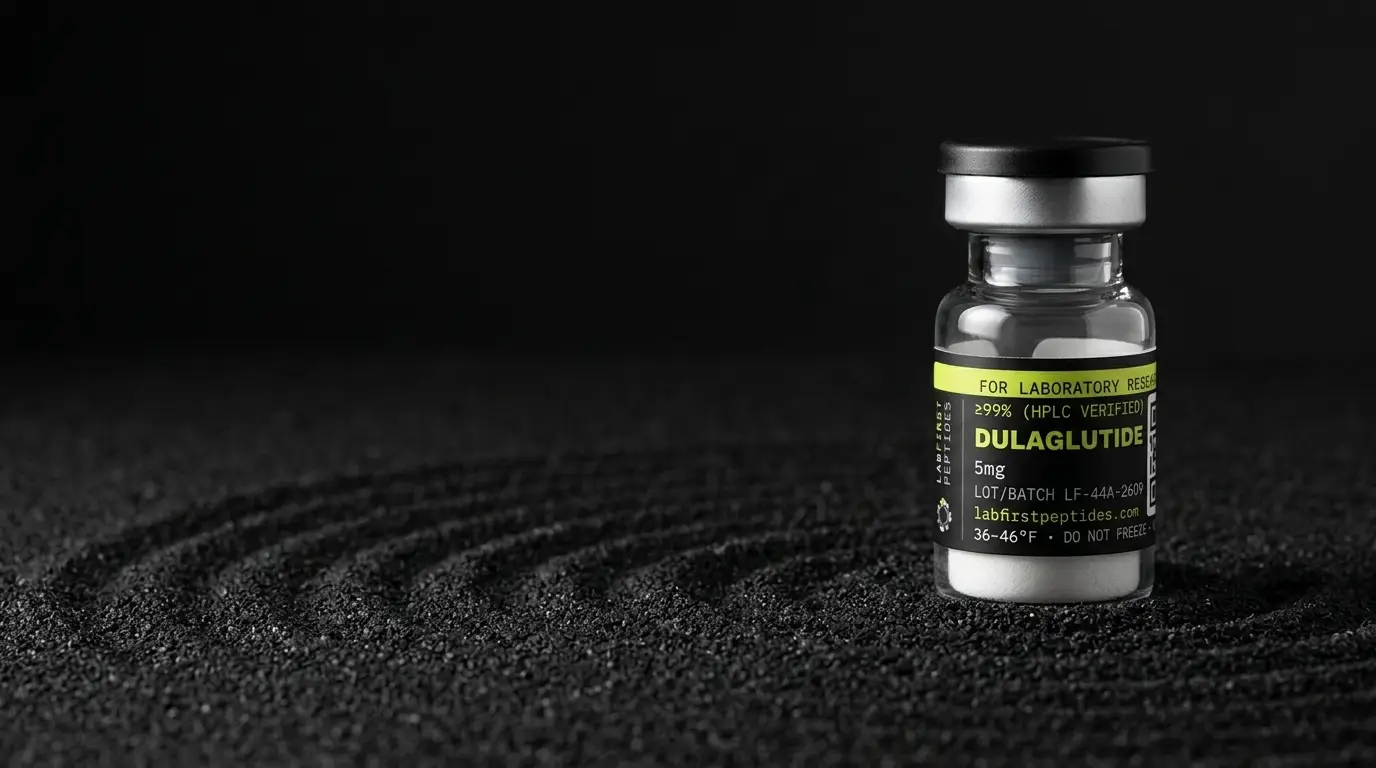
- A certificate applies to your vial only when its lot identifier matches the vial exactly.
One lot, one report
Picture two sheets of paper on a bench. One says a small peptide weighs 1,019 daltons and is 99 percent pure. The other says a protein weighs about 63,000 daltons and shows four chromatograms. Both are called a certificate of analysis, and they are not read the same way.
A certificate of analysis reports what a named laboratory measured on a named lot, on a named date, by named methods. It applies to your vial only when the lot number on the vial and the lot number on the report are the same string of characters.
For dulaglutide the second sheet is the right model. The molecule is a protein, so its certificate should carry protein tests. A document that reads like a small-peptide report, one mass and one purity percentage, has left out most of what a reader needs to know about this material.
- Molecule: two-chain Fc-fusion, about 63 kDa
- Lot identifier matches the vial exactly
- Mass: intact or reduced, stated
- Peptide map: enzyme and fragment assignments
- SEC: main peak, aggregates, fragments
- Issuing laboratory and report number
What molecule should the report describe?
The FDA label for the approved product describes dulaglutide as a fusion protein made of two identical chains joined by disulfide bonds. Each chain carries a GLP-1 analog sequence at its N-terminus, attached by a small peptide linker to the Fc portion of a modified human immunoglobulin G4 heavy chain.
The same description gives the GLP-1 part as 90 percent homologous to native human GLP-1 (7-37), with changes near the site that interacts with the enzyme DPP-4, and it gives the overall molecular weight as approximately 63 kilodaltons. The labeled molecule is produced in Chinese hamster ovary cell culture.
Those facts set the expectations for the certificate. The theoretical mass is tens of thousands of daltons, not a few thousand. The molecule has disulfide bonds holding two chains together, and it is large enough that the sequence cannot be read off a single mass number. The certificate for a research lot should state which molecule it claims, with the chain structure, so the results have something to be compared against.
The fields, in order
| Field | What it should say | How you check it |
|---|---|---|
| Issuing laboratory | Name, address, report number, signatory | Contact the laboratory with the report number |
| Product and lot | Dulaglutide, the lot identifier printed on the vial, fill size (5 mg or 10 mg) | Read the vial label against the report |
| Appearance | Physical state and color of the lyophilized material | Look at the vial on receipt |
| Intact or reduced mass | Observed mass by mass spectrometry beside the theoretical value, with the method | Check that the theoretical value describes the two-chain fusion protein |
| Peptide map | Enzyme used, chromatogram, and how fragments were assigned | Look for sequence coverage and named fragments |
| Size variants | SEC result: main peak, high-molecular-weight species, low-molecular-weight species | Read the three numbers together, not only the main peak |
| Other purity methods | Reversed-phase or ion-exchange profile, or SDS-PAGE | Check that each method has its own result |
| Protein content | Method (UV with a stated extinction coefficient, or amino acid analysis) | Check that the method and coefficient are named |
| Dates | Manufacture date and test date, separately | Check the order and the gap |
Completeness matters more than any single number. A report that fills six of these rows with methods attached tells you more than one that lists nine bare percentages.
Identity: mass plus a peptide map
ICH Q6B, the international guideline on specifications for biotechnological products, says identity tests should be highly specific and based on unique aspects of the molecular structure, and that more than one test may be needed. For a protein this size, that is the normal case.
Mass spectrometry of the intact or reduced protein is the first line. Under reducing conditions the disulfide bonds between the two chains break, so the observed species is a single chain at roughly half the intact mass. The certificate should say which condition was used. A mass reported without that note cannot be compared against anything.
The peptide map carries the sequence information. Q6B describes it as cutting the product into fragments with an enzyme or chemical, separating them by HPLC, and identifying the fragments by methods such as mass spectrometry. It also notes that peptide mapping is frequently used to confirm structure for lot release. A dulaglutide certificate with a mass and no map has confirmed size, not sequence. Our dulaglutide identity guide covers these methods in more depth.
Purity: several methods, read together
Q6B states that the absolute purity of a biotechnological product is difficult to determine, that results depend on the method, and that purity is usually estimated by a combination of methods. So a single purity percentage on a dulaglutide certificate is incomplete by the guideline's own standard.
Size-exclusion chromatography is the method to look for first. Q6B defines aggregates as dimers and higher multiples of the desired product and names size-exclusion chromatography and capillary electrophoresis as ways to resolve and measure them. On a dulaglutide SEC trace, the intact two-chain molecule is the main peak. An aggregate is two or more of those molecules stuck together, which elutes earlier. Fragments elute later.
Charge and hydrophobicity methods add a different view. Deamidated or oxidized forms may sit inside the SEC main peak and only separate on reversed-phase or ion-exchange chromatography. A certificate that reports the SEC main peak alone has said nothing about those variants.
Protein content: label versus measurement
The fill size on the label, 5 mg for DL5 or 10 mg for DL10, is the stated amount of material in the vial. The certificate should report how the protein content was measured, because that measured figure, not the fill size, is the amount of protein the lot actually holds.
Q6B describes determining an extinction coefficient at a set wavelength, such as 280 nm, on a solution whose protein content is known from amino acid analysis or nitrogen determination. It adds that when UV absorption is used to measure content, the extinction coefficient for that particular product should be used. A content figure calculated from a generic coefficient is an estimate.
The gap can be real. If a 10 mg vial holds 9.0 mg of protein by the stated method, the label and the measurement differ by 10 percent, and the lot record should carry the measured figure.
Appearance, water and what is not on the page
Q6B asks for a qualitative statement of the physical state and color of the material, and that line belongs on a dulaglutide certificate as it does on any other. A lyophilized protein usually arrives as a cake or powder. Record what the vial looks like on receipt and compare it with the report. A collapsed or wet-looking cake is worth noting even if every other field reads well.
Water content and excipients are the other mass in the vial. If the lot was freeze-dried with buffer salts or stabilizers, those contribute to the labeled fill weight and not to the protein figure. The certificate should say whether the fill size refers to protein or to total solid, because the two describe different amounts of protein.
Some fields will be missing from most research-lot certificates, such as biological activity assays that an approved product's specification would carry. That absence is normal for research material. What matters is that the report does not imply a test it did not run.
How do you verify the report?
Verification happens at the issuing laboratory. Find its contact details yourself, give it the report number and lot identifier, and ask whether the report exists and covers that lot. The seller who handed you the document cannot confirm it.
Our certificates are pending. A lot's results appear on our certificate index only once the certificate for that lot is published, and this page states no results for any lot. The dulaglutide product page links the certificate when it exists.
If you are comparing documentation across GLP-1 materials, the dulaglutide versus semaglutide comparison sets the two side by side, and the semaglutide certificate guide shows how a small-peptide report differs.
Red flags
- A single mass near a few thousand daltons. That describes a GLP-1 peptide, not the Fc-fusion protein.
- No statement of reducing or non-reducing conditions next to a mass.
- A purity figure with no SEC result. Aggregates are the main size-related variant for a protein like this.
- No peptide map, or a map with no enzyme and no fragment assignments.
- A lot number that resembles the vial's but does not match it exactly.
- A test date earlier than the manufacture date.
The first flag is the most telling. It usually means the report was written from a peptide template and the molecule on the page is not the one named in the header.
Regulatory position
Dulaglutide is the active ingredient of an FDA-approved drug product first approved in the United States in 2014. Material sold for laboratory research is not that approved product, is not made or tested under its approval, and carries no claim to be equivalent to it.
No certificate for a research lot turns that lot into an approved product. The certificate describes chemistry and identity only.
Status verified September 29, 2026.
FOR LABORATORY AND IN-VITRO RESEARCH USE ONLY. NOT FOR HUMAN OR ANIMAL CONSUMPTION.
What is Dulaglutide studied for?
Published research on Dulaglutide investigates the areas below, which is a different question from what Dulaglutide will do for anyone, a claim about a living system that nothing on this site is sold for.
What it is. Recombinant fusion protein: two GLP-1 analogue peptides linked to a modified human IgG4 Fc fragment. Not a peptide in the sense the rest of this catalog uses the word.
What the research looks at. An approved medicine, marketed as Trulicity, with an extensive clinical literature. Also used as a GLP-1 receptor agonist reference compound in preclinical research.
How it is thought to work. Agonist at the GLP-1 receptor. The Fc fusion is the long-acting strategy — a large protein is cleared slowly by the kidney and is recycled through the neonatal Fc receptor, which extends circulating time by a completely different route from the albumin-binding acylation used by semaglutide.
What is not established. That a research vial under this name contains the same molecule as the licensed product. A recombinant fusion protein is manufactured in cell culture rather than synthesised, and identity and purity for such a product mean something different from what they mean for a synthetic peptide.
The full record, including the certificate for the lot in stock, is on the Dulaglutide product page.
Common questions
What molecular weight should a dulaglutide certificate show?
Why doesn't one HPLC purity number work for dulaglutide?
What is a peptide map on a certificate?
Where are the certificates for your dulaglutide lots?
More documentation guides
Sources
- TRULICITY (dulaglutide) prescribing information, section 11 Description (DailyMed, National Library of Medicine). Structure of the two-chain Fc-fusion protein, 90 percent homology to GLP-1 (7-37), CHO expression, approximately 63 kDa, and the 2014 initial U.S. approval.
- ICH Q6B, Specifications: Test Procedures and Acceptance Criteria for Biotechnological/Biological Products. Identity tests, purity by a combination of methods, peptide mapping for lot release, aggregates by size-exclusion chromatography, extinction coefficient for content.
- FDA guidance page for ICH Q6B. FDA adoption of the Q6B guideline (August 1999).