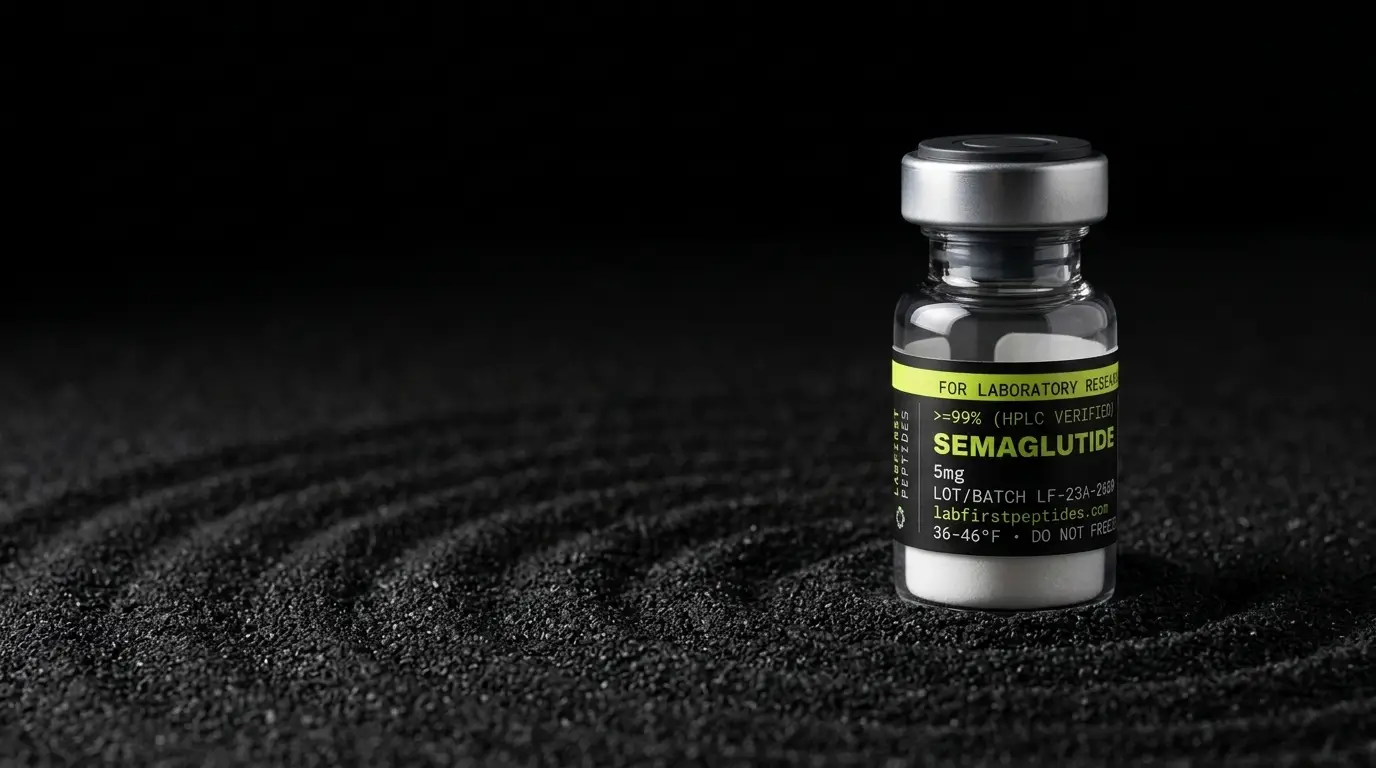
A semaglutide certificate of analysis is a lot-specific test report. Read it for six things: an identity method with an observed mass, a purity method with a stated technique, net peptide content, a lot number matching the vial, a test date, and a named issuing laboratory that will confirm the report directly.
- Semaglutide's registry identity is CAS 910463-68-3, molecular formula C187H291N45O59, average molecular weight about 4113.6 g/mol.
- Chromatographic purity is an area percentage and net peptide content is a mass fraction; a certificate that states both separately is answering both questions.
- A certificate is verified with the laboratory that issued it, using the report number, never with the seller who forwarded it.
- ISO/IEC 17025 accreditation of a testing laboratory can be checked in public directories maintained by the accreditation bodies.
- Pixel-identical chromatograms on certificates for different lots mean an image was copied, not that a second lot was tested.
What this guide covers
This guide walks through a semaglutide certificate of analysis field by field, explains which numbers have to match the molecule, and shows how to confirm the report with the laboratory that issued it. Think of it like a vehicle history report tied to one VIN. It only helps if the number on the report matches the number on the car in front of you. A clean report for a different VIN tells you nothing about this vial.
A certificate of analysis is a test report for one lot of material. A laboratory took a sample from that lot, ran named methods on it, and recorded what the instruments measured. That is the entire claim. It is not a certification of the supplier, and it says nothing about any vial the laboratory never sampled.
The lot-specific part carries most of the weight. A supplier who sends the same handsome PDF with every order is not documenting anything, and a certificate that cannot be tied to the lot number printed on your vial describes some other material, possibly excellent material, that you do not have. So the first read of any certificate is clerical rather than chemical: does the lot on the document match the lot on the label, and is the document dated?
Semaglutide attracts more counterfeit paperwork than most research compounds because the commercial pressure around it is unusual. The compound is expensive to make well and cheap to fake on paper. That asymmetry is why the reading skill matters more here than it does for a bulk reagent, and why the verification step later in this guide is not optional homework.
- Lot number on the document matches the vial, character for character
- Identity: named mass method, theoretical mass near 4113.6 Da
- Purity: RP-HPLC area percent with method parameters stated
- Net peptide content stated separately from purity
- Report number confirmed with the issuing laboratory, not the seller
What mass should the numbers match?
Semaglutide is a modified GLP-1 analog of 31 amino acid residues. Three structural features bear on its paperwork: α-aminoisobutyric acid replaces alanine at position 8, arginine replaces lysine at position 34, and the lysine at position 26 carries a C18 fatty diacid attached through a linker built from glutamic acid and two short ethylene glycol units. The lipid and its linker are part of the molecule, and they are part of its mass.
The registry facts a certificate should be consistent with: CAS number 910463-68-3, molecular formula C187H291N45O59, average molecular weight close to 4113.6 g/mol. PubChem carries the same figures. An identity section quoting a theoretical mass near 4113.6 and an observed mass within the instrument's stated tolerance of it is describing semaglutide. A theoretical mass hundreds of daltons away is describing a different compound, a truncated sequence, or a clerical error, and any of the three stops the purchase until it is explained.
Do not expect the observed mass to arrive as one clean number on every certificate. Electrospray instruments report multiply charged species that software deconvolutes to a neutral mass; MALDI-TOF reports are closer to direct. Either is acceptable when the method is named. A bare identity: conforms with no method and no numbers is a sentence. It tests nothing.
Which six fields should you read, and in what order?
Read the document in the order below. Each field has a defensible form and a degraded one, and the degraded forms tend to cluster on the same certificates.
| Field | A defensible entry | The degraded version |
|---|---|---|
| Identity | Named mass method (ESI-MS or MALDI-TOF), theoretical mass near 4113.6 Da, observed mass with a stated tolerance | "Conforms" with no method and no numbers |
| Purity | RP-HPLC area percent with column, gradient and detection wavelength stated | A bare percentage with no method parameters |
| Net peptide content | Mass fraction by amino acid analysis or nitrogen determination, stated separately from purity | Absent, or silently conflated with purity |
| Lot number | Matches the vial label character for character | Absent, generic, or different from the label |
| Test date | A real date consistent with the lot's production window | Missing, or identical across every certificate the seller has ever sent |
| Issuing laboratory | Named laboratory with an address and a report number the lab will confirm | Seller's own letterhead with no laboratory named |
Two of these fields do the forensic work. The test date catches recycled documents, because a template reused across lots tends to keep its original date. The report number catches them again, because a genuine laboratory can pull the report when asked and a fabricated one cannot. Appearance and water content sometimes appear as additional lines; they are welcome, and they are secondary. The six fields above decide whether the document means anything at all.
How are purity and net content different?
Chromatographic purity is an area percentage: of everything the detector saw eluting, what fraction of the signal sat in the semaglutide peak. Net peptide content is a mass fraction: of the milligrams in the vial, how many are peptide. The two are routinely confused, and the confusion always flatters the material.
Lyophilized peptides are usually supplied as trifluoroacetate salts, and the counterion together with residual water and bound salts commonly accounts for a tenth to a fifth of the gross mass. A vial can therefore be 99 percent pure by HPLC while holding meaningfully less semaglutide by mass than its label implies. Neither number is dishonest. They answer different questions, and a certificate stating both is a sign the supplier understands its own product.
The distinction has a price attached. Two 5 mg vials at the same list price are not the same offer if one states 99 percent purity alongside 85 percent net content and the other states purity alone. The cost-per-milligram tool does that arithmetic once content is known; without a content figure the comparison cannot honestly be made. Where the field is missing, the conservative read is that the label mass is gross mass and the peptide mass is unknown.
What should an attached chromatogram look like?
Some certificates attach the chromatogram image, and it rewards thirty seconds of attention. There should be one dominant peak, with the integration table attributing the claimed area percentage to it, and the retention time should sit where the method section implies. Small early peaks are commonly solvent front and buffer artifacts. A shoulder on the main peak is more interesting, because closely eluting impurities in a peptide are often deletion or oxidation variants that a casual integration can fold into the parent peak.
The forensic value is elsewhere. Chromatograms are effectively fingerprints of a run. Two certificates for different lots carrying pixel-identical chromatograms were produced by copying an image, not by testing two lots. Sellers who reuse one real report across many shipments are more common than outright forgers, and this is the fastest way to catch them. Keep the PDFs from every order; the comparison costs nothing, and it only works if you have the history.
Red flags on a semaglutide certificate
The degraded forms of the six fields tend to cluster on the same certificates. Any one of these is a reason to stop and ask:
- identity reading "conforms" with no method and no numbers;
- a bare purity percentage with no method parameters;
- net peptide content absent, or silently conflated with purity;
- a lot number that is absent, generic, or different from the label;
- a test date that is missing, or identical across every certificate the seller has ever sent;
- the seller's own letterhead with no laboratory named;
- pixel-identical chromatograms on certificates for different lots.
How do you verify the report with the laboratory, step by step?
A seller forwarding a certificate is a claim, whoever the seller is. Verification means contacting the laboratory named on the document and asking whether that report number, for that lot, on that date, is theirs. Reputable testing laboratories answer the question as a matter of routine. It is the entire point of putting a report number on the page.
Three checks, in increasing order of effort:
- Existence. The named laboratory should be findable independently of the certificate, with a real address and an actual testing business.
- Accreditation. ISO/IEC 17025 is the operative standard for testing laboratory competence, and the accreditation bodies that grant it maintain public directories where a laboratory's status and scope can be looked up directly. A laboratory absent from every directory can still be legitimate, and the burden of proof has shifted.
- Confirmation. The email or call quoting the report number, which costs ten minutes.
One move outranks all three. Send a sample from your own vial to a laboratory you chose, and compare its result against the certificate. Third-party retesting is the only check that binds the paper to the material in your hand rather than to the lot as the seller describes it, and for an expensive compound bought in quantity the assay fee is small against the cost of running work on mislabeled material. Our quality standard describes which documents accompany each lot here and what each one is entitled to claim.
What does the certificate not cover?
A clean certificate is a statement about a sampled lot on a test date. It says nothing about what the material did afterward in a warehouse or a mail van, and nothing about freezer discipline once it arrives. Handling after purchase runs on the chemistry laid out in the storage and stability guide; the degradation routes described there apply to semaglutide as well, since it shares the lipidated, interface-active character. No document forwards responsibility for storage.
Research-grade certificates also normally exclude sterility and endotoxin unless those tests are named with methods. A semaglutide certificate silent on them has made no claim either way, and reading a sterility promise into a purity number is a category error. This is one of the structural differences between documented research material and the FDA-approved semaglutide medicines, which are prescription products released under pharmaceutical quality systems that run exactly those tests lot by lot. A research vial with a good certificate is well-documented research material and nothing more. The Semaglutide product record lists the vial sizes this catalog carries and the documentation that ships with each lot.
FOR LABORATORY AND IN-VITRO RESEARCH USE ONLY. NOT FOR HUMAN OR ANIMAL CONSUMPTION. NOT FOR PERSONAL, MEDICAL, DIAGNOSTIC, THERAPEUTIC, OR RECREATIONAL USE.
Bottom line
A semaglutide certificate is a test report for one lot. Match its lot number to your vial, check the theoretical mass near 4113.6 against a named method and an observed value, read purity and net content as separate numbers, and confirm the report number with the issuing laboratory. Retesting a sample from your own vial is the only check that ties the paper to the material in your hand.
What is Semaglutide studied for?
Published research on Semaglutide investigates the areas below, which is a different question from what Semaglutide will do for anyone, a claim about a living system that nothing on this site is sold for.
What it is. A peptide that works on the GLP-1 receptor.
What the research looks at. One of the most heavily published peptides in metabolic research, with a large registered clinical record. Approved medicines containing it exist under their own brand names.
How it is thought to work. A copy of the body’s own GLP-1, changed so it lasts far longer. Two changes do that: a fatty acid chain that lets it ride on albumin in the blood, and a swapped building block that stops the DPP-4 enzyme cutting it up. Those two edits are why it stays around for days where natural GLP-1 lasts minutes.
What is not established. What is sold here is a research chemical, not a drug product. Listing it is not an approval, and not a claim that it is equivalent to, as safe as, or a fit substitute for any approved medicine.
The full record, including the certificate for the lot in stock, is on the Semaglutide product page.
Common questions
What theoretical mass should a semaglutide certificate show?
Is 99% HPLC purity the same as 99% semaglutide by mass?
Does a certificate prove the vial in my hand is good?
How do I confirm the issuing laboratory actually tested the lot?
Published certificates for Semaglutide
Every figure below is read from a report the laboratory issued for that lot; each page carries the PDF and the lab's own verification link.
More documentation guides
Sources
- PubChem entry for semaglutide. CAS registry number, molecular formula and average mass that anchor the identity fields discussed here.
- ICH Q2, Validation of Analytical Procedures. What a validated identity or purity method entails, and why method parameters belong on the certificate rather than in a seller's assurances.
- ISO/IEC 17025, general requirements for the competence of testing and calibration laboratories. The accreditation standard behind laboratory verification; accreditation bodies publish directories of accredited laboratories and their scopes.
- USP General Chapter <621>, Chromatography. Conventions for chromatographic method description and system suitability that a defensible purity section reflects.