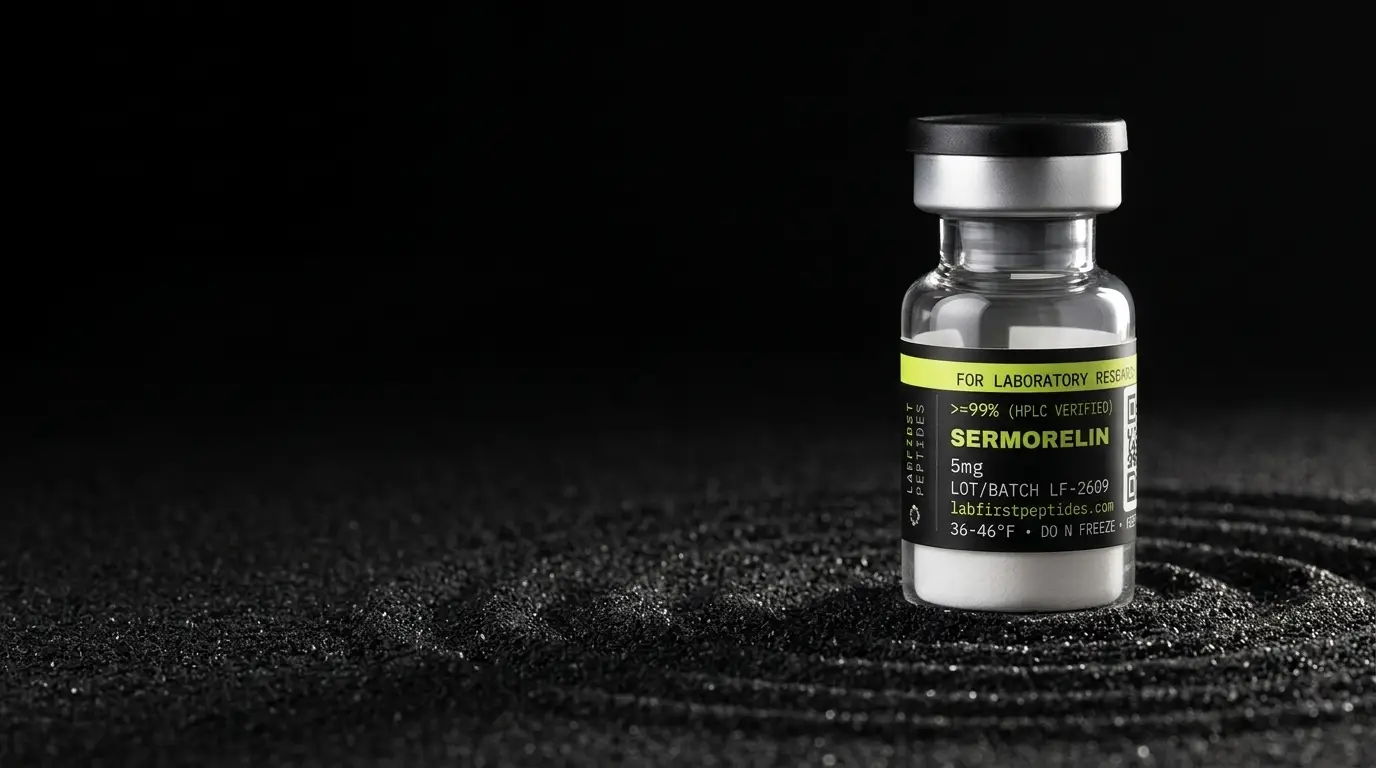
A sermorelin acetate certificate of analysis is a test report for one lot. Read it in order. Match the lot number to the vial and check the test date. Then check identity by mass near 3357.9, purity by RP-HPLC with the chart attached, deletion sequences, acetate and peptide content, water, and the issuing lab.
- Sermorelin is GHRH(1-29), C149H246N44O42S, average mass near 3357.9, PubChem CID 16132413.
- That record is the free peptide; the product is the acetate salt and reports differently.
- A 29-mer gives a charge-state envelope, so the certificate mass is a deconvoluted figure.
- Deletion sequences are the characteristic impurity of long peptide synthesis.
- Deletion impurities often co-elute, which can flatter a reported purity figure.
- Acetate content is part of the product and is weight that is not peptide.
What does a sermorelin certificate actually certify?
One batch, one day, one set of checks: that is all a certificate of analysis covers. Much like a receipt, it only counts if its batch number matches the vial in front of you.
It records what a named laboratory measured on a sample drawn from one lot, on one date, by named methods. It is evidence about that sample, not a warranty about the vial on your bench.
Two documents get confused. A specification sheet lists the limits a product is meant to meet, carries no lot number and no results, and describes an intention. A certificate carries both because it describes an event.
If the page has no lot number on its face it is the first kind of document, whatever the heading says. For a peptide this long that distinction matters more than usual, because the impurity profile genuinely differs from batch to batch.
- Lot number on the report against the lot number on the vial
- Test date after the fill date, and distinct from the print date
- Identity: a deconvoluted mass, compared against the free peptide near 3357.9
- Salt form stated, because the product is the acetate
- Related substances: deletion sequences from 28 coupling steps
- Acetate content, net peptide content, and water by Karl Fischer
- Accession number confirmed at the issuing laboratory
How do you read it field by field?
Lot number first, against the vial, and nothing further until they match. Then dates: the test date should follow the fill date, and a print date carries no analytical weight.
Then the results in the order they matter for a long synthetic peptide. Identity by mass spectrometry, reported as a deconvoluted mass. Purity by reversed-phase HPLC with the chromatogram attached. Related substances, which for this compound means deletion sequences. Acetate content. Net peptide content. Water. Appearance last.
Each result needs its method named. Purity by area percent, by net peptide content and by amino acid analysis are three different numbers for one vial, and they do not agree.
What mass should the identity result show?
Sermorelin is the first 29 residues of growth hormone releasing hormone, molecular formula C149H246N44O42S, average mass near 3357.9, cataloged as PubChem CID 16132413.
Note what that record describes. It is sermorelin as the free peptide. The product sold here is the acetate salt, so a lot certificate reports the salt rather than these reference figures, and the two are not the same number.
That distinction is not pedantry. A buyer comparing a certificate against a database entry will find they disagree, and the reason is the counterion rather than a quality problem. A certificate that names the salt form avoids the confusion entirely.
Why is a 29-mer harder to weigh than a short peptide?
Because electrospray ionisation does not give one peak. A molecule this size picks up several protons, so the instrument sees a family of charge states rather than a single mass-to-charge value.
Those signals are combined mathematically into one figure, a process called deconvolution. The number on the certificate is the output of that calculation, not a raw reading.
The practical consequence is that mass accuracy is coarser here than for a heptapeptide. A difference of one or two mass units is meaningful on an 800-dalton molecule and sits inside ordinary measurement scatter on a 3,358-dalton one. So a mass match on sermorelin is weaker evidence than the same match on a short peptide, and it needs the separation alongside it.
What are deletion sequences and why do they matter here?
They are the characteristic impurity of long peptide synthesis. The chain is assembled one residue at a time, and every coupling step is efficient rather than perfect. A step that fails on a small fraction of chains produces molecules missing exactly one residue.
With 29 residues there are 28 coupling steps, so there are many opportunities. A deletion impurity differs from the target by the mass of one amino acid, somewhere between 57 and 186 daltons.
On a 3,358-dalton molecule that is a shift of a few percent, and such species often elute very close to the target because they are nearly the same molecule. This is the specific reason a long peptide's purity number deserves more scrutiny than a short one's.
What does the purity figure leave out?
Anything that does not absorb at the detection wavelength or does not elute. Reversed-phase purity is an area percentage of what the detector saw, which is narrower than it sounds.
Peptides are read at 214 nanometres because that responds to the peptide bond, so peptide impurities are seen well. Salts and water are largely invisible. A vial can be 98 percent pure by area and still be substantially acetate and moisture by weight.
For this compound there is a second limit. Deletion sequences that co-elute with the target are counted inside the main peak rather than beside it, so the reported purity can be flattered by a separation that was not developed to resolve them.
What is acetate content, and why is it its own field?
Sermorelin is supplied as an acetate salt, so acetate is not a contaminant. It is part of the product, present in a definite proportion, and it is measured rather than assumed.
It matters commercially because it is weight you paid for that is not peptide. Acetate content of ten percent on a nominal vial size means a tenth of the powder is counterion before water is counted at all.
It also distinguishes a properly finished product from one that skipped a step. Peptides leave preparative HPLC as trifluoroacetate salts, and converting to acetate takes an extra exchange. A certificate reporting acetate is evidence that exchange happened; one reporting trifluoroacetate on a product labeled acetate is a contradiction worth raising.
What is net peptide content, and why does it change the price?
It states what fraction of the powder is actually peptide, the remainder being counterion, residual water and any inorganic content.
The consequence is arithmetic. A vial labeled 5 milligrams may hold 5 milligrams of powder of which a real fraction is salt and water. Net peptide content of 80 percent means 4 milligrams of peptide, and two suppliers quoting the same price for the same nominal size are not selling the same amount of compound.
Ask which basis the label uses. Both gross and net are legitimate fill bases, and only one is comparable across vendors without doing the conversion yourself. The cost per milligram comparison ranks the catalog on one basis for that reason.
What do the water and appearance fields tell you?
Water is measured by Karl Fischer titration, which is specific to water. Loss on drying reports everything volatile and reads high when residual solvent is present, so the two are not interchangeable.
Water matters more for a long peptide than a short one, because lyophilized cake with higher residual moisture is more prone to both hydrolysis and physical collapse over time.
Appearance should read as a white to off-white lyophilized powder or cake. It is the least informative line on the document and it earns its place only as a cheap cross-check a buyer can perform against their own vial without equipment.
What does the certificate not cover?
Everything after the sample was drawn. Storage temperature, light, how long the vial has been open and how many times it has been entered are all outside it.
For a long peptide the gap has a particular shape. Aggregation is a physical change rather than a chemical one, it develops in storage and in solution, and a certificate written at release describes material that had not yet had the opportunity.
Moisture ingress also quietly makes the net content figure optimistic, because the powder now weighs more per unit of peptide than it did at test. The number was true and is now slightly generous.
How do you verify the document is genuine?
Confirm the report at the issuing laboratory rather than with the seller. An independent laboratory issues each certificate against an accession number or verification key that resolves on its own site. If the number resolves to a different product, a different lot, or nothing, the document does not describe your material.
Certificates with the verification key removed deserve particular suspicion, and this is not hypothetical in this market. A PDF is easy to edit; a third-party lookup is not.
Lot reports for material supplied here resolve through the certificate verification page, and the sizes carried appear on the sermorelin acetate product record.
What is the regulatory position?
Sermorelin has existed as an approved drug substance in a finished pharmaceutical product. Research-grade material is not that product, and a certificate for laboratory material does not confer the status of the approved one.
What a research certificate can honestly establish is narrower and still useful: what a named laboratory measured, on a named lot, on a named date, by named methods. Read against that standard a good certificate is strong evidence and a vague one is none.
Material described here is supplied for laboratory use only, and nothing in this guide describes use in a person or an animal.
FOR LABORATORY AND IN-VITRO RESEARCH USE ONLY. NOT FOR HUMAN OR ANIMAL CONSUMPTION. NOT FOR PERSONAL, MEDICAL, DIAGNOSTIC, THERAPEUTIC, OR RECREATIONAL USE.
What is Sermorelin Acetate studied for?
Published research on Sermorelin Acetate investigates the areas below, which is a different question from what Sermorelin Acetate will do for anyone, a claim about a living system that nothing on this site is sold for.
What it is. A man-made peptide matching the first 29 building blocks of growth-hormone-releasing hormone.
What the research looks at. An older clinical and hormone-research record exists, mostly about how the GHRH receptor behaves and about using the peptide as a diagnostic tool.
How it is thought to work. It works on the GHRH receptor. Those first 29 building blocks are the shortest piece of the natural hormone that still works on the receptor, which is why the class is built on that particular cut.
What is not established. What is sold here is a research chemical, not a drug product. Sermorelin, CJC-1295 and Mod GRF(1-29) are close relatives and get mixed up constantly in commercial listings, so check the certificate for which molecule is actually in the vial.
The full record, including the certificate for the lot in stock, is on the Sermorelin Acetate product page.
Common questions
What mass should a sermorelin certificate show?
Why is the mass on a long peptide less conclusive?
What is a deletion sequence?
Why does acetate appear on the certificate?
How do I confirm a sermorelin certificate is real?
More documentation guides
Sources
- PubChem Compound Summary for CID 16132413, Sermorelin. The openable record for the free peptide, giving the molecular formula C149H246N44O42S and average mass near 3357.9 that a certificate for the acetate salt is compared against.
- ICH Q2(R2), Validation of Analytical Procedures . Defines specificity, accuracy and precision for identity and assay procedures, and is the basis for requiring that each certificate result names the method that produced it.
- FDA guidance, Q6B Specifications: Test Procedures and Acceptance Criteria. Sets out how related substances such as deletion sequences are reported separately from total purity, and why identity, purity and content are distinct attributes.
- Finnrick independent verification portal. Third-party lookup used to confirm a certificate resolves to the lot it claims to describe, rather than confirming a document with the seller who supplied it.