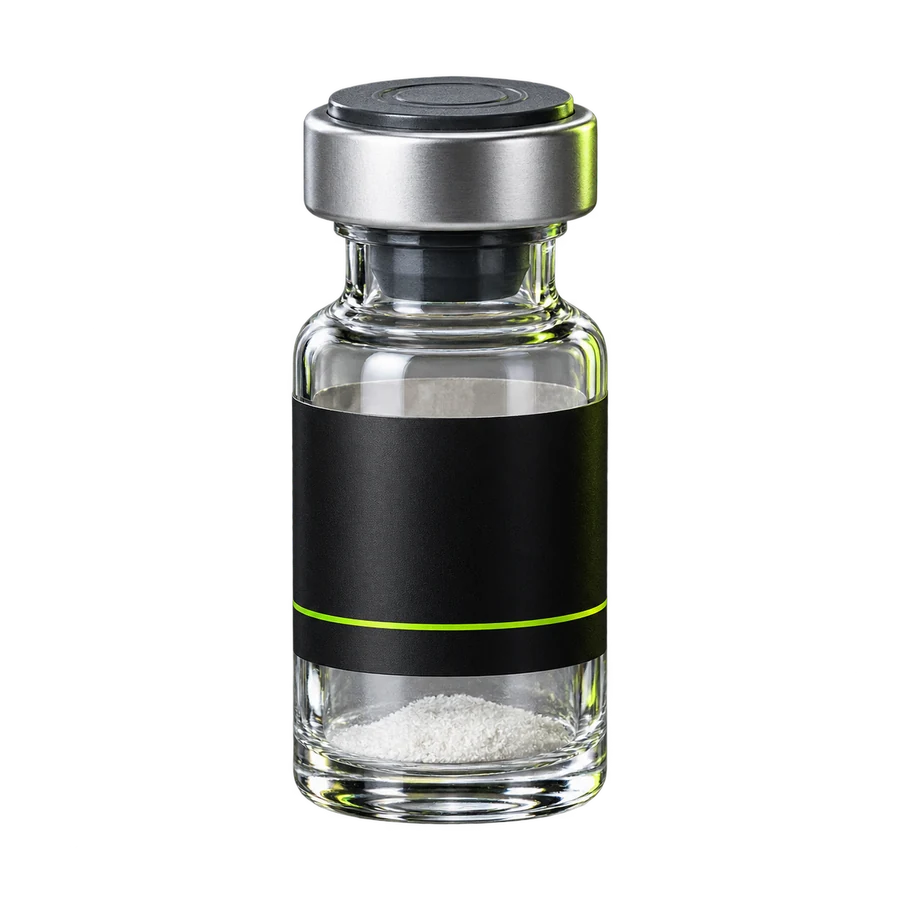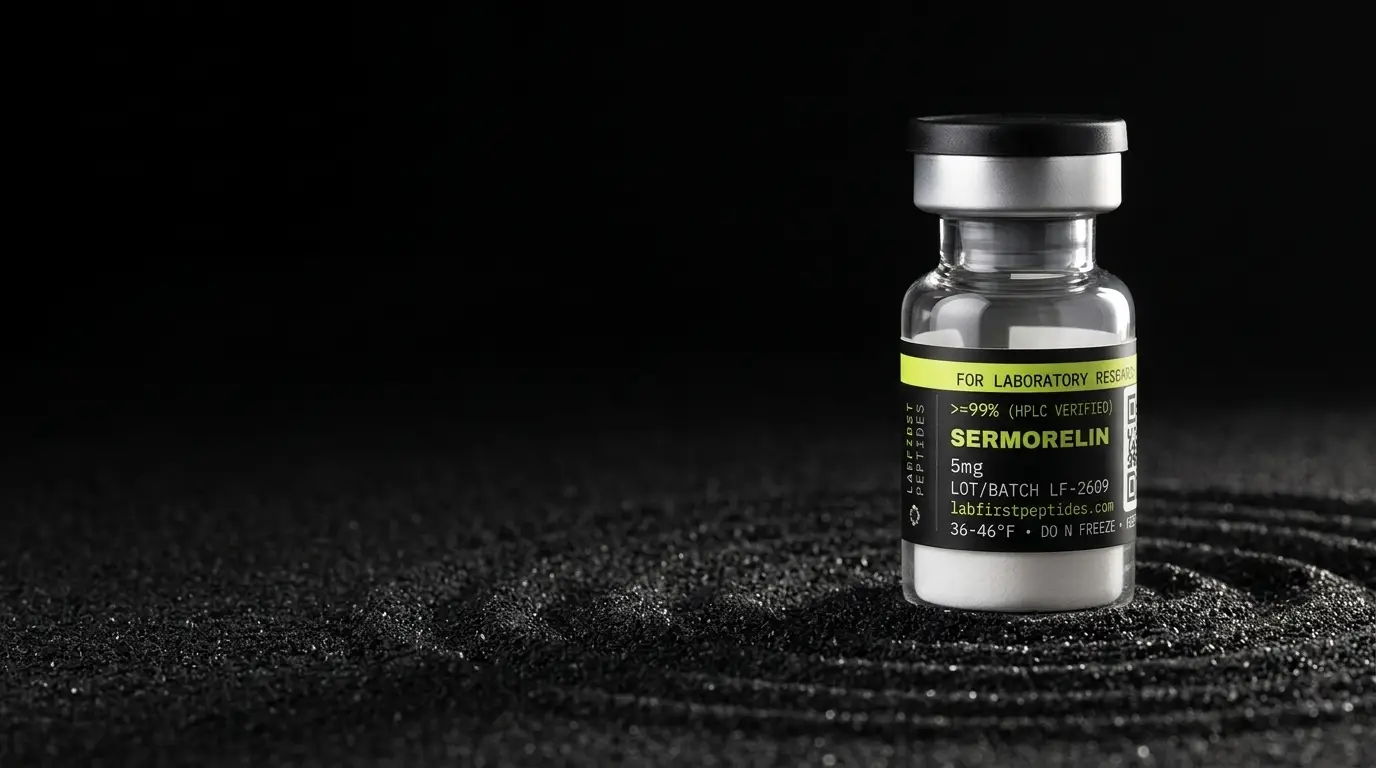
Sermorelin is listed online as tablets, pills, a nasal spray and a freeze-dried powder in a vial. Those are different products made by different companies. A certificate of analysis belongs to one lot of one material, so a report for a research powder describes nothing about a tablet.
- Sermorelin corresponds to the first 29 residues of growth-hormone-releasing hormone.
- Formula C149H246N44O42S, average mass 3,357.9 g/mol, PubChem CID 16132413 — figures for the free peptide.
- Supplied here as the acetate salt, so the lot certificate reports the salt rather than the free-peptide figures.
- A certificate covers one lot of one material by one method on one date, and never a second product.
What is sold under the name sermorelin?
In plain terms, a shared name is like two shops with the same sign. What sits inside can be quite different, so the paperwork from one tells you nothing about the other.
Search the name and four different things come back. A freeze-dried powder in a sealed vial, sold for laboratory work. Tablets and capsules. A nasal spray. And a compounded preparation dispensed through a pharmacy or a clinic. They share a name on a label and very little else.
The name refers to a molecule: a 29-residue peptide, formula C149H246N44O42S, average mass 3,357.9 g/mol, cataloged at PubChem CID 16132413. What a listing sells is a product, and a product is the molecule plus everything done to it — the form, the excipients, the fill, the handling, and the paperwork that describes that particular batch.
The distinction sounds pedantic until you try to verify one listing using another listing's document. That is where it stops being pedantic.
Is a sermorelin tablet the same material as a sermorelin vial?
No, and not in a way that a purity figure can bridge. A tablet is a manufactured dosage form: the active is blended with binders, fillers and a coating, pressed, and released under whatever process controls that manufacturer runs. A lyophilized vial is the peptide freeze-dried on its own and sealed.
Two consequences follow. The first is that the certificate for a research vial reports on the powder in that vial. It has nothing to say about a tablet: not its content, not its uniformity, not what else is in it. The second is that a tablet has its own questions, and they are questions its own manufacturer has to answer.
This record is the powder. It is sold for laboratory work, and every claim on this site is scoped to that.
Why does one certificate never cover two products?
A certificate of analysis is narrower than most people expect. It records what one laboratory measured, by one named method, on one lot, on one date. Strip away any of those four and the remainder stops being evidence.
So a report showing 98.4% by HPLC for lot A of a freeze-dried powder is a statement about lot A of that powder. It is not a statement about lot B, and it is certainly not a statement about a tablet pressed somewhere else from material bought somewhere else. A seller who offers one document to vouch for a different product is not making a subtle error; they are describing something they did not test.
Our certificate index lists every lot with its own report for exactly this reason.
What does "oral sermorelin" mean on a listing?
Usually it means a tablet, a capsule or a sublingual troche sold as a consumer product. Sometimes it means a compounded preparation. The phrase describes a route, not a grade of material, and it tells you nothing about how the contents were verified.
The question worth asking of any such listing is the same one worth asking here: which laboratory tested this batch, by what method, on what date, and can the report be opened on that laboratory's own site. If the answer is a PDF with no verification key, the format of the product is the least of the problems.
Sermorelin, CJC-1295 and Mod GRF(1-29): why the names blur
These three appear as near-synonyms in commercial listings and they are not the same molecule. Sermorelin corresponds to the first 29 residues of growth-hormone-releasing hormone. CJC-1295 without DAC, also written Mod GRF(1-29), carries substitutions that change the sequence. CJC-1295 with DAC adds a further modification again.
The practical test is the mass. A certificate reporting an observed mass against a theoretical one settles which molecule was in the vial, and the theoretical figures differ between these three. A listing that names two of them interchangeably has told you it is working from a catalog description rather than from a report.
The Sermorelin Acetate record and the CJC-1295 (no DAC) record are separate pages with separate lots and separate certificates, and that separation is the point.
The salt form, and why the number on the certificate differs
Sermorelin is supplied here as the acetate salt. The published figures above (C149H246N44O42S at 3,357.9 g/mol) describe the free peptide. The salt weighs more, because the counter-ion is part of the solid.
That is not a discrepancy to be explained away; it is a fact the certificate carries. A lot report states what was measured on the material as supplied, which is the acetate. Anyone converting a mass to a molar amount needs to know which of the two figures they are using, and a listing that quotes the free-peptide mass for a salt has quoted the wrong number for the thing in the vial.
The molarity calculator carries the published mass with the record it came from, and flags the compounds where the two differ.
What the lot certificate actually reports
Three separate measurements, and they answer different questions. Identity asks which molecule is present, and mass spectrometry answers it by weighing what is there and reading the result against the mass sermorelin acetate should have. Purity asks what fraction of the contents is that molecule, and chromatography answers it. Net content asks how much material is in the vial at all.
The third is the one most often missing and the one that changes arithmetic. A vial can be pure and short at the same time: 98% of a fill that came in light is still light. The labeled mass is nominal; the measured net content for a lot is on that lot's report, and a record that needs to be accurate uses the measured figure.
Each number carries the method that produced it and the date it was run. A figure with neither is a marketing line wearing a lab coat.
Does sermorelin need to be refrigerated?
The sealed vial is kept cold, dry and out of the light, and the lot record carries the retest date for it in that state. That is the figure to work from rather than a general shelf life quoted for the compound, because a shelf life belongs to a material stored a particular way and not to a name.
A freeze-dried peptide is stable largely because the water has been taken out of it, which is why the seal matters as much as the temperature. Anything a laboratory prepares afterwards is dated by that laboratory and kept in its own record; no printed figure survives every bench, and nothing on this page attempts to supply one.
What to check before buying any form of it
Five checks, and they work on us as well as on anyone else. Does the report name an issuing laboratory rather than the seller. Does it carry a verification key or QR that opens on that laboratory's own site. Does the lot number on the paper match the vial in hand. Does every figure have a method and a date beside it. Was identity tested at all, or only purity.
The last one catches more listings than the rest combined. Purity says how much of the contents is one substance. Proving that the substance is the one named is a separate test, and it is the one quietly skipped.
Verifying a certificate works through each of them.
What this page is not
It is not a comparison of formats by effect, and there is no version of that comparison this shop can honestly publish. Everything sold here is research material, supplied under a research-use restriction, and nothing on this site is sold for use in a person or an animal.
What can be documented is what the material is, what its certificate covers, and where the boundary between one product and another sits. That is the whole of it, and it is more than most listings offer. It is also the reason the format question keeps coming back: a tablet, a spray and a vial can carry the same name on the label and answer to three different manufacturers, three different processes and three separate sets of paperwork, so the only way to compare them is one document at a time.
If a seller cannot produce the report for the lot in front of you, the format of the product is not the thing to argue about. Ask for the paper first, and read the answer for what it does not say.
FOR LABORATORY AND IN-VITRO RESEARCH USE ONLY. NOT FOR HUMAN OR ANIMAL CONSUMPTION. NOT FOR PERSONAL, MEDICAL, DIAGNOSTIC, THERAPEUTIC, OR RECREATIONAL USE.
What is Sermorelin Acetate studied for?
Published research on Sermorelin Acetate investigates the areas below, which is a different question from what Sermorelin Acetate will do for anyone, a claim about a living system that nothing on this site is sold for.
What it is. A man-made peptide matching the first 29 building blocks of growth-hormone-releasing hormone.
What the research looks at. An older clinical and hormone-research record exists, mostly about how the GHRH receptor behaves and about using the peptide as a diagnostic tool.
How it is thought to work. It works on the GHRH receptor. Those first 29 building blocks are the shortest piece of the natural hormone that still works on the receptor, which is why the class is built on that particular cut.
What is not established. What is sold here is a research chemical, not a drug product. Sermorelin, CJC-1295 and Mod GRF(1-29) are close relatives and get mixed up constantly in commercial listings, so check the certificate for which molecule is actually in the vial.
The full record, including the certificate for the lot in stock, is on the Sermorelin Acetate product page.
Common questions
Does a certificate for sermorelin powder cover sermorelin tablets?
Is sermorelin the same as CJC-1295 or Mod GRF(1-29)?
Why does the certificate mass not match the published mass?
What does oral sermorelin mean on a product listing?
What form is sold on this page?
More documentation guides
Sources
- PubChem Compound Summary for CID 16132413, Sermorelin. The openable record behind the formula and average mass quoted above, and the free-peptide figures the acetate salt is distinguished from.
- ICH Q2(R2), Validation of Analytical Procedures . Defines what makes an analytical result valid and reproducible, and is why a purity figure with no named method and no date is treated here as unverifiable.