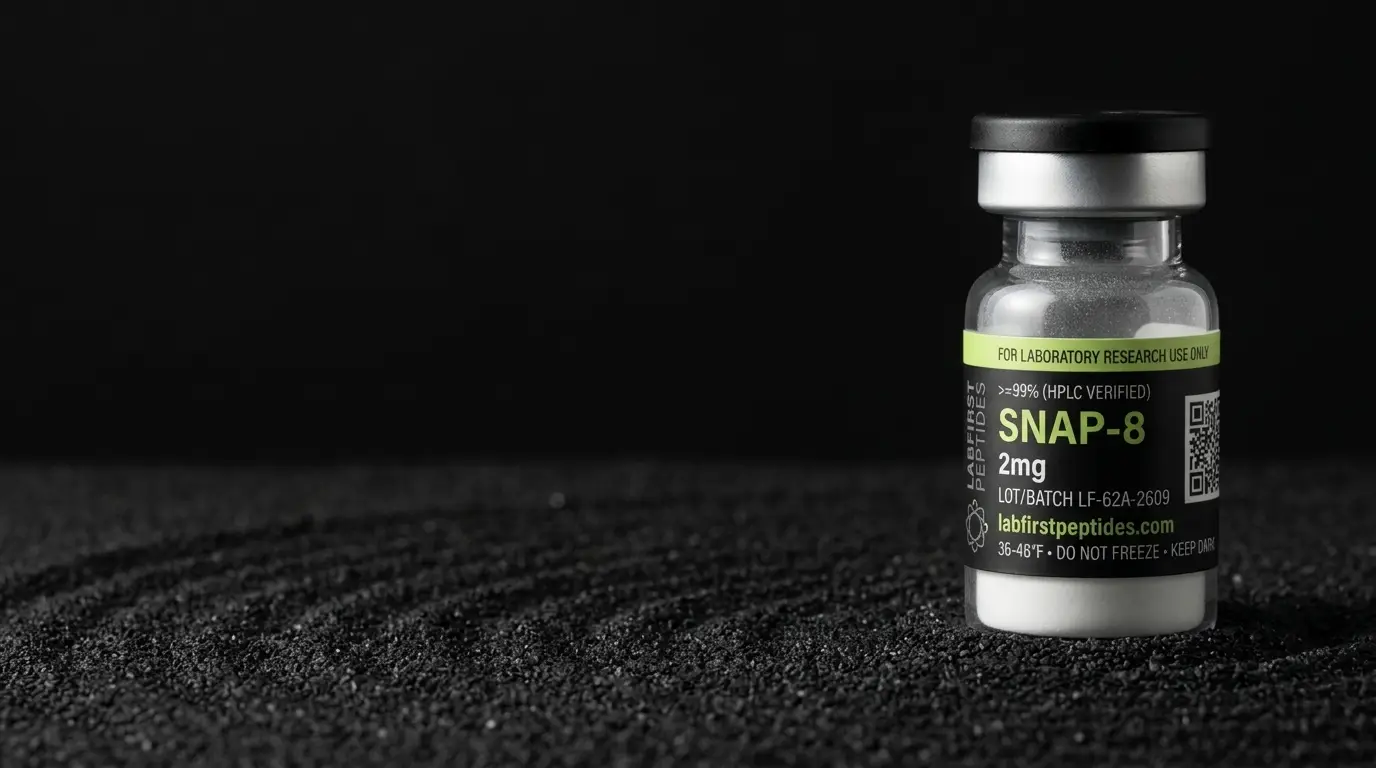
A SNAP-8 certificate of analysis is a test report on one lot of acetyl octapeptide-3, Ac-EEMQRRAD-NH2. In plain terms, it only describes your vial if the lot numbers match. Then check identity by mass near 1075.2, HPLC purity with its conditions stated, net peptide content, counterion, water, and the issuing laboratory.
- SNAP-8 is acetyl octapeptide-3, Ac-Glu-Glu-Met-Gln-Arg-Arg-Ala-Asp-NH2, PubChem CID 76283482.
- SNAP-8 has the formula C41H70N16O16S, average molecular weight 1075.2 and monoisotopic mass 1074.4876.
- Expected electrospray ions fall near 1075.50 (1+), 538.25 (2+) and 359.17 (3+).
- Methionine oxidation adds about 16 daltons; deamidation or a free-acid C-terminus adds about 0.98.
- No tryptophan or tyrosine, so purity is read in the low ultraviolet near 214 nm.
- Lot results appear on the certificate page only once that lot's certificate is published.
One lot, one report
A vial of white powder arrives with a sheet of paper. The paper claims the powder is a particular eight-residue peptide at a stated purity. The certificate of analysis is that paper, and the job is to decide whether it actually describes the vial in your hand.
A certificate records what a named laboratory measured on a sample drawn from one lot, on one date, by named methods. It says nothing about any other lot, and nothing about what happened to the vial after the sample was taken.
Keep it apart from a specification sheet. A specification lists the limits a product is meant to meet and carries no lot number and no results. A certificate carries both. If there is no lot number on the face of the document, it is a specification, whatever the heading says.
- Lot number on the report matches the vial
- Sequence printed with the acetyl cap and C-terminal amide
- Mass near 1075.2, with the ion or charge state named
- Oxidized methionine checked at plus 16
- HPLC purity at a stated wavelength, chromatogram attached
- Net peptide content and counterion named
- Report number confirmed with the issuing laboratory
What is SNAP-8, chemically?
SNAP-8 is a trade-style name for acetyl octapeptide-3. PubChem catalogs it as CID 76283482, with the sequence written Ac-Glu-Glu-Met-Gln-Arg-Arg-Ala-Asp-NH2, the molecular formula C41H70N16O16S, and a computed molecular weight of 1075.2. The same record lists CAS number 868844-74-0.
Two details in that sequence matter for the certificate. The N-terminus is acetylated, so the first glutamate carries an acetyl cap in place of a free amine. The C-terminus is an amide, written -NH2, in place of a free carboxylic acid. Both modifications are part of the identity. A molecule with the same eight residues and a free acid at the end is a different compound with a slightly different mass.
The record also lists several near-miss synonyms, including acetyl glutamyl heptapeptide-3. A certificate should settle the question by printing the sequence, not a name alone.
Eight residues joined in a line need seven peptide bonds. Count them on the printed structure if one is attached. The chain holds three acidic residues (two glutamates and an aspartate), two basic arginines, and one methionine, the only sulfur atom in the formula. That single sulfur is why the formula ends in S, and it is also the residue most likely to change during storage, as the mass section below explains. When a certificate prints a formula, compare it with C41H70N16O16S letter by letter.
The fields, in order
Read the lot number first and compare it with the vial label, character by character. Nothing else on the page counts until those match.
Then the dates. The test date should fall after the manufacture or fill date. A print date carries no analytical weight at all.
Then the results, each with its method beside it: identity by mass spectrometry, purity by HPLC, net peptide content, counterion, water content and appearance. A number with no method is an assertion, and two numbers from different methods cannot be compared as if they were the same measurement.
Last, the issuing laboratory, a report or accession number, and a signature. Those are what let you confirm the document with someone other than the seller.
Identity: the mass arithmetic
The PubChem record gives a monoisotopic mass of 1074.4876 for the neutral molecule. Electrospray mass spectrometry rarely reports the neutral mass directly. It reports ions carrying one or more extra protons, and you can predict where they should fall with a pocket calculator.
| Ion | Calculation | Expected m/z |
|---|---|---|
| [M+H]+ | 1074.488 + 1.007 | about 1075.50 |
| [M+2H]2+ | (1074.488 + 2.015) / 2 | about 538.25 |
| [M+3H]3+ | (1074.488 + 3.022) / 3 | about 359.17 |
With two arginines in the chain, a doubly charged ion is a reasonable thing to see. A certificate may report any of these, or a deconvoluted neutral mass. What it should state is which one it reports, so the reader can check the arithmetic.
Two small mass shifts worth checking
Methionine sits at position three, and methionine is easily oxidized to the sulfoxide. That adds one oxygen atom, about 16 daltons. A spectrum with a peak 16 above the main ion is showing oxidized peptide. A small one is common in stored peptide; a large one is a quality question the certificate should address.
The second shift is harder to spot. Glutamine at position four can deamidate to glutamate, which raises the mass by about 0.98. The C-terminal amide losing its amide group to become a free acid produces almost the same 0.98 change. Both are listed among the modifications that high-resolution peptide methods are used to detect.
A shift under one dalton is lost on a low-resolution instrument. On a certificate that reports a mass to one decimal place, it may be invisible. That is a limit of the method, and it is fair to ask what resolution the laboratory used.
Purity: an area percent under stated conditions
Purity on a peptide certificate is almost always reversed-phase HPLC, reported as the main peak's share of the total detected peak area. The number only means something alongside the column, the mobile phase, the gradient and the detection wavelength.
SNAP-8 contains no tryptophan and no tyrosine, so detection at 280 nanometers would see very little. The workable wavelength is in the low ultraviolet, around 214, where the peptide bond itself absorbs. A certificate should print the wavelength it used.
ICH Q2(R2) describes specificity as the ability to measure the intended analyte without interference from other components. For a purity figure, that means the method has to separate the main peptide from its likely neighbors, such as the oxidized form and deletion sequences. An attached chromatogram lets you see whether it did.
Net peptide content and the counterion
Lyophilized peptide powder is never all peptide. Part of the weight is counterion left from purification, usually trifluoroacetate or acetate, and part is water. Net peptide content states the fraction that is actually peptide.
SNAP-8 carries two arginines, each with a strongly basic guanidino group, so it holds counterions readily. At a molecular weight near 1075, each counterion is a noticeable share of the powder. Purity and net content answer different questions: a lot can be 99 percent pure by HPLC and still be well under 100 percent peptide by weight.
Our SNAP-8 is listed as SKU NP810, a 2 mg vial. The certificate should say whether that figure is gross powder or net peptide, because only a net figure lets you work out the true amount in a laboratory solution.
Checking the document itself
Confirm the report with the issuing laboratory, not with the seller. Independent laboratories issue each report under a number that can be looked up on their own system. If that number resolves to a different compound, a different lot or nothing, the document does not describe your material.
Watch for the plain warning signs. The sequence is missing. The mass is given with no ion or charge state. The purity has no chromatogram and no conditions. The lot number on the page differs from the one on the vial. Any one of those is reason to ask for more before relying on the report.
For SNAP-8 sold here, a lot's results appear on the certificate page only once the certificate for that lot is published. Until then there is no result for that lot to quote, and we do not quote one. The SNAP-8 product page lists the size carried.
What does the certificate leave out?
Everything after the sample was drawn. Storage temperature, light, humidity, and how often the vial has been opened all sit outside the report.
Lyophilized peptide takes up moisture from the air, and a methionine-containing peptide can oxidize slowly once exposed. So the certificate describes the lot as it was on the test date. A vial kept sealed, cold and dry stays closer to that description.
The methods behind the identity and purity lines are covered in more depth in our guides to LC-MS identity testing and HPLC purity versus identity.
FOR LABORATORY AND IN-VITRO RESEARCH USE ONLY. NOT FOR HUMAN OR ANIMAL CONSUMPTION.
What is SNAP-8 studied for?
Published research on SNAP-8 investigates the areas below, which is a different question from what SNAP-8 will do for anyone, a claim about a living system that nothing on this site is sold for.
What it is. Acetyl octapeptide-3 (acetyl glutamyl heptapeptide-3) — an eight-residue peptide extending the sequence of the six-residue Argireline.
What the research looks at. Topical cosmetic use on expression lines. The published literature specific to this peptide is very thin and largely industry-generated rather than independent.
How it is thought to work. Proposed to mimic the N-terminal end of SNAP-25 and compete with it for a position in the SNARE complex, destabilising complex formation and thereby reducing vesicle fusion and neurotransmitter release at the neuromuscular junction. This is a topical cosmetic mechanism, not a systemic one.
What is not established. Essentially the whole of it. No independent peer-reviewed trial establishes the mechanism or the effect for this specific peptide, and the SNARE-competition hypothesis has not been demonstrated to occur in intact human skin.
The full record, including the certificate for the lot in stock, is on the SNAP-8 product page.
Common questions
What mass should a SNAP-8 certificate show?
Why does the C-terminal amide matter?
What does a peak 16 daltons above the main mass mean?
Is HPLC purity the same as the amount of peptide in the vial?
More documentation guides
Sources
- PubChem Compound Summary for CID 76283482, acetyl octapeptide-3. Sequence Ac-EEMQRRAD-NH2, formula C41H70N16O16S, molecular weight 1075.2, monoisotopic mass 1074.4876, CAS 868844-74-0 and synonyms.
- ICH Q2(R2), Validation of Analytical Procedures . Definition of specificity as measuring the intended analyte without interference from other components.
- ICH Q6B, Specifications: Test Procedures and Acceptance Criteria for Biotechnological/Biological Products. Identity, purity and content treated as separate attributes, each tied to its own analytical procedure.
- Using mass spectrometry for robust identity release testing in a global quality control network, mAbs, 2026. Lists oxidation and deamidation among the modifications that high-resolution peptide LC-MS methods detect.