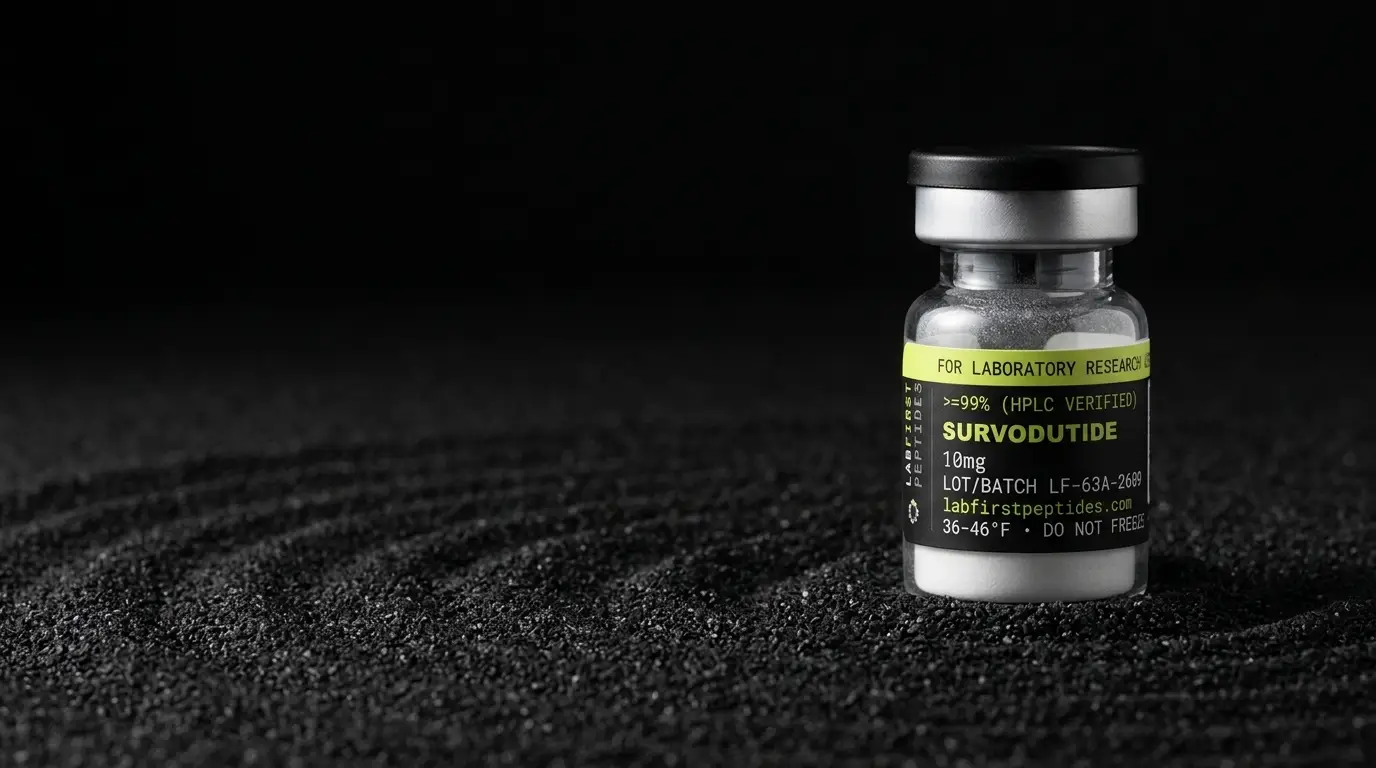
Read a survodutide certificate as a record for one lot only. Confirm the lot on the paper matches the vial, that identity rests on mass spectrometry rather than retention time, that the purity figure names its chromatographic method and wavelength, and that net peptide content is stated separately from gross fill mass.
- A certificate of analysis is a lot-specific test record, not a release document and not a statement of fitness for any purpose.
- Survodutide has no compendial monograph or official reference standard, so every method on a certificate is the issuing laboratory's own.
- Retention time comparison is consistent with identity; mass spectrometry with a stated theoretical value is what actually supports it.
- A purity percentage without column, gradient and detection wavelength cannot be evaluated and should be treated as an opinion.
- Net peptide content, not label mass, determines the concentration of a prepared solution, and omitting it introduces a ten to twenty percent unknown.
- Verification means contacting the issuing laboratory through independently found details, or testing a portion of your own vial.
A certificate of analysis describes one lot and nothing else
The document that arrives with a vial of survodutide is a test record. It reports what an analyst measured on a sample drawn from one lot, by named methods, on a stated date. That is the entire scope of its claim. It is not a quality system, not a batch release under GMP, and not an assertion that the material is fit for any particular purpose.
Most arguments about research peptide paperwork come from asking the paper to say more than it does. A certificate carrying a clean purity figure and an attached chromatogram tells you something real about the sample that went onto the column. Whether that sample came from the same lot as the vial on your bench is a separate question, and the certificate alone cannot answer it. Everything below is about closing that gap.
Survodutide adds a wrinkle that a reader coming from small-molecule work should register early. It is an investigational compound, known in the development literature as BI 456906, an acylated peptide agonist at both the glucagon and GLP-1 receptors. There is no compendial monograph for it, no USP reference standard, and no official assay procedure. Every method on the certificate is therefore the issuing laboratory's own, and the burden of judging whether the method can support the claim sits with you.
- Lot number on the vial against the lot number on the paper
- Identity method named, with observed and theoretical mass both printed
- Purity figure with column, gradient and detection wavelength
- Water, counterion and net peptide content as three separate numbers
- Issuing laboratory contacted through details found independently of the PDF
The fields, and what each one has to say
| Field | A usable entry | What a weak entry looks like |
|---|---|---|
| Product name and synonym | Survodutide, with BI 456906 given as the development code | Name only, no synonym, no CAS or sequence reference of any kind |
| Lot or batch number | Alphanumeric identifier that appears identically on the vial label | Blank, handwritten, or a number that differs from the vial by one character |
| Manufacture or fill date | Explicit date, distinct from the test date | Absent, leaving the age of the powder unknown |
| Test date and report date | Both stated; the gap between them is small and explained | A single undated signature block |
| Appearance | White to off-white lyophilized powder or cake | Wording copied from a different product entirely |
| Identity | Named technique, instrument class, observed versus theoretical mass | The word Conforms with no method and no number |
| Purity | RP-HPLC area percent with column, gradient, detection wavelength | A bare percentage, often to two decimal places |
| Related substances | Largest single impurity, and total impurities, as separate figures | Not reported at all |
| Water content | Karl Fischer or loss on drying, with the percentage | Omitted, which makes net content uninterpretable |
| Counterion | Acetate or trifluoroacetate content, quantified | Omitted, or named without a figure |
| Net peptide content | Percentage by amino acid analysis or nitrogen determination | Conflated with chromatographic purity |
| Net content per vial | Nominal fill mass, and how it was verified | The label claim repeated as though it were a measurement |
| Microbiological attributes | Stated as not tested, honestly | Sterile or Endotoxin-free claimed with no method behind it |
| Issuing laboratory | Legal name, address, report number, named signatory | A logo, a first name, and no contact route |
Read the table as a checklist for absences. On research peptide certificates the informative content is usually in what has been left out. A document reporting only identity and purity, with no water, no counterion and no net peptide content, is not necessarily dishonest. It is incomplete, and the incompleteness lands entirely on your concentration arithmetic.
Identity: what the method can actually prove
Identity is the field most often filled in with the least evidence. Three claims get made, and they are not equivalent.
- Retention time comparison. The sample elutes where a reference material elutes under the same gradient. That is consistent with identity. It is not identity, because many closely related sequences co-elute, and for a developmental compound there may be no independent reference material to compare against in the first place.
- Mass determination. ESI-MS gives the molecular mass, usually from several charge states deconvoluted to one figure. This is strong evidence when the observed and theoretical masses are both printed and the instrument class is stated. A single number labelled Found with no theoretical value beside it is decoration.
- Sequence confirmation. MS/MS fragmentation, or amino acid analysis combined with fragmentation data, gets closer to proving that the residues are in the order claimed. Amino acid analysis on its own establishes composition, not sequence.
For survodutide specifically, the primary structure in the public domain is less thoroughly documented than for approved incretin agents, and the authoritative definition of the molecule is the WHO International Nonproprietary Name entry rather than any supplier document. If a certificate prints a molecular formula or a theoretical mass, recompute it from the sequence you have on file rather than accepting the printed value. Certificates get copied between products, and a mass that belongs to a different peptide is a common and entirely silent error.
One more point on lipidated peptides. The acyl group carries a substantial share of the total mass, so a batch missing the fatty acid conjugation altogether differs from the intended molecule by hundreds of daltons and is trivially detectable by mass. A batch with the correct mass and the wrong point of attachment is not. If the acylation site matters to your work, the certificate probably does not settle it and you will need your own fragmentation data.
Purity: the number means nothing without the method
Chromatographic purity is a method-dependent quantity. The same lot can report 96% or 99% depending on gradient slope, column chemistry, run time and detection wavelength, and none of those variants is fraudulent. A certificate that gives you the figure without the conditions has given you an opinion.
What a competent purity entry states:
- Column dimensions, stationary phase and particle size.
- Mobile phase composition, including the acid modifier, and the gradient programme with total run time.
- Detection wavelength. Peptide bond absorbance near 214 nm sees far more than 280 nm does, and a purity figure quoted at 280 nm on a peptide with few aromatic residues is close to meaningless.
- Flow rate, column temperature, and injection volume.
- Whether the figure is area percent of the total integrated area, and what the integration cut-off was.
The chromatogram itself is worth more than the number. Look at the baseline, the shoulder on the main peak that integration may have swallowed, and the region late in the gradient where lipidated impurities elute. A gradient that ends abruptly after the main peak cannot report on anything more hydrophobic than the target. USP General Chapter on Chromatography sets out the system suitability logic behind all of this, including resolution and tailing expectations and the extent to which conditions may be adjusted without revalidating; it is the reference to reach for when judging whether a method could plausibly resolve what it claims to resolve.
Total impurities and largest single impurity are separate numbers and should be reported separately. A lot at 98.0% total purity with a single 1.6% impurity is a different material from a lot at 98.0% with eight impurities below 0.4% each.
Net peptide content, and why the label mass is not the peptide mass
This is where certificates most often break laboratory arithmetic. Chromatographic purity describes the proportion of peptide-related material that is the target sequence. It says nothing about how much of the powder in the vial is peptide at all. Lyophilized peptide carries water and counterion, and both are weighed into the fill.
Three quantities need to be distinguished on the paper:
- HPLC purity, in area percent, describing peptide-related species only.
- Net peptide content, in weight percent, typically by amino acid analysis or nitrogen determination, describing how much of the solid mass is peptide.
- Fill mass, the gross weight of solid in the vial.
Take a nominal 10 mg vial with net peptide content reported at 82.5%, water at 4.8% by Karl Fischer and acetate at 3.1%. The peptide mass present is:
10 mg × 0.825 = 8.25 mg
Brought into 2 mL of diluent, the peptide concentration is:
8.25 mg ÷ 2 mL = 4.13 mg/mL
Not the 5.00 mg/mL that a naive reading of the label gives. That is a 17% error carried silently into every downstream calculation, and it is the sort of discrepancy that shows up months later as a curve that will not reconcile with published data. The vial concentration calculator handles the same arithmetic for other fill masses and diluent volumes, and the cost per mg tool is where net content matters commercially: two vials at the same price and the same nominal mass are not the same purchase if one is 82% peptide and the other 94%.
Where net peptide content is absent from the certificate, the honest position is that the concentration of any solution you prepare is unknown to within roughly ten to twenty percent. Some protocols tolerate that. Say so in the record either way.
Lot match, dates, and the integrity of the document
Read the lot number off the vial and off the certificate as two separate acts, character by character, before anything else. Transposed digits are the single most common defect in research peptide documentation, and a mismatched lot voids the document regardless of how good the analysis is.
Then look at the dates. Manufacture date and test date should both be present. A test date months after the fill date tells you the material sat somewhere before anyone characterised it. A test date years before the shipping date tells you the certificate describes a lot that has since aged under storage conditions the certificate says nothing about. Neither is disqualifying on its own; both belong in your record.
On the file itself. Certificates arrive as PDFs, and PDFs are trivially editable. Check whether the document metadata shows a creation date and producing application consistent with a laboratory reporting system rather than a graphics editor. Look for a report number distinct from the lot number, since real analytical reports carry their own sequential identifier. Look for a named signatory with a role, and for the laboratory's legal name and address rather than a logo. None of these proves authenticity. Their absence is informative.
Verify at the laboratory, not with the seller
A seller confirming their own certificate has told you nothing you did not already have. The verification that matters goes to the issuing laboratory, and it is a short exchange.
- Email or call the laboratory using contact details you found independently, not the ones on the PDF. A spoofed certificate usually comes with a spoofed contact route.
- Give them the report number and the sample identifier, and ask whether the report exists and matches what you hold. Most contract laboratories will confirm existence and the headline results to the party holding the report, though some will only speak to the client who commissioned the work.
- Ask who submitted the sample and how it was identified on receipt. This is the question that separates a lot-representative test from a test on a sample the seller chose and labelled themselves. The laboratory tests what arrives. It has no view on whether the tube came from your lot.
- Ask for the raw data files, not the summary. Chromatograms as instrument files, mass spectra with the acquisition parameters. A laboratory that ran the work has these. A document generator does not.
- Ask whether the laboratory holds ISO/IEC 17025 accreditation for the relevant test methods, and for the scope document. Accreditation is method-specific, and a laboratory accredited for elemental analysis is not thereby accredited for peptide purity.
If your work depends on the identity or content figures, the terminal step is independent testing. Send a portion of your own vial, drawn and labelled by you, to a laboratory you selected. It costs money and takes a fortnight. It is the only procedure that produces a certificate about the material you actually hold. Our own approach to lot documentation is set out under the quality standard.
What the certificate does not cover
A typical research peptide certificate reports identity, purity, and sometimes water and counterion. The following are usually absent, and their absence is not a defect in the document so much as a fact about the material.
- Sterility and bacterial endotoxin. Not tested, in almost every case. A lyophilized powder filled outside an aseptic process should not be assumed to be either sterile or low in endotoxin.
- Microbial limits, total aerobic count, and specified organisms.
- Residual solvents from synthesis and cleavage. ICH Q3C sets the framework for classifying and limiting these in pharmaceutical manufacture; research material is generally not assessed against it.
- Elemental impurities, covered for medicines by ICH Q3D, including metals introduced by catalysts or equipment.
- Stability data for the specific lot. A storage recommendation printed on a certificate is a convention unless a study sits behind it. The same reasoning applies here as in storage and stability for lyophilized peptides.
- Any statement about suitability for a purpose. Certificates report measurements.
ICH Q2(R2) is the useful yardstick for the methods themselves. It sets out what specificity, accuracy, precision and range mean for an analytical procedure and what evidence supports each. A method described on a certificate in enough detail to be reproduced is a method you can judge against that framework. A method described as HPLC is not.
The incoming inspection record
Whatever the certificate says, your own record is the document that will be consulted when a result looks wrong. Keep it short and keep it contemporaneous.
At minimum: date of receipt, condition on arrival including whether the cold chain held, the lot number as read from the vial, the certificate report number and issuing laboratory, the purity and net content figures transcribed by hand, any field that was absent, and the initials of whoever checked. Where you have queried the issuing laboratory, note the date and the reply. Where net peptide content was missing, note explicitly that solution concentrations derived from this lot carry an unquantified error.
That last line takes ten seconds to write and saves an afternoon of reconstruction eighteen months later. Records that only capture the good news are the ones that fail under scrutiny.
Regulatory position
Survodutide (BI 456906) is a dual glucagon and GLP-1 receptor agonist under clinical development by Boehringer Ingelheim, originating from work with Zealand Pharma. As of the verification date below it holds no marketing authorisation from the FDA, the EMA, or any comparable regulator, and it is in late-stage clinical investigation rather than commercial supply.
Consequences for documentation: there is no USP or Ph. Eur. monograph, no official reference standard, and no compendial assay. Every analytical method on a supplier certificate is that laboratory's own. Because no approved product exists, survodutide has never appeared on an FDA drug shortage list, and the compounding enforcement discretion that applied to certain marketed incretin agents has never had any application here.
Status verified 26 August 2026. Clinical and regulatory status for an investigational compound changes; recheck before relying on this paragraph.
FOR LABORATORY AND IN-VITRO RESEARCH USE ONLY. NOT FOR HUMAN OR ANIMAL CONSUMPTION. NOT FOR PERSONAL, MEDICAL, DIAGNOSTIC, THERAPEUTIC, OR RECREATIONAL USE.
What is Survodutide studied for?
Published research on Survodutide investigates the areas below, which is a different question from what Survodutide will do for anyone, a claim about a living system that nothing on this site is sold for.
What it is. Dual glucagon receptor and GLP-1 receptor agonist peptide, developed as BI 456906.
What the research looks at. Investigational, developed by Boehringer Ingelheim. Studied in phase II randomised placebo-controlled trials in type 2 diabetes and in metabolic liver disease.
How it is thought to work. Agonist at both the glucagon receptor (GCGR) and the GLP-1 receptor. The two-arm design follows the same logic as retatrutide's glucagon arm: GLP-1 receptor agonism acts on calorie intake, glucagon receptor agonism acts on energy expenditure and hepatic metabolism.
What is not established. No approved product. Adverse events, predominantly gastrointestinal, were reported at a substantially higher rate than for the comparator in the published phase II trial.
The full record, including the certificate for the lot in stock, is on the Survodutide product page.
Common questions
What is the difference between HPLC purity and net peptide content?
Is a certificate without a chromatogram worth anything?
Can I confirm a certificate is genuine without paying for retesting?
Why does survodutide have no reference standard?
Should a certificate state that the material is sterile?
How much does an absent water content figure matter?
More documentation guides
Sources
- USP-NF General Chapter on Chromatography. Establishes system suitability criteria, resolution and tailing expectations, and the limits of permitted method adjustment; supports the judgement of whether a stated RP-HPLC method can resolve what the purity figure claims.
- ICH Q2(R2), Validation of Analytical Procedures. Defines specificity, accuracy, precision and range for analytical methods; the framework against which a certificate's stated methods can be assessed.
- ICH Q3C and Q3D guidelines on residual solvents and elemental impurities. Supports the point that these attributes are governed for pharmaceutical manufacture and are typically not assessed at all for research-grade peptide material.
- WHO International Nonproprietary Names programme, published INN lists. The authoritative public definition of the survodutide molecule, and the reference against which a supplier-stated formula or theoretical mass should be recomputed.