Identity is confirmed by matching a measured molecular mass to the mass calculated from the stated sequence, then supporting that with fragmentation or peptide mapping and a chromatographic retention match against a characterised reference. A purity percentage describes peak area only. It says nothing about which molecule the peak is.
- A purity percentage describes chromatographic homogeneity and carries no information about which molecule the main peak represents.
- Identity confirmation requires a theoretical mass, an observed mass, and a stated tolerance; any one of the three missing makes the claim unverifiable.
- Intact mass cannot distinguish isobaric substitutions or an acyl chain attached to the wrong residue, so fragmentation data is needed for sequence-level confirmation.
- Survodutide has no USP or Ph. Eur. monograph and no compendial reference standard, so retention-time identity tests depend on a laboratory-qualified in-house reference.
- Net peptide content is a separate measurement from HPLC purity and is the figure that governs concentration arithmetic.
- Survodutide (BI 456906) remains investigational with no marketing authorisation in the US or EU as of 26 August 2026.
Purity and identity answer different questions
A certificate that reports 99.1% by RP-HPLC is making one claim: that a single chromatographic peak accounted for 99.1% of the integrated absorbance in that run. It is a statement about homogeneity. It contains no information about what the peak is. A vial of a different lipidated glucagon-family analogue, correctly synthesised and well purified, will produce exactly that number.
This distinction gets collapsed constantly in supplier documentation, and the collapse is convenient. Purity is cheap to generate and easy to read. Identity requires an orthogonal measurement, a theoretical value to compare against, and a stated tolerance. Any certificate that lists a purity figure and a compound name with nothing in between is asking you to accept the name on trust.
The working position in a laboratory that has to defend its results is that identity and purity are separate acceptance criteria with separate methods and separate raw data. If the file for a given lot contains a chromatogram and no mass spectrum, the identity of that lot is undocumented. It may well be correct. It is not confirmed.
- Label and product name — no evidentiary weight
- Purity percentage — homogeneity only
- Retention time match — method-dependent, needs a qualified reference
- Intact mass within a stated tolerance — composition confirmed
- Fragmentation or peptide map over the modified residue — sequence and acylation site confirmed
What mass spectrometry establishes
The primary identity evidence for a peptide of this size is a molecular mass measurement, usually by electrospray ionisation on a time-of-flight or Orbitrap instrument, reported against a mass calculated from the declared sequence and declared modifications. Two things have to be present for that comparison to mean anything: the theoretical value, and the tolerance the laboratory accepted.
A multiply charged peptide appears as a series of ions rather than one line. The relationship for protonated species is m/z = (M + z × 1.00728) ÷ z, and the spacing between isotope peaks within a charge state is 1 ÷ z. Charge state is read off that spacing, which is why raw spectra are more useful than a deconvoluted number alone. A deconvolution report tells you what the software concluded. The spectrum lets you check whether the charge envelope and isotope pattern support it.
Mass alone has known blind spots. Leucine and isoleucine are identical in mass. Glutamine and lysine differ by about 0.036 Da at the residue level, which a low-resolution instrument will not separate. Deamidation adds 0.984 Da, so any tolerance wider than roughly half a dalton on a 4 kDa molecule cannot exclude a deamidated impurity co-eluting under the main peak. A single reported mass within a loose window is weak evidence dressed as strong evidence.
Sequence-level confirmation, and when to demand it
ICH Q6B sets the expectation plainly for biotechnological products: an identity test should be highly specific and based on unique aspects of the molecular structure. Molecular mass is a property of composition. Sequence is a property of structure. For a first lot from a new supplier, or where a synthesis route is unknown, mass alone leaves a real gap.
Two routes close it. Top-down fragmentation, where the intact molecule is dissociated in the instrument and the b/y or c/z ion series is matched against the predicted series, gives partial to substantial sequence coverage without any sample manipulation. Bottom-up peptide mapping digests the molecule with a specific protease and identifies the resulting fragments by LC-MS/MS, reporting coverage as a percentage of residues observed. Coverage below about 90% should be read for where the gaps fall rather than as a single figure; a gap over the modified residue is the gap that matters.
For an acylated peptide, localisation of the fatty acid side chain is a distinct question from confirming its presence. Total mass confirms that the modification mass is there somewhere. Only fragmentation across the attachment site shows which residue carries it. A regioisomer with the chain on the wrong lysine is mass-identical and, in receptor work, may not behave the same way at all.
Chromatography as the second leg
Retention time matching against a characterised reference is the classical identity test and it remains useful, with limits that USP General Chapter <621> makes explicit through its system suitability requirements. Retention is a property of the method as much as of the analyte. Column lot, temperature, ion-pairing agent and gradient slope all move it. An unqualified retention time on a certificate, with no reference injection and no system suitability data, is a number without a scale.
Three practices raise its value. Co-injection, where reference and sample are run together and a single symmetrical peak results, is stronger than two separate runs with similar times. A second, genuinely orthogonal gradient or stationary phase reduces the chance of coincidental co-elution. Photodiode array data allows a spectral comparison across the peak, which will flag a shoulder that integration smoothed over.
Chromatography also does something mass spectrometry does poorly. Ion suppression and differential ionisation mean MS response is a bad proxy for relative amount, so the impurity profile belongs on the UV trace while identity belongs on the mass spectrum. Reading each for what it can support is the whole trick.
| Evidence | Method | What it establishes | What it cannot exclude |
|---|---|---|---|
| Supplier label | None | Nothing | Anything |
| Purity percentage | RP-HPLC, UV area | Chromatographic homogeneity | A different compound entirely |
| Retention time match | RP-HPLC vs reference | Consistency with the reference under one method | Co-eluting isomers and close analogues |
| Intact molecular mass | ESI-TOF or Orbitrap | Elemental composition within the stated tolerance | Isobaric substitutions, sequence scrambling, wrong acylation site |
| Fragmentation or peptide map | LC-MS/MS | Sequence over the covered residues | Modifications in uncovered gaps |
| Amino acid analysis | Hydrolysis, derivatisation, HPLC | Residue composition and net peptide content | Sequence order |
What survodutide specifically makes harder
Survodutide, development code BI 456906, is a lipidated linear peptide in the glucagon and GLP-1 family, acting as a dual agonist at both receptors. Public chemical registries carry the structure under that code. The sequence you compute a theoretical mass from should come from the registry record, not from a supplier product page, and if you cannot obtain a sequence you can compute against, you cannot verify a reported mass at all. That is worth saying flatly because it is the point at which most informal verification quietly stops.
Three structural features shape the analysis. A fatty acid chain attached through a linker makes the molecule strongly hydrophobic, so it retains late on C18 and tends to give broad, sometimes shouldered peaks unless the gradient is shallow across the elution window. The same amphiphilic character means adsorption to glass and to some plastics at low concentration, which shows up as poor injection reproducibility rather than as anything obviously wrong. And non-coded residues of the α-aminoisobutyric acid type, characteristic of this class as a defence against DPP-4 cleavage, are not recognised by every search algorithm; a peptide-mapping report generated with default settings can report a false negative simply because the software had no residue mass for them.
Storage state also affects what an identity test sees. Deamidation and oxidation products are identity-adjacent findings, and a lot that was analysed six months ago is not necessarily the material now in the freezer. The reasoning behind that is set out in the guide on storage and stability of lyophilized peptides, which applies to any acylated analogue of this size.
Reading the certificate
A certificate of analysis is a document with a chain of custody, not a marketing artefact. What follows is what a competent one carries and what its absence implies.
| Element | Acceptable form | Red flag |
|---|---|---|
| Lot identifier | Unique, matching the vial label and the raw data files | Absent, or a generic product code only |
| Test date and analyst | Date of analysis, plus release date if different | No date, or a date that predates the lot |
| Theoretical mass | Stated, with monoisotopic or average specified | Only an observed value, nothing to compare it to |
| Observed mass and tolerance | Observed value plus accepted window in Da or ppm | "Conforms" with no number |
| Raw data | Lot-specific spectrum and chromatogram, axes legible | The same image reused across lots, or no traces at all |
| Chromatographic method | Column, mobile phase, gradient, detection wavelength | "HPLC" and a percentage |
| Net peptide content | Reported separately from HPLC purity | Purity presented as if it were mass content |
| Counterion and water | Salt form named; residual water by Karl Fischer or TGA | Silence, which leaves gravimetric work unanchored |
| Laboratory | Named, in-house or third party, contactable | Unnamed "independent lab" |
Net peptide content deserves a sentence of its own because it is where mass arithmetic goes wrong. A vial labelled 10 mg may hold 10 mg of gross powder that is 82% peptide by content, the balance being counterion, water and residual salts. Concentration calculated from the label rather than from content will be systematically high. The vial concentration calculator handles the division; deciding which mass figure to enter is a documentation judgement, and our quality standard page sets out which figures we publish per lot.
Worked example: checking a reported mass
Take an illustrative case. A certificate reports an observed monoisotopic mass of 4000.40 Da against a theoretical 4000.00 Da, and states that the result conforms.
Mass error in parts per million:
(0.40 ÷ 4000.00) × 106 = 100 ppm
For a modern high-resolution instrument, 100 ppm is one to two orders of magnitude worse than routine performance. More usefully, 0.40 Da sits inside the 0.984 Da shift a single deamidation would produce, so the window as reported cannot distinguish the intact molecule from a partially deamidated one. The certificate is not wrong. It is uninformative at the tolerance it chose.
The same spectrum offers a cross-check. At the 3+ charge state the expected ion is:
(4000.00 + 3 × 1.00728) ÷ 3 = 1334.34
with isotope peaks spaced 1 ÷ 3 = 0.333 apart. If the published spectrum shows spacing near 0.5, the charge state was assigned as 3+ when the ion was 2+, and the deconvoluted mass is wrong by a factor. That kind of error is visible in thirty seconds on a raw trace and invisible on a summary line.
Regulatory position and reference standards
Survodutide (BI 456906) is an investigational dual glucagon and GLP-1 receptor agonist. As of the verification date below it holds no marketing authorisation in the United States or the European Union, and clinical development has been in late-stage trials for obesity and for metabolic dysfunction-associated steatohepatitis. FDA Fast Track designation, announced for the MASH programme in 2024, is a procedural mechanism affecting review interaction. It is not an approval and carries no finding of safety or efficacy.
There is no USP or Ph. Eur. monograph and no official compendial reference standard for this molecule. That has a direct analytical consequence: retention-time identity tests have no authoritative comparator, so the reference material is whatever a laboratory has itself characterised, and its provenance becomes part of the identity claim. Where a certificate cites a "reference standard" without saying where it came from and how it was qualified, the chain terminates in an assertion.
Status verified 26 August 2026.
FOR LABORATORY AND IN-VITRO RESEARCH USE ONLY. NOT FOR HUMAN OR ANIMAL CONSUMPTION. NOT FOR PERSONAL, MEDICAL, DIAGNOSTIC, THERAPEUTIC, OR RECREATIONAL USE.
What is Survodutide studied for?
Published research on Survodutide investigates the areas below, which is a different question from what Survodutide will do for anyone, a claim about a living system that nothing on this site is sold for.
What it is. Dual glucagon receptor and GLP-1 receptor agonist peptide, developed as BI 456906.
What the research looks at. Investigational, developed by Boehringer Ingelheim. Studied in phase II randomised placebo-controlled trials in type 2 diabetes and in metabolic liver disease.
How it is thought to work. Agonist at both the glucagon receptor (GCGR) and the GLP-1 receptor. The two-arm design follows the same logic as retatrutide's glucagon arm: GLP-1 receptor agonism acts on calorie intake, glucagon receptor agonism acts on energy expenditure and hepatic metabolism.
What is not established. No approved product. Adverse events, predominantly gastrointestinal, were reported at a substantially higher rate than for the comparator in the published phase II trial.
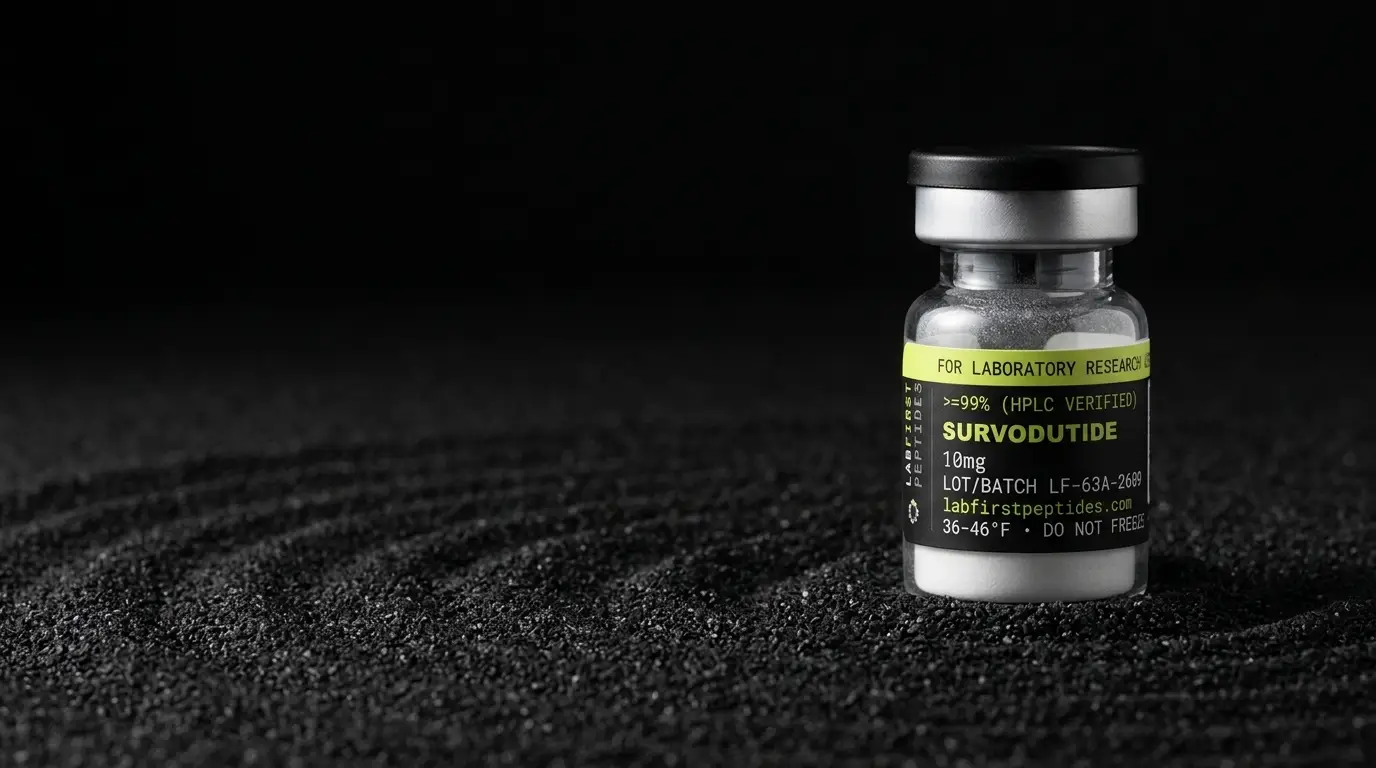
The full record, including the certificate for the lot in stock, is on the Survodutide product page.
Common questions
Is a mass spectrum on its own enough to confirm identity?
What mass tolerance should a certificate state?
Why does the certificate list purity and net peptide content separately?
The certificate says the reference standard matched. Is that sufficient?
Can identity be confirmed after a vial has been in solution for weeks?
What is the single most common documentation failure?
More documentation guides
Sources
- ICH Q6B, Specifications: Test Procedures and Acceptance Criteria for Biotechnological/Biological Products. Establishes that an identity test should be highly specific and based on unique aspects of molecular structure; supports the separation of identity from purity acceptance criteria.
- USP General Chapter <621>, Chromatography. Defines system suitability and the conditions under which retention comparison against a reference is a valid identification, supporting the limits placed on retention-time evidence here.
- ICH Q2(R2), Validation of Analytical Procedures. Defines specificity and the requirement to demonstrate that a procedure discriminates the analyte from closely related substances; underlies the argument for orthogonal methods.
- Public chemical registries (PubChem, CAS) entries for survodutide / BI 456906. Source of the declared structure and modification from which a theoretical mass is computed; establishes the compound as an acylated dual glucagon/GLP-1 receptor agonist peptide.