A TB-500 certificate of analysis is a test report on one lot. Read it in order: what molecule was tested, by which mass method, purity by RP-HPLC under a stated gradient, net peptide content, lot identifier, test date, and issuing laboratory. Then verify the report with that laboratory.
- A certificate of analysis reports what one named laboratory measured on one named lot on one named date, and nothing beyond that.
- TB-500 is used commercially for two different molecules: the acetylated heptapeptide Ac-LKKTETQ near 889 Da and full-length thymosin β-4 near 4963 Da.
- Neither material has a USP monograph, so purity claims are made against supplier-defined specifications rather than a compendial standard.
- Ac-LKKTETQ contains no tryptophan or tyrosine, so RP-HPLC detection must run near 214 or 220 nm and a purity figure quoted at 280 nm is not credible.
- Net peptide content, not labelled mass, sets the true concentration once diluent is added; the difference commonly runs to fifteen percent or more.
- Verification means contacting the issuing laboratory with the report number, because the seller who supplied the document cannot confirm it.
What a certificate of analysis is
A certificate of analysis reports what a named laboratory measured, on a named lot, on a named date, using named methods. That is the whole of it. It is not a guarantee about the vial in your hand, it is not a quality system, and it carries no claim about anything the tested lot was later blended with, repackaged into or stored in.
The document earns its keep in one narrow situation: a result comes out wrong and you need to know whether the starting material was what the protocol assumed. A certificate that names a method, a lot and an issuing laboratory answers that. A certificate that says Purity: 99.2% above a company logo answers nothing, because there is no way to interrogate it.
So the useful reading habit is not scanning for a high number. It is checking whether each claim on the page is attached to enough detail that someone else could repeat it, and whether the lot identifier on the page matches the lot identifier on the vial. Most certificates in circulation for research peptides fail on one of those two counts.
- Which molecule — sequence, terminal modifications, theoretical mass
- Lot identifier — must match the vial, not resemble it
- Identity — observed mass, charge state, spectrum attached
- Purity — wavelength, gradient, column, chromatogram attached
- Net peptide content — the field that fixes your concentration
- Issuing laboratory — report number, signatory, accreditation scope
TB-500 names two different molecules
Before any field on the certificate means anything, settle what was tested. The label TB-500 is used commercially for at least two distinct materials.
Most often it means a short synthetic fragment of thymosin β-4, the acetylated heptapeptide Ac-Leu-Lys-Lys-Thr-Glu-Thr-Gln, corresponding to residues 17 to 23 of the parent sequence. As the acetylated free acid its average mass sits near 889 Da. The C-terminal amide form differs by roughly one mass unit, which matters when you compare an observed mass against a theoretical one.
Less often it means full-length thymosin β-4 itself: a 43-residue, N-terminally acetylated peptide with a reported mass near 4963 Da. PubChem carries the canonical sequence for the parent molecule and is the reference to check the residues against.
These are not interchangeable analytes. They have different masses, different chromatographic behaviour and different impurity profiles. A certificate headed TB-500 that never states a sequence or a theoretical mass has skipped the first question the document exists to answer. Ask which molecule, in writing, before reading further.
The fields, in order
| Field | What it should say | How you check it | What a gap means |
|---|---|---|---|
| Issuing laboratory | Legal name, address, report number, signatory, accreditation status | Contact the laboratory with the report number | Unverifiable; treat as a marketing document |
| Product and sequence | Name, one-letter or three-letter sequence, terminal modifications, theoretical mass | Recompute the mass from the sequence | You do not know which analyte was tested |
| Lot or batch number | An alphanumeric identifier that also appears on the vial label | Read the vial | The document is not tied to your material |
| Appearance | White to off-white lyophilized powder or cake | Visual inspection on receipt | Minor, but a mismatch is worth recording |
| Identity | ESI-MS or MALDI-TOF, observed mass, charge states, spectrum attached | Compare observed against your own calculation | Purity without identity is a number about an unknown |
| Purity | RP-HPLC area percent, wavelength, column, gradient, run time, chromatogram attached | Look at the trace, not the number | Unfalsifiable claim |
| Net peptide content | Percent by amino acid analysis or elemental nitrogen | Recalculate your working concentration | Your stated concentration is high by an unknown margin |
| Water content | Karl Fischer or loss on drying, percent | Sum it against content and counterion | Mass balance cannot be closed |
| Counterion | Trifluoroacetate or acetate, percent, method | Ion chromatography or fluorine NMR result | Unaccounted mass, and an unlisted assay variable |
| Dates | Manufacture date and test date, separately | Check the order and the interval | Cannot tell whether the data describe this lot now |
The order matters less than the completeness. A certificate that reports six of those ten fields properly is more use than one that reports all ten as bare numbers with no methods.
Identity: mass, and the arithmetic you can do without the lab
Identity on a peptide certificate is almost always mass spectrometry, reported as an observed mass against a theoretical one. Electrospray on a small peptide typically shows the singly protonated species, so for the acetylated heptapeptide you would expect a base peak near 890 in the positive mode. Full-length thymosin β-4 at roughly 4963 Da shows a family of multiply charged states instead, and the report should say which charge state was used to arrive at the reported mass.
Do the calculation yourself. Sum the residue masses, add water for the free acid, add 42 for the N-terminal acetyl, subtract about one unit if the C-terminus is amidated. If your figure and the certificate's theoretical figure disagree by more than rounding, one of you is working from a different sequence, and that is a question worth asking before anything goes into solution.
Mass confirms composition. It does not confirm sequence order. Two peptides with the same residues in a different arrangement are indistinguishable by intact mass alone, which is why sequence-level confirmation needs fragmentation data or amino acid sequencing, and why most research certificates do not claim it.
Purity: an area percent, at one wavelength, under one gradient
Reversed-phase HPLC purity is the percentage of total integrated peak area falling under the main peak. Every word in that sentence is a condition. Change the wavelength, the gradient slope, the column chemistry or the integration window and the number changes.
For this analyte the wavelength is not a free choice. The heptapeptide Ac-LKKTETQ contains no tryptophan and no tyrosine, so there is nothing to detect at 280 nm. Detection has to run near 214 or 220 nm, where the amide backbone absorbs. Full-length thymosin β-4 carries a single phenylalanine and little more, so the same constraint holds. A certificate quoting purity at 280 nm for either material has reported something that cannot have been measured as described.
Low-wavelength detection responds to peptide bonds. It responds weakly or not at all to inorganic salts, to the counterion, and to some synthesis scavengers. So an RP-HPLC purity of 98 percent is a statement about the peptidic impurity profile and says nothing about the non-peptidic mass in the vial.
What a chromatogram shows that a number cannot: whether the baseline drifts, whether the main peak is symmetrical, whether the gradient ran long enough for late-eluting material to appear, and whether integration started after the injection front. USP General Chapter <621> sets the system suitability framework a serious method reports against. ICH Q2(R2) is the reference for what a laboratory means when it calls a procedure validated.
One gradient is one experiment. Deletion and insertion sequences can co-elute with the target under a single set of conditions and separate cleanly under a different pH or ion-pairing agent. Where purity actually matters to a study, an orthogonal condition is the check.
Net peptide content is where the mass goes missing
A vial labelled 10 mg contains 10 mg of solid. Some of that solid is peptide. The rest is water taken up during lyophilization and handling, plus counterion carried over from purification. Preparative reversed-phase work usually uses trifluoroacetic acid, and a peptide with two lysine residues carries a meaningful trifluoroacetate load, commonly a double-digit weight percentage before any salt exchange to acetate.
Net peptide content is the field that quantifies this, measured by amino acid analysis after hydrolysis, or by elemental nitrogen. With no aromatic residue in the short fragment, UV quantitation is not available as a shortcut. If the certificate reports purity but not content, the honest position is that the peptide mass in the vial is unknown to somewhere between five and twenty percent.
Worked through, with a certificate reporting 82 percent net peptide content on a nominal 10 mg lot:
10 mg × 0.82 = 8.2 mg peptide
Brought into 2 mL of diluent, that is:
8.2 mg ÷ 2 mL = 4.1 mg/mL, not 5.0 mg/mL
In molar terms, against 889 g/mol:
8.2 mg ÷ 889 g/mol = 9.2 µmol → 4.6 mM in 2 mL
An eighteen percent error in stated concentration propagates into every dilution downstream. The vial concentration calculator handles the arithmetic for other vial sizes; the correction for net content has to come off the certificate first. The same figure changes procurement comparisons, which is why cost per mg is only comparable between suppliers who both report content.
Lot, dates and the issuing laboratory
Three checks here, all quick, all commonly failed.
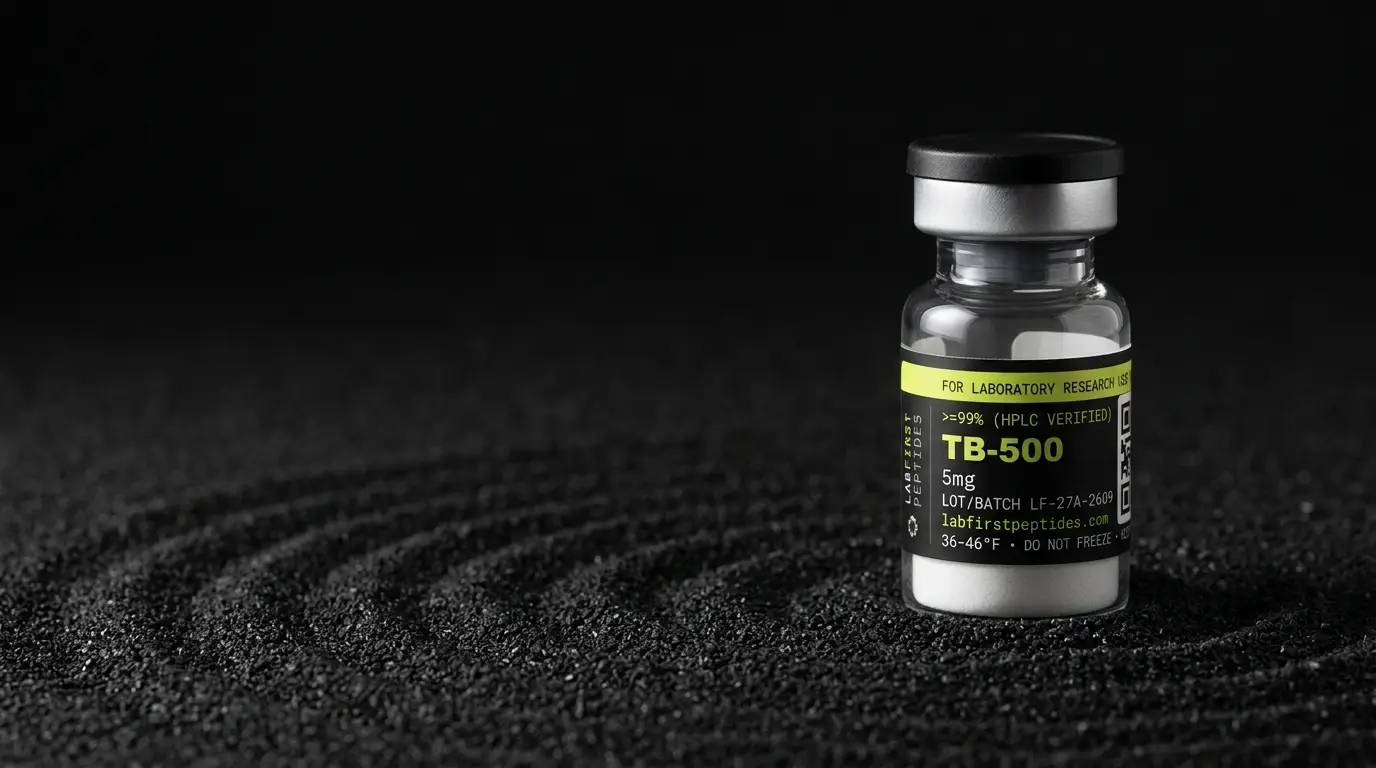
Lot match. The identifier on the certificate must be the identifier printed on the vial. Not similar, not a prefix, not "the same batch". A certificate supplied for a different lot describes different material, however recent. Where a supplier repackages bulk, ask whether the certificate covers the bulk lot or the fill, and what identifier connects the two.
Dates. Manufacture date and test date are separate fields and should appear separately. A test date preceding the manufacture date is a clerical error at best. A test date years old tells you the data were valid once, for a material that has since been stored somewhere, by someone, under conditions the document does not describe. There is no pharmacopeial monograph for TB-500, so no compendial retest interval exists to appeal to; the interval is a matter of your own judgement and your protocol.
Issuing laboratory. Manufacturer in-house QC and independent third-party testing are both legitimate and they are not the same claim. An independent report carries a laboratory name, an address, a report number and a signatory. ISO/IEC 17025 accreditation, where held, is granted for a defined scope of tests, and a laboratory accredited for elemental analysis is not thereby accredited for peptide purity. Reading the scope is the step people skip.
Verification at the laboratory
The seller sent you the document, so the seller cannot verify it. Verification means going to the party that generated the data.
Take the report number and the lot identifier from the certificate and contact the issuing laboratory directly, using contact details you found yourself rather than the ones on the PDF. Ask three things: whether that report number exists, whether it was issued for that lot, and whether the results on your copy match theirs. Accredited laboratories are used to this request. Some will confirm only to the client who commissioned the work, which is itself informative, because it tells you the report is real and the client relationship exists.
Then check the accreditation independently. National accreditation bodies publish searchable directories of accredited laboratories with their scopes. A certificate bearing an accreditation logo for a body that does not list the laboratory is the single clearest signal available.
Where a report cannot be verified and the study depends on it, the remaining option is your own testing. In-house RP-HPLC against the certificate's stated conditions, plus an intact mass, costs a morning and settles identity and gross purity. Our quality standard describes which of these checks are run per lot rather than per shipment. Diluent lots deserve the same treatment; see the notes on bacteriostatic water for what the accompanying documentation should cover there.
Red flags, ranked by how much they tell you
- No lot number, or a lot number that does not match the vial. Everything else on the page is then unattached to your material.
- No issuing laboratory name or report number. The document cannot be checked with anyone.
- Purity with no chromatogram, or a chromatogram cropped so the time axis and baseline are not visible.
- No net peptide content. Common, and the most expensive omission in practice.
- A stated wavelength that could not have produced the result, such as 280 nm for a peptide with no aromatic residues.
- Identical retention times or visually identical traces across certificates for different compounds. Someone reused a file.
- Purity quoted to two decimal places from an area-percent integration. The method does not support that precision.
- GMP or pharmaceutical-grade language with no registration number, no site name and no inspection reference.
- Sterility or endotoxin results on a document that otherwise describes a research chemical, with no method cited. Endotoxin testing has a defined method and a defined unit; a bare "passes" is not a result.
None of these is proof of fraud on its own. Two or three together describe a supplier whose documentation is decorative.
Regulatory position
TB-500 is not an approved drug in the United States or the European Union, and neither the heptapeptide fragment nor full-length thymosin β-4 has a USP monograph. Purity and identity claims are therefore made against a supplier-defined specification and general pharmacopeial chapters, not against a compendial standard for this substance.
FDA has evaluated a number of peptides nominated for use in pharmacy compounding under section 503A and placed several in the category of substances raising significant safety concerns, which excludes them from that route. Thymosin β-4 and its fragments have no lawful route to human use in a research-chemical supply chain.
The World Anti-Doping Agency Prohibited List names thymosin-β4 and its derivatives, TB-500 among them, under the growth factors section, prohibited at all times in and out of competition.
Status verified 26 August 2026.
FOR LABORATORY AND IN-VITRO RESEARCH USE ONLY. NOT FOR HUMAN OR ANIMAL CONSUMPTION. NOT FOR PERSONAL, MEDICAL, DIAGNOSTIC, THERAPEUTIC, OR RECREATIONAL USE.
What is TB-500 studied for?
Published research on TB-500 investigates the areas below, which is a different question from what TB-500 will do for anyone, a claim about a living system that nothing on this site is sold for.
What it is. A man-made peptide matching a section of thymosin beta-4.
What the research looks at. Animal and cell-culture research on the cell skeleton and how cells move. Suppliers often blur TB-500 and full thymosin beta-4 together. They are not the same molecule, and this record is about the section.
How it is thought to work. Thymosin beta-4 is a protein that grabs hold of actin, the building material of a cell’s internal skeleton, and the section sold as TB-500 is its actin-grabbing part. The published work is about how actin behaves and how cells move in culture.
What is not established. No approved product, no official standard, and very little human research. The section-versus-whole-protein distinction gets blurred commercially, so check which one a certificate actually names.
The full record, including the certificate for the lot in stock, is on the TB-500 product page.
Common questions
Which molecule does a TB-500 certificate usually describe?
Is 99 percent purity by HPLC a meaningful figure?
Why does net peptide content change my working concentration?
How do I verify a certificate independently?
What does the absence of a USP monograph change?
Should a research peptide certificate report sterility or endotoxin?
More documentation guides
Sources
- USP General Chapter <621>, Chromatography. Defines system suitability, integration and reporting expectations for HPLC procedures; supports the point that an area-percent purity figure is meaningless without stated conditions.
- ICH Q2(R2), Validation of Analytical Procedures. Establishes what specificity, accuracy, precision and range mean when a laboratory describes a purity or content method as validated.
- PubChem compound record for thymosin beta-4. Reference for the canonical 43-residue sequence and reported mass of the parent peptide, against which fragment numbering and theoretical masses can be checked.
- ISO/IEC 17025, General requirements for the competence of testing and calibration laboratories. Basis for the scope-of-accreditation check; accreditation is granted for defined tests, not for a laboratory as a whole.