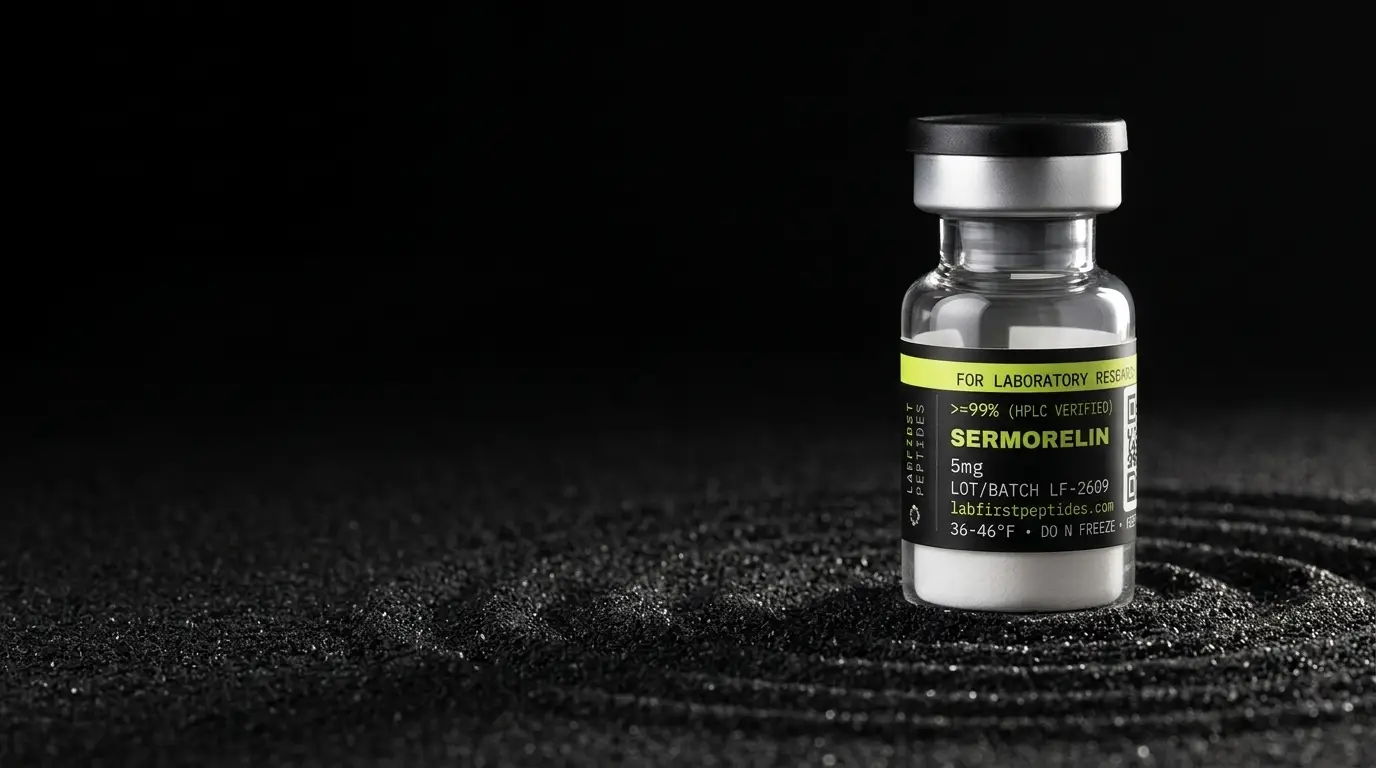
Sermorelin acetate identity is confirmed with a mass reading near 3357.9, a separation that pulls apart deletion sequences, and sequence evidence. At 29 residues, mass alone proves less than it does for a short peptide. So peptide mapping and amino acid analysis carry more of the weight here.
- Sermorelin is GHRH(1-29), C149H246N44O42S, average mass near 3357.9, PubChem CID 16132413.
- Electrospray gives a charge-state envelope, so the certificate mass is deconvoluted.
- A one-dalton error is obvious at 800 daltons and hides inside scatter at 3,358.
- Peptide mapping localises an error to a fragment, which intact mass cannot do.
- Deletion sequences often co-elute, so resolution matters more than sensitivity.
- The database record is the free peptide; the product is the acetate salt.
What does identity mean for a long synthetic peptide?
In plain terms, a long peptide is like a long sentence. Missing one word barely changes its weight, so you also have to read it piece by piece to be sure every word is there.
That the molecule in the vial is the one the label names, established by evidence rather than assertion. Sermorelin is the first 29 residues of growth hormone releasing hormone, molecular formula C149H246N44O42S, average mass near 3357.9, PubChem CID 16132413.
Identity and purity are separate questions. A vial can hold the right molecule at poor purity or the wrong one at high purity, and a certificate answering one has answered half.
Length changes the balance of evidence. On a short peptide a mass match does most of the work. On a 29-mer it does noticeably less, for reasons the next two sections set out.
- Charge-state envelope deconvoluted into one mass near 3357.9
- Salt form stated, because the reference figure is the free peptide
- RP-HPLC resolution developed to separate deletion sequences
- Peptide mapping localises an error to a fragment
- Amino acid analysis confirms composition independently
- The methionine fragment carries any 16-dalton oxidation shift
- Accession number confirmed at the issuing laboratory
Why is the mass reported as a deconvoluted figure?
Because electrospray ionisation does not produce one peak for a molecule this size. It picks up several protons, so the instrument records a family of charge states, each at a different mass-to-charge ratio.
Software combines that envelope into a single mass. The number printed on a certificate is the output of that calculation rather than a direct reading, and it inherits whatever assumptions the deconvolution made.
That is not a criticism of the method, which is standard and reliable. It is a reason to read the figure as one piece of evidence rather than a verdict, and a reason a good report states the method rather than just the answer.
Why is a mass match weaker evidence here?
Arithmetic. A one-dalton difference is a large, obvious signal on an 800-dalton peptide. On a 3,358-dalton molecule the same absolute difference is a fraction of the ordinary measurement scatter.
So errors that a short peptide's mass would expose immediately can hide inside the tolerance of a long peptide's measurement. A substitution of one amino acid for another of similar mass is the clearest example.
This is why the certificate for a long peptide should carry more than mass and a purity percentage. The instruments have not become less capable; the target has become harder to distinguish from its near neighbours.
What is peptide mapping, and why does it matter for a 29-mer?
It is the technique that becomes genuinely practical at this length. The peptide is cut at defined points by a specific enzyme, producing a set of fragments, and each fragment is weighed.
The result is a pattern rather than a single number. A substitution or deletion anywhere in the chain changes the mass of the fragment containing it, so an error invisible in the intact mass becomes obvious in the map.
Short peptides do not need this, because their intact mass already resolves everything. Long peptides do, which is why peptide mapping appears in specifications for larger molecules and rarely for small ones. Its absence from a certificate is a limit worth noticing.
What are deletion sequences and how are they found?
They are the characteristic impurity of stepwise synthesis. The chain is built one residue at a time across 28 coupling steps, and a step that fails on a fraction of chains yields molecules missing exactly one residue.
Each deletion differs from the target by one amino acid mass, between about 57 and 186 daltons. That is detectable, but such species are nearly the same molecule and often elute very close to the target on a reversed-phase column.
Which means resolution matters more than sensitivity here. A separation not developed to pull deletions away from the main peak will count them inside it, and the purity number will look better than the material is.
What does amino acid analysis add?
Composition, measured independently of everything else. The peptide is hydrolysed to its constituent residues and each is quantified, giving the ratio of amino acids present.
For a long peptide that is more valuable than for a short one. It confirms the residue inventory without relying on the separation or the mass, and it fails in different ways from both, which is what makes it genuinely orthogonal rather than confirmatory.
It also produces a peptide content figure by weight that does not depend on chromatographic assumptions. That number is the honest answer to how much peptide is in the vial, and it is why net peptide content is reported separately from area purity.
How does the salt form affect the numbers?
The PubChem record describes sermorelin as the free peptide. The product is the acetate salt, so a certificate reports the salt and the two figures differ.
A buyer comparing the certificate against a database entry will see a discrepancy and may read it as a quality problem. It is not. It is the counterion, and a certificate that names the salt form removes the confusion entirely.
For identity the salt changes nothing, because the mass spectrometer reports the peptide rather than the salt. For quantity it changes a good deal, because the balance weighs peptide plus acetate plus absorbed water.
Does the methionine complicate identification?
It adds a known impurity to look for. The sulfur in the formula belongs to a methionine, and methionine oxidises to the sulfoxide, adding one oxygen and 16 mass units.
On a short peptide 16 daltons stands out sharply. On a 3,358-dalton molecule it is proportionally small, which makes the oxidised species harder to resolve from the parent both by mass and by separation.
Peptide mapping helps here too. The fragment containing the methionine carries the full 16-dalton shift on a much smaller piece, so an oxidation that is marginal in the intact mass is unambiguous in the map.
What makes evidence orthogonal?
Two methods are orthogonal when they can fail independently. Retention time and peak area come from one separation, so a problem with that separation moves both and their agreement proves little.
For sermorelin the genuinely orthogonal set is a chromatographic separation, an intact mass, and either peptide mapping or amino acid analysis. Each answers a question the others cannot, and each fails for different reasons.
A certificate carrying only the first two has established that something of about the right mass came off a column at about the right time. That is real evidence and it is not the whole of it.
How do you check the report describes your vial?
Confirm the accession or verification number at the issuing laboratory rather than with the seller. The laboratory holds the record; a seller holds a copy of a document. If the number resolves to a different lot, a different product, or nothing, the analysis is not evidence about your material.
Then match the lot number on the report to the vial. Rigorous analysis counts for nothing attached to the wrong batch, and that mismatch is far more common than falsified results.
Reports for material supplied here resolve through the certificate verification page, and the sizes carried appear on the sermorelin acetate product record.
What should you ask a supplier about identity?
Three questions. What was the deconvoluted mass, as a number. Was any sequence-level work done, meaning peptide mapping or amino acid analysis. And does the accession number resolve at the issuing laboratory.
The middle question is the one specific to a peptide this long. On a short peptide its absence is unremarkable; here it is the difference between knowing the molecule weighs the right amount and knowing it is the right molecule.
How to read the rest of the document is covered in the certificate guide.
What is the regulatory position?
International guidance on analytical validation defines what makes an identity method fit for purpose: specificity, accuracy, precision, and a demonstration that the method distinguishes the target from what else might plausibly be present. For a long peptide that last clause is the demanding one.
Sermorelin has existed as an approved drug substance in a finished pharmaceutical product, made under manufacturing rules research-grade material is not made under. A research certificate does not confer that status.
What it can honestly establish is what a named laboratory measured, on a named lot, by named methods.
FOR LABORATORY AND IN-VITRO RESEARCH USE ONLY. NOT FOR HUMAN OR ANIMAL CONSUMPTION. NOT FOR PERSONAL, MEDICAL, DIAGNOSTIC, THERAPEUTIC, OR RECREATIONAL USE.
What is Sermorelin Acetate studied for?
Published research on Sermorelin Acetate investigates the areas below, which is a different question from what Sermorelin Acetate will do for anyone, a claim about a living system that nothing on this site is sold for.
What it is. A man-made peptide matching the first 29 building blocks of growth-hormone-releasing hormone.
What the research looks at. An older clinical and hormone-research record exists, mostly about how the GHRH receptor behaves and about using the peptide as a diagnostic tool.
How it is thought to work. It works on the GHRH receptor. Those first 29 building blocks are the shortest piece of the natural hormone that still works on the receptor, which is why the class is built on that particular cut.
What is not established. What is sold here is a research chemical, not a drug product. Sermorelin, CJC-1295 and Mod GRF(1-29) are close relatives and get mixed up constantly in commercial listings, so check the certificate for which molecule is actually in the vial.
The full record, including the certificate for the lot in stock, is on the Sermorelin Acetate product page.
Common questions
What mass should a sermorelin certificate show?
Why is a mass match less conclusive on a long peptide?
What is peptide mapping?
Why does amino acid analysis matter more here?
Does the methionine make identification harder?
More documentation guides
Sources
- PubChem Compound Summary for CID 16132413, Sermorelin. The openable record for the free peptide, giving the molecular formula C149H246N44O42S and average mass near 3357.9 that a deconvoluted result is compared against.
- ICH Q2(R2), Validation of Analytical Procedures . Defines specificity for identity procedures, including the requirement that a method distinguishes the target from closely related substances, which is the demanding clause for a long peptide.
- FDA guidance, Q6B Specifications: Test Procedures and Acceptance Criteria. Sets out peptide mapping and amino acid analysis among the identity tests expected for larger molecules, and why they are reported alongside rather than instead of intact mass.
- Finnrick independent verification portal. Third-party lookup used to confirm a certificate resolves to the lot it claims to describe, rather than confirming a document with the seller who supplied it.