A Semax certificate of analysis is a test report for one lot. Read it in order. Match the lot number to the vial and check the test date. Then check identity by mass near 813.9, purity by RP-HPLC with the chart attached, the oxidation impurity, net peptide content, water, and the lab that issued it.
- Semax is C37H51N9O10S, average mass near 813.9, PubChem CID 9811102.
- The single sulfur is an N-terminal methionine, the most readily oxidised common residue.
- The characteristic impurity is methionine sulfoxide, 16 mass units heavier.
- The oxidised form is more polar and usually elutes just ahead of the main peak.
- Area purity and net peptide content are different numbers and both belong on the report.
- No FDA-approved product and no US pharmacopeial monograph exist for this compound.
What does a Semax certificate actually certify?
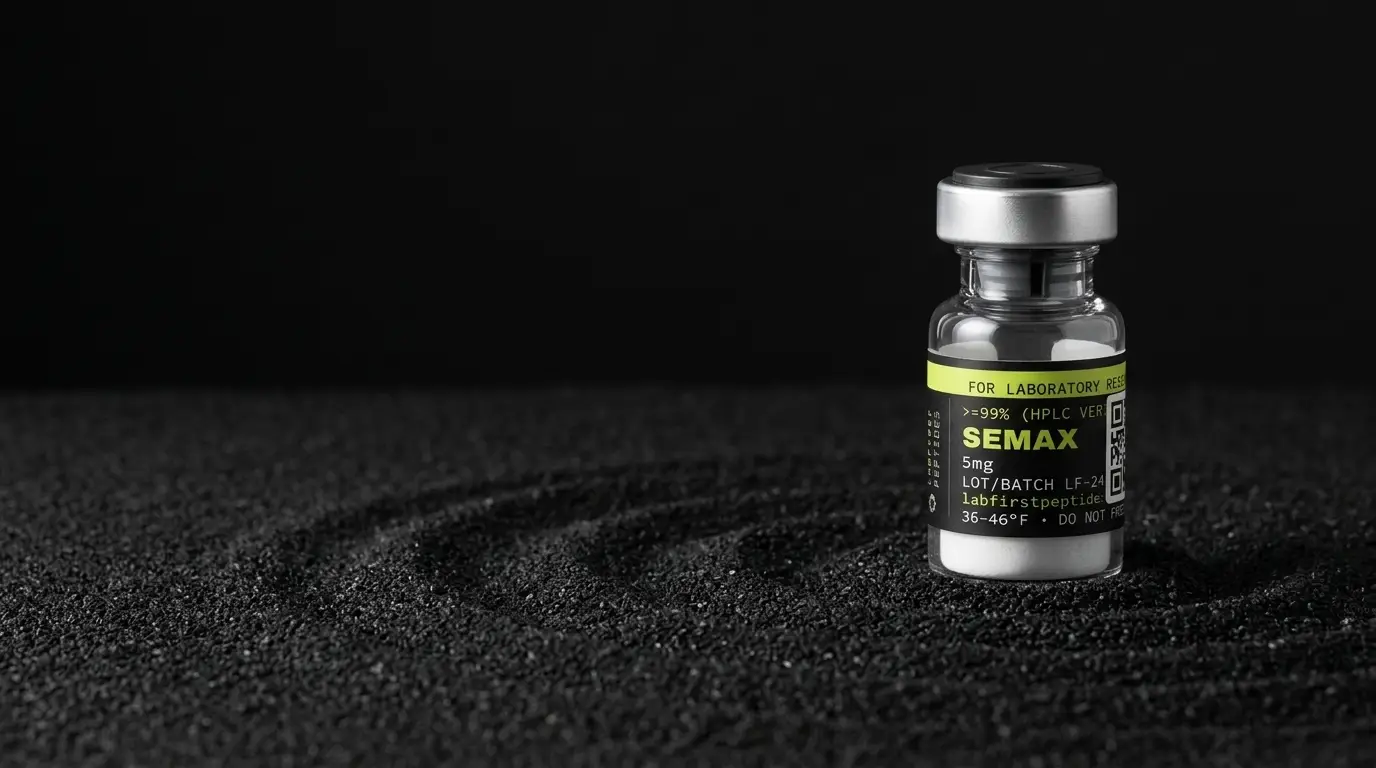
Check the batch number first. The certificate proves what was checked on one batch, on one day, the way a receipt proves one purchase, and it only counts if that number matches the vial in front of you.
It records what a named laboratory measured on a sample drawn from one lot, on one date, by named methods. It is evidence about a sample that belonged to a batch at the moment it was taken, and it is not a warranty about the vial on your bench.
Two documents get confused constantly. A specification sheet lists limits the product is supposed to meet and carries no lot number and no results, because it describes an intention. A certificate carries both, because it describes an event that happened.
If the page in front of you has no lot number on its face, it is the first kind of document whatever the heading claims.
- Lot number on the report against the lot number on the vial
- Test date after the fill date, and distinct from the print date
- Identity: observed mass against an average near 813.9
- The oxidation impurity, 16 mass units heavier, reported on its own line
- Purity: area percent at 214 nm with the chromatogram attached
- Net peptide content, counterion, and water by Karl Fischer
- Accession number confirmed at the issuing laboratory
How do you read it field by field?
Lot number first, against the vial, and nothing else until they match. Then the dates: a test date should follow the fill date, and a print date carries no analytical meaning at all.
Then results in the order they matter for this compound. Identity by mass spectrometry. Purity by reversed-phase HPLC with the chromatogram attached rather than summarised. The oxidation impurity, which for Semax deserves its own line. Net peptide content. Water. Appearance last, because it tells you least.
Every result needs a method beside it. Purity by area percent, purity by net peptide content and purity by amino acid analysis are three different numbers for one vial and they do not agree with each other.
What mass should the identity result show?
Semax is a heptapeptide, the ACTH fragment 4-7 with a Pro-Gly-Pro tail. Its molecular formula is C37H51N9O10S with an average mass near 813.9, cataloged as PubChem CID 9811102.
That single sulfur atom in the formula is the whole story of this compound analytically. It belongs to a methionine residue at the N-terminus, and methionine is the most readily oxidised of the common amino acids.
So the expected mass is 813.9, and the number a reader should also look for is 16 higher. Methionine sulfoxide weighs one oxygen more than methionine, and that oxidised form is the impurity this peptide generates in storage more readily than any other.
Why does the oxidation peak matter more here than elsewhere?
Because it is the degradation route this molecule actually takes, rather than a theoretical one. Many peptides oxidise slowly at a susceptible residue. Semax carries methionine in the most exposed position on the chain.
Oxidised material is a different molecule. It weighs 16 more, it usually elutes slightly earlier on a reversed-phase column because the sulfoxide is more polar, and it appears as a shoulder or a resolved peak just ahead of the main one.
A certificate that reports total purity but never mentions oxidation has not told you the useful thing. A chromatogram will show it whether or not the text does, which is one of several reasons to insist the chromatogram is attached rather than described.
How is the oxidised form distinguished from the intended one?
By mass, cleanly. Methionine sulfoxide carries one extra oxygen, so the oxidised peptide weighs 16 more than the intended molecule. That is a large, unambiguous difference to a mass spectrometer.
By separation, less cleanly but usefully. The sulfoxide is more polar than the parent, so on a reversed-phase column it comes off earlier. Where the two are well resolved the chromatogram shows a distinct peak; where they are not, it shows a shoulder on the leading edge of the main one, and integration decisions start to matter.
Neither method alone settles it. A mass detector on the same run as the separation is what turns a suspicious shoulder into a named impurity, which is the practical argument for insisting on more than a purity percentage.
What does the purity number leave out?
Everything that does not absorb at the detection wavelength or does not come off the column. Reversed-phase purity is an area percentage of what the detector saw, which is a narrower claim than it appears.
Peptides are read at 214 nanometres, which responds to the peptide bond itself and therefore sees peptide impurities well. Salts and water are largely invisible to it. A vial can be 99 percent pure by area and still be substantially counterion and moisture by weight.
That is why net peptide content exists as a separate figure. The two answer different questions and a certificate reporting only the flattering one has chosen which question to answer on your behalf.
What is net peptide content, and why does it change the price?
A synthetic peptide is not shipped as pure peptide. It carries a counterion from purification, usually trifluoroacetate or acetate, and it carries water because lyophilized peptide is hygroscopic.
The consequence is arithmetic. A vial labeled 10 milligrams may hold 10 milligrams of powder of which a real fraction is salt and water. Net peptide content of 80 percent on that vial means 8 milligrams of peptide, and two suppliers quoting the same price for the same nominal size are not necessarily selling the same amount.
Ask which basis the label uses. The cost per milligram comparison ranks the catalog on one basis for exactly this reason.
What should the appearance field say, and why is it last?
A white to off-white lyophilized powder or cake. That is the whole expectation, and it is the least informative line on the document.
It earns its place only as a cheap cross-check. Powder that has caked hard, or shifted noticeably in color, is telling you something happened after filling, and appearance is the one field a buyer can verify against their own vial without equipment.
What it cannot do is substitute for the analytical fields above it. Oxidised Semax looks exactly like unoxidised Semax, and so does material that is mostly salt. This is precisely why appearance is read last rather than first.
What do the water and counterion fields tell you?
Water is measured by Karl Fischer titration, which is specific to water. Loss on drying reports everything volatile, so it reads high when residual solvent is present, and the two numbers are not interchangeable however similar they look.
Counterion identity is worth reading rather than skipping. Trifluoroacetate is the usual residue of preparative HPLC and is not inert in every experimental context; acetate is produced by an extra exchange step. Which one is present is a fact about how the material was made.
Both feed the net content arithmetic, and together they explain most of the gap between a high area purity and a lower net peptide figure.
What does the certificate not cover?
Everything after the sample was drawn. Storage temperature, light exposure, how long the vial has been open and how many times it has been entered are all outside the document entirely.
For this compound that gap has a specific shape. Oxidation continues after dispatch, so a lot with a clean oxidation result at test can carry more oxidised material months later if it has been stored warm or in light. The certificate was true and is now describing a slightly different vial.
Handling belongs with the storage record rather than the test report, and reading one as though it covered both is the common mistake.
How do you verify the document is genuine?
Confirm the report at the issuing laboratory rather than with the seller. An independent laboratory issues each certificate against an accession number or verification key that resolves on its own site. If that number resolves to a different product, a different lot, or nothing, the document does not describe your material however professional it looks.
Certificates with the verification key removed deserve particular suspicion, and this is not a hypothetical concern in this market.
Lot reports for material supplied here resolve through the certificate verification page, and the sizes carried appear on the Semax product record. Certificates are issued per lot rather than per product.
What is the regulatory position?
There is no FDA-approved drug product containing Semax and no United States pharmacopeial monograph defining what an acceptable batch is. That absence is a fact worth stating plainly rather than working around, and it means the specification a lot is released against is the supplier's own.
What a research certificate can honestly establish is narrower and still useful: what a named laboratory measured, on a named lot, on a named date, by named methods. Read against that standard a good certificate is strong evidence and a vague one is none.
Material described here is supplied for laboratory use only, and nothing in this guide describes use in a person or an animal.
FOR LABORATORY AND IN-VITRO RESEARCH USE ONLY. NOT FOR HUMAN OR ANIMAL CONSUMPTION. NOT FOR PERSONAL, MEDICAL, DIAGNOSTIC, THERAPEUTIC, OR RECREATIONAL USE.
What is Semax studied for?
Published research on Semax investigates the areas below, which is a different question from what Semax will do for anyone, a claim about a living system that nothing on this site is sold for.
What it is. A man-made peptide seven building blocks long, based on a fragment of ACTH.
What the research looks at. Animal research coming largely from a narrow set of research groups.
How it is thought to work. Built from a piece of adrenocorticotropic hormone with a short tail added for durability, and it does not carry the parent hormone’s effect on cortisol. How it works is not settled.
What is not established. No approved product in the United States and no official standard. As with Selank, the published record is concentrated and thinner than the volume of commercial writing suggests.
The full record, including the certificate for the lot in stock, is on the Semax product page.
Common questions
What molecular mass should a Semax certificate show?
Why does oxidation matter so much for Semax?
Does a high purity figure mean the vial is mostly peptide?
What is the difference between Karl Fischer and loss on drying?
How do I confirm a Semax certificate is real?
Published certificates for Semax
Every figure below is read from a report the laboratory issued for that lot; each page carries the PDF and the lab's own verification link.
More documentation guides
Sources
- PubChem Compound Summary for CID 9811102, Semax. The openable record for Semax, giving the molecular formula C37H51N9O10S and the average mass near 813.9 that an identity result is read against.
- ICH Q2(R2), Validation of Analytical Procedures . Defines specificity, accuracy and precision for identity and assay procedures, and is the basis for requiring that each certificate result names the method that produced it.
- FDA guidance, Q6B Specifications: Test Procedures and Acceptance Criteria. Sets out how specifications are built for peptide products, including why a named degradation product such as an oxidised form is reported separately from total purity.
- Finnrick independent verification portal. Third-party lookup used to confirm a certificate resolves to the lot it claims to describe, rather than confirming a document with the seller who supplied it.