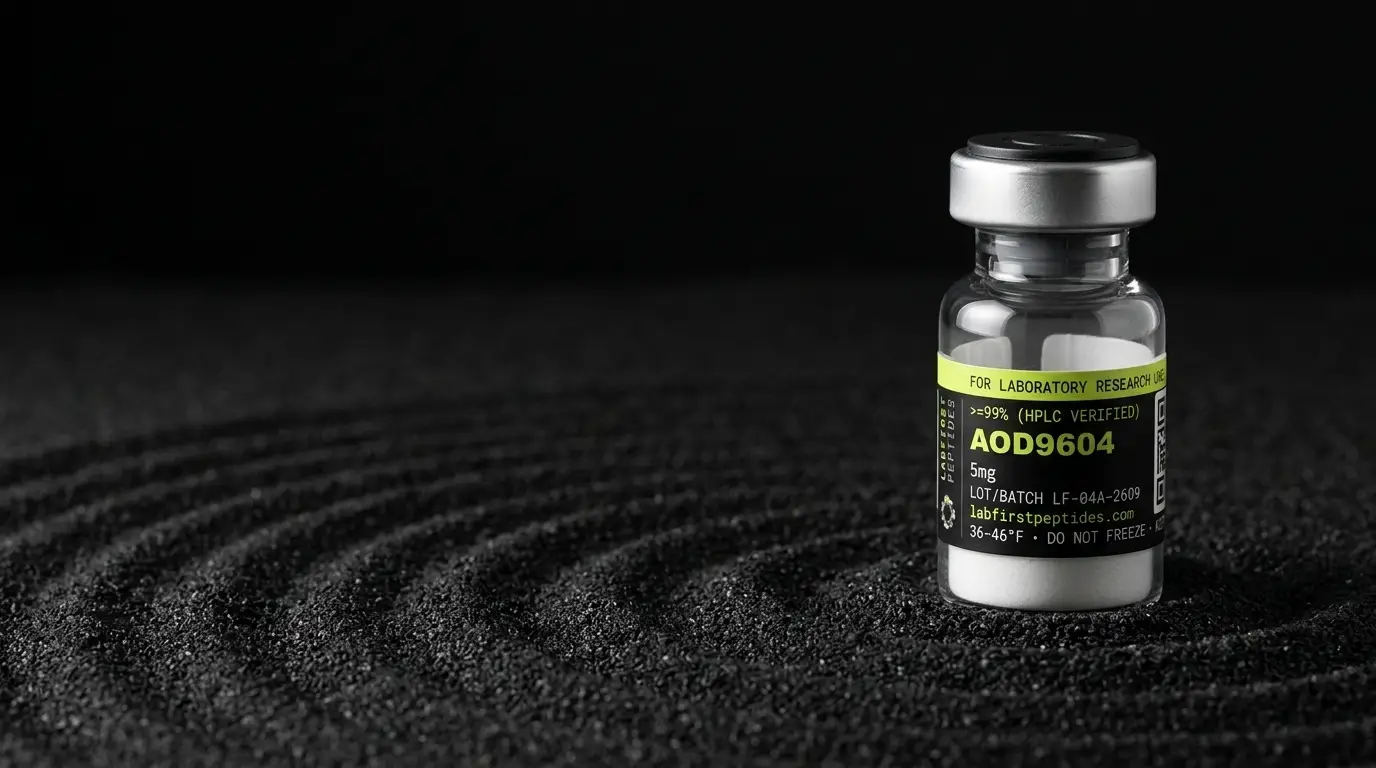
Here is how AOD9604 identity is confirmed. The main test is mass spectrometry, which should read near 1815.1. The lab also checks that the disulfide bond is closed, which the mass shows as a two-dalton difference. AOD9604 has only two cysteines, which makes the job simpler: there is exactly one way for those two to pair.
- AOD9604 is C78H123N23O23S2, average mass near 1815.1, PubChem CID 71300630.
- The mass answers two questions: the sequence and whether the disulfide is closed.
- Closed weighs about two daltons less than the reduced open form.
- Two cysteines means exactly one internal pairing, so no disulfide mapping is needed.
- A dimer weighs roughly twice the monomer and is unmistakable.
- Cysteine is partly destroyed by standard acid hydrolysis, so composition may omit it.
What does identity mean for this peptide?
In plain terms, identity means two things here: the chain is the right sequence, and one internal link between the two cysteines is closed. Closing that link removes two hydrogen atoms, which is why the mass shifts by about two daltons.
That the molecule in the vial is the one the label names, and that a specific internal bond is present. AOD9604 has the molecular formula C78H123N23O23S2, average mass near 1815.1, cataloged as PubChem CID 71300630.
It derives from a fragment near the end of human growth hormone, with a modification at the front of the chain. So there are two identity questions rather than one: is the sequence right, and is the disulfide closed.
The second question is the one a plain linear peptide never has to answer, and it is what makes this certificate different from most in the catalog.
- Observed mass against an average near 1815.1
- The same figure reports the disulfide: closed is about two lighter
- Two cysteines means one possible pairing, so no mapping is required
- A dimer weighs roughly twice the monomer and shows plainly
- Reduced and non-reduced views compared where the report carries both
- Composition analysis, remembering cysteine may be omitted by method
- Accession number confirmed at the issuing laboratory
What does the mass result confirm?
Both questions at once, which is unusually convenient. At 1,815 daltons the measurement is comfortable, with a simple charge pattern and no meaningful scatter to hide a discrepancy.
A missing residue, an extra one or a truncated chain all shift the mass by amounts the instrument resolves immediately.
The disulfide adds a second reading. Forming that bond removes two hydrogen atoms, one from each cysteine, so the closed form weighs about two daltons less than the open reduced form. The same number therefore reports on the sequence and on the loop, provided the certificate prints it rather than a verdict.
Why do two cysteines make this simpler than it could be?
Because there is only one way to pair them internally. Disulfide mapping is a substantial exercise for a protein with six or eight cysteines, since the number of possible pairings grows quickly and the wrong pattern is a real and common defect.
With exactly two, the question collapses. Either they are joined to each other or they are not, and the mass answers that directly.
So a problem that would need enzymatic digestion and careful fragment analysis on a larger molecule is settled here by a two-dalton reading. It is worth knowing that this compound is genuinely easier in that respect rather than assuming every disulfide-containing peptide poses the same difficulty.
What can still go wrong with the bond?
It can fail to form, leaving the reduced open chain. That reads as roughly two daltons heavy.
Or it can form between molecules rather than within one. A cysteine in one molecule bonding to a cysteine in another gives a dimer, and further linkages give larger species.
Both are detectable. The reduced form by its small mass shift, the dimer by weighing roughly twice the monomer. Neither is subtle in the way an isomer or a stereoisomer is subtle, which puts this compound in the fortunate half of the catalog as far as analysis goes.
What does reduced versus non-reduced analysis show?
Running the sample as supplied shows what is present. Running it again after deliberately reducing all disulfides converts everything to the open form and breaks any intermolecular links, collapsing dimers back to monomers.
The comparison is what carries the information. A single clean peak under both conditions indicates monomeric material with its bond intact. A larger peak before reduction that shrinks afterwards, with the monomer growing, indicates disulfide-linked species were present.
Most research certificates run only the non-reduced view. That is a limit rather than a failure, and it means one view was taken of a question that has two.
What does the separation contribute?
It answers how much of the sample is the target and separates the species the mass identifies. Reversed-phase HPLC separates by hydrophobicity, and dimers are large enough that a separation usually resolves them clearly.
The reduced form is the harder case. It differs from the closed form by two daltons and a slightly more open shape, so whether they separate depends on the method rather than being guaranteed.
Peptides are read at 214 nanometres because that responds to the peptide bond. Detection at 280 depends on aromatic residues, which answers a narrower question about a subset of the molecule.
How is the parent fragment excluded?
By mass, straightforwardly. This compound is a modified version of a growth hormone fragment, and the modification changes the molecular weight by an amount an instrument reads without ambiguity.
So a certificate reporting a mass consistent with the unmodified fragment rather than this compound has identified a different molecule, and that is a plain finding rather than a judgement call.
This is a useful contrast with the CJC-1295 situation elsewhere in this catalog, where the compound and its parent differ by about ten daltons on a 3.3 kilodalton molecule. Here the difference is proportionally larger and the molecule smaller, so the same class of question is much easier to answer.
What does composition analysis add?
An independent check on the residue inventory and a peptide content figure by weight. Amino acid analysis hydrolyses the peptide and quantifies the freed residues.
For a disulfide-containing peptide there is a wrinkle worth knowing: cysteine is partly destroyed by standard acid hydrolysis, so it is typically either not reported or measured after a separate oxidation step that converts it to a stable derivative.
A composition report that silently omits cysteine has not failed, it has hit a known limitation of the method. Knowing that is the difference between reading a report and being puzzled by it.
How do you check the report describes your vial?
Confirm the accession or verification number at the issuing laboratory rather than with the seller. The laboratory holds the record; a seller holds a copy of a document. If the number resolves to a different lot, a different product, or nothing, the analysis is not evidence about your material.
Then match the lot number on the report to the vial. Rigorous analysis attached to the wrong batch is not rigour, and that mismatch is more common than falsified results.
Reports for material supplied here resolve through the certificate verification page, and the sizes carried appear on the AOD9604 product record.
What should you ask a supplier about identity?
Three questions. What was the observed mass, as a number. Was the disulfide confirmed closed, whether by that mass or by comment. And was any dimer content assessed.
The third is the one most likely to be unanswered and the one this compound most invites. A small amount of dimer is a routine finding rather than a scandal, and a supplier who reports a figure has been honest about an ordinary imperfection.
How to read the rest of the document is covered in the certificate guide.
Where does this compound sit among the others?
In the analytically fortunate half, and it is worth saying so directly. Several compounds in this catalog have defining features that ordinary methods cannot see: a stereochemical substitution, an isomeric rearrangement, a ten-dalton gap on a large molecule.
AOD9604 has none of those. Its sequence, its disulfide status and its dimer content are all visible to a competent mass measurement and a reasonable separation.
That does not make a certificate optional. It means a certificate that was actually run should have caught what matters, so the absence of findings here is more meaningful than it would be for a compound whose failures hide from the instruments.
What is the regulatory position?
International guidance on analytical validation defines what makes an identity method fit for purpose: specificity, accuracy, precision, and a demonstration that the method distinguishes the target from what else might plausibly be present. For this compound the plausible alternatives are the reduced form, a dimer and the unmodified parent fragment, and mass addresses all three.
There is no FDA-approved product containing AOD9604 and no United States pharmacopeial monograph, so no official standard requires a disulfide confirmation or sets a dimer limit.
What a research certificate can honestly establish is what a named laboratory measured, on a named lot, by named methods.
FOR LABORATORY AND IN-VITRO RESEARCH USE ONLY. NOT FOR HUMAN OR ANIMAL CONSUMPTION. NOT FOR PERSONAL, MEDICAL, DIAGNOSTIC, THERAPEUTIC, OR RECREATIONAL USE.
What is AOD9604 studied for?
Published research on AOD9604 investigates the areas below, which is a different question from what AOD9604 will do for anyone, a claim about a living system that nothing on this site is sold for.
What it is. A man-made peptide matching the tail end of human growth hormone.
What the research looks at. It appears in a limited set of animal and early human studies about that piece of the hormone.
How it is thought to work. A piece of the hormone rather than the whole thing, and it does not carry growth hormone’s full range of effects. The published accounts of how it works are not settled.
What is not established. No approved drug product. Supplier copy routinely credits it with the pharmacology of whole growth hormone, which the primary research does not support.
The full record, including the certificate for the lot in stock, is on the AOD9604 product page.
Common questions
What mass should AOD9604 show on a certificate?
Why is having only two cysteines an advantage?
What are the plausible failure modes for the bond?
Why does cysteine sometimes go missing from composition analysis?
Is AOD9604 easier to verify than other peptides here?
More documentation guides
Sources
- PubChem Compound Summary for CID 71300630, AOD-9604. The openable record giving the molecular formula C78H123N23O23S2 and average mass near 1815.1, and showing the two cysteines whose pairing this page turns on.
- UniProt P01241, Somatotropin (human growth hormone). The reference protein record for human growth hormone, the parent from whose C-terminal region this modified fragment derives.
- ICH Q2(R2), Validation of Analytical Procedures . Defines specificity, including that a method must distinguish the target from closely related substances, which for this compound means the reduced form, a dimer and the unmodified fragment.
- FDA guidance, Q6B Specifications: Test Procedures and Acceptance Criteria. Sets out how disulfide structure and aggregate content are specified and tested separately from chemical purity, including the role of reduced and non-reduced analysis.