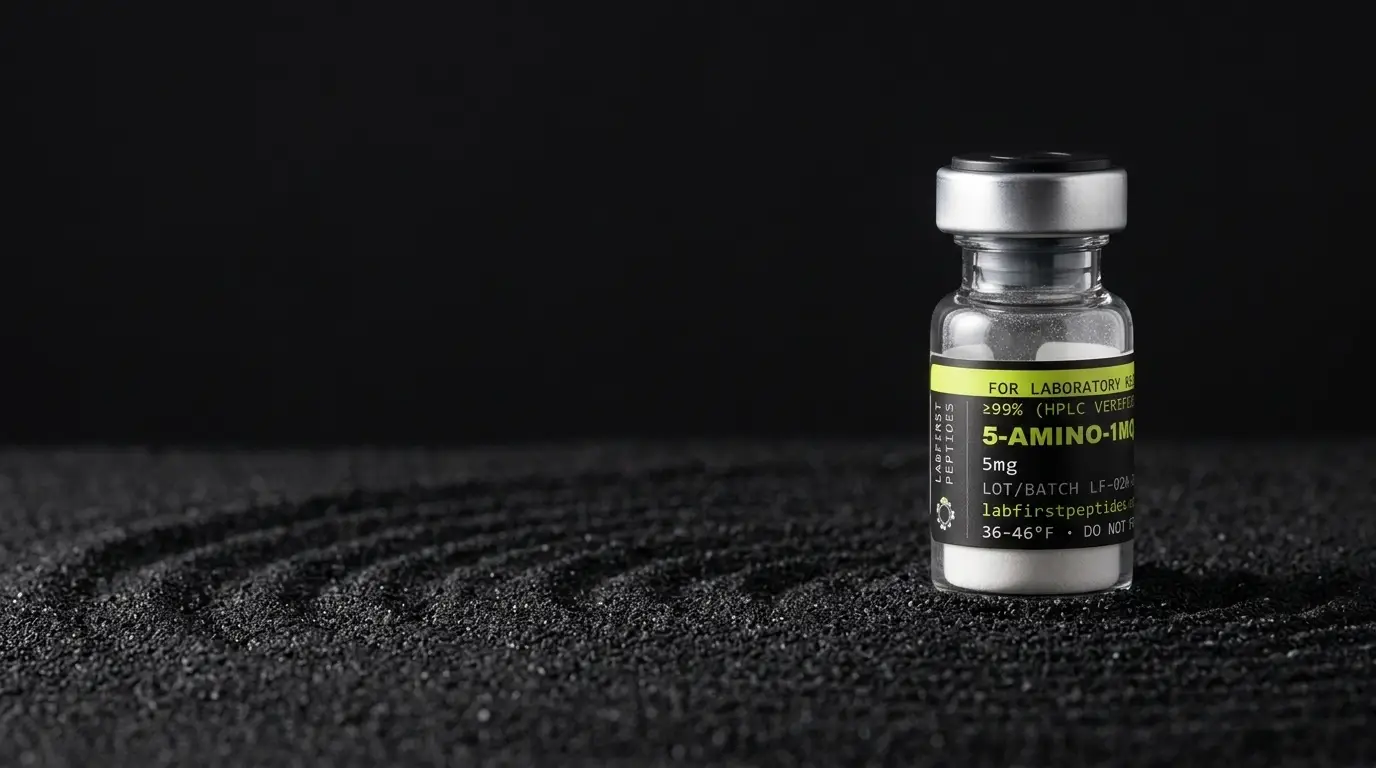
To buy 5-Amino-1MQ safely, buy only against a lot certificate that names the salt. The compound is 5-amino-1-methylquinolinium, a small cation of 159.2 Da, usually sold as the iodide. It is not a peptide, so its salt form sets how much active compound a vial holds. LabFirst lists 2 sizes from $55, each lot independently tested.
- 5-Amino-1MQ is sold at LabFirst in 5mg, 50mg from $55, cheapest per mg in the 50mg vial at $1.80.
- The identity reference for 5-Amino-1MQ is 159.092 Da monoisotopic (C10H11N2+), PubChem CID 950107.
- A complete certificate carries identity by mass spectrometry, purity by HPLC with method and date, and net content in milligrams, all for the lot printed on the vial.
- LabFirst lots are tested by Kovera Labs, an independent laboratory, and each lot's certificate is published on its product page and in the certificate index once the report is back.
- Ground Advantage shipping is $15 flat under $200 and free above, US only; volume tiers are 10% at ten vials of one size and 15% at twenty.
What is 5-Amino-1MQ, and is it a peptide?
5-Amino-1MQ is not a peptide. It is 5-amino-1-methylquinolinium, a small aromatic cation, formula C10H11N2+ and 159.2 Da for the cation, described in the 2017 paper cited at the foot of this page as a membrane-permeable inhibitor of the enzyme nicotinamide N-methyltransferase. PubChem lists the cation as CID 950107. Because it carries a permanent positive charge it is always sold as a salt with a counter-ion, most often iodide, sometimes chloride, and the counter-ion is not a detail: iodine weighs 126.9 Da, so the iodide salt is 286.1 Da and the cation is only 56% of its mass.
That arithmetic is where most 5-Amino-1MQ listings go wrong. A 50 mg vial of the iodide salt holds about 28 mg of the active cation; a 50 mg vial of the chloride salt (194.7 Da) holds about 41 mg. Two listings at the same price and the same labeled milligrams can differ by nearly half in what they contain, and a certificate that does not state the salt form has not told you how much 5-Amino-1MQ is in the vial. It is the single most important line on the certificate and the one most often missing.
Being a small molecule, it dissolves, stores and tests differently from the peptides around it: identity is a single sharp mass at m/z 159.1 and, in a well-characterized lot, an NMR spectrum; purity is HPLC with UV detection at the quinolinium absorbance; and the compound is a colored, crystalline solid rather than a white lyophilized cake. The research is enzyme and cell work; this page describes the material, not any use.
The reference point for identity is public. PubChem lists 5-amino-1-methylquinolinium (cation) as CID 950107 with molecular formula C10H11N2+, an average molecular weight of 159.21 Da and a monoisotopic mass of 159.092 Da. Those are the numbers a mass spectrometer is checked against, and the number a certificate must print beside the observed mass. Listed as the cation; the salt form on a certificate (commonly iodide or chloride) changes the mass of the solid, not of the cation the assay identifies.
In plain terms: A small molecule, a methylquinolinium salt, not a peptide. No approved product. Being a small molecule rather than a peptide, it dissolves, stores and tests differently from the rest of this catalog, and its certificate should be read on small-molecule terms.
- Lot on the vial matches the certificate
- Laboratory named, with its own lookup
- Theoretical mass printed and correct
- Purity has a method and a date
- Net content stated in milligrams
5-Amino-1MQ for sale: what do the sizes cost per mg?
LabFirst lists 5-Amino-1MQ in 2 sizes (5mg, 50mg) from $55 to $90, priced per vial with the per-mg figure beside it so sizes can be compared without arithmetic. Per mg, the 50mg vial is the cheapest at $1.80 and the 5mg the dearest at $11, which is the usual shape; the table below is the arithmetic, and the per-mg column, not the vial price, is the one to compare.
| Size | Price | Per mg | 10 units | 20 units | Availability |
|---|---|---|---|---|---|
| 5mg | $55 | $11 | $495 ($9.90/mg) | $935 ($9.35/mg) | In stock (9), lot LF-02A-2609 |
| 50mg (best per mg) | $90 | $1.80 | $810 ($1.62/mg) | $1530 ($1.53/mg) | Backorder, join the waitlist |
The volume tiers are per size, not per basket: ten vials of one size take 10% off that line and twenty take 15%, and mixed sizes do not combine. Ground Advantage shipping is a flat $15 on orders under $200 and free from $200, within the United States only, with same-day dispatch on orders placed before 12 PM Pacific on a business day. The cost per mg tool runs the same comparison across any two listings, ours or anyone else's.
5-Amino-1MQ is a two-step small-molecule synthesis, cheap per gram at scale, and the price of a vial is mostly the vial, the fill and the laboratory work. That is why the 50 mg vial costs so little more than the 5 mg vial and why the per-milligram figure falls so steeply between them. A laboratory that will use the material buys the 50 mg vial; one qualifying a lot buys the 5 mg vial once and reads the salt form on its certificate before anything larger.
The price signal is the salt. Two 50 mg listings at the same price are not the same price if one is iodide (28 mg of cation) and the other chloride (41 mg), and a seller who cannot name the salt cannot be compared with anyone. Compare per milligram of cation, not per milligram of powder. The only discounts on this page are the volume tiers, per size and unchanged month to month, and the lot on the vial is whatever the certificate index says on the day.
What should a 5-Amino-1MQ certificate show?
Three tests answer three different questions, and a certificate of analysis for 5-Amino-1MQ is only complete when it carries all three for the exact lot on the vial. Identity is settled by mass spectrometry, and the number to look for on a 5-Amino-1MQ certificate is 159.092 Da monoisotopic (or 159.21 Da average, if the laboratory reports the deconvoluted average mass). The observed mass should sit within the instrument's stated tolerance of that figure, and the certificate should print both the theoretical and the observed value, not just a tick.
Purity is a separate question, answered by HPLC: how much of what came off the column was the compound. The figure is only interpretable with its method beside it (column, gradient, detection wavelength) and a date, which is what ICH Q2(R2) means when it asks that an analytical procedure be shown fit for its purpose. A percentage with no method and no date is a number somebody typed, and a certificate that carries every test but for a different lot number than the vial is the most common failure of all and the easiest to catch. Net content is the third test and the one most often missing: the milligrams of 5-Amino-1MQ actually in the vial, measured, against the size printed on the label.
Identity is the observed mass against 159.092 Da for the cation, seen directly in positive-mode electrospray as m/z 159.1 since the molecule already carries its charge. That single peak is easy to obtain and easy to fake by name, so a lot that has been properly characterized also carries a proton NMR spectrum, which shows the N-methyl singlet and the aromatic pattern of the quinolinium ring and cannot be produced by a different compound. A certificate should state the salt form beside the identity, because the mass spectrometer never sees the iodide or chloride at all; the counter-ion has to be declared, or measured by ion chromatography, and it decides the net content.
Purity by HPLC with UV detection should show the chromatogram with its conditions; the impurities that matter are unmethylated 5-aminoquinoline (the starting material, 14 Da lighter) and other methylated isomers, which resolve on the right method. Net content is the third line and the one that pays: it should be stated as milligrams of cation, or as milligrams of a named salt from which the cation can be calculated, with a water content by Karl Fischer if the salt is hygroscopic. A 50 mg label with no salt named is a number without a unit.
Where should you buy 5-Amino-1MQ? Five checks before you order
Every seller of 5-amino-1mq says "third-party tested". The phrase costs nothing. These five checks take about four minutes per listing and separate a tested lot from a tested-sounding one.
- The lot on the vial is the lot on the certificate. Read the printed lot number, then open the certificate and match it. A certificate for "5-Amino-1MQ" with no lot, or a lot that does not match, describes some other vial.
- The laboratory is named and has its own lookup. The report should come from a laboratory the seller does not own, with a search code you can enter on the laboratory's own site. LabFirst lots are tested by an independent laboratory and the laboratory's report is published for each lot; anything that exists only as the seller's own summary has not been verified.
- The theoretical mass is printed, and it is the right one. For 5-Amino-1MQ that is 159.092 Da monoisotopic; a certificate that prints a different figure has either measured a different molecule or copied a template.
- Purity has a method and a date. An HPLC percentage should name the method and the run date. A figure that reads "99%+" with neither, or one date reused across every product a seller lists, is decoration.
- Net content is stated in milligrams. The label size is a claim; the certificate's net content is the measurement. If the certificate has no net content line, the purity figure describes the powder, not the vial, and the price per mg you calculated is fiction.
Which red flags show up on 5-Amino-1MQ listings?
The ways listings for this compound go wrong:
- "50 mg 5-Amino-1MQ" with no salt named. The iodide salt is 56% cation by mass and the chloride 82%; without the salt form the milligrams of active compound are unknown by nearly half.
- A certificate with only a mass at 159. That single peak is expected and easy; a lot that has been properly characterized also shows an NMR spectrum and states or measures the counter-ion.
- 5-Amino-1MQ described as a peptide, stored, dissolved and priced as one. It is a small-molecule salt, and its certificate should be read on small-molecule terms: HPLC-UV, NMR, ion chromatography, Karl Fischer.
- "Pharmaceutical grade 5-Amino-1MQ". There is no USP monograph, no approved product and no specification for this material; the phrase names something that does not exist.
How do I verify a LabFirst 5-Amino-1MQ lot?
The 5-Amino-1MQ sizes in stock today carry lot LF-02A-2609. Lot LF-02A-2609 is at the laboratory for identity, purity and net content. Until the report is attached the product page says "pending verification" against that lot and makes no purity claim; the price stands and the report goes live the day it arrives, on the page and at /coa/.
Verification runs through the laboratory, not through us. Open the certificate index, find the lot, and read the laboratory's report; it is the laboratory's own document, not ours, and the laboratory will confirm it against its records.
The product page reads the live stock feed on load (stock, lot and certificate state for every size), so what you see when you order is what ships. The lot is printed on the label and encoded in the QR patch on its right-hand side; scanning it opens that lot's record.
How should 5-Amino-1MQ be stored, and how does it ship?
As a crystalline quinolinium salt, 5-Amino-1MQ holds up better than any peptide on this site: no chain to hydrolyze, no residues to oxidize, and a dry solid that keeps at 2 to 8 C out of light for the shelf period on the certificate. Light is the one thing to respect, since aromatic amines discolor on exposure, and a lot that has darkened has changed. The iodide salt is somewhat hygroscopic, so a vial opened in humid air should be used and not re-sealed for storage.
Orders ship within the United States, Ground Advantage at a flat $15 under $200 and free above it, same day when placed before 12 PM Pacific on a business day, and the shipping page states the cutoff, the carriers and what is and is not promised.
The record a laboratory keeps on arrival is what makes the certificate usable later, and it is short:
- the lot number as printed on the vial, and the certificate's accession or search code beside it;
- the date received and the condition of the seal;
- the storage location and temperature it went into;
- the number of vials, and later the date each one was opened and by whom.
A 5-Amino-1MQ vial with that record behind it can be traced from the bench to the laboratory report in one step; without it, the certificate is a document about a vial that can no longer be identified.
What is the regulatory status of 5-Amino-1MQ?
No approved medicine contains 5-Amino-1MQ and no USP or Ph. Eur. monograph defines an acceptable lot. It is a research chemical from the enzyme-inhibitor literature, not a peptide, and it was not part of the peptide-focused changes the FDA made to its interim 503A bulk substances list in September 2023; nothing about that list, or about the compounding status of any peptide, transfers to this compound by association. It is sold here as laboratory material only, and the salt form on the certificate is the only thing that says how much of it a vial contains.
FOR LABORATORY AND IN-VITRO RESEARCH USE ONLY. NOT FOR HUMAN OR ANIMAL CONSUMPTION. LabFirst sells 5-Amino-1MQ to laboratories and researchers as material for in-vitro work, gives no guidance on use, and ships only against that understanding. Nothing on this page or on the product page describes preparing or administering anything.
Bottom line
5-Amino-1MQ is a small quinolinium cation, 159.092 Da monoisotopic, and it is always sold as a salt. Buy it against a certificate for the lot printed on the vial. That certificate should name the salt form, print the observed mass, give HPLC purity with its method and date, and state net content in milligrams. At LabFirst the 50mg vial is the cheapest per mg. There is no USP monograph and no approved product, so "pharmaceutical grade" means nothing here.
What is 5-AMINO-1MQ studied for?
Published research on 5-AMINO-1MQ investigates the areas below, which is a different question from what 5-AMINO-1MQ will do for anyone, a claim about a living system that nothing on this site is sold for.
What it is. A small molecule, a methylquinolinium salt, not a peptide.
What the research looks at. It appears in enzyme and cell-biology research on NNMT and nicotinamide, mostly in cells and animals.
How it is thought to work. Described in the research as a blocker of an enzyme called NNMT, which sits in the pathway that handles nicotinamide.
What is not established. No approved product. Being a small molecule rather than a peptide, it dissolves, stores and tests differently from the rest of this catalog, and its certificate should be read on small-molecule terms.
The full record, including the certificate for the lot in stock, is on the 5-AMINO-1MQ product page.
Common questions
Where can I buy 5-Amino-1MQ online?
How much does 5-Amino-1MQ cost?
Is 5-amino-1-methylquinolinium the same as 5-Amino-1MQ, and does the salt matter?
Which 5-Amino-1MQ size should a laboratory order first?
How do I check that a 5-Amino-1MQ certificate is real?
How is a 5-Amino-1MQ certificate different from a peptide certificate?
More procurement guides
Sources
- PubChem, 5-amino-1-methylquinolinium (cation), CID 950107. Public record for the molecular formula (C10H11N2+), average molecular weight (159.21 Da) and monoisotopic mass (159.092 Da) quoted here as the identity reference.
- Neelakantan and colleagues, Selective and membrane-permeable small molecule inhibitors of nicotinamide N-methyltransferase reverse high fat diet-induced obesity in mice, Biochemical Pharmacology . Primary description of the compound in the literature; supports the class and naming stated here, not any use.
- Ruf and colleagues, Novel tricyclic small molecule inhibitors of nicotinamide N-methyltransferase for the treatment of metabolic disorders, Scientific Reports . Primary description of the compound in the literature; supports the class and naming stated here, not any use.
- Sun and colleagues, Nicotinamide N-methyltransferase (NNMT): a novel therapeutic target for metabolic syndrome, Frontiers in Pharmacology . Primary description of the compound in the literature; supports the class and naming stated here, not any use.
- ICH Q2(R2), Validation of Analytical Procedures (2023) . Why a purity figure is only interpretable with its method, and what "fit for purpose" means for the HPLC and mass spectrometry results a certificate reports.