To buy research peptides online, run the order in three stages. Before ordering, verify the substance's identity fields, the lot's certificate and laboratory, and the supplier's real identity. At checkout, confirm the salt form and mass convention, and sign the research-use acknowledgement. On receipt, check the packing record against the order, inspect, record the lot, and store as specified.
- Buying research peptides online is a three-stage workflow: verify before ordering, acknowledge at checkout, reconcile and record on receipt.
- Before ordering, check the substance's identity fields, the lot's certificate and laboratory, and the supplier's real identity and terms.
- The research-use acknowledgement at checkout is the transaction's statement of what is being bought, and a laboratory address is part of the supplier's control.
- On receipt, the lot identifier on the vial is the only link to the certificate read before ordering; reading it is the step most often skipped.
- All sales final is the honest term for research chemicals; exceptions are the supplier's error or carrier damage, on evidence, within a stated window.
What this guide covers
Buying a research chemical online is the same transaction as buying one from a catalog by telephone thirty years ago, with one difference: the evidence is on the screen and can be read before anything is ordered. That turns the purchase into a workflow with a before, a during and an after, and a laboratory that runs all three has done everything a buyer can do to make sure the vial that arrives is the substance it was meant to be, at the quantity the label implies, from a supplier that can be held to it.
The checklist below is that workflow, written for a laboratory buyer and applying the standard a laboratory already uses for any reagent. It is not specific to any supplier, and it should be run against this one. The pharmaceutical version of the same discipline is in 21 CFR 211.84, which qualifies a supplier by validating its analyzes rather than by reading its claims; nothing here is required of a research buyer by rule, and all of it is worth doing for the same reason the rule exists.
This guide covers that workflow in order: checking the substance and then the lot and supplier before ordering, what matters at checkout, what to do when the parcel arrives, what to do when something is wrong, and how the steps change inside an institution. A short list of red flags, the full checklist and a bottom line close it out.
- Before: identity fields, lot certificate verified with the laboratory, supplier located
- Checkout: research-use acknowledgement, laboratory address, confirmation kept
- On arrival: packing record reconciled, lot on vial matches the certificate
- Inspection: seal and appearance checked, lot recorded, stored unopened
- If wrong: photographs, packing record and confirmation, within the stated window
How to check the substance before ordering: step by step
Start with what the listing says the material is, because everything after depends on it.
- Read the sequence line. It should be in standard notation with termini and modifications stated. A trade name alone is not an identity.
- Resolve the CAS number. Check the format and check digit, then confirm at CAS or PubChem that it resolves to the substance and form named. The CAS number guide covers the four-minute routine.
- Check the formula and weight against the sequence. The formula and weight guide shows the arithmetic; a mismatch is a record error.
- Find the salt form and the labeled-mass convention. Trifluoroacetate or acetate, and whether 5 mg means fill weight or peptide. Both change the arithmetic on the bench, and the net content guide explains how.
- Read the first paragraph of the listing. If it describes what the compound does in a body, the supplier is not selling a research peptide, and the checklist ends here.
None of this takes long, and all of it is possible from the listing alone. A listing that does not allow it, because the fields are missing, has failed the check by omission.
How do you check the lot and the supplier before ordering?
The substance is what the material is meant to be. The lot is what a sample was found to be, and the supplier is who stands behind both.
- Find the lot currently shipping. Named on the record, and the identifier that will be on the vial.
- Open its certificate and read the header first. Issuing laboratory, report number, sample and lot identifiers, test date. The certificate reading guide goes field by field.
- Check that identity, purity and content are separate results with methods. Mass spectrometry with observed and theoretical mass; HPLC with conditions; a quantity method if content is reported. A single percentage is not three results.
- Verify the certificate with the laboratory. Use the laboratory's own route. The Verify a COA page describes it. If there is no route, the certificate is the supplier's word.
- Locate the supplier. Legal name, street address on every page, mailboxes, telephone, and a plain statement that it is not a pharmacy or compounding facility. The supplier evaluation guide scores this in full.
- Read the dispatch and returns terms. A stated cutoff, an honest refusal to quote delivery dates, all sales final with exceptions for the supplier's error or carrier damage within a stated window.
A supplier that passes these has given a buyer evidence rather than adjectives. The order can proceed on the evidence, and if the evidence later turns out to be wrong there is a document and a counterparty to take it back to.
What matters at checkout?
Checkout is short and three things in it matter.
The research-use acknowledgement. A research chemical supplier restricts sale to laboratory research use, and the checkout should ask the buyer to acknowledge that restriction rather than bury it in terms. Acknowledge it because it is true; a buyer who cannot has come to the wrong kind of supplier. The acknowledgement is the transaction's statement of what is being bought.
The delivery address and the account. A laboratory or institutional address, and a contact who will receive the parcel and can reconcile it. Some suppliers ask what kind of organization is ordering; answer accurately, because the answer is part of the supplier's own control on who it sells to, and a supplier that runs that control is one worth buying from.
The order record. Keep the confirmation. It carries the order number, the SKUs and sizes, and it is what the packing record will be reconciled against. If the record names the lot at the point of order, so much the better; if it does not, the packing record will, and the two together tie the certificate read before ordering to the vial that arrives.
Payment is the one part of the workflow with nothing to check beyond the ordinary: a supplier that takes payment through a recognizable processor on a page that is its own. A supplier that asks for payment by a method that cannot be reversed, to a name that is not its own, has failed the supplier check retroactively.
One more habit worth forming at checkout: note the lot identifier if the record shows it, in the same place the order number is kept. When the parcel arrives the reconciliation then takes a minute, and if the lot changed between order and dispatch, the supplier's note saying so is expected rather than discovered.
What should you do when the parcel arrives?
The parcel is the point at which the evidence on the screen meets the material, and a laboratory that does the following in the first hour has closed every gap a buyer can close.
| Step | Establishes |
|---|---|
| Reconcile the packing record against the order | Every SKU, size and quantity ordered is what arrived |
| Read the lot identifier on each vial against the packing record and the certificate read before ordering | The vial is from the lot the certificate describes |
| Inspect the vial: seal intact, appearance matching the certificate and safety data sheet | Nothing happened in transit, and the material looks like what the documents describe |
| Record the lot against the study or project in the laboratory's own system | Backward traceability from any future result to the lot |
| Store as the record specifies, unopened, and let a cold parcel reach room temperature before any seal is broken | The material stays what the certificate says it was |
| File the certificate and the safety data sheet with the lot | The evidence is where the material is |
The second row is the one that matters most and is most often skipped. A certificate was read, a vial arrived, and the only thing joining them is the lot identifier on both. Read it. A vial whose lot differs from the certificate on the record is a question for the supplier before the seal is broken, and a supplier with records answers it in a sentence. The batch traceability guide covers what that lot identifier has to reach on the supplier's side.
Appearance is a small check with a real yield. The certificate and the safety data sheet both describe the material, usually as a white to off-white lyophilized solid. A vial that does not match has a question attached to it before anything else is done, and photographing it at that moment is worth more than any description later.
What if something is wrong with the order?
Most orders are right. When one is not, the supplier's terms and the buyer's evidence decide what happens, and both are set before the parcel is opened.
A supplier's terms should replace or refund, in full, anything that arrives damaged, incorrect, or not matching its lot record, on evidence and within a stated window; seventy-two hours from delivery is a common one. The evidence is photographs of the parcel and the vial, the packing record, and the order confirmation. A buyer that took the receiving steps above has all of it to hand.
A result that disagrees with the certificate after the material has been used is a different case, and the supplier's answer to it is the last test of its documentation. A supplier with records asks for the buyer's method and chromatogram, pulls the laboratory record for the lot, checks a reserve sample if one was kept, and either explains the difference or replaces the material. The independent testing guide covers when a laboratory should run its own receiving check, and why a retained vial from the lot is worth keeping for exactly this conversation.
What a buyer cannot do is return an opened research chemical for restocking, and a supplier that offers to accept one is a supplier that will resell it. In this category, all sales final is the term that keeps the next buyer's vial from being yours.
How does ordering through an institution change the steps?
A laboratory inside a university, hospital or company buys through a purchasing function, and the workflow above gains a few steps that are worth knowing in advance so the order does not stall.
Purchasing will want the supplier's legal name, address and tax identity for its vendor file, and an invoice that names the same entity. A supplier that passed the identity check can supply all three on request; one that cannot has failed it in a way that now blocks the order. Ask early, because vendor onboarding is the slowest step and it happens once.
The research-use acknowledgement should be signed by a named person at the laboratory, not by a purchasing agent who has not seen the material's record. It is the laboratory's statement of what it is buying and why, and it belongs with someone who can make it truthfully. Where an institution's own chemical-procurement policy requires a safety data sheet on file before receipt, download it from the record at the time of ordering; the safety data sheet guide covers what it should contain.
Receipt usually goes through a departmental stockroom rather than straight to the bench, which adds a link to the chain of custody inside the institution. The receiving steps above still apply; they happen at the stockroom, and the person who runs them should be the one who records the lot and passes the documents on with the vial. A vial that reaches the bench without its lot recorded has lost its connection to the certificate at the last step, after every earlier one was done properly.
Finally, record the evaluation. A note in the laboratory's approved-vendor file saying which checks were run, on what date, against which lot, turns a one-time effort into a standing qualification, and it tells the next person in the laboratory what was verified and what was not. Re-run the lot-level checks whenever the shipping lot changes; the supplier-level ones hold until something about the supplier does.
What should you check on research peptides for sale?
A lot-specific certificate you can verify at the laboratory that issued it, and a listing that describes the material rather than what it might do.
Verification is the step that separates suppliers. An independent laboratory issues each report against an accession number that resolves on its own site, and a certificate with that key stripped out is unverifiable however well it is presented. Checking takes a minute, and it is the only check a well-made PDF cannot defeat.
After that, read what the listing does not say. A page quoting purity without naming the method, or giving a nominal vial size with no net peptide content basis, has left out the two numbers that decide what you are buying. For what a listing price looks like against the market, the research peptide price index publishes monthly medians by compound and vial size.
Red flags on a research peptide listing
Any one of these is a reason to stop and ask before ordering:
- Language about what the compound does in a body. That supplier is not selling a research peptide.
- Missing identity fields: no sequence in standard notation, a CAS number that does not resolve, or a formula and weight that do not match the sequence.
- A single purity percentage standing in for identity, purity and content, or a purity figure with no method.
- A certificate with no route to verify it with the issuing laboratory.
- A contact form with no legal name or street address.
- A request for payment by a method that cannot be reversed, to a name that is not the supplier's own.
The checklist, in one place
- Sequence in standard notation; CAS number resolves; formula and weight match the sequence.
- Salt form and labeled-mass convention stated.
- Listing describes a substance, not a use.
- Lot named; certificate linked; header complete; identity, purity and content separate with methods; verified with the laboratory.
- Supplier locatable; boundary stated; dispatch and returns terms honest.
- Research-use acknowledgement signed; laboratory address; order confirmation kept.
- Packing record reconciled; lot on vial matches the certificate; seal and appearance checked; lot recorded; stored as specified; documents filed.
- Terms and evidence ready if anything is wrong.
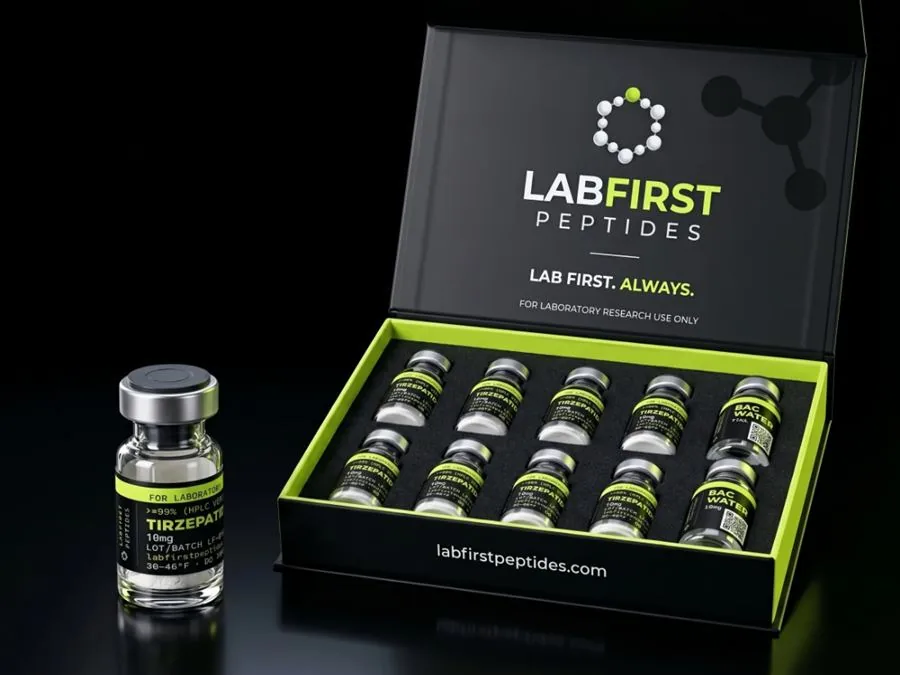
Eight lines, and the whole of them takes less time than a single failed experiment on the wrong reagent. Every family in the LabFirst catalog is meant to pass them from its own record: identity fields stated, salt form and convention stated, the shipping lot named and its certificate linked with a verification route where the report has landed, a research-use acknowledgement at checkout, a packing record in every parcel, and the dispatch and returns position on the shipping page. Run the list against us. That is what it is for.
A procurement checklist establishes that a laboratory bought what it meant to buy from a supplier that can be held to it. It establishes nothing about what the substance is for. FOR LABORATORY AND IN-VITRO RESEARCH USE ONLY. NOT FOR HUMAN OR ANIMAL CONSUMPTION. Research peptides are supplied to laboratories, and every step on this page exists so a laboratory can confirm what it received, and for no other purpose.
Bottom line
Buying research peptides online is a three-stage workflow. Before ordering, verify the substance's identity fields, the lot's certificate with the laboratory that issued it, and the supplier's real identity and terms. At checkout, sign the research-use acknowledgement and keep the order record. On receipt, read the lot on each vial against the certificate, record it, store the material as specified and file the documents with it. A supplier worth buying from passes every step, and this one should be run through the same list.
Common questions
What should I check before buying research peptides online?
What should I do when the parcel arrives?
Can I return a research peptide if I ordered the wrong one?
Why does checkout ask me to acknowledge research use?
Related guides: buying and vetting a supplier
Sources
- 21 CFR 211.84, Testing and approval or rejection of components, drug product containers, and closures. The pharmaceutical model for qualifying a supplier by validating its analyzes, which the before-ordering checks follow.
- FDA / ICH Q6B, Specifications: Test Procedures and Acceptance Criteria for Biotechnological/Biological Products. Identity, purity and quantity as separate tests, which the certificate check requires to be separate on the report.
- ISO/IEC 17025:2017, General requirements for the competence of testing and calibration laboratories. The accreditation standard behind the laboratory whose certificate is verified before ordering.
- OSHA, 29 CFR 1910.1200, Hazard Communication. Why a safety data sheet accompanies the material and is filed with the lot on receipt.
- 21 CFR 211.194, Laboratory records. The record a supplier should be able to produce when a buyer's result disagrees with the certificate.
- CAS, CAS REGISTRY: what is a CAS Registry Number. The identifier resolved in the first before-ordering step.