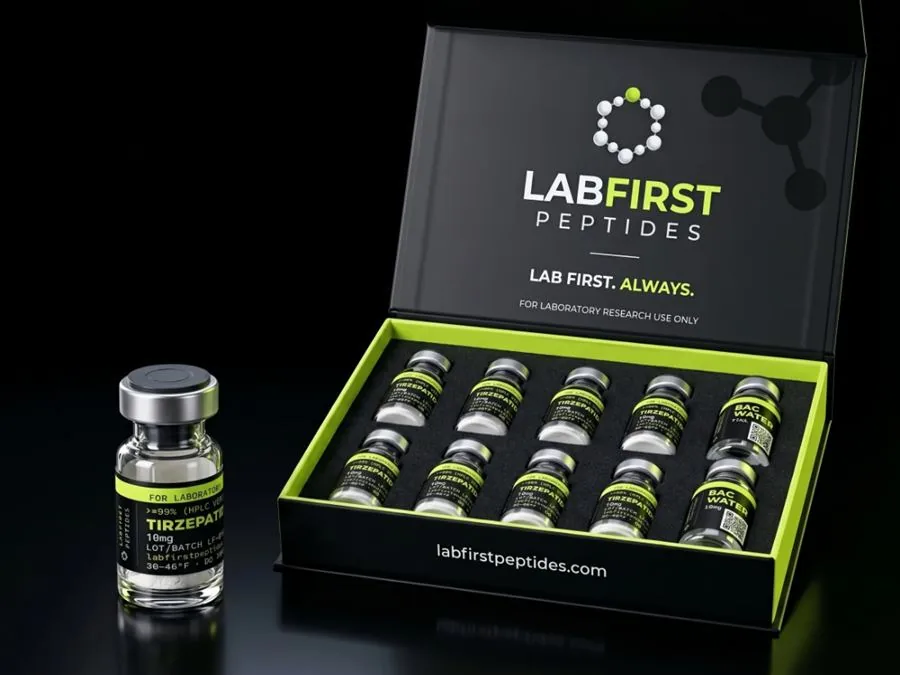
RUO peptides are materials labeled Research Use Only, sold for lab and in-vitro work outside any clinical or diagnostic quality system. The label limits how they may be used. It says nothing about quality. Identity and purity come from the test documents behind the lot, so reading and checking them is the real skill.
- The Research Use Only statement originates in the FDA's in vitro diagnostic labeling regulation, 21 CFR 809.10(c), and functions as a restriction on application rather than a quality claim.
- Area-percent RP-HPLC purity counts only material that absorbs at the detection wavelength and elutes from the column; water, salts and counterion are invisible to it.
- Chromatographic purity and net peptide content are different measurements, and solution arithmetic that conflates them is off by the content factor.
- An observed mass consistent with theory establishes formula-level identity, not residue order.
- A certificate with no lot number, no issuing laboratory or no date cannot be verified and carries no evidential weight.
What are RUO peptides, and where does the label come from?
In plain terms, an RUO label is a rule about where the material may be used, a bit like a "not for resale" sticker. It tells you nothing about what is inside the vial. Only the lab paperwork speaks to that.
Research Use Only is a regulatory phrase before it is a marketing one. It originates in the FDA's labeling regulation for in vitro diagnostic products, 21 CFR 809.10(c), which requires a product at the research stage to carry the statement "For Research Use Only. Not for use in diagnostic procedures." The agency's 2013 guidance on the distribution of RUO- and IUO-labeled products fills in the intent: the label marks material sitting outside the design controls, clearance pathways and quality obligations that bind a finished diagnostic.
The research-chemical market borrowed the term. A catalog peptide sold as an RUO peptide is making the same declaration in a different setting: the material is supplied for laboratory and in-vitro work, and it has never passed through the systems a clinical, diagnostic or pharmaceutical product must pass through. No sterility assurance, no endotoxin release criterion unless one is stated on the certificate, no formulation work, no stability program of the kind that produces an expiry date a regulator would accept.
Read that way, the label is informative. RUO is a restriction on application, and only that. It is not a grade. Two suppliers can print the same three letters over lots of very different quality and both be labeling correctly, which is why the letters themselves settle nothing about what is in the vial.
- Lot number on the report matches the vial
- Chromatogram present, with integration marks
- Method conditions stated: column, gradient, wavelength
- Observed mass within tolerance of theoretical
- Issuing laboratory named, report dated
What certifies the contents of research use only peptides?
Every claim about the contents of an RUO vial lives somewhere else: in the analytical documentation issued for the lot. For a synthetic peptide the working set is small. A certificate of analysis tied to a lot number. A reversed-phase HPLC purity figure with the chromatogram behind it. A mass spectrum, usually electrospray, whose observed mass is compared against the theoretical mass of the declared sequence. Beyond that core, better suppliers add appearance, counterion identity, water content and sometimes net peptide content.
The direction of the relationship matters. The label tells a buyer what the material must not be used for. The documentation tells a buyer what the material is, to the extent the methods can say so. A listing that leans on the letters RUO while supplying thin or absent paperwork has the relationship backwards, because the letters were never the part carrying information about quality. What a supplier commits to testing and disclosing for every lot is set out in its own quality standard, and that page is worth reading before the catalog page.
One habit separates qualified readers from casual ones: they treat every number on a certificate as the output of a specific method, with that method's blind spots, rather than as a property of the peptide. The rest of this guide is a map of those methods and their blind spots.
What does each method measure?
The table below covers the methods that appear on peptide certificates, what each one actually measures, and the gap between a passing result and the conclusion people tend to draw from it.
| Method | What it measures | A passing result establishes | It leaves open |
|---|---|---|---|
| RP-HPLC, area-percent | Share of UV-absorbing, column-eluting material in the main peak at a stated wavelength | Chromatographic purity against detectable impurities | Water, residual salts, counterion, anything that does not absorb or does not elute |
| LC-MS or ESI-MS | Observed molecular mass against the theoretical mass of the declared sequence | Identity consistent with the declared molecular formula | Residue order; isomeric substitutions of identical mass; aggregation state |
| Amino acid analysis or nitrogen determination | Net peptide content of the gross solid | How much of the vial mass is peptide rather than water and counterion | Which peptide it is |
| Karl Fischer titration | Residual water in the solid | A mass-balance correction and a handling flag | Chemical purity entirely |
| LAL endotoxin assay | Bacterial endotoxin level | Suitability for endotoxin-sensitive in-vitro systems, where stated | Sterility, which is a different test and rarely claimed |
Two of those rows do most of the work in practice. Chromatographic purity and peptide content are different measurements, and conflating them is the most common reading error on a certificate: a lot can be 99% pure by HPLC while peptide accounts for three-quarters of the gross mass, with the remainder as bound water and trifluoroacetate counterion left over from synthesis and purification. Neither figure is wrong. They answer different questions, and solution-preparation arithmetic that ignores the difference is quietly off by the content factor.
The mass-spectrometry row deserves its own caution. An observed mass matching theory within instrument tolerance means the molecular formula is consistent with the declared sequence. It does not prove residue order, and it cannot separate isomers of identical mass. For a catalog compound this is normally an acceptable level of assurance; sequence-level proof requires orthogonal methods a routine certificate will not carry, and a certificate that claims otherwise is overreaching on its own data.
How do you read the report?
A certificate is read in about two minutes once the habit is formed. The checks, in the order they catch problems:
- The lot number on the document matches the lot number on the vial. A certificate without a lot identifier certifies nothing, however impressive the numbers on it.
- The chromatogram is present, with integration marks, and the stated purity is consistent with what the trace shows. A bare percentage with no trace behind it is an assertion.
- The method conditions are stated: column, gradient, detection wavelength. Area-percent purity is only interpretable relative to the conditions that produced it.
- The observed mass and the theoretical mass both appear, and the difference sits within ordinary instrument tolerance.
- The document names the laboratory that ran the analysis and carries an issue date. Undated and unattributed documents cannot be verified, which makes them decoration.
Precision is its own signal. Purity quoted as 99.87% on a routine area-percent method is claiming decimal places the method does not honestly support; a supplier reporting 98.6% with a visible trace is telling you more, with less. The same skepticism applies to certificates that look identical across lots and months, since real analytical output varies lot to lot.
Documentation quality also changes what a price means. A low figure per milligram attached to an unverifiable certificate is not comparable with a higher figure backed by a complete one, and the cost-per-milligram tool is the place to run that comparison once purity and content are in hand.
How do you verify a report with the issuing laboratory?
Most certificates in this market are issued either by the supplier's own laboratory or by an independent third-party laboratory the supplier contracted. That distinction is worth establishing before anything else, because a self-issued certificate is a self-declaration, and its value rests entirely on the supplier's internal discipline. A third-party report adds an outside party with its own name at stake.
Verification is unglamorous and effective. The report carries the issuing laboratory's name and a report or job number; contact the laboratory and ask whether it issued that report for that lot. A genuine laboratory answers that question routinely, since confirming issuance discloses nothing proprietary. A report that cannot be confirmed, or an issuing laboratory that cannot be found, converts the certificate from evidence into artwork. Recycled and forged certificates circulate in this market, and the issuance check is the cheap control against them.
Independent re-testing is the stronger control where the stakes warrant it: an aliquot of the received material sent to a laboratory of the buyer's own choosing, with the certificate's figures as the comparison point. Note the limit of both checks. Verification and re-testing speak to the lot as sampled, and nothing on any certificate covers what happened to a specific vial after it shipped. Receipt condition and storage are the buyer's side of the record, and the storage and stability guide covers what that side involves.
What boundary does the label draw?
The label's restriction is the one part of an RUO listing that documentation quality cannot change. However complete the analytical package, the material remains outside every quality system that clinical, diagnostic and pharmaceutical products pass through, and no certificate upgrades it. FOR LABORATORY AND IN-VITRO RESEARCH USE ONLY. NOT FOR HUMAN OR ANIMAL CONSUMPTION. NOT FOR PERSONAL, MEDICAL, DIAGNOSTIC, THERAPEUTIC, OR RECREATIONAL USE.
The labeling requirement itself is stable law. 21 CFR 809.10(c) has carried the Research Use Only statement for decades, and the FDA's 2013 distribution guidance remains the agency's current word on how the label is meant to function. Checked against the current Code of Federal Regulations, August 25, 2026.
Bottom line
RUO is a restriction on use and nothing more. It is not a grade, and two suppliers can print it over lots of very different quality. What the vial holds is answered by the certificate for the lot: a lot number that matches, a chromatogram with conditions, observed against theoretical mass, and a named laboratory you can contact to confirm the report.
Common questions
What are RUO peptides?
Is RUO a quality grade?
Is 99% HPLC purity the same as 99% peptide in the vial?
How can a certificate of analysis be verified?
Why does mass spectrometry not prove the sequence?
Related guides: buying and vetting a supplier
Sources
- FDA, 21 CFR 809.10(c) and the 2013 guidance on distribution of RUO- and IUO-labeled in vitro diagnostic products. Origin of the Research Use Only labeling statement and the agency's position that the label restricts intended use rather than certifying quality.
- USP General Chapter 621, Chromatography. Compendial framework for chromatographic procedures and system suitability that underlies area-percent purity reporting.
- ICH Q2, Validation of Analytical Procedures. Defines specificity, accuracy and precision; the reason stated method conditions matter on a certificate, and the line between a validated method and an instrument printout.