No. No FDA-approved drug contains GHK-Cu, and Drugs@FDA lists no product carrying it. The compound appears in cosmetics under the INCI name Copper Tripeptide-1, but cosmetic ingredients are not FDA-approved either, because no approval pathway for them exists. Research-grade GHK-Cu is supplied for laboratory use only.
- No FDA-approved drug contains GHK-Cu, and its use in cosmetics as Copper Tripeptide-1 involves no ingredient approval because none exists for cosmetics.
- GHK-Cu is the copper(II) complex of the tripeptide glycyl-L-histidyl-L-lysine, first isolated from human plasma in the early 1970s.
- The free tripeptide has formula C14H24N6O4 and a mass near 340.4 g/mol; the 1:1 copper complex is commonly listed near 404 g/mol.
- A genuine 1:1 complex is roughly sixteen percent copper by mass, a figure an ICP assay can check directly.
- Copper's two stable isotopes give any copper-containing ion a paired mass-spectral peak pattern that serves as a built-in identity signature.
- The Modernization of Cosmetics Regulation Act of December 2022 added registration and listing duties for cosmetics without creating any ingredient approval pathway.
One question, three regulatory doors
In plain terms, FDA approval belongs to a finished drug product, and an ingredient on its own has none. GHK-Cu shows up in cosmetics, which is a separate door with no approval step. Being on sale is a different thing from being approved.
The question arrives as one sentence and has to be answered as three, because FDA approval is a property of drug products, and GHK-Cu reaches the market through three separate doors. Taken as a drug question, the answer is short. Drugs@FDA, the agency's public register of approved drug products, lists no medicine containing GHK-Cu, and no marketing application for one has ever been approved. There is no partial credit in that register. A compound either appears in an approved application or it does not, and this one does not.
The cosmetic door is where most of the confusion starts. GHK-Cu appears in cosmetic formulations under the INCI name Copper Tripeptide-1, and the presence of those products on retail shelves gets read as approval constantly. It is nothing of the kind. Under the Federal Food, Drug, and Cosmetic Act, cosmetic products and their ingredients, color additives aside, are not subject to premarket approval at all. A cosmetic containing Copper Tripeptide-1 is a lawful product that no regulator reviewed for that ingredient before sale.
The third door is the one this catalog occupies: research material, supplied to laboratories with documentation of identity and purity and nothing else claimed for it.
| Regime | Question it answers | GHK-Cu status |
|---|---|---|
| FDA drug approval | Has a medicine containing it been licensed? | No approved product on record |
| Cosmetic regulation | May it appear in cosmetic formulations? | Used as Copper Tripeptide-1; no ingredient approval exists or is required |
| Research supply | May a laboratory obtain it for in-vitro work? | Sold as a research chemical against a certificate of analysis |
- Drug approval: no product on record at Drugs@FDA
- Cosmetics: used as Copper Tripeptide-1, an unreviewed lawful ingredient
- MoCRA (December 2022): registration and listing duties only
- Research supply: certificate of analysis, laboratory use only
- Repeat the check yourself and date it
Identity and nomenclature
GHK-Cu is the copper(II) complex of glycyl-L-histidyl-L-lysine, a tripeptide first isolated from human plasma in the early 1970s. The peptide portion is three residues long: glycine, L-histidine, L-lysine. Its molecular formula is C14H24N6O4, with an average mass close to 340.4 g/mol and a monoisotopic mass of 340.19. The 1:1 copper complex is commonly listed near 404 g/mol, though published records differ in how they treat protonation state and hydration, which is why a certificate should say exactly which species its mass refers to.
The naming is looser than the chemistry. The free peptide travels as GHK; the complex as GHK-Cu, Cu-GHK, or copper peptide; cosmetic labeling uses the INCI name Copper Tripeptide-1. PubChem carries records for both the free tripeptide and the copper complex, and they are different articles. One contains roughly sixteen percent copper by mass. The other contains none. A listing that treats the two names as interchangeable has already told you something about the listing.
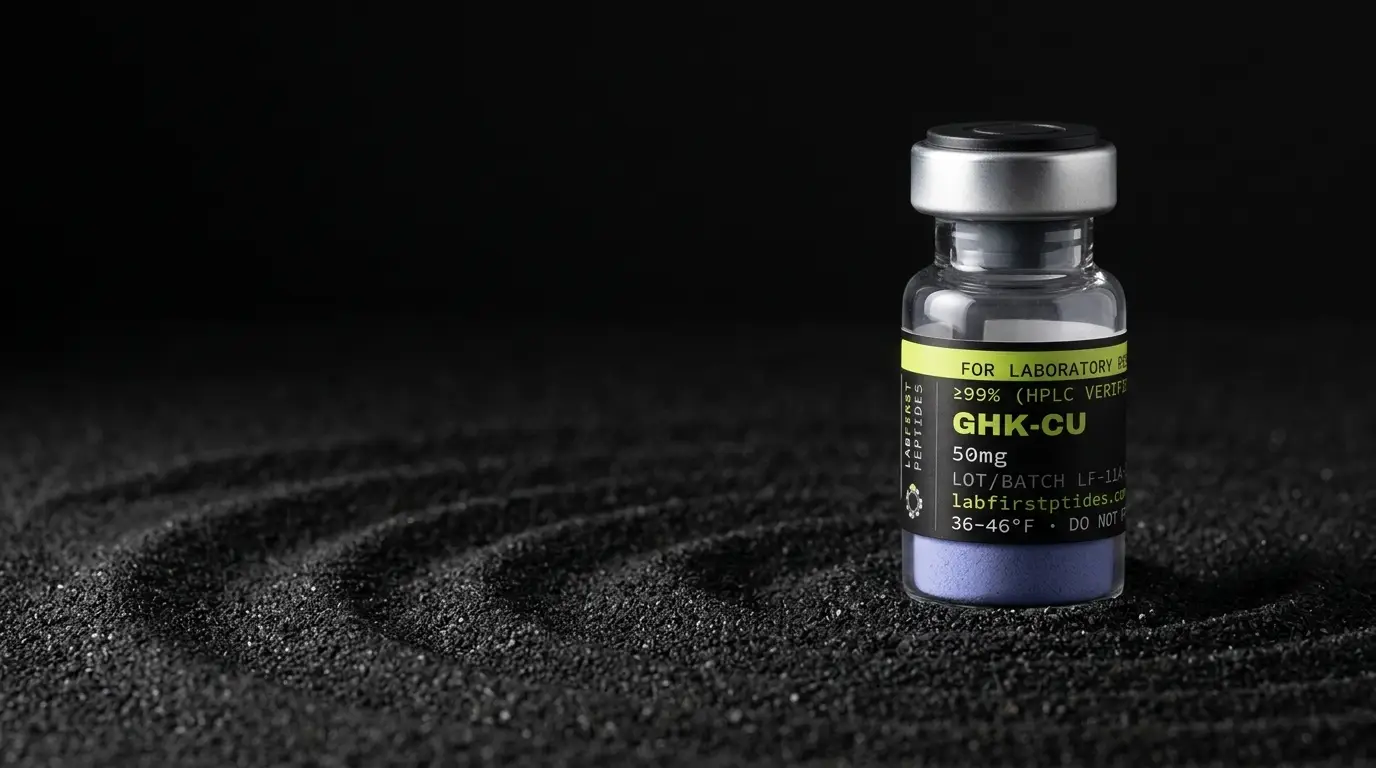
The coordination chemistry is well described in the literature: the copper ion is held by the amino-terminal nitrogen of glycine, the deprotonated backbone amide of the glycine-histidine bond, and the imidazole nitrogen of histidine. That chelation is what makes the complex stable enough to isolate, and it also gives the material its most recognisable property. Copper(II) absorbs in the visible region, so the solid runs blue to blue-violet and solutions carry a blue tint. Supplier listings, including the GHK-Cu product record, should state the salt form and what the labeled weight counts.
Regulatory status, with dates
A search of Drugs@FDA returns no approved drug product containing GHK-Cu, under that name or as Copper Tripeptide-1. The compound sits in no over-the-counter monograph. No FDA marketing authorisation of any kind attaches to it.
On the cosmetic side, the governing framework is the Federal Food, Drug, and Cosmetic Act, which has never required premarket approval for cosmetic ingredients other than color additives. The Modernization of Cosmetics Regulation Act, enacted in December 2022, added facility registration, product listing and adverse-event duties for cosmetics; it did not create an ingredient approval pathway. "FDA registered" on a cosmetic label is a statement about paperwork, never about review of the ingredient.
Status verified 25 August 2026 against Drugs@FDA.
Anyone repeating this check later needs about two minutes: search Drugs@FDA for the compound name and its aliases, and treat an empty result as the answer. The date matters, because status language written without one goes stale silently.
For research material the position is simpler still. GHK-Cu is supplied as a laboratory chemical, and everything on this page describes that article and no other. FOR LABORATORY AND IN-VITRO RESEARCH USE ONLY. NOT FOR HUMAN OR ANIMAL CONSUMPTION. NOT FOR PERSONAL, MEDICAL, DIAGNOSTIC, THERAPEUTIC, OR RECREATIONAL USE.
How identity and purity are confirmed
Purity and identity are separate questions answered by different instruments, and a certificate quoting only a percentage has answered the easier one. Reversed-phase HPLC reports the fraction of chromatographic signal sitting in the main peak. Run well, it is a fine measure of how much of the peptide-related material is a single species. It cannot say whether that species is GHK, whether copper is present, or how much of the vial's weight is peptide rather than water and counterion.
Identity is mass spectrometry's job. The free tripeptide gives a protonated ion near 341.2, and the complex announces the metal in a way that is hard to counterfeit: copper has two stable isotopes separated by two daltons at roughly a 69 to 31 abundance ratio, so any copper-containing ion shows a paired-peak pattern that a copper-free molecule cannot produce. An analyst reading the spectrum gets the peptide mass and the metal in one measurement.
The copper itself is a third, separate assay. From the atomic masses, a genuine 1:1 complex runs close to sixteen percent copper by weight, and inductively coupled plasma methods measure the actual figure directly. A result near sixteen percent supports the complex. A result near zero means the vial holds free peptide, whatever the label says. Color points the same direction more cheaply, since a colorless solution of claimed GHK-Cu is a contradiction, but color is a cue rather than data.
| Measurement | Instrument | What it establishes |
|---|---|---|
| Chromatographic purity | RP-HPLC | Fraction of peptide-related signal in the main peak; silent on identity and on copper |
| Mass identity | LC-MS or ESI-MS | That the observed mass matches the sequence, and via the isotope pattern whether copper is present |
| Copper content | ICP-OES or ICP-MS | Whether the article is the complex or the free peptide |
| Water and counterion | Karl Fischer titration, ion analysis | How much of the vial's weight is peptide at all |
Reading the certificate of analysis
No compendial monograph exists for GHK-Cu, so the certificate of analysis is the only document that speaks for a given lot, and it deserves a slower read than it usually gets. The name field should distinguish the complex from the free peptide explicitly. The identity entry should name the method and give the observed mass, not just the word "conforms". The purity entry should name the technique and report an area percentage. Where the complex is claimed, a copper content entry belongs on the page, and its absence is worth a query before purchase rather than after.
Then the housekeeping, which is where weak documentation actually fails: the lot number on the certificate matching the lot number on the vial, a test date, and the name of the laboratory that ran the analysis. A certificate is verified with the laboratory that issued it, on contact details you look up yourself. The seller forwarding a PDF is not verification; it is the thing being verified. The criteria this catalog applies to its own documentation are set out in the quality standard.
Storage and solution handling
Handling follows general lyophilized-peptide practice, and it is worth saying plainly that no public stability program stands behind any specific figure for this compound; what follows is standard laboratory convention. The dry solid keeps best sealed against moisture, dark, and cold, with freezer storage for archival holds and refrigeration for a working vial. Let a cold vial reach room temperature before opening it, since condensation on a cold cake is the most common avoidable handling error, and record the date of first entry.
Solutions add a copper-specific wrinkle. Copper(II) is redox-active, so a prepared solution is kept away from reducing agents and is never combined with other stocks; the metal can also migrate out of one complex and into other molecules, which is a second reason a GHK-Cu solution lives alone. A prepared solution that shifts color or throws a precipitate is discarded, and the observation logged.
The preparation arithmetic is ordinary. A 50 mg vial brought into 5 mL of diluent gives:
50 mg ÷ 5 mL = 10 mg/mL
and the vial concentration calculator covers other volumes and vial sizes. Diluent choice follows the same logic as for any peptide, which the bacteriostatic water guide works through: preserved water where a container will be entered across days, plain sterile water with single-entry handling otherwise. Date every container at preparation. An undated solution of a blue compound is still an undated solution.
Common questions
Is GHK-Cu approved by the FDA for any use?
Does the 2022 cosmetics law change GHK-Cu's status?
What is the difference between GHK and GHK-Cu?
How can a laboratory confirm material is really the copper complex?
Is there a USP monograph or official stability data for GHK-Cu?
Published certificates for GHK-Cu
Every figure below is read from a report the laboratory issued for that lot; each page carries the PDF and the lab's own verification link.
More laboratory guides
Sources
- Drugs@FDA, FDA's register of approved drug products. Searchable record establishing the absence of any approved drug product containing GHK-Cu; checked 25 August 2026.
- Federal Food, Drug, and Cosmetic Act and FDA cosmetics guidance, including MoCRA (2022). Statutory basis for the statement that cosmetic ingredients other than color additives receive no premarket approval, and for the December 2022 registration and listing duties.
- PubChem records for glycyl-L-histidyl-L-lysine and its copper complex. Formula, mass and nomenclature for the free tripeptide and the 1:1 copper(II) complex.
- Pickart and Margolina. Regenerative and Protective Actions of the GHK-Cu Peptide in the Light of the New Gene Data. International Journal of Molecular Sciences 19(7):1987 . Basis for the description of the GHK tripeptide and its copper complex, from the group that characterized it.