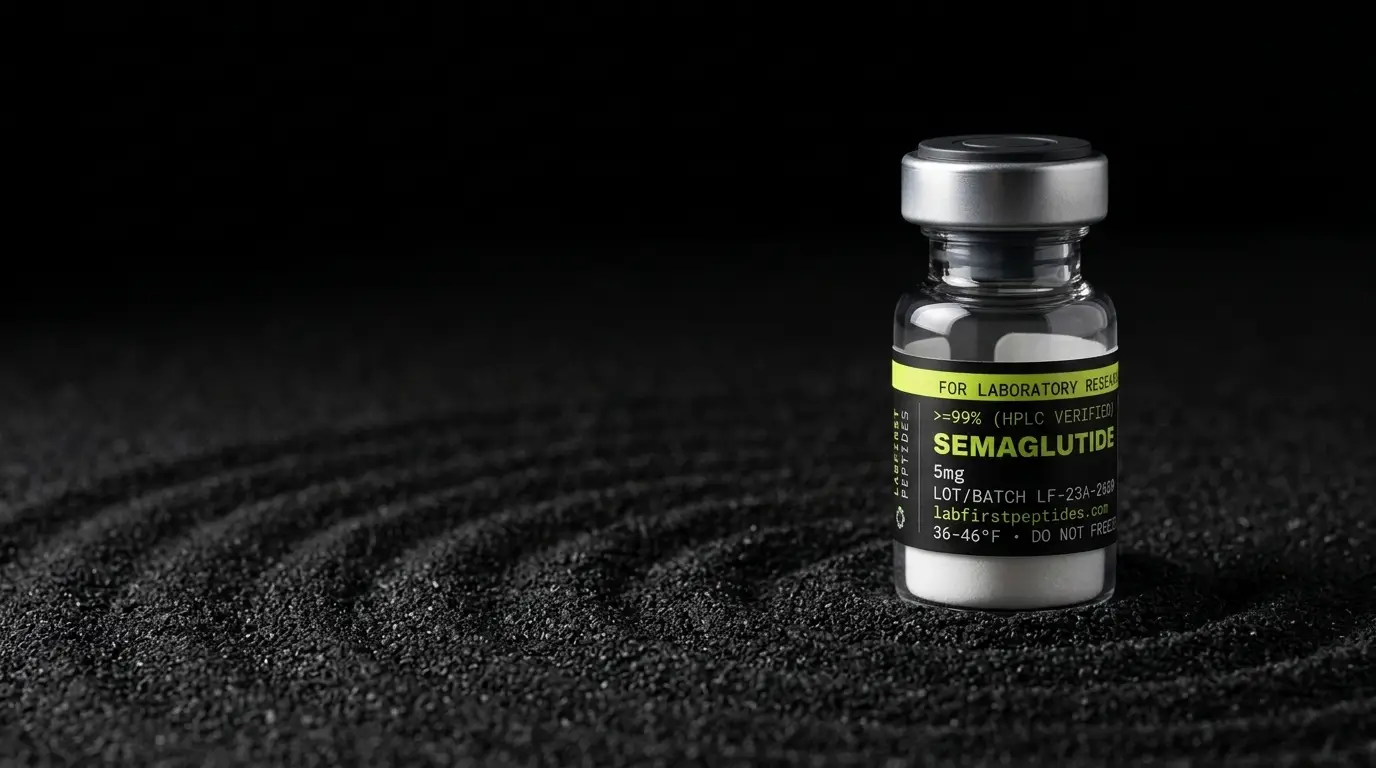
To buy semaglutide peptide for lab use, start with what it is: a 31-residue acylated GLP-1 analog, CAS 910463-68-2, sold as a lyophilized powder. A sound purchase rests on documents for that exact lot. Look for an RP-HPLC purity chromatogram, a mass confirming identity, water and counterion figures, and a stated storage basis.
- Semaglutide is a 31-residue linear GLP-1 analog, CAS 910463-68-2, formula C187H291N45O59, average mass near 4113.6 Da for the free acid.
- Its structure is [Aib8, Arg34]GLP-1(7-37) with Lys26 acylated through a gamma-glutamic acid and two AEEA spacers to a C18 fatty diacid.
- Chromatographic purity and net peptide content are separate figures; a lot at 99% by HPLC area may be roughly 80% peptide by mass.
- Identity requires a mass measurement, but mass cannot resolve isoaspartate or D-amino epimers, so chromatographic evidence is needed alongside it.
- The FDA recorded the semaglutide injection shortage as resolved on February 21, 2025, with compounding enforcement discretion ending April 22, 2025 for 503A and May 22, 2025 for 503B facilities.
What is semaglutide peptide as a research material?
Search traffic for semaglutide splits into two populations that want completely different things. One wants a prescription medicine. The other wants a characterized reference material for in-vitro work, and needs to know whether a given vial contains what the label claims. This page is written for the second group only.
Research-grade semaglutide is a lyophilized powder, usually 2 mg to 10 mg per vial, sold against a certificate of analysis that speaks to identity and purity. That is a narrow claim about a narrow thing. It says nothing about sterility, endotoxin load, particulate matter, container-closure integrity, or the batch-release apparatus that sits behind a licensed product. A certificate showing 99.1% by area under a single chromatographic method is a chemistry statement, and treating it as a quality statement about a finished formulation is the mistake most often made in this market.
The practical consequence for procurement is that the document set matters more than the number on the front page. Two vials can both say 99% and be different materials: one characterized by orthogonal methods on that specific lot, the other carrying a purity figure copied forward from a batch synthesized eighteen months earlier. Nothing in the powder itself distinguishes them.
- Lot identifier that matches the vial label
- RP-HPLC purity with the chromatogram and method conditions
- Observed mass against theoretical, charge states reported
- Water content and counterion, so net peptide content is known
- Storage basis, and honesty about whether a retest date rests on data
What identity and naming fields apply?
Semaglutide is an analog of human glucagon-like peptide-1, specifically of the GLP-1(7-37) fragment, with two amino acid substitutions and a fatty diacid conjugate. Written in the convention used across the GLP-1 literature it is [Aib8, Arg34]GLP-1(7-37) acylated on Lys26. The alanine at position 8 is replaced by α-aminoisobutyric acid, which blocks dipeptidyl peptidase-4 cleavage at that bond, and the lysine at 34 is replaced by arginine so that acylation happens only at the intended site.
| Field | Value |
|---|---|
| Common name | Semaglutide |
| Structural description | [Aib8, Arg34]GLP-1(7-37), Lys26 acylated via AEEA-AEEA-γGlu to a C18 fatty diacid |
| CAS registry number | 910463-68-2 |
| Molecular formula | C187H291N45O59 |
| Average molecular weight | approximately 4113.6 Da (free acid) |
| Chain length | 31 residues, linear, no disulfide bonds |
| Termini | Free N-terminal histidine; free C-terminal glycine (not amidated) |
| ATC code | A10BJ06 |
| Aliases seen in supply listings | GLP-1 analog 2211, sema, and sponsor development designations from the pre-approval literature |
Two nomenclature traps recur. First, position numbering: the literature usually keeps GLP-1 numbering, so Aib sits at position 8 and the acylation at Lys26 even though the peptide as synthesized is only 31 residues long. A supplier writing Aib2 is using sequential numbering, which is fine on its own. The trouble is that listings mix the two systems. Second, salt form. Material is commonly supplied as an acetate or as a sodium salt, and the counterion changes what a milligram of powder contains.
What does the structure predict about behavior?
The side chain on Lys26 is the part that governs handling. It is a C18 dicarboxylic acid attached through a γ-glutamic acid spacer and two units of 8-amino-3,6-dioxaoctanoic acid. Lau and colleagues described the design work behind that linker choice in the Journal of Medicinal Chemistry in 2015; the short version is that the diacid drives strong albumin binding while the hydrophilic spacers keep receptor engagement intact.
For a laboratory the consequence is that semaglutide is amphiphilic. Amphiphilic molecules accumulate at interfaces, so the air-water boundary in a half-filled vial is a genuine site of loss, and adsorption to glass and some plastics can quietly remove material at low concentrations.
The sequence also tells you which chemical routes are live. There is no methionine and no cysteine, so the classic oxidation hotspots are absent, but tryptophan at position 31 oxidizes and histidine at the N-terminus is not inert. Glutamine is present and can deamidate. The aspartate at position 15 is a candidate for aspartimide formation and subsequent isoaspartate, which is a mass-neutral rearrangement and therefore invisible to a mass spectrum alone. Aib at position 8 confers peptidase resistance and nothing else; it is not protection against water, heat or light, and reading enzymatic stability as general stability is a common error.
Which methods establish identity and purity?
No single method settles the question. Purity by chromatography and identity by mass are different assertions, and a certificate that carries only one of them has answered half the problem.
| Method | What it establishes | Typical observation | Blind spot |
|---|---|---|---|
| RP-HPLC, C18 or C8, UV 214 nm | Chromatographic purity as area percent; related-substance profile | Gradient of acetonitrile against aqueous acid or phosphate buffer; main peak with resolved impurity shoulders | Co-elution; isomers with identical retention; anything not absorbing at the monitored wavelength |
| LC-MS, ESI positive | Molecular identity | Multiply charged envelope, with [M+3H]3+ near m/z 1372 and [M+4H]4+ near m/z 1029 for the free acid | Cannot separate isobaric species such as isoaspartate or D-amino epimers |
| Peptide mapping with MS/MS | Sequence coverage and the site of acylation | Enzymatic digest, fragment assignment across the chain including the Lys26 conjugate | Labor-intensive; rarely present on a routine research certificate |
| Amino acid analysis | Composition and peptide content | Hydrolysis followed by derivatized chromatography | Destroys the sample; tells you nothing about sequence order |
| Karl Fischer or loss on drying | Water content of the lyophilizate | Commonly several percent in a freeze-dried cake | Reflects the vial tested, not the one shipped to you |
| Ion chromatography | Counterion identity and level | Acetate or trifluoroacetate quantified against standards | Often omitted, which leaves net peptide content unknown |
| Size-exclusion chromatography | Aggregate and high-molecular-weight species | Main monomer peak with early-eluting shoulder if aggregation has occurred | Insensitive to small covalent modifications |
The distinction between chromatographic purity and peptide content is where most confusion lives. A powder can be 99% pure by HPLC area and still be, by mass, roughly 80% peptide once water, counterion and residual salts are accounted for. Both figures are honest; they answer different questions. If a protocol depends on knowing how much peptide is in the vial, the certificate needs a content assay, not only an area percent. General approaches for chromatographic system suitability and water determination are laid out in the USP general chapters, and residual solvent limits follow the ICH Q3C classification.
How do you read the certificate of analysis?
Ask for the certificate before ordering, not after. A supplier who will not send a lot-specific document pre-purchase is telling you something.
| Field | What a competent document shows | If missing |
|---|---|---|
| Lot or batch identifier | A unique string that also appears on the vial label | The document cannot be tied to the material in your hand |
| Analysis date | A date, distinct from any print or issue date | You cannot tell whether the data predates the batch |
| Purity with method conditions | Area percent plus column, mobile phase, gradient, detection wavelength | A bare number with no way to judge whether it could resolve anything |
| Chromatogram image | The actual trace, axis labels legible, integration visible | Assume the number was typed, not measured |
| Mass confirmation | Observed versus theoretical mass, with the charge states seen | Identity is unestablished; purity of an unknown is not useful |
| Water and counterion | Karl Fischer or LOD figure, counterion species and percent | Net peptide content is a guess |
| Storage and retest basis | Recommended conditions, and whether a retest date rests on data or convention | Treat any shelf-life claim as unsupported |
Red flags, in rough order of how often they appear: one certificate reused across every lot, with only the batch number changed; a chromatogram with no axis values; purity quoted to 99.9% on a synthetic peptide of this length, which is implausible without exceptional purification; the phrase pharmaceutical grade with no auditable quality system named; and any human-use framing anywhere on the paperwork. That last one has nothing to do with chemistry. It tells you what business the seller thinks it is in. Our own documentation baseline is described on the quality standard page.
How to buy semaglutide for lab work: step by step
The checks below take a few minutes per supplier and all of them come from the certificate.
- Ask for the lot certificate before ordering. A supplier who will not send a lot-specific document before purchase is telling you something.
- Match the lot. The identifier on the certificate should also appear on the vial label.
- Check the mass. Look for observed against theoretical mass for C187H291N45O59, with the charge states seen.
- Check the purity evidence. An area percent needs the chromatogram and the method conditions beside it.
- Find water and counterion figures. Without them, net peptide content is a guess.
- Compare on cost per milligram of peptide. Vial price alone tells you very little.
How should the sealed powder be stored?
Sealed lyophilized powder held at or below minus 20 °C, dark and desiccated, sits in the slowest regime available. Refrigerated storage at 2 to 8 °C is reasonable for a working vial with a defined use window. The failure that costs most material is opening a cold vial in a humid room, where condensation lands directly on a hygroscopic cake. Let the sealed vial equilibrate on the bench before breaking the seal, every time. The same physics applies across this compound class, and the longer treatment in the tirzepatide storage and stability guide transfers directly.
Record the storage condition on arrival and keep the vial in its carton between uses. The counterion and water figures on the certificate matter here too, since they turn the label mass into net peptide content.
Why does semaglutide for sale vary so much in price?
Cost per milligram varies more than the chemistry does, and most of the spread is explained by things a purchaser can ask about. Synthesis route is the first: a solid-phase build of a 31-residue chain followed by site-selective acylation is a different cost structure from a recombinant backbone acylated chemically, and both are in use. Purification passes are the second. Getting from a crude 70% to a clean 98% costs yield, and the yield loss shows up in the price.
Then there is the analytical burden. A lot characterized by RP-HPLC, LC-MS, amino acid analysis, Karl Fischer and ion chromatography carries real instrument time. Suppliers who skip most of that are cheaper, and the saving is exactly the documentation you would need to defend the material later. Lyophilization, counterion exchange, vial fill under controlled conditions and cold-chain transport all add. Our handling and transit conditions are set out under shipping.
Compare on cost per milligram of peptide, not cost per vial. A 10 mg vial at 78% net content and a 5 mg vial at 94% are not in the ratio the labels suggest, and vial size differences make sticker prices meaningless on their own. The cost per mg tool normalizes the comparison. Where a quote sits far below the market for material of a stated purity, the likeliest explanations are a lower actual purity, an unstated salt and water load, or a certificate that was not generated on that lot. The semaglutide product record lists the current lot documentation.
What is its research program status and regulatory position?
Semaglutide is a GLP-1 receptor agonist. Prescription medicines containing semaglutide have been approved by the FDA since 2017, in subcutaneous and oral forms, manufactured under pharmaceutical quality systems that a research-chemical supply chain does not reproduce. The molecule remains the subject of an active sponsor and academic research program across several therapeutic areas; endpoint data from those trials belongs in the clinical literature and is outside the scope of a chemistry reference.
On February 21, 2025 the FDA recorded the semaglutide injection shortage as resolved. The agency's stated period of enforcement discretion for compounded semaglutide then closed on April 22, 2025 for 503A compounding pharmacies and May 22, 2025 for 503B outsourcing facilities. Research-grade powder has never been a lawful route to human use at any point in that sequence, before, during or after the shortage.
Status verified August 26, 2026.
FOR LABORATORY AND IN-VITRO RESEARCH USE ONLY. NOT FOR HUMAN OR ANIMAL CONSUMPTION. NOT FOR PERSONAL, MEDICAL, DIAGNOSTIC, THERAPEUTIC, OR RECREATIONAL USE.
One more point on diligence, since it is the question suppliers get asked least. Ask who performed the analysis. In-house testing by the manufacturer is normal and acceptable; a third-party report from a named laboratory on a named lot is stronger. Either is better than an unattributed document, and an unattributed document is what most of this market runs on.
Bottom line
Semaglutide peptide for research is a lyophilized powder of one 31-residue acylated GLP-1 analog, CAS 910463-68-2. A sound purchase rests on documents for the exact lot: a mass that matches, a chromatogram with its method, and water and counterion figures that let you work out net peptide content. Approved semaglutide medicines are a different article. Research powder has never been a lawful route to human use.
Common questions
What identity data should a semaglutide certificate of analysis contain?
Why does purity by HPLC differ from peptide content?
Is research-grade semaglutide the same substance as the approved medicine?
Which degradation products are hardest to detect?
How should the powder be stored on arrival?
Does a stated shelf life on the certificate mean anything?
Where can I buy semaglutide peptide online?
How much does Semaglutide cost?
Is sema the same as semaglutide, and is research semaglutide the same as Ozempic?
Which Semaglutide size should a laboratory order first?
How do I check that a Semaglutide certificate is real?
How do I tell semaglutide from the bare peptide without its side chain?
Published certificates for Semaglutide
Every figure below is read from a report the laboratory issued for that lot; each page carries the PDF and the lab's own verification link.
More laboratory guides
Sources
- Lau et al., Journal of Medicinal Chemistry, 2015. Primary report of the design of the once-weekly GLP-1 analogue semaglutide, including the Aib8 substitution and the gamma-glutamic acid plus AEEA linker to the C18 diacid; supports the structural description and the rationale for albumin binding.
- PubChem compound record for semaglutide, NIH National Library of Medicine. Supports the CAS registry number, molecular formula and average molecular weight cited in the identity table.
- United States Pharmacopeia general chapters on chromatography, water determination and residual solvents. Establish the system-suitability, water-content and solvent-limit conventions that a competent peptide certificate of analysis is written against; ICH Q3C provides the solvent class limits referenced.
- FDA drug shortage database and compounding enforcement statements, February to May 2025. Supports the 21 February 2025 shortage resolution for semaglutide injection and the 22 April and 22 May 2025 end dates for enforcement discretion at 503A and 503B facilities respectively.