Are peptides legal? In the US, buying and selling peptides for laboratory research is generally lawful. The line is intended use. A peptide sold for human use without FDA approval is treated as an unapproved drug. That is why research peptides carry a research-use-only label, and why sellers cannot offer dosing or health claims.
- Peptides are not a controlled class under US federal law; legality turns on intended use.
- The FD&C Act at 21 U.S.C. 321 defines a drug partly by intended use to treat disease or affect body structure or function.
- A peptide marketed for human use without FDA approval is treated as an unapproved drug.
- Research use only is a labeling category, defined for in-vitro diagnostics at 21 CFR 809.10(c).
- FDA category 2 for compounding names GHRP-2, GHRP-6, ipamorelin acetate and kisspeptin-10 as potential significant safety risks.
The short version: legality follows intended use
In plain terms, the law cares less about what a peptide is than about what it is sold for. The same vial can be a lawful laboratory reagent or an unlawful unapproved drug, depending on how it is labeled, marketed and used.
Peptides are not a controlled class under US federal law. There is no general statute that makes owning or buying a peptide a crime, and most of the compounds sold for research are not scheduled substances. What US law does regulate closely is the sale of anything intended to diagnose, treat or prevent disease, or to affect the structure or function of the body. That is the legal definition of a drug, and a product that meets it needs FDA approval before it can be marketed for that purpose.
So the useful question is rarely "is this peptide legal". It is "what is this peptide being sold for, and does the way it is sold match that purpose". A research supplier that sells lot-documented material for in-vitro and laboratory work sits on one side of that line. A seller that lists doses, before-and-after results or promised effects on the body sits on the other, whatever the label says.
This page explains the rules that draw that line, in the order they usually come up. It is general information about how the law is structured, not legal advice for any particular situation.
- Peptides are not a controlled class
- Intended use decides whether it is a drug
- Human-use marketing makes an unapproved drug
- Research use only means no clinical claims
- Buy lot-documented material for the lab
What the FD&C Act says a drug is
The Federal Food, Drug, and Cosmetic Act defines a drug in section 201(g), codified at 21 U.S.C. 321. The definition covers articles intended for use in the diagnosis, cure, mitigation, treatment or prevention of disease, and articles other than food intended to affect the structure or any function of the body.
The key word is intended. Intent is read from the whole picture: labeling, advertising, product descriptions, website copy, social media, and even what a seller's staff say in reply to customer questions. If the evidence shows a product is meant for people, it is regulated as a drug for people, and marketing it without an approved application is a violation.
That is why compliant research suppliers are strict about language. They describe identity, purity, storage and documentation. They do not describe effects, doses, protocols or results in humans or animals, because those descriptions are exactly the evidence of intent the law looks at. When a site that calls itself a research supplier also publishes dosing charts, the research-use label does not protect it. FDA warning letters to peptide sellers commonly quote the seller's own marketing back at them for this reason.
Where the research-use label fits in the law
Research use only, often shortened to RUO, is a labeling category. For in-vitro diagnostic products it is defined in FDA regulations at 21 CFR 809.10(c), which describes products in the laboratory research phase that are not represented as effective for any clinical purpose, and requires the statement that the product is for research use only and not for use in diagnostic procedures.
Research chemicals outside diagnostics borrow the same idea: the material is supplied for laboratory investigation, and nothing about it is represented as safe or effective for use in people. A research-use label is a real commitment about how the product is offered. It is not a formula that makes any marketing acceptable.
For a buyer, the practical meaning is simple. A research-use peptide comes with no promise that it is suitable for any use in a living person or animal, and a responsible supplier will refuse to discuss such use. What it should come with is documentation: a lot number, and a certificate of analysis for that lot showing identity and purity. Our guide to what the RUO designation certifies covers the label itself in more detail.
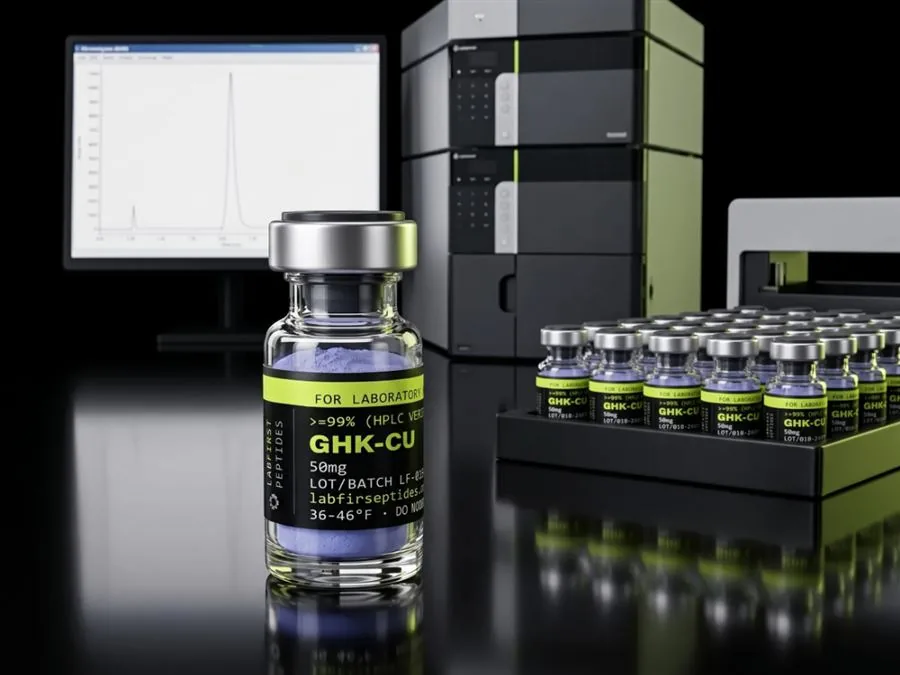
FOR LABORATORY AND IN-VITRO RESEARCH USE ONLY. NOT FOR HUMAN OR ANIMAL CONSUMPTION.
Compounding pharmacies and the FDA bulk substance lists
A separate set of rules applies to compounding pharmacies, which prepare medications for individual patients under sections 503A and 503B of the FD&C Act. Compounders may only use bulk drug substances that meet certain criteria, and the FDA reviews substances nominated for use.
While that review runs, the FDA sorts nominated substances into categories. Category 2 holds bulk drug substances that, in the agency's words, may present significant safety risks. The FDA's category 2 page names several peptides, including GHRP-2, GHRP-6, ipamorelin acetate and kisspeptin-10. The same page records that nominations for a number of other peptides, among them BPC-157, thymosin alpha 1, the thymosin beta-4 fragment sold as TB-500, semax and selank acetate, were withdrawn by the people who nominated them.
These lists govern pharmacies preparing medicine for patients. They are not a list of banned chemicals, and they do not make a research reagent unlawful. What they do show is that the FDA has not accepted these peptides for routine use in compounded medicine, which is one more reason research material must not be represented as a treatment.
Where the line is usually crossed
Most enforcement against peptide sellers follows a few repeat patterns, and all of them come back to intended use:
- Dosing and protocols. Tables of amounts, schedules or injection guidance show the product is meant for people.
- Health and body claims. Words about healing, fat loss, muscle, sleep, skin or longevity describe effects on the body, which is the drug definition.
- Human-use packaging. Pre-filled pens, nasal sprays or capsules marketed to consumers point the same way.
- A research label on consumer marketing. A disclaimer at the bottom of a page full of claims does not cancel the claims.
Imports follow the same logic. Much research peptide supply is made overseas, and shipments entering the US pass through FDA review at the border. Under section 801 of the FD&C Act the agency can refuse entry to goods that appear to be unapproved drugs, and it judges that partly from how the goods are labeled and described. A shipment documented as research material from a supplier that sells to laboratories reads very differently from consumer-labeled vials with dosing inserts. For a domestic buyer, a US supplier that handles the import and holds the documentation removes that step entirely.
State law can add its own rules on top, and sport has separate rules again: the World Anti-Doping Agency prohibited list includes several peptide classes, so a peptide can be lawful to sell for research and still banned for a competing athlete. Anyone with a specific legal question about their own situation should ask a lawyer who practices FDA law.
How to buy research peptides the lawful way
For a laboratory buyer, staying on the right side of the line looks like this. Buy from a supplier that sells for research use and behaves like it: no dosing content, no health claims, no human-use packaging. Expect a lot number on every vial and a certificate of analysis for that lot, and check the certificate against the vial before use. Keep the material in the laboratory, used for the research it was bought for.
A supplier's documentation also protects the buyer. A lot-specific certificate is evidence that the material is what it claims to be, which matters for research results as much as for compliance. Our guide to reading a peptide COA explains what each field should show, and the certificate index lists the documentation for each lot we sell.
The same logic explains what a careful supplier will not do. It will not tell you how much to take, whether a compound works, or how to use it on a person or an animal. That refusal is not unhelpfulness. It is the line the law draws, held in plain sight.
Common questions
Is it illegal to buy peptides online?
Are research peptides FDA approved?
Why won't research suppliers answer dosing questions?
Does the FDA ban peptides like BPC-157?
More laboratory guides
Sources
- Federal Food, Drug, and Cosmetic Act section 201, 21 U.S.C. 321 (Cornell LII). Statutory definition of a drug, including the intended-use language the whole page rests on.
- 21 CFR 809.10, labeling for in vitro diagnostic products (eCFR). Defines research-use-only labeling and the required statement in 809.10(c).
- FDA, Certain bulk drug substances for use in compounding that may present significant safety risks. Category 2 peptides named, and the withdrawn nominations including BPC-157 and TB-500.
- FDA, Compounding and the FDA: Questions and Answers. How sections 503A and 503B govern compounding pharmacies and outsourcing facilities.
- FDA warning letters database. Where enforcement letters to sellers, including peptide sellers, are published.
- World Anti-Doping Agency, Prohibited List. Sport rules that prohibit several peptide classes independently of US law.