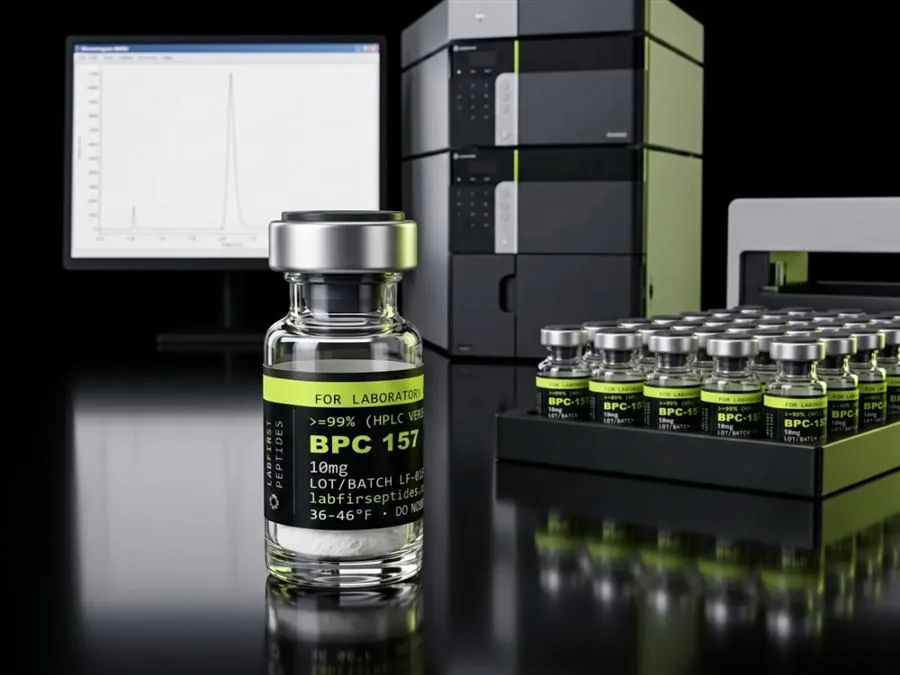
Grey market peptides are sold outside the rules that govern the product, usually as research chemicals while being marketed for human use. The tell is the gap between the label and the sales pitch. Documented research supply sells for laboratory use, carries a lot number and a certificate for that lot, and never offers dosing or health claims.
- Grey market peptides are typically labeled as research chemicals while being marketed for human use.
- Dosing content, effect claims and human-use packaging reveal the real intended use regardless of the label.
- A genuine certificate names a specific lot that matches the vial, the testing laboratory, methods, results and date.
- Independent identity, purity and net-content testing costs a few hundred dollars per sample, which shows up in honest pricing.
- The WHO treats substandard and falsified medical products as a global problem because packaging and paperwork can be convincing.
What grey market means
Think of it like a car sold with a racing-only sticker that the seller then advertises as a daily driver. The sticker says one thing, the sales pitch says another, and the buyer is left carrying the risk of the difference.
A black market deals in goods that are illegal to sell at all. A grey market is murkier: the goods themselves may be lawful to sell in some form, but they are sold in a way that sidesteps the rules for that form. In peptides, the common pattern is material labeled as a research chemical while the seller markets it, openly or by hint, for use in people.
That gap matters because the rules exist for a reason. A product intended for human use is regulated as a drug in the United States, which means approval, manufacturing controls and truthful labeling. A research chemical carries none of those guarantees and makes no claim that it is suitable for any use in a person. Selling one as if it were the other leaves the buyer with neither the protections of a medicine nor the documentation discipline of a serious research supplier.
Our guide to whether peptides are legal explains where US law draws that line. This page is about recognizing which side of it a seller is on.
- No dosing or effect claims
- A lot number on every vial
- A certificate for that lot
- A certificate you can verify with the lab
- A price and payment that make sense
The warning signs in how a product is sold
Grey market sellers are usually easy to recognize once you know where to look, because the marketing gives them away. The clearest signs are:
- Dosing content. Charts, calculators framed around amounts to take, protocols or cycle plans. A research supplier has no reason to publish these.
- Effect claims. Promises about fat loss, muscle, healing, skin, sleep or longevity. These describe effects on the body, which is drug marketing.
- Human-use formats. Pre-filled pens, nasal sprays, capsules or kits with syringes, sold to consumers.
- Before-and-after content and testimonials describing personal use.
- A disclaimer that contradicts the page. A research-use line at the bottom of copy written entirely for personal use.
- Private channels. Pushing buyers to encrypted chat groups for the real product list or advice.
Any one of these is a reason for caution. Several together describe a seller whose research label is decoration.
The warning signs in the paperwork
Documentation is where serious supply and grey market supply separate most clearly, because good documentation is expensive and hard to fake well.
A real certificate of analysis names a specific lot, and that lot number matches the one printed on the vial. It names the laboratory that ran the tests, gives the identity method and result, the purity method and figure, and the date. Ideally it can be checked with the issuing laboratory directly.
Grey market paperwork tends to fail in predictable ways. The same certificate appears across many products or many months. The lot number on the certificate matches nothing on the vial, or the vial has no lot number at all. The document names no laboratory, or names one that cannot be found or contacted. Purity is stated as a round number with no method and no chromatogram. Sometimes the certificate is a real one from another company with the name changed.
The WHO describes substandard and falsified medical products as a global problem precisely because packaging and paperwork can look convincing. The defence is to check the document against the vial and against the lab, not to trust its appearance. Our guide to reading a peptide COA walks through each field.
The warning signs in price and payment
Price and payment tell you about a seller's economics, and economics tell you about quality.
Testing costs money. An independent analysis of identity, purity and net content runs to a few hundred dollars per sample, and a supplier that tests every lot builds that into its price. A price far below the rest of the market for the same compound and size often means the testing was never done, or was done once and reused.
Payment arrangements are another signal. Sellers who accept only irreversible methods, rotate payment accounts frequently, or ask buyers to describe purchases as something else are managing risk on their side, not yours. Pressure to pay quickly, limited-time offers tied to private groups, and no physical business address point the same way.
None of this means a low price is proof of a problem, or that every small seller is grey market. It means that price, payment and paperwork should tell a consistent story. When a seller's price only makes sense if nothing was tested, believe the price.
What documented research supply looks like instead
The opposite of grey market supply is not a particular brand. It is a set of habits that are visible from the outside.
A documented research supplier describes its products in terms of chemistry and handling: what the compound is, its sequence or structure, its molecular weight, how to store it and how its identity and purity were checked. It says nothing about what the compound does in a body, because it is not selling it for use in one, and it declines questions that ask.
It assigns a lot number to every batch and prints it on every vial. It tells you which lot is currently shipping for each size, and it publishes a certificate of analysis for that lot, or says plainly when a certificate is pending rather than borrowing one from an earlier batch.
It is an identifiable business with an address, a phone number that is answered, normal payment methods, and written terms covering what happens if a vial arrives damaged or incorrect. It ships with tracking and handles the import step itself, so the buyer receives domestic stock rather than a parcel from an unknown overseas sender.
None of this is remarkable. That is the point. Serious research supply is boring in the right ways, and the absence of those boring habits is the most reliable warning sign there is.
Why it matters for research
For a laboratory, the problem with grey market material is not only legal exposure. It is bad data. A peptide that is the wrong compound, a truncated sequence, underfilled, or contaminated produces results that cannot be reproduced and cannot be trusted. Weeks of work built on an unverified reagent can be lost to a vial that was never what its label said.
That is the practical value of lot documentation. A lot number ties the vial in your hand to a specific test report. If a result looks wrong, you can check the reagent. If a second order behaves differently, the lot numbers show whether it was a different batch. The staged guide to bulk supplier red flags covers the same checks at larger order sizes.
FOR LABORATORY AND IN-VITRO RESEARCH USE ONLY. NOT FOR HUMAN OR ANIMAL CONSUMPTION.
A short checklist before you order
Before ordering research peptides from any supplier, including us, run through five questions:
- Does the seller behave like a research supplier? No dosing, no effect claims, no human-use packaging.
- Is there a lot number on every vial? And does the product page say which lot is currently shipping?
- Is there a certificate for that lot? One that names the laboratory, the methods, the results and the date.
- Can the certificate be checked? With the issuing laboratory, not only on the seller's site.
- Do price and payment make sense? A price that allows for testing, and normal payment through a business that can be identified.
A supplier that passes all five is selling research material. One that fails several is selling something else under a research label. Our certificate index is where we publish the documentation for each lot we sell, so these questions can be answered about us as well.
Common questions
What does grey market peptides mean?
How can I tell if a peptide seller is grey market?
Are cheap peptides always grey market?
Why do grey market sellers use research-use labels?
More laboratory guides
Sources
- World Health Organization, Substandard and falsified medical products fact sheet. Scope of the falsified product problem and why convincing packaging is not proof of authenticity.
- FDA warning letters database. Enforcement letters that quote sellers' own marketing as evidence of intended use.
- Federal Food, Drug, and Cosmetic Act section 201, 21 U.S.C. 321 (Cornell LII). The intended-use definition of a drug that grey market marketing falls under.
- 21 CFR 809.10, labeling for in vitro diagnostic products (eCFR). What a research-use-only label is meant to represent.