Where to buy retatrutide comes down to documents. Reta is lab shorthand for retatrutide, Eli Lilly code LY3437943, an investigational triple agonist at the GIP, GLP-1 and glucagon receptors. No approved medicine contains it. Look for a certificate for the exact lot with a mass spectrum, an HPLC chromatogram and a stated net peptide content.
- Reta peptide means retatrutide, development code LY3437943, an investigational triple agonist at the GIP, GLP-1 and glucagon receptors.
- No approved medicine contains retatrutide, and there is no USP or Ph. Eur. monograph or official reference standard for it.
- Deconvoluted ESI-MS separates retatrutide from tirzepatide, semaglutide and liraglutide easily, but cannot detect sequence scrambling or racemization.
- HPLC area percent purity and net peptide content are different numbers, and only the second tells you how much peptide a vial holds.
- A certificate without a lot number, an analysis date, method conditions and an attached chromatogram documents nothing.
- The lipid conjugate makes the molecule interface-active, so it adsorbs to container surfaces at low concentration.
What does reta name, and why keep the abbreviation out of a record?
In plain terms, "reta" is a nickname, and nicknames cause mix-ups. It is like ordering a part by its slang name and getting the wrong one. Writing the full name, retatrutide, keeps the record clear.
"Reta" is community shorthand. It has no standing as a chemical name and it resolves ambiguously the moment someone else reads your notebook. The compound behind the abbreviation is retatrutide, originally described under the Eli Lilly development code LY3437943, a synthetic peptide agonist acting at three receptors: the glucose-dependent insulinotropic polypeptide receptor, the glucagon-like peptide-1 receptor, and the glucagon receptor. The first full pharmacological description appeared in Cell Metabolism in 2022 from Coskun and colleagues.
Names you will see in circulation for the same material:
- Retatrutide: the INN, and the term to use in any record.
- LY3437943: the development code, still the most searchable identifier in the primary literature.
- Triple agonist, GGG tri-agonist and reta: informal names, worth translating on receipt.
A CAS registry number is assigned. Verify it against the registry itself rather than against a vendor listing, because transcription errors in supplier catalogs are common and a wrong CAS on a purchase order propagates into every downstream document. The same caution applies to molecular formula strings copied between websites. Public compound records place the average mass near 4,731 Da; the number that matters for your work is the theoretical mass printed on the certificate for your lot, compared against the mass the instrument actually observed.
If the material arrives labeled only "reta 10mg", the labeling itself is the first quality signal, and it is not a good one.
- Lot identifier and analysis date — without these, nothing below counts
- Mass spectrum with theoretical and observed mass
- RP-HPLC chromatogram with method conditions, not just a percentage
- Net peptide content and counterion identity
- Water content and stated fill weight tolerance
- Independent third-party confirmation, named
What is the structure and physical form of retatrutide peptide?
Retatrutide is a linear 39-residue peptide built on a GIP-analog backbone, incorporating non-coded α-aminoisobutyric acid residues to blunt dipeptidyl peptidase cleavage, a fatty diacid conjugated through a linker to a lysine side chain, and a C-terminal amide. Secondary sources disagree on residue positions for the Aib substitutions and the lipidation site; where a position assignment matters to your work, take it from the primary publication or the patent family rather than from an aggregator page.
Two structural features drive handling behavior. The lipid chain makes the molecule amphiphilic, so it concentrates at air-water interfaces and adsorbs to container surfaces at low concentration. The Aib substitutions resist enzymatic cleavage and do nothing at all about hydrolysis, deamidation or oxidation, which is a distinction people routinely collapse.
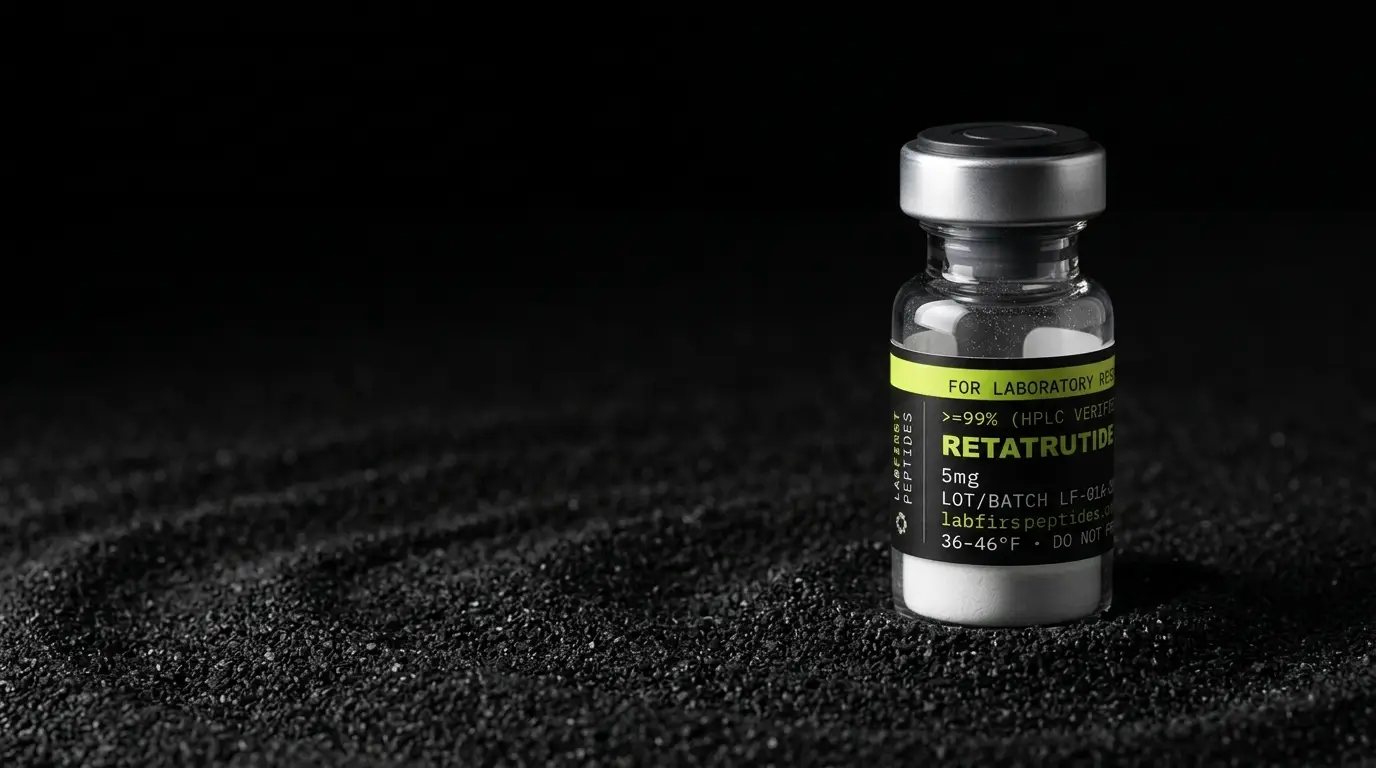
Supplied form is almost always a lyophilized cake or powder in a sealed glass vial, usually as an acetate or trifluoroacetate salt. Which counterion is present is not cosmetic. TFA is a synthesis residue with known effects in cell-based systems, and if your assay is cell-based you want the salt form on the certificate before the vial ships, not after an unexplained result.
What does a mass spectrum settle about identity, and what does it leave open?
Identity confirmation for a 39-mer rests on electrospray LC-MS. The instrument sees a family of multiply charged ions, deconvolution gives a mass, and that mass is compared with the theoretical value for the stated sequence and salt form. This is a cheap, fast test and it catches the crudest failure mode in the research-chemical trade, which is a vial containing a different incretin peptide entirely.
| Compound | Approximate average mass | Separation from retatrutide |
|---|---|---|
| Retatrutide | ~4,731 Da | reference |
| Tirzepatide | ~4,813 Da | ~80 Da, trivially resolved |
| Semaglutide | ~4,114 Da | ~600 Da, trivially resolved |
| Liraglutide | ~3,751 Da | ~1,000 Da, trivially resolved |
The limits are worth stating plainly. A deconvoluted mass does not distinguish sequence isomers, does not detect D-amino acid incorporation from racemization during synthesis, and will not flag a scrambled sequence of identical composition. A single-residue deletion shifts mass by roughly 60 to 190 Da depending on the residue, which is detectable, but the impurity peak has to be looked for rather than assumed absent. Settling those questions requires a peptide map: enzymatic digest, LC-MS/MS on the fragments, coverage reported against the claimed sequence. Few research suppliers run one. A supplier who does, and who will send the raw data file rather than a summary table, is telling you something about their quality system.
What is purity, and which number is not purity?
Chromatographic purity is measured by reversed-phase HPLC, typically a C18 column with a water/acetonitrile gradient in dilute trifluoroacetic acid, detection at 214 or 220 nm where the amide backbone absorbs. The reported figure is the main peak as a percentage of total integrated peak area. USP General Chapter <621> sets the system suitability expectations that make such a number meaningful; ICH Q2(R2) covers what validating the method involves.
Area percent is a relative measure. It says nothing about how much of the powder in the vial is peptide. Net peptide content accounts for counterion, residual water and residual solvent, and for a lyophilized TFA salt it can sit well below 90 percent of gross mass. A vial sold as 10 mg at 99 percent HPLC purity may contain rather less than 10 mg of peptide, and the certificate is the only place that gets resolved.
| Line item | Method | What it establishes | If absent |
|---|---|---|---|
| Identity | ESI-MS or MALDI-TOF | Observed mass matches theoretical | You cannot exclude a substituted compound |
| Chromatographic purity | RP-HPLC, area % at 214/220 nm | Main peak relative to related substances | The headline percentage is an assertion |
| Net peptide content | Amino acid analysis, UV, or nitrogen determination | Peptide mass fraction of the powder | Cost per mg of peptide is unknown |
| Water content | Karl Fischer or loss on drying | Residual moisture | Mass basis and stability both unverified |
| Counterion | Ion chromatography | Acetate or TFA, and how much | Assay interference risk in cell work |
| Related substances | RP-HPLC impurity profile | Deletion, oxidation, truncation peaks | Nothing is known about failure mode |
| Aggregates | SEC or SE-HPLC | High molecular weight species | Interface-active peptide, unquantified |
| Fill weight | Gravimetric, with tolerance | Actual vial contents against label | Every mass figure starts wrong |
A certificate carrying a lot number, an analysis date, the method conditions and an attached chromatogram is a document. A one-page PDF stating "Purity: 99.1%" with no lot, no date and no trace is marketing with a border around it. Our own quality standard page sets out which of these items we publish per lot and which we do not.
What drives the price?
Retatrutide is expensive to make honestly. A 39-residue chain by solid-phase synthesis accumulates deletion and truncation impurities at every coupling, the lipidation step adds a conjugation and a further purification, and the preparative HPLC that pulls a 98 percent fraction out of crude material discards a great deal of the crude. Yield, not raw material, sets the floor.
| Driver | Effect on price |
|---|---|
| Purity specification | Moving from 95% to 99% can cost more in discarded fractions than the whole synthesis |
| Analytical package | Lot-specific MS plus HPLC plus water and counterion determination is real instrument time |
| Third-party confirmation | An independent laboratory assay per lot adds a fixed cost spread across the lot |
| Salt form and net peptide | Two vials at the same price per gross mg differ in peptide delivered |
| Fill size and vial count | Aseptic-adjacent filling of many small vials costs more per mg than fewer large ones |
| Cold chain | Insulated packaging and coolant are per-shipment costs, not per-mg |
Compare on cost per milligram of peptide, not per vial and not per gross milligram of powder. The cost per mg tool does that arithmetic when net peptide content is known, and refuses to guess when it is not. Prices far below the market cluster are worth treating as information: the most common explanations are a lower real purity than claimed, an overstated fill weight, or a different molecule.
See shipping for how we package and document temperature-controlled transit.
Where to buy retatrutide: what to ask for before money moves
Work through these steps before ordering.
- Ask for the certificate for the specific lot you would receive.
- Check that it carries a lot identifier, an analysis date, the method conditions and an attached chromatogram.
- Look for a mass spectrum, compared with the theoretical mass for your lot.
- Find a stated net peptide content and a named counterion.
- Compare price on cost per milligram of peptide.
A supplier holding stock can produce the certificate in minutes. A supplier who cannot is either drop-shipping from an intermediary or has no lot-level traceability, and both mean the document you eventually receive describes material you cannot connect to your vial.
Signals that reliably correlate with problems:
- A certificate with no lot identifier, no analysis date, or a date that predates the synthesis
- A purity figure with no method conditions and no chromatogram attached
- Claims of "pharmaceutical grade", "GMP" or "sterile" with no audit reference, no facility name and no sterility or endotoxin data
- Identical chromatogram images reused across different products, which is easier to spot than vendors seem to expect
- Marketing copy that references body composition, clinical outcomes or human use in any form; a supplier that writes it is not operating within research-use-only boundaries and its documentation should be read in that light
- No named counterion anywhere in the paperwork
Retatrutide is not a scheduled controlled substance in the United States. That does not make importation frictionless: customs treatment of research chemicals varies, and labeling that fails to state research-use-only restrictions creates problems at the border rather than solving them. Our listing of retatrutide for sale shows the analytical package supplied per lot.
How should it be stored, and what goes in the record?
Held as a sealed, dry, dark solid at minus 20 °C or below, retatrutide sits in a slow degradation regime. Moisture is the variable that governs, not the freezer setting. The most common avoidable loss happens when a cold vial is opened in a humid room and the hygroscopic cake takes up condensed water within seconds. Let the sealed vial equilibrate to room temperature before breaking the seal, every time. The reasoning is set out at greater length in our note on storage and stability for lipidated peptides, and it transfers directly.
The record for each vial carries the lot, the date received, where it was stored and the net peptide content from the certificate. A 10 mg nominal vial at 87 percent net content holds about 8.7 mg of peptide, and the record should say which of those two figures it uses.
This page stops at the sealed vial.
What is the regulatory status?
Retatrutide is an investigational agent. Its clinical development has been reported through phase 3, under the TRIUMPH program name, and trial registrations are public in the ClinicalTrials.gov register. This article deliberately reports no efficacy or endpoint data; the primary publications and the register are the appropriate places to read those.
As of the verification date below, no marketing authorization for a medicine containing retatrutide could be confirmed in the United States or the European Union. Approval status can change between the writing of a page and the reading of it, so check the FDA approvals databases and the EMA medicines register directly rather than relying on any supplier page, including this one.
Two consequences follow for laboratory buyers. There is no USP or Ph. Eur. monograph and no pharmacopeial reference standard for retatrutide, which means every purity figure you receive rests on the supplier's own method and its own reference material. And an unapproved active ingredient does not carry a general pathway into compounded preparations; research-grade material has never been a lawful route to human use at any point.
Status verified August 26, 2026.
Bottom line
Reta is retatrutide, LY3437943, an investigational peptide with no approved medicine and no pharmacopeial reference standard. Buy it against a lot certificate that shows a mass spectrum, an HPLC chromatogram with method conditions, an analysis date and net peptide content. Compare on cost per milligram of peptide. Treat a price far below the market as information.
FOR LABORATORY AND IN-VITRO RESEARCH USE ONLY. NOT FOR HUMAN OR ANIMAL CONSUMPTION. NOT FOR PERSONAL, MEDICAL, DIAGNOSTIC, THERAPEUTIC, OR RECREATIONAL USE.
What is Retatrutide studied for?
Published research on Retatrutide investigates the areas below, which is a different question from what Retatrutide will do for anyone, a claim about a living system that nothing on this site is sold for.
What it is. An experimental peptide that works on three incretin receptors at once.
What the research looks at. It shows up in clinical-stage metabolic research under the developer code LY3437943. The published work is about how it behaves at those receptors, how the effect changes with the amount given, and the measurements the sponsor registered its trials to take.
How it is thought to work. It switches on three receptors at the same time: GIP, GLP-1 and glucagon. Everything before it in this family worked on one or two. Hitting all three is why researchers treat it as its own kind of compound rather than a stronger version of what already existed.
What is not established. No regulator has approved it for anything, anywhere. It is still experimental, and nobody has made a finding about whether it is safe, whether it works, or whether it is fit for any purpose outside a registered trial.
The full record, including the certificate for the lot in stock, is on the Retatrutide product page.
Common questions
Where can I buy retatrutide for research?
Is reta peptide the same thing as retatrutide?
What single document matters most when sourcing?
Why does 99 percent purity not mean 99 percent peptide?
Can LC-MS alone confirm a vial contains retatrutide?
Does retatrutide have a pharmacopeial reference standard?
Why do prices vary so widely between suppliers?
Published certificates for Retatrutide
Every figure below is read from a report the laboratory issued for that lot; each page carries the PDF and the lab's own verification link.
More laboratory guides
Sources
- Coskun et al., Cell Metabolism, 2022. First full pharmacological description of LY3437943 as a triple GIP, GLP-1 and glucagon receptor agonist; supports the nomenclature, receptor targets and development-code equivalence stated here.
- USP General Chapter <621>, Chromatography. Establishes system suitability, resolution and integration expectations that make a reported RP-HPLC area percent figure interpretable rather than decorative.
- ICH Q2(R2), Validation of Analytical Procedures. Defines what validating an identity or purity method requires, and is the reference point for judging whether a supplier method has been validated at all.
- PubChem, National Library of Medicine. Public compound record for retatrutide; source for cross-checking identifiers and the approximate molecular mass against vendor-supplied values.